

Walk through most operations during fall sorting and you'll hear the same conversations at the chute. "She's getting old." "That ewe always looks rough." "Keep her, she throws nice calves." Everybody has an opinion, and the opinions shift depending on who's holding the sort stick and how tired they are. By the time you're three hours into working cattle, the standard for "good enough to keep" has quietly dropped.
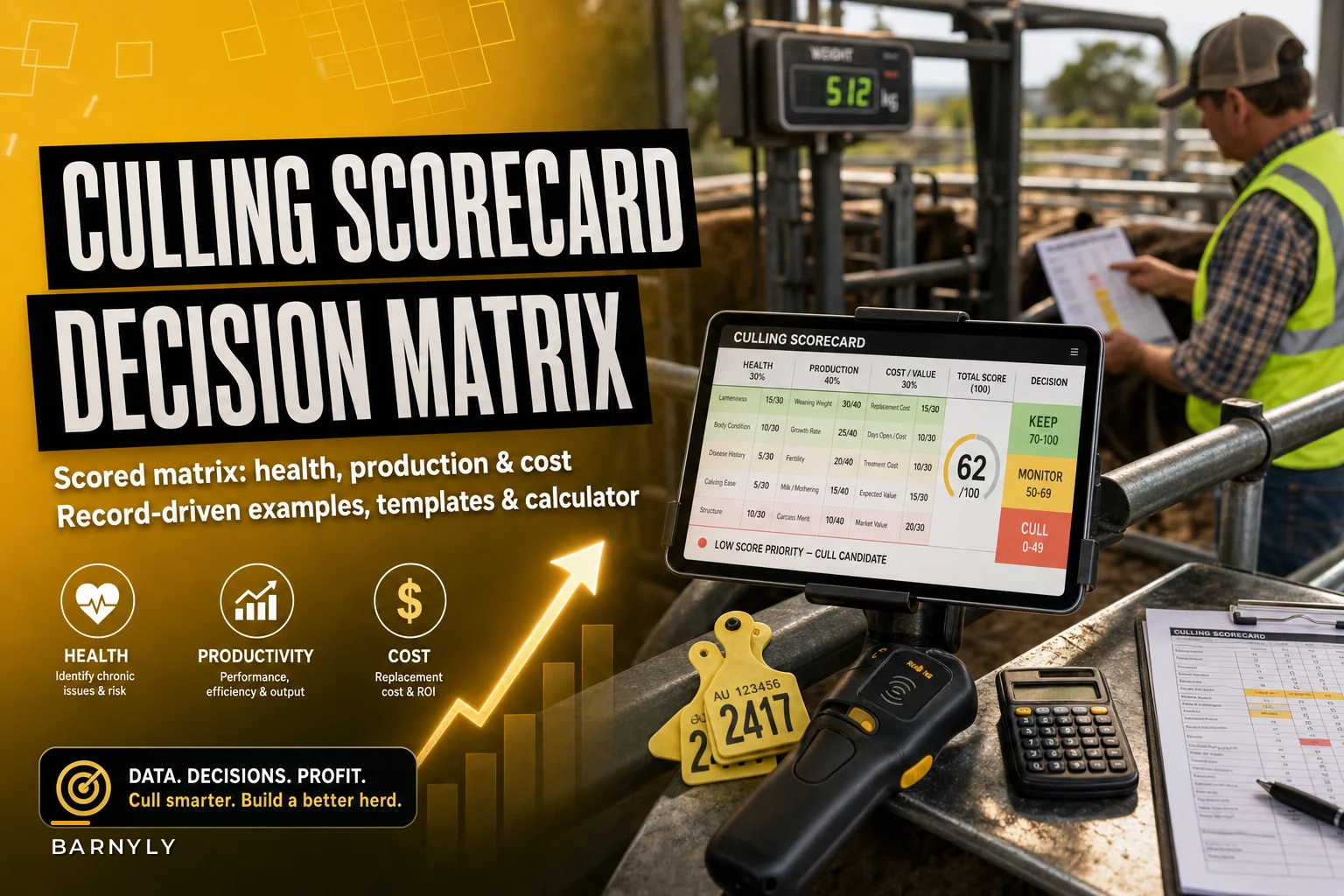
The problem isn't that people make bad decisions in the moment. It's that there's no shared standard, so the same animal gets sorted differently on a Tuesday than on a Saturday, or by you versus your hired hand. A scored culling decision framework for livestock fixes that by turning the call into a number you can defend, repeat, and look back on.
This isn't about replacing stockmanship. It's about making sure a 12-year-old cow with a bad bag and two open years doesn't get kept because she's got a pretty face, and a sound 6-year-old doesn't get shipped because she happened to be thin the day you sorted.
Why "we'll know her when we see her" quietly costs you money
The hidden cost of unscored culling shows up in two directions at once, and both are expensive.
First, you keep animals too long. A cow that's cost you a missed calf, a late calf, and extra feed through a hard winter looks fine at the chute because those costs already happened. It's a sunk expense you can't see standing in front of you. So she gets another chance. And another. Across a 200-head herd, even five or six of these "one more year" passes can eat a real chunk of your annual margin in animals that are carried but not producing.
Second, you cull too aggressively when prices are good or when you're frustrated. A sound, productive female gets shipped during a cull run because she was in the wrong pen on the wrong day. Replacing her costs real money — bred heifer prices, development time, the generational loss of her genetics in your herd.
The core issue is that culling pulls three different considerations in three different directions:
-
Health and soundness — can she physically stay in the herd and perform?
-
Production — is she actually earning her keep right now?
-
Replacement cost — what does it cost to put a better animal in her place?
Hold any one of these up alone and you'll make a bad call. A healthy cow that produces nothing is still a drain. A productive cow that's structurally breaking down won't make it through next season. And a marginal cow might be worth keeping one more year if replacements are running expensive. The framework exists to weigh all three at once, consistently.
Building the scoring matrix
The whole point is to convert soft judgments into numbers that reflect how you actually value things on your operation. Here's a working structure you can adapt. Each category gets scored, weighted, and summed into a single cull score.
Simplify farm operations and enhance animal care.
Barnyly helps you organize, track, and manage every aspect of your farm operations seamlessly.
- Comprehensive livestock tracking
- Automated health alerts
- Feed and resource scheduling
No credit card required
| Category | What you're scoring | Weight | Score range |
|---|---|---|---|
| Reproductive record | Calving interval, open years, breed-back | 30% | 1–5 |
| Health & soundness | Feet/legs, udder, eyes, body condition trend | 25% | 1–5 |
| Production output | Weaning weight of offspring, milk, growth | 20% | 1–5 |
| Age & remaining useful life | Years of likely productivity left | 10% | 1–5 |
| Replacement economics | Cost to replace vs. keep right now | 15% | 1–5 |
Score each animal 1 to 5 in every category, where 5 means "strong, keep" and 1 means "weak, cull candidate." Multiply each score by its weight, sum them, and you get a composite between 1.0 and 5.0.
-
Below 2.5 — cull now
-
2.5 to 3.4 — watch list, re-evaluate next cycle or flag for a hard look
-
3.5 and above — keep
The weights matter more than people expect. If you're a commercial cow-calf operation living or dying on weaning weights and breed-back, reproduction and production should carry the most weight — which is why they total half the score above. A seedstock operation might weight genetics and longevity differently. A dairy will lean hard on production and health. There's no universal correct weighting; there's only the weighting that matches how your operation actually makes money.
A worked example you can copy
Take a real-feeling scenario. Commercial cow-calf, running around 180 brood cows in the northern plains. Three cows end up in the "maybe" pile during fall preg-check and you want to score them instead of arguing.
Cow 114 — 9 years old, bred back on time every year, weaned a calf about 40 pounds below herd average this year, slightly sunken udder but functional, feet are fine.
-
Reproductive
5 (never missed)
-
Health/soundness
4 (minor udder wear)
-
Production
2 (below-average weaning)
-
Age/useful life
2 (getting up there)
-
Replacement economics
3 (bred heifers running expensive this year)
Score: (5×.30) + (4×.25) + (2×.20) + (2×.10) + (3×.15) = 1.5 + 1.0 + 0.4 + 0.2 + 0.45 = 3.55 → keep
She barely clears the line. Her reliability and the cost of replacing her this year carry her through one more season. That's a defensible call, and it'll be the same call whether you or your neighbor runs the numbers.
Cow 087 — 6 years old, came up open this year (first miss), good udder, sound feet, weans heavy calves, mid-prime age.
-
Reproductive
2 (open this year)
-
Health/soundness
5
-
Production
5 (consistently heavy weaners)
-
Age/useful life
5
-
Replacement economics
3
Score: (2×.30) + (5×.25) + (5×.20) + (5×.10) + (3×.15) = 0.6 + 1.25 + 1.0 + 0.5 + 0.45 = 3.80 → keep
The open year hurts, but her production, youth, and soundness say she's worth a second chance. Without a framework, "open cow" might have shipped her automatically — and you'd have lost one of your better females over a single miss.
Cow 142 — 11 years old, open, body condition slipping all year, developing a bad quarter, feet showing wear.
-
Reproductive
1
-
Health/soundness
2
-
Production
2
-
Age/useful life
1
-
Replacement economics
3
Score: (1×.30) + (2×.25) + (2×.20) + (1×.10) + (3×.15) = 0.3 + 0.5 + 0.4 + 0.1 + 0.45 = 1.75 → cull now
No argument needed. The number confirms what the whole picture already says. The value isn't that the framework surprised you — it's that it made the call objective and left a record behind.
The part most operations skip: writing it down
This is where a lot of it falls apart in practice. People build a scoring sheet, use it for one season, and then it lives in a truck glovebox and never gets referenced again. The framework only earns its keep if the scores become records you can actually look back on.
A single year's score tells you about a moment. A trend across years tells you about an animal. Cow 087 scoring a 3.80 this year matters a lot more when you can see she scored 4.2 and 4.4 the two years before — that open year is clearly a blip, not a decline. Flip it: a cow drifting from 3.9 to 3.5 to 3.1 over three cycles is quietly telling you she's on her way out before she ever drops below your cull line.
A record-driven approach also protects you from recency bias. The cow standing in front of you at the chute looks like however she looks today. Her three-year score history doesn't care that she's muddy and thin in October.
This is where AI-assisted farm management platforms can earn their place — not by making the cull decision for you, but by handling the bookkeeping you'll never keep up with by hand. When reproductive records, weaning weights, body condition notes, and health events already live in the same system, the scoring happens off data you've been collecting anyway instead of pulling numbers from memory. The software can flag animals that have crossed below a threshold two cycles running, surface declining trends before they hit your cull line, and keep every score attached to the animal's permanent record. The decision stays yours. The grunt work of tracking it doesn't have to be.
When this framework actually makes sense
This approach pays off most when:
-
You're running enough head that you can't carry every animal's full history in your head — generally somewhere north of 50 to 80 breeding females.
-
More than one person helps with sorting decisions, so consistency between people actually matters.
-
You're already capturing the underlying records (preg-check, weaning weights, health events). The framework is only as good as the data feeding it.
-
You want to defend culling decisions to a partner, lender, or the next generation taking over the operation.
The framework is only as good as the data feeding it.
When to leave the spreadsheet in the truck
It's not always the right tool, and pretending otherwise is how good systems get resented.
-
Very small herds where you genuinely know every animal individually. The overhead of scoring 20 cows you can describe from memory isn't worth it.
-
Obvious culls. A cow with cancer eye or a prolapse doesn't need a composite score. Don't score your way around common sense — the framework is for gray-area animals, not the clear ones.
-
When your records are too thin to score honestly. If you don't actually have reliable weaning weights or breed-back history, a scoring sheet built on guesses just launders guesswork into false precision. Fix the recordkeeping first.
And a warning on weighting: don't set your weights to justify a decision you've already made emotionally. If you catch yourself cranking the "replacement economics" weight up just to keep a favorite cow, you've broken the whole point. The framework works because it's set before you look at specific animals, not tuned animal by animal.
A short real scenario
A family cow-calf operation running roughly 220 head had a standing problem: two brothers sorting cows disagreed constantly, and their herd was aging because every borderline female got the benefit of the doubt. Average cow age had crept up, and open rates were climbing with it.
They built a weighted scoring sheet over a winter, scored the whole herd at preg-check, and set a hard cull line. The first year was uncomfortable — the scores pushed out about a dozen cows that one brother would've kept on feel. But within two seasons, average cow age came down, the open rate improved noticeably, and the arguments at the chute mostly stopped. The number did the talking. They weren't fighting about cows anymore; they were occasionally disagreeing about weights, which is a much shorter conversation.
The replacement cost side tightened up too. By scoring economics into the decision, they stopped auto-culling sound young cows during high-price cull runs and held onto genetics they would have otherwise shipped for a short-term check.
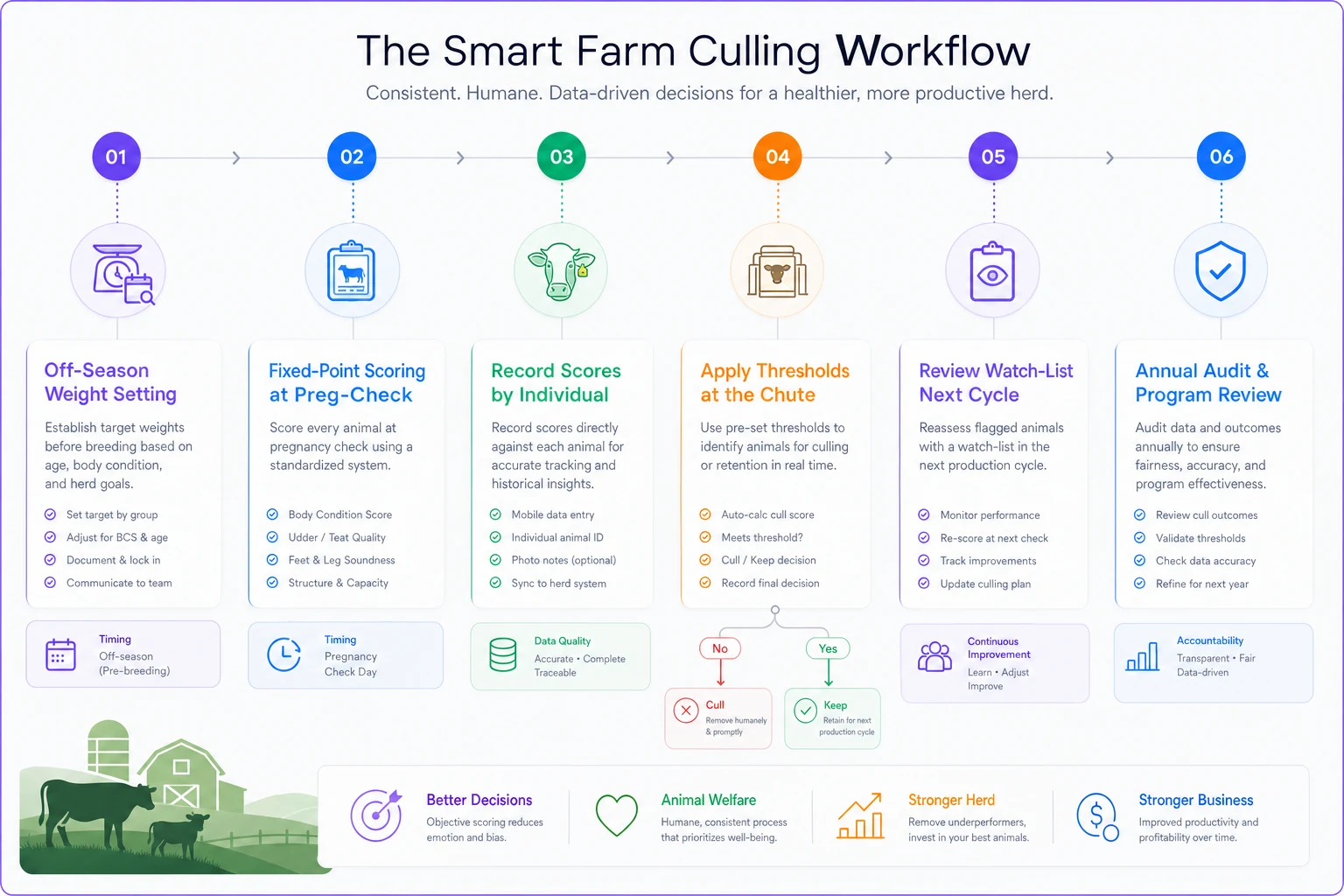
Running it as a repeatable process
To make this stick rather than fizzle after one season:
-
Set your weights once, off-season. Decide what your operation actually values before any specific animal is in front of you. Revisit weights annually, not mid-sort.
-
Score at a fixed point every cycle — preg-check is the natural one for cow-calf, since you've already got them in the chute and the reproductive data is fresh.
-
Record every score against the individual animal, not just the cull/keep outcome. The history is the asset.
-
Apply your thresholds mechanically at the chute. Below the line goes, above stays, the middle band gets a documented second look.
-
Review your watch-list band next cycle. Those middle-score animals are where your real decisions live — a declining trend in that band is your early warning.
-
Audit your own calls once a year. Did the cows you kept perform? Did the ones you shipped deserve it? Adjust weights if the pattern says you're consistently over- or under-valuing something.
Score at a fixed point every cycle — preg-check is the natural one for cow-calf, since you've already got them in the chute and the reproductive data is fresh.
Here's a simple visual of the repeatable process you want to make routine.
The goal across all of it is boring consistency. A culling decision framework for livestock isn't supposed to be clever — it's supposed to make sure the same animal gets the same honest evaluation regardless of who's sorting, how good prices are, or how late in the day it is. Turn the gut feel into a number, write the number down, and let the trend across years do the work your memory can't.
The goal across all of it is boring consistency. A culling decision framework for livestock isn't supposed to be clever — it's supposed to make sure the same animal gets the same honest evaluation regardless of who's sorting, how good prices are, or how late in the day it is. Turn the gut feel into a number, write the number down, and let the trend across years do the work your memory can't.
Ready to optimize your farm management?
Join hundreds of farmers using Barnyly to save time, improve animal health, and increase farm productivity.