

Three years ago, a beef operation in Nebraska got the call every livestock producer dreads. USDA inspection in 48 hours. The ranch had solid records—vaccination dates scattered across wall calendars, movement logs in various Excel sheets, treatment records in a filing cabinet. Everything documented, nothing centralized.
The inspection found gaps. Not because records didn't exist, but because they couldn't produce them fast enough. Missing movement documentation from four months back. Treatment records that didn't match the format inspectors wanted. Feed additive logs buried somewhere in email attachments.
$45,000 in violations. Not for poor practices, but for poor record assembly.
This happens more than producers realize. Traceability requirements have shifted from basic documentation to comprehensive, inspection-ready systems that can produce specific records within minutes, not hours. Most farms maintain the data. They just can't package it correctly when inspectors arrive.
Why perfectly good records fail inspection standards
Farm records typically evolve organically. A notebook here for treatments. A whiteboard for breeding dates. Excel for inventory. Phone photos of feed receipts. Each system works individually, but inspection readiness requires something different—immediate access to interconnected documentation that tells a complete story.
The disconnect happens because producers focus on recording information rather than organizing for retrieval. Your vaccination log might be perfect, but if it doesn't connect to individual animal IDs and movement history, inspectors see fragmented data, not comprehensive traceability.
State and federal requirements keep evolving too. What passed inspection two years ago might trigger violations today. ADT (Animal Disease Traceability) rules now require electronic records for certain interstate movements. Organic certifications demand detailed grazing logs with specific date ranges. Export markets want treatment histories going back 180 days minimum.
The complexity multiplies with mixed operations. Cow-calf producers selling to feedlots need different documentation than direct-market operations. Grass-fed programs require pasture rotation records. Antibiotic-free claims need detailed health management logs showing prevention protocols, not just treatment absence.
Most producers discover these gaps during inspection, when fixing them becomes impossible.
Movement logs that actually track what inspectors verify
Movement documentation causes more inspection failures than any other record type. Not because producers don't track movements, but because they track the wrong details or organize them incorrectly.
Simplify farm operations and enhance animal care.
Barnyly helps you organize, track, and manage every aspect of your farm operations seamlessly.
- Comprehensive livestock tracking
- Automated health alerts
- Feed and resource scheduling
No credit card required
A compliant movement log needs:
Basic movement data:
-
Date and time (not just date)
-
Origin location (premise ID when applicable)
-
Destination details (including premise ID)
-
Number of animals
-
Individual IDs or group/lot identification
-
Transportation method
-
Person responsible for movement
Supporting documentation:
-
Health certificates when crossing state lines
-
Brand inspection documents (required states)
-
CVIs (Certificate of Veterinary Inspection)
-
Test results if required (TB, brucellosis)
-
Treatments within withdrawal periods
The challenge isn't recording this—it's organizing it so you can pull any specific movement from six months ago in under five minutes.
Create a single movement log template that captures everything, then link supporting documents by reference number. Don't rely on memory to find that health certificate from last spring's sale. Number every document, note that number in your movement log, and file documents in numerical order.
For operations moving cattle frequently, the documentation burden becomes overwhelming without systematic organization. A 300-head operation moving groups to summer pasture, then to finishing, then to market generates dozens of movement events annually. Each needs complete documentation retained for the required timeframe.
Retention timelines that prevent costly documentation gaps
Record retention requirements vary wildly depending on your operation type, location, and market channels. Generic advice to "keep everything for three years" misses critical nuances that trigger violations.
Federal minimums (USDA/APHIS):
-
Animal identification records
5 years
-
Interstate movement records
5 years
-
Treatment records
2 years past withdrawal
-
Feed records
1 year minimum
But specific programs require more:
-
Organic certification
5 years all records
-
Natural/grass-fed programs
Often 18-24 months
-
Export eligible
Varies by country (Japan requires lifetime traceability)
-
QSA programs
3 years minimum
State-specific additions complicate this:
-
California
Brand inspection records 3 years
-
Texas
Equine movement records 5 years
-
Montana
Grazing permits 7 years
-
Florida
Cattle fever documentation indefinite
The practical approach: Identify your longest retention requirement and apply it universally. Storage is cheap compared to violations. But organize by retention date, not record type. Create folders labeled by disposal year—"Dispose after January 2029"—rather than trying to remember individual requirements.
| Retention requirement |
|---|
| Animal identification records: 5 years |
| Interstate movement records: 5 years |
| Treatment records: 2 years past withdrawal |
| Feed records: 1 year minimum |
| Organic certification: 5 years all records |
| Natural/grass-fed programs: Often 18-24 months |
| Export eligible: Varies by country (Japan requires lifetime traceability) |
| QSA programs: 3 years minimum |
| California: Brand inspection records 3 years |
| Texas: Equine movement records 5 years |
| Montana: Grazing permits 7 years |
| Florida: Cattle fever documentation indefinite |
Electronic records help here, but scanning isn't enough. File naming matters. "TreatmentlogMarch.pdf" becomes useless when you have five years of March logs. Better: "2024-03-15TreatmentLot47_Withdrawal2024-04-01.pdf"—instantly searchable, immediately useful.
The quick-pack template that beats the 48-hour scramble
When inspection notice arrives, you need a system that produces required documentation fast. Not hunting through files hoping you kept the right papers. A proper quick-pack system means organizing continuously, not frantically.
The inspection-ready binder system:
Create three binders that live in your office:
Binder 1: Current Operations (Rolling 90 days)
-
Active treatment records with withdrawal dates
-
Recent movement logs
-
Current inventory counts
-
Feed delivery receipts
-
Veterinary visit notes
-
Mortality records
Binder 2: Historical Records (91 days to 1 year)
-
Completed treatment cycles
-
Past movement documentation
-
Previous inventory reconciliations
-
Breeding/calving records
-
Health certificates
-
Test results
Binder 3: Program Documentation (Updated annually)
-
Premise ID documentation
-
Program certifications
-
Standard operating procedures
-
Veterinary relationship documents
-
Feed supplier guarantees
-
Employee training records
Every document goes into the current binder first, then rotates to historical after 90 days. Annual documents stay in program documentation until renewed. This system means you can grab three binders and have 90% of what inspectors need immediately accessible.
The digital backup follows the same structure. Three folders, same categories, same rotation schedule. When inspectors want electronic records, you're ready. When they want paper, you're ready.
A simple visual helps show the binder rotation workflow.
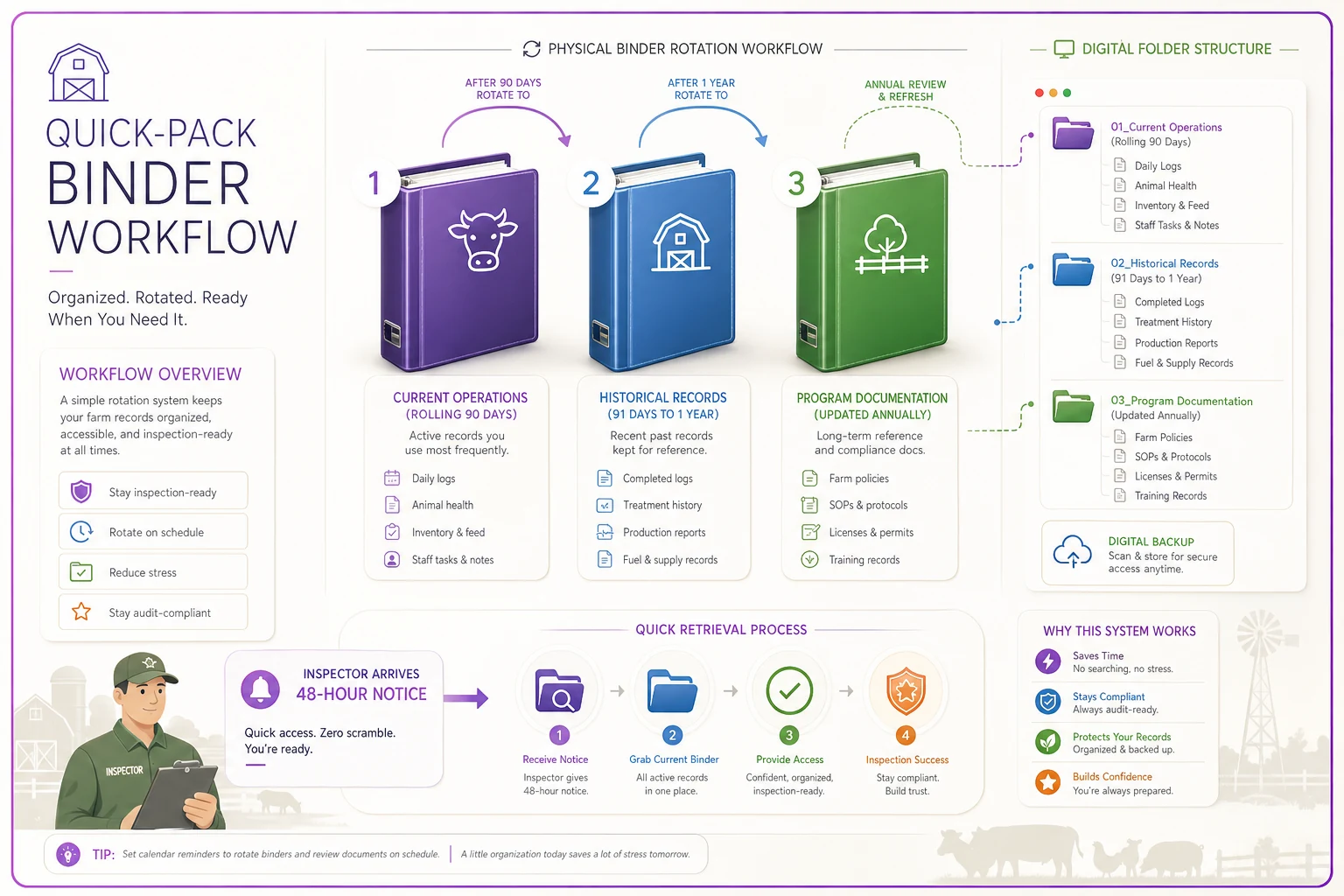
This system means you can grab three binders and have 90% of what inspectors need immediately accessible.
Critical inspection documents farms consistently miss
Certain documents cause repeated problems across operations because producers don't realize inspectors expect them. These aren't always explicitly required, but their absence raises red flags.
The overlooked essentials:
Veterinary Client Patient Relationship (VCPR) documentation Not just knowing your vet's name. Written documentation establishing the relationship, including farm visit frequency, emergency protocols, and prescription oversight procedures. Many producers assume the relationship is obvious. Inspectors want paper.
Feed mixing/sequencing logs If you mix medicated and non-medicated feeds, inspectors want to see flush batches between them. Documentation should show: mix order, flush quantities, equipment cleaning protocols. Operations using the same mixer for different species especially need this.
Visitor logs for biosecurity Anyone entering livestock areas—veterinarians, nutritionists, haulers, even family members from other farms. Date, time, purpose, last livestock contact. Seems excessive until disease tracing becomes necessary.
Water source testing Annual water quality tests, especially for operations claiming natural or organic status. Nitrate levels, bacterial counts, mineral content. Some producers test but don't retain results systematically.
Equipment calibration records Scales for weighing animals or feed, medication dosing equipment, temperature monitoring devices. Annual calibration or verification logs. Inspectors question data accuracy without these.
Employee training documentation Who's authorized to administer treatments? What training did they receive? When? Even family operations need this for anyone handling medications or making treatment decisions.
Building traceability into daily operations without the overhead
The burden of maintaining inspection-ready records feels overwhelming when treated as separate from daily operations. The farms that excel at traceability don't do more paperwork—they structure operations to generate compliant documentation automatically.
Start with standardized forms for everything. Not different notebooks for different people or seasons. One treatment form design. One movement log format. One feeding record template. Consistency enables quick compilation when inspectors arrive.
Take a cow-calf operation in Wyoming that restructured their entire recording system around inspection requirements rather than convenience. Instead of recording treatments when convenient, they document immediately using a single form that captures: animal ID, diagnosis, treatment, dose, route, withdrawal date, administrator, and veterinary authorization if required.
The form lives on clipboards in the treatment area, truck, and barn. Every evening, completed forms get photographed and filed. Once weekly, someone enters the data into a spreadsheet for searching and reporting. The paper becomes the legal record, the digital enables quick retrieval.
Photograph completed forms every evening and file them weekly to keep digital copies current and searchable.
This operation also maintains a "movement packet" template—a folder with blank forms for every possible movement scenario. Selling cattle? Grab the sale packet. Moving to summer pasture? Pasture packet. Each pre-organized with required forms, ready for completion.
They spend roughly three hours weekly on record management, down from scrambling for days before each inspection. The difference: building documentation into workflows rather than treating it as an afterthought.
Where operational software transforms compliance from scramble to system
The gap between maintaining good records and having inspection-ready documentation often comes down to retrieval and formatting. You might have every treatment documented, but can you produce a report showing all antibiotics used on animals sold in the last six months? Can you generate movement histories for specific animals across multiple years?
AI-powered operational software changes this dynamic significantly. Not by replacing paper records—many inspectors still want physical documentation—but by creating searchable, reportable databases from your existing recording habits.
Modern farm management platforms now use AI automation to cross-reference treatment records with movement logs automatically. When you record a treatment, the system automatically calculates withdrawal dates, sets alerts, and flags any animals moving before clearance. When you log a movement, it checks for required health papers and withdrawal compliance.
The real advantage comes during inspection. Instead of manually compiling records, you generate comprehensive reports instantly. Every animal treated with a specific medication. Every movement to a particular location. Complete health histories for animals in specific lots. What once took hours of manual searching becomes a few clicks.
These systems also prevent gaps before they become violations. AI agents can identify missing documentation—movements without health certificates, treatments without withdrawal dates, gaps in required testing schedules. They send alerts before problems compound, turning reactive scrambling into proactive management.
The automation particularly helps with retention schedule management. Instead of manually tracking when records can be destroyed, the system maintains retention calendars based on your specific requirements. It knows organic certification needs five years while basic federal requirements need two. Nothing gets destroyed early, nothing accumulates forever.
For operations selling into multiple markets with different requirements, this becomes essential. Export-eligible cattle need different documentation than domestic sales. Natural programs have different retention rules than conventional. AI-powered platforms track these program-specific requirements automatically, ensuring you maintain exactly what each market demands without overwhelming your filing system.
From reactive documentation to proactive compliance
The difference between operations that breeze through inspections and those that scramble isn't about having more records—it's about structuring documentation for retrieval from day one. Every successful traceability system shares common elements: standardized forms, consistent organization, clear retention schedules, and quick retrieval methods.
Inspectors don't expect perfection. They expect accessibility. They want to see that you can track an animal's history, verify treatment protocols, and demonstrate movement compliance. The farms that struggle aren't necessarily doing anything wrong. They just can't prove they're doing things right fast enough.
Start with the quick-pack binder system. Three binders, rotated regularly, containing your rolling 90 days, historical year, and program documentation. This alone solves most inspection readiness issues. Add standardized forms for all recording, implement clear retention schedules, and maintain both paper and digital copies of critical documents.
Modern operational software accelerates this transformation. AI automation turns scattered records into searchable databases. It identifies gaps before inspectors do. It generates reports that once required hours of manual compilation. But technology supplements good systems—it doesn't replace them.
Good documentation helps you make better management decisions, track performance accurately, and respond quickly to disease concerns or market requirements. Inspection readiness becomes a byproduct of operational excellence, not a separate burden that disrupts your actual work.
The $45,000 violation that Nebraska ranch faced wasn't about bad practices. It was about retrieval and organization. With the right systems—whether paper-based, digital, or hybrid—that scramble becomes unnecessary. Your records tell your operation's story. Make sure you can share that story clearly when anyone asks.
The $45,000 violation that Nebraska ranch faced wasn't about bad practices. It was about retrieval and organization. With the right systems—whether paper-based, digital, or hybrid—that scramble becomes unnecessary. Your records tell your operation's story. Make sure you can share that story clearly when anyone asks.
Ready to optimize your farm management?
Join hundreds of farmers using Barnyly to save time, improve animal health, and increase farm productivity.