

Running cattle alongside sheep and goats creates vaccination timing problems that most mixed-species operations don't realize exist until something goes wrong. The challenge isn't just coordinating different species' schedules—it's understanding how certain vaccines interfere with each other when animals share pastures, water sources, and handling facilities.
After building operational software for mixed livestock operations, vaccination conflicts that cause expensive problems follow predictable patterns. A dairy running 200 goats alongside 80 beef cattle typically discovers these conflicts after a respiratory outbreak spreads between species, or when withdrawal periods overlap during peak production seasons. That costs thousands in lost milk revenue.
Why standard vaccination calendars fail mixed herds
Mixed species vaccination schedules break down because they weren't designed for operations where different animals share resources. Most veterinary guidance assumes single-species herds with dedicated facilities.
The operational reality looks different. Small ruminants shed modified-live vaccine strains for 7-14 days after vaccination. When cattle use the same water troughs during this period, they're exposed to vaccine virus that can trigger mild illness or interfere with their own upcoming vaccinations. This creates a cascade of timing problems that standard calendars never address.
Sheep and goats need CDT vaccines every 6 months in high-risk areas. Cattle need respiratory vaccines seasonally. Both need parasite management that can't overlap with certain vaccines. Labor availability peaks during certain months. Processing facilities have limited capacity. Weather windows for safe handling vary by region.
These constraints create a scheduling puzzle that gets exponentially harder as herd sizes grow. A farm with 50 goats and 30 cattle has roughly 400 potential scheduling conflicts across a year. Double those numbers, and conflicts increase to over 1,600 possible interference points.
Building your consolidated calendar from scratch
Start with withdrawal periods and work backward. This reverses traditional planning but prevents the most costly mistakes.
Simplify farm operations and enhance animal care.
Barnyly helps you organize, track, and manage every aspect of your farm operations seamlessly.
- Comprehensive livestock tracking
- Automated health alerts
- Feed and resource scheduling
No credit card required
Map your market commitments first. If you're selling goat milk year-round, those withdrawal windows are non-negotiable. If cattle go to auction in October, their pre-sale vaccination window is fixed. These hard dates become your calendar anchors.
Next, identify vaccine shedding periods. Modified-live vaccines create temporary contamination zones. Sheep receiving live Chlamydia vaccines shed for 10 days. Cattle getting intranasal IBR vaccines shed for up to 14 days. During these windows, species need separate water and feed areas.
Your base calendar structure:
-
January-February
Cattle respiratory boosters (before calving stress)
-
March-April
Small ruminant CDT primary series
-
May-June
Cattle reproductive vaccines
-
July-August
Parasite management window (all species)
-
September-October
Small ruminant CDT boosters
-
November-December
Cattle scour prevention for calves
This framework adapts to regional variations, but the spacing prevents major conflicts.
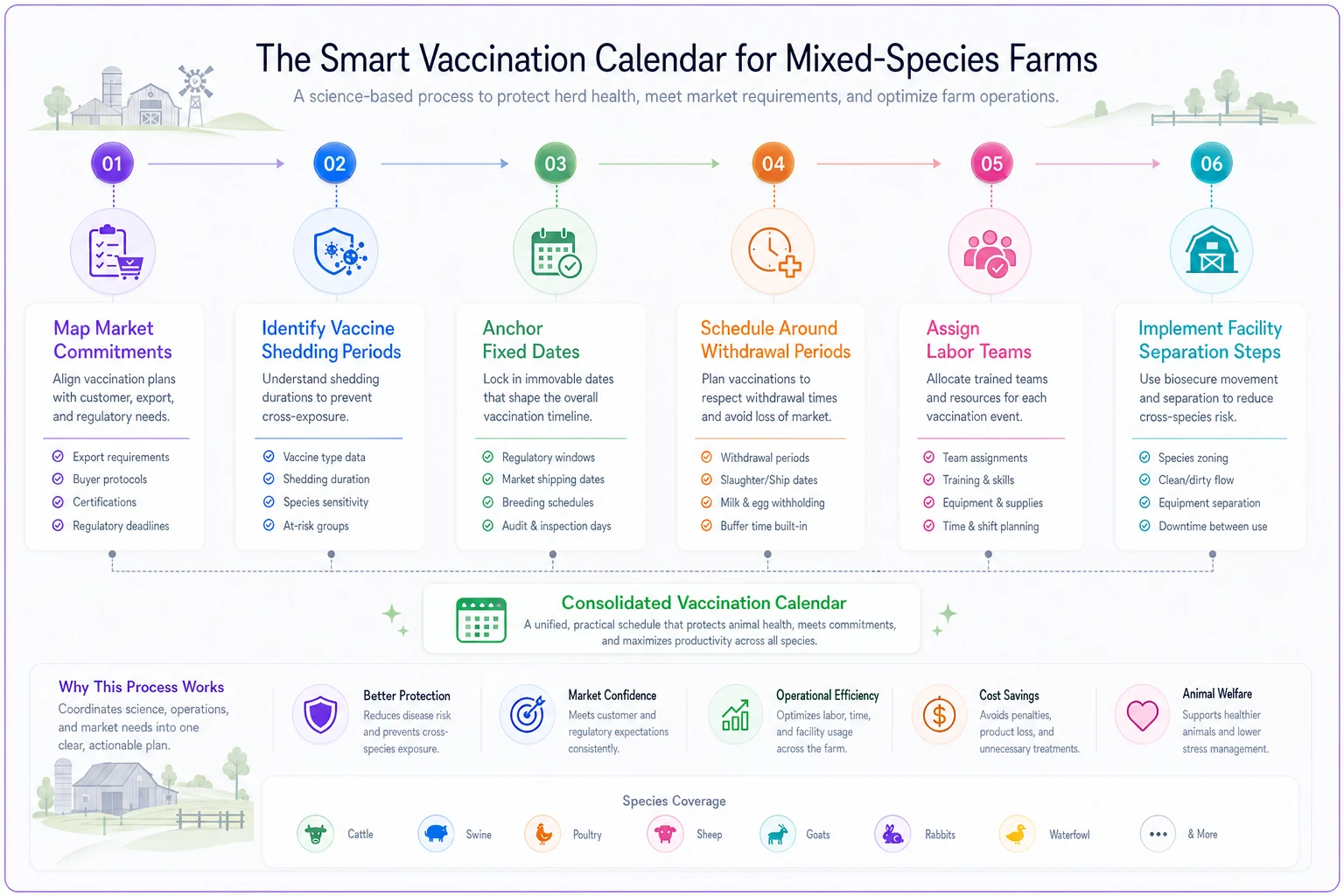
A simple workflow like this helps teams visualize anchors and avoidance windows.
Labor assignment rules that actually work
Mixed-species vaccination days fail when labor assignments ignore skill requirements. Not everyone can safely handle a 1,400-pound bull for vaccination. Not everyone has the patience for 200 skittish goats.
Skill matching matters more than you'd think. Assign your most experienced handler to species changes. They recognize when a normally docile animal is stressed and likely to bolt. They know the subtle body language differences between a nervous goat and an aggressive one.
Create species-specific teams:
-
Cattle team
Minimum 3 people (handler, vaccinator, recorder)
-
Small ruminant team
Minimum 2 people (catcher, vaccinator/recorder)
-
Float position
Cross-trained on both, handles emergencies
Cross-train the float specifically on emergency containment and rapid animal handling so they can stabilize situations without slowing vaccinations.
The float position is critical. When 30 goats break through inadequate fencing mid-vaccination (happens more than you'd think), someone needs to manage the chaos while others continue working. This person also covers when someone gets kicked, stepped on, or needs a break.
Schedule your strongest crew for cattle days. Physical demands are highest, injury risk peaks, and mistakes cost more. Schedule your most patient crew for small ruminants. Volume is higher, repetitive stress increases, and animals are more reactive to rough handling.
The 48-hour separation rule
After hundreds of mixed-species operations, one rule prevents most vaccine interference: maintain 48-hour separation between modified-live vaccines across species.
This means if cattle receive MLV respiratory vaccine on Monday, sheep and goats wait until Thursday for any MLV products. The gap allows viral shedding to decrease below interference thresholds and gives shared facilities time to clear naturally.
Water trough contamination clears fastest with high turnover. A 100-gallon trough serving 20 animals cycles completely in 48 hours. Larger tanks or lower stocking rates need 72 hours for safety.
Feed bunk contamination persists longer. Virus particles survive in organic matter for 5-7 days under ideal conditions. If you can't maintain separate feeding areas, schedule killed vaccines only during overlap periods.
Conflict resolution protocols
Even perfect planning hits unexpected conflicts. A supplier runs out of vaccine. Weather delays everything by a week. Half your crew gets sick.
Priority hierarchy:
-
Withdrawal periods for market animals
-
Breeding season vaccines (can't delay without losing entire production cycle)
-
Young stock primary series (maternal antibodies waning)
-
Adult boosters (have residual immunity)
-
Optional vaccines (convenience timing)
When conflicts arise, protect revenue-generating activities first. A dairy losing three days of marketable milk costs more than delaying beef cattle boosters by a week.
For labor conflicts, implement the "two-species maximum" rule. Never attempt three different species in one day, regardless of crew size. Fatigue-driven mistakes spike after the second species. Equipment contamination risk triples. Record-keeping errors become inevitable.
Sample schedule: 150 goats, 75 cattle, 40 sheep
Here's a working calendar for a typical mixed operation in the Southeast, adjusting for regional disease pressure and market timing:
Spring vaccination window (March 15-April 15):
-
Week 1
Cattle respiratory complex (MLV)
-
Week 2
Facility cleaning, equipment maintenance
-
Week 3
Goat CDT, caseous lymphadenitis (killed vaccines only)
-
Week 4
Sheep CDT, footrot prevention
Summer management (June 1-30):
-
Week 1
Cattle pour-on parasiticides
-
Week 2
Rest period (no animal handling)
-
Week 3-4
Small ruminant FAMACHA scoring and selective deworming
Fall push (September 1-October 15):
-
Week 1-2
Small ruminant breeding soundness, vaccines
-
Week 3
Facility separation for breeding groups
-
Week 4-5
Cattle pre-sale vaccines and treatments
-
Week 6
Final pregnancy checking all species
Winter preparation (November 15-December 15):
-
Week 1
Cattle scour vaccines for spring calving
-
Week 2
Small ruminant pneumonia prevention
-
Week 3-4
Final boosters before severe weather
This schedule assumes standard crew availability and moderate disease pressure. High-risk operations need monthly health assessments between major vaccination windows.
Equipment and facility modifications
Mixed operations need duplicate equipment or strict sanitization protocols. A single contaminated syringe can spread caseous lymphadenitis from goats to sheep in minutes, creating abscesses that destroy marketability.
Maintain separate handling equipment by species:
-
Color-coded syringes (red for cattle, blue for goats, green for sheep)
-
Dedicated halters and leads
-
Species-specific marking crayons
-
Separate hoof trimming tools
The cost seems excessive until you calculate disease transmission losses. One CL outbreak in a clean sheep flock costs $5,000-8,000 in culled animals and lost sales. Triple equipment sets cost under $500.
| Equipment | Notes |
|---|---|
| Color-coded syringes | red for cattle, blue for goats, green for sheep |
| Dedicated halters and leads | species-specific use to prevent cross-contamination |
| Species-specific marking crayons | prevent mix-ups during processing |
| Separate hoof trimming tools | avoid transmitting hoof pathogens |
Facility modifications focus on flexibility. Permanent cattle chutes won't work for goats. Sheep-height panels are dangerous for cattle. The solution is modular systems with adjustable components.
Install removable panel inserts that reduce cattle alley width for small ruminants. Add temporary platforms that raise workers to comfortable vaccination height for tall cattle. Create bypass routes so you can process different species without moving everyone through the same contact points.
Monitoring and adjustment triggers
Your consolidated calendar needs built-in review points. Disease pressure changes seasonally. Parasite resistance develops. Market demands shift. What worked last year might fail catastrophically this year.
Monitor these indicators monthly:
-
Treatment failure rates by species
-
Days between scheduled and actual vaccination
-
Labor hours per animal processed
-
Injury rates during handling
-
Disease outbreak patterns
When any indicator exceeds threshold (treatment failures above 15%, delays beyond 7 days, injury rate over 5%), trigger calendar review. Small adjustments prevent major collapses.
A goat operation started seeing Pasteurella outbreaks despite proper vaccination. Investigation revealed their calendar put respiratory vaccines during peak humidity season when stress was highest. Shifting the schedule by three weeks eliminated outbreaks completely.
Technology and record integration
Manual tracking of mixed-species vaccination schedules generates errors that compound over time. A missed booster becomes a disease outbreak. A miscalculated withdrawal becomes a residue violation. The complexity requires systematic record-keeping that paper can't handle efficiently.
Modern operations use AI-powered scheduling platforms that automatically flag conflicts between species, calculate withdrawal periods across multiple products, and adjust for labor availability. These systems reduce scheduling errors by roughly 80% compared to spreadsheet-based planning.
Pattern recognition matters more than raw data entry. When the same vaccination gets delayed three years running, that's a calendar design problem, not bad luck. Software that tracks these patterns helps rebuild schedules around operational reality instead of theoretical ideals.
Integration with treatment records reveals hidden connections. Maybe goat respiratory problems spike two weeks after cattle vaccination. That correlation suggests aerosol transmission of vaccine virus—something you'd never catch without consolidated data analysis.
Making it sustainable long-term
The best mixed species vaccination schedule means nothing if your team can't maintain it through staff turnover, seasonal labor shortages, and operation growth.
Build redundancy into critical positions. Cross-train at least two people for each species-specific role. Document procedures in visual formats that work regardless of language or literacy levels. A laminated chart showing injection sites beats a 20-page manual that nobody reads.
Create escalation protocols for when things go wrong. Who makes the call to delay vaccination? What triggers bringing in veterinary support? When do you separate species completely versus managing through a disease challenge? Clear decision trees prevent panic-driven mistakes.
Review and revise annually, but resist constant tinkering. Operations that change their calendar every few months never develop smooth routines. Pick a schedule, run it for a full year, document every problem, then make comprehensive adjustments based on data, not frustration.
Your mixed-species operation has unique constraints that no template perfectly addresses. Starting from a proven framework, adapting based on your specific challenges, and maintaining disciplined execution creates a vaccination program that protects animal health without destroying operational efficiency.
The farms that thrive with multiple species are the ones that acknowledge the complexity upfront and build systems robust enough to handle it.
Ready to optimize your farm management?
Join hundreds of farmers using Barnyly to save time, improve animal health, and increase farm productivity.