
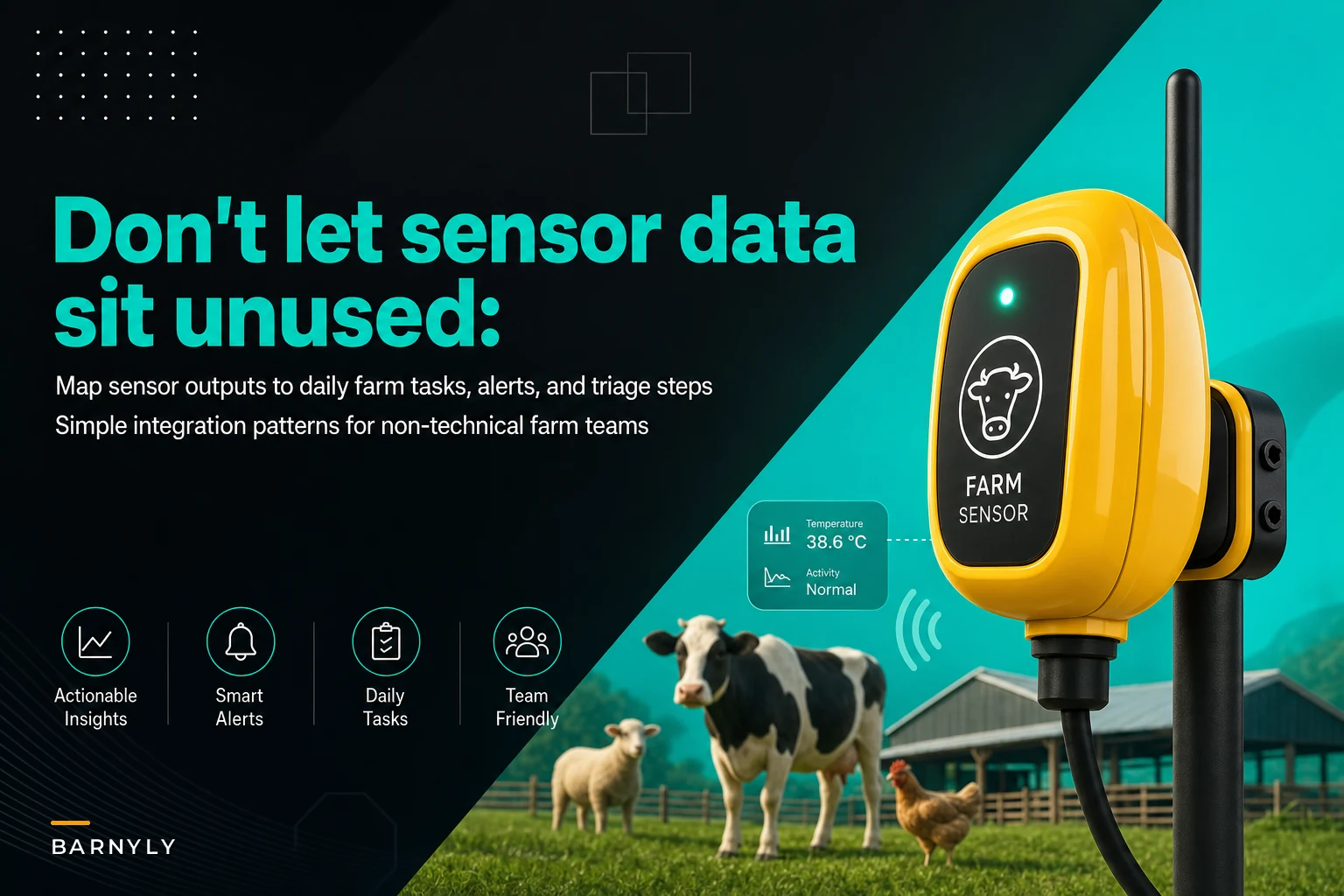

You've got temperature sensors in the feed storage. Moisture monitors in the hay barn. Water level sensors on tanks. Maybe even some fancy ammonia sensors in the poultry house. The data flows into dashboards that nobody checks unless something already went wrong.
This pattern shows up constantly—farms spending thousands on monitoring equipment that generates endless graphs but zero actual workflow changes. The sensors work fine. The data collection works fine. But the connection between "sensor shows problem" and "someone fixes problem" barely exists.
The gap isn't technical. It's operational. Your team doesn't need more dashboards. They need sensor readings that automatically create tasks, send alerts at the right threshold, and integrate sensor data into farm workflows they already follow.
Why sensor data becomes expensive decoration
Most sensor installations follow the same broken pattern. Equipment vendor shows up, installs sensors, sets up a dashboard, provides login credentials, and leaves. Six months later, you realize nobody's logged in since week two.
The breakdown happens because sensor data lives in its own world, separate from daily operations. Your morning feed crew doesn't start their day checking temperature graphs. Your afternoon water crew doesn't review tank level trends. The data exists, but it never intersects with actual work patterns.
Temperature spikes in grain storage happen at 2 AM. By the time someone checks the dashboard at 8 AM during morning rounds, you've already lost quality. Water tanks run dry on weekends when nobody's monitoring screens. Ammonia builds up overnight in poultry houses while everyone's home.
The vendors who sold you these systems promised "real-time monitoring" but delivered delayed discovery. Real-time data means nothing if real-time response doesn't follow.
Alert fatigue ruins even good sensor systems
When farms try fixing the monitoring gap, they usually overcorrect with alerts. Every minor fluctuation triggers a notification. Phones buzz constantly. Email inboxes fill with warnings. After three days of false alarms, everyone starts ignoring everything.
Simplify farm operations and enhance animal care.
Barnyly helps you organize, track, and manage every aspect of your farm operations seamlessly.
- Comprehensive livestock tracking
- Automated health alerts
- Feed and resource scheduling
No credit card required
One dairy operation I worked with set their bulk tank temperature alerts so tight that normal compressor cycling triggered warnings every few hours. The maintenance manager's phone would explode with notifications during milking. After a week, he disabled all alerts. Two months later, an actual cooling failure went unnoticed for six hours.
The problem multiplies across different sensor types. Water sensors alert on minor level changes. Feed bin sensors trigger on normal settling. Weather stations warn about conditions you can see by looking outside. Soon your team treats all sensor alerts like car alarms—annoying background noise that probably means nothing.
Sensor thresholds that match operational reality
Getting sensor integration right starts with thresholds that reflect actual operational boundaries, not theoretical ideals. Your grain moisture sensor shouldn't alert at perfect storage moisture—it should alert when moisture reaches the point where you need to run aeriation fans or move product.
Here's what practical thresholds look like across common sensor types:
| Sensor | Thresholds |
|---|---|
| Grain Storage Temperature | Grain Storage Temperature - Warning threshold: 5°F above average mass temperature - Action threshold: 8°F above average or 90°F absolute - Critical threshold: 10°F above average or 100°F absolute - Response time expectation: Warning = next day, Action = same day, Critical = immediate |
| Water Tank Levels | Water Tank Levels - Information threshold: Below 50% capacity - Planning threshold: Below 30% capacity - Action threshold: Below 20% capacity - Critical threshold: Below 10% capacity - Response varies by season and livestock count |
| Ammonia in Poultry Houses | Ammonia in Poultry Houses - Awareness level: 15 ppm - Ventilation adjustment: 20 ppm - Immediate action: 25 ppm - Evacuation consideration: 35+ ppm - Different thresholds for bird age groups |
| Feed Bin Levels | Feed Bin Levels - Reorder point: 5 days of inventory - Low warning: 3 days of inventory - Critical: 1.5 days of inventory - Empty protection: 12 hours of inventory - Adjusts for delivery schedules and consumption rates |
These thresholds connect to specific actions your team already knows how to execute.
From sensor reading to assigned task
The missing piece in most sensor deployments? Automatic task creation. A temperature spike shouldn't just send an alert—it should create a maintenance ticket, assign it to the right person, and track completion.
Consider a realistic Tuesday morning scenario. Your grain temperature sensor detects a hot spot developing in bin #3. In most operations, here's what happens: Sensor sends alert to operations manager's phone at 6 AM. Manager sees it during breakfast but doesn't act immediately. Gets to office at 8 AM, checks dashboard, confirms the reading. Calls maintenance lead around 9 AM. Maintenance lead is fixing a gate, says they'll check after lunch. Finally inspects bin at 2 PM. Starts aeriation fans. Problem that started Monday night gets addressed Tuesday afternoon.
Now imagine this workflow: Sensor detects temperature rise Monday at 11 PM. System automatically creates task: "Investigate bin #3 temperature anomaly." Assigns to on-call maintenance for Tuesday morning based on rotation schedule. Sends backup alert to operations manager. Maintenance tech sees task on morning list, investigates at 7 AM shift start. Runs aeriation immediately. Documents action in task. System confirms temperature dropping. Task closes automatically when temperature returns to normal range.
The second approach turns sensor data into workflow. The response happens because it's part of someone's explicit task list, not because someone remembered to check a dashboard.
The diagram below shows the flow from sensor detection to task creation and resolution.
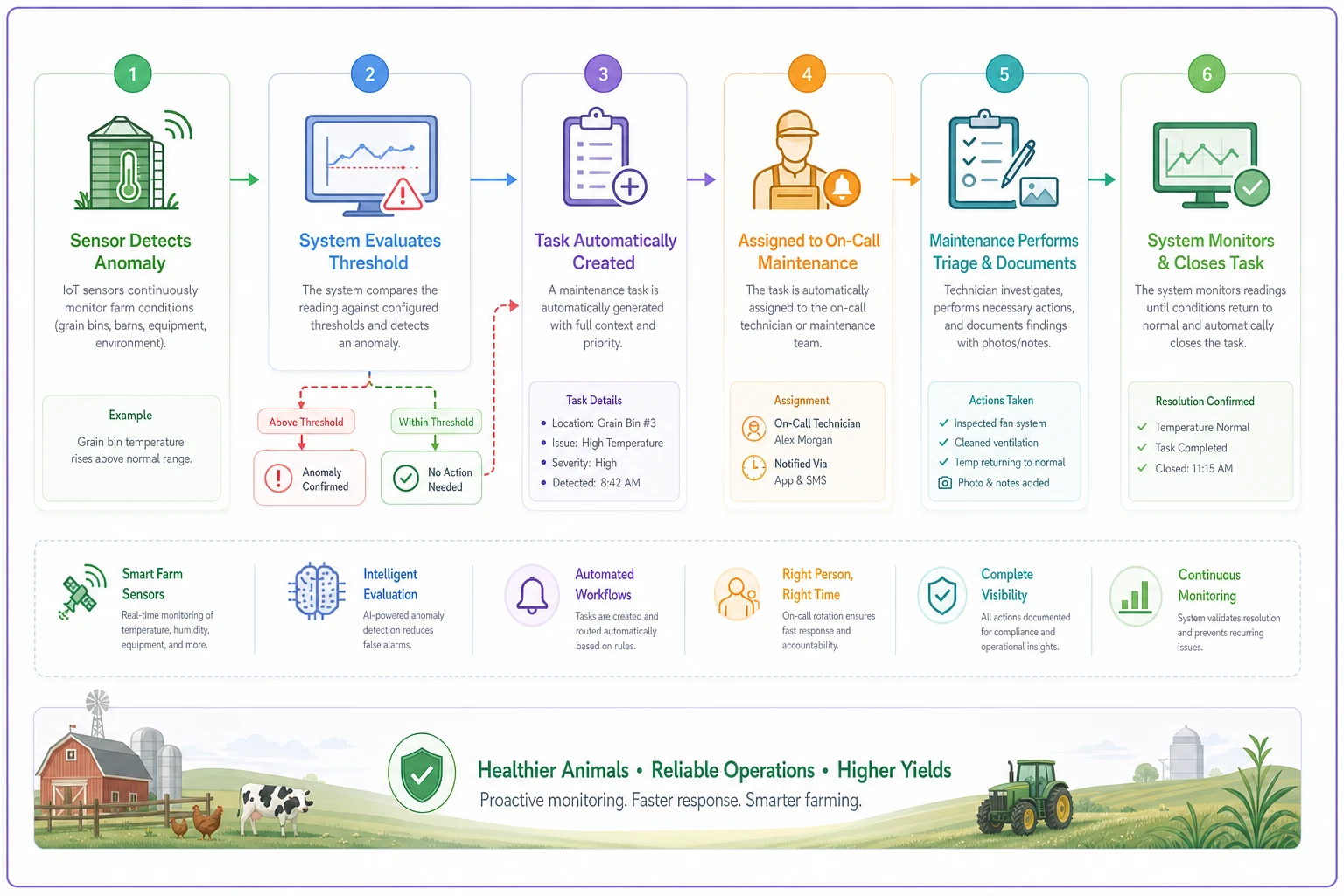
This simple flow ensures sensor readings become assigned tasks instead of ignored alerts.
Simple triage steps anyone can follow
Not every sensor alert needs an expert. Most can be handled through simple triage steps that any team member can execute. But those steps need to be documented and attached to the alert, not stored in someone's head.
Water Tank Low Level Triage
-
Check if automatic fill valve is open
-
Verify water source pump is running
-
Look for obvious leaks around tank
-
Check livestock water consumption against normal
-
If all normal, manually fill and monitor
-
If abnormal, escalate to maintenance
Feed Bin Sensor Malfunction Triage
-
Visually check actual bin level
-
Tap sensor housing to free stuck components
-
Check sensor power and connection
-
Compare reading to consumption records
-
If reading wrong, note actual level and flag for calibration
-
If bin actually low, verify next delivery date
Temperature Spike in Storage Triage
-
Check all bins for similar readings (system-wide vs single point)
-
Verify sensor hasn't shifted into direct sunlight
-
Check for recent grain additions that might be warm
-
Look for signs of biological heating (smell, moisture)
-
Start aeriation if any doubt
-
Schedule full inspection if aeriation doesn't reduce temperature
These steps transform panicked responses into methodical processes. New employees can handle basic sensor alerts while experienced staff focus on actual problems.
Integration patterns that don't require IT degrees
The best sensor integrations use patterns simple enough that your operations manager can modify them without calling tech support. These patterns connect sensors to existing workflows instead of creating new ones.
Pattern 1: Sensor to Schedule Morning feed crew already checks bins during first rounds. Add sensor readings to their existing checklist. Don't make them log into separate system—put yesterday's min/max readings on the same sheet they're already carrying. Abnormal readings become part of their standard reporting, not a separate process.
Pattern 2: Threshold to Task List Maintenance already works from daily task lists. When sensors hit action thresholds, automatically add inspection tasks to tomorrow's list. Include sensor location, current reading, and simple triage steps directly in task description. Task stays open until someone documents the resolution.
Pattern 3: Sensor Trends to Weekly Planning Management already holds weekly planning meetings. Generate one-page sensor summary showing trend lines for the past week. Focus on readings approaching thresholds, not current status. This creates proactive maintenance scheduling instead of reactive scrambling.
Pattern 4: Exception-Only Reporting Stop sending daily "everything's fine" reports. Send notifications only when readings exceed thresholds or sensors go offline. Include context: "Bin #4 temperature rising 3°F per hour, currently 87°F, exceeded threshold at 2:47 AM." Every notification should demand action, not just awareness.
Include simple triage steps directly in the task description so field crews can act without flipping through manuals.
These patterns connect sensors to existing workflows instead of creating new, fragile processes.
Seasonal adjustment keeps alerts relevant
Static thresholds generate false alarms because farming isn't static. Summer temperature thresholds don't work in winter. Wet season water consumption differs from dry periods. Your sensor integration needs seasonal intelligence.
Build threshold schedules that adjust automatically:
Summer Operation Mode (June-September)
-
Grain temperature warning
95°F
-
Water tank refill
40% capacity
-
Ventilation minimum
4 air changes/hour
-
Feed reorder
4 days inventory
Winter Operation Mode (December-March)
-
Grain temperature warning
60°F
-
Water tank refill
25% capacity
-
Ventilation minimum
2 air changes/hour
-
Feed reorder
7 days inventory
Transition Periods (Spring/Fall)
-
Use graduated thresholds
-
Increase monitoring frequency
-
Lower response time expectations
-
Add manual verification steps
This prevents your team from becoming numb to alerts during seasonal transitions when false alarms typically spike.
Which sensors actually improve operations
Not every sensor delivers operational value. Some create more monitoring burden than benefit. After watching hundreds of sensor deployments, clear patterns emerge about which ones actually integrate into farm workflows.
High-value sensors that integrate well:
-
Water level monitors (prevent livestock stress)
-
Grain temperature cables (protect major asset)
-
Electric fence voltage monitors (prevent escapes)
-
Cooler/freezer temperature (compliance and loss prevention)
-
Feed bin levels (automate reordering)
Medium-value sensors worth considering:
-
Ammonia/air quality monitors (health and performance)
-
Soil moisture sensors (irrigation optimization)
-
Gate/door position sensors (security and animal movement)
-
Flow meters on water lines (leak detection)
-
Weather stations (spray timing and planning)
Low-value sensors that rarely integrate:
-
Humidity sensors in storage (usually redundant with temperature)
-
Light level sensors (unless specific photoperiod control)
-
Vibration sensors on equipment (too many false positives)
-
Generic motion sensors (except specific applications)
-
pH sensors requiring frequent calibration
The pattern is clear: sensors that prevent immediate operational problems integrate successfully. Sensors that provide "nice to know" information usually get ignored.
Fixing broken sensor workflows
If you've already invested in sensors that aren't integrated into daily operations, you don't need to start over. Most sensor systems can be salvaged with workflow adjustments.
Start by identifying where sensor data should intersect with existing tasks. Your morning livestock check already includes water tank inspection—add the sensor reading to that checklist. Your evening security round already checks buildings—include door sensor status. Your weekend maintenance schedule already covers equipment—incorporate sensor-flagged issues.
Next, eliminate redundant monitoring. If sensors monitor grain temperature, stop manual temperature checks. If water levels are tracked automatically, remove visual inspection requirements. Don't run parallel manual and automated systems—pick one and trust it.
Then simplify the response chain. Each sensor alert should go to exactly one person who can act on it. That person needs the authority to fix the issue or escalate it. Stop sending alerts to everyone—it ensures nobody feels responsible.
Create accountability by tracking response metrics. How long between alert and acknowledgment? Between acknowledgment and resolution? Which alerts get ignored? Which generate the most false positives? Use these patterns to refine thresholds and assignments.
Finally, sunset sensors that don't earn their keep. If a sensor hasn't triggered a useful action in six months, disconnect it. The maintenance burden and alert fatigue aren't worth theoretical monitoring capability.
Building resilient sensor operations
The best sensor integrations anticipate failure. Sensors break. Networks go down. Power fails. Your workflow can't collapse when technology hiccups.
Build manual overrides into every sensor-driven process. If the feed bin sensor fails, your team needs a visual inspection protocol. If water tank monitors go offline, someone needs to check levels manually. These backup procedures should be documented and practiced, not figured out during crisis.
Consider a rotation schedule for sensor verification. Every Thursday, maintenance checks 20% of sensors against manual readings. Over five weeks, every sensor gets verified. This catches drift before it causes operational problems. It also keeps manual measurement skills sharp.
Set up escalation patterns for sensor failures. First alert goes to operations. If no response in 2 hours, alert maintenance. After 4 hours, notify management. After 8 hours during critical periods, trigger emergency protocols. Define these escalations before you need them.
Don't let sensors replace judgment. A sensor saying the grain is fine doesn't override the smell of heating. A water level reading doesn't trump visual observation of livestock behavior. Sensors provide information, but experienced operators make decisions.
When integration actually pays off
Sensor integration makes sense when the cost of missing something exceeds the cost of integration. A few hours of heating grain can destroy thousands in value. Empty water tanks can kill livestock. Failed cooling can ruin entire production batches. These scenarios justify robust integration.
But not every operation needs every sensor integrated. A small cow-calf operation might only need water tank monitoring. A grain operation focuses on temperature and moisture. Poultry operations prioritize environmental controls. Match integration investment to operational risk.
Here's when to integrate sensor data into farm workflows:
-
High-value inventory at risk (grain, feed, frozen products)
-
Compliance requirements for monitoring
-
Livestock welfare depending on the system
-
Labor shortage requiring automation
-
Multiple facilities requiring central oversight
-
Historical problems that sensors could prevent
Here's when sensor integration might not make sense:
-
Manual checks take less than 15 minutes daily
-
Redundant systems already provide coverage
-
Low consequence of temporary failures
-
Stable conditions that rarely change
-
Single operator who prefers hands-on management
Match integration investment to operational risk and prioritize where missing something is costly.
Practical next steps
If your sensor data isn't triggering daily tasks, start with one critical sensor and one workflow. Pick your highest-risk monitoring point—maybe bulk tank temperature or primary water supply. Create a simple integration: sensor threshold triggers task assignment.
Document the triage steps. Train the response team. Run the integration for a month. Track how many alerts convert to actual problems found. Adjust thresholds based on operational reality, not vendor recommendations.
Once one sensor integration works smoothly, add another. Build gradually. Each integration should prove its value before you add complexity. Within six months, you'll have sensor data that actually drives operational improvements instead of just filling dashboards.
The gap between sensor capability and operational integration isn't technical—it's workflow design. Stop trying to force your team to check dashboards. Start making sensor data show up in the tools they already use. When sensor readings automatically become tasks, alerts become assignments, and thresholds match operational reality, integration happens naturally.
Your sensors should be invisible to daily operations until they detect something requiring action. Then they should be impossible to ignore. That's integration that actually works.
The operations that successfully integrate sensor data into farm workflows aren't the ones with the most sensors or the fanciest dashboards. They're the ones that connected sensor outputs to the tasks someone was already doing, at thresholds that actually matter, with responses everyone understands.
That temperature sensor in your grain bin doesn't need a prettier dashboard. It needs to automatically create a Monday morning task for maintenance when readings trend toward trouble. That's the difference between monitoring and integration—one generates data, the other drives action.
Your sensors should be invisible to daily operations until they detect something requiring action. Then they should be impossible to ignore. That's integration that actually works.
Ready to optimize your farm management?
Join hundreds of farmers using Barnyly to save time, improve animal health, and increase farm productivity.