

Three weeks into June, a rancher in central Missouri looked at his south pasture and knew something was wrong. The grass that should've been knee-high barely reached his boots. His 40-head operation had moved through the same six paddocks for years without issue, but this season the forage just wasn't recovering.
Most rotations fail because recovery time isn't actually fixed
The math was brutal. Each paddock needed 28-35 days minimum to recover during peak growing season. His cattle were rotating back every 18 days. The grass never got a chance to rebuild root reserves before getting hammered again.
This wasn't a drought problem or a fertility issue. The pastures were getting grazed before they could fully photosynthesize and store energy.
Every rotation made it worse.
Recovery windows change more than most operations track
Pasture rotation schedules fail because they treat recovery time like it's written in stone. Move the herd every 7 days. Rest each paddock for 21 days. Clean, simple, wrong.
Simplify farm operations and enhance animal care.
Barnyly helps you organize, track, and manage every aspect of your farm operations seamlessly.
- Comprehensive livestock tracking
- Automated health alerts
- Feed and resource scheduling
No credit card required
Grass recovery speed changes with temperature, moisture, and season. Cool-season grasses in April might fully recover in 21 days. Those same grasses in August drought conditions need 45 days or more. Fixed schedules either overgraze during slow growth or waste forage during rapid growth.
The bigger problem happens when stocking rates don't match available forage. A 30-cow operation on 120 acres sounds reasonable until you calculate actual grazing days per paddock. Split those 120 acres into four 30-acre paddocks, and if each paddock needs 35 days recovery, the math breaks immediately. The cattle return to paddock one after 21 days because there's nowhere else to go.
Spring flush hits and grass grows faster than cattle can eat it. Paddocks get rank and stemmy. Quality drops. Operations either hay the excess or watch it go to seed.
Summer brings the real test. Growth slows but rotation speed stays the same. Pastures get grazed too short. Root systems weaken. Recovery takes longer each rotation.
Fall offers a recovery window - cool nights and moisture return. Grass wants to grow but weakened root systems from summer overgrazing can't capitalize. The operation limps into winter with depleted stands.
Stocking rate calculations most templates miss
Standard stocking rate formulas assume uniform production across all acres. They ignore sacrifice areas, water sources, shade zones, or the 15-20% of every pasture that cattle won't graze properly.
A realistic stocking calculation for rotational grazing works differently. Start with total acres. Subtract non-grazeable areas (usually 10-15% minimum). Divide by the number of paddocks you can realistically fence and water. That gives you effective acres per paddock.
Now factor in recovery time. If you need 30 days recovery and plan to graze for 3 days, you need 11 paddocks minimum (30 ÷ 3 + 1). Most operations try to make it work with 6-8 paddocks and wonder why the grass disappears by July.
Take a 150-acre farm with 45 cow-calf pairs. Looks like 3.3 acres per animal unit. Comfortable, right?
Remove 15 acres for lanes, water, and shade (10%). Down to 135 effective acres. Split into 8 paddocks. Each paddock is roughly 17 acres.
With 45 pairs grazing 17 acres for 3 days, that's intense pressure. The paddock needs serious recovery time - probably 35-40 days minimum during growing season. But with only 8 paddocks, cattle return every 24 days. The deficit compounds with each rotation.
Building rotation templates based on actual recovery data
Generic rotation calendars assume grass grows at the same rate from April through October. Real operations need templates that adjust for growth curves.
For cool-season grass operations in the transition zone:
| Period | Growth Rate | Recovery Days Needed | Grazing Days per Paddock | Paddocks Required |
|---|---|---|---|---|
| Early Spring (Apr-May) | Rapid | 18-24 | 2-3 | 7-9 |
| Late Spring (May-Jun) | Very Rapid | 15-21 | 2-3 | 6-8 |
| Summer (Jul-Aug) | Slow | 35-45 | 3-4 | 10-12 |
| Early Fall (Sep-Oct) | Moderate | 25-30 | 3-4 | 8-10 |
| Late Fall (Nov) | Slow | 40-50 | 4-5 | 10-12 |
The problem becomes obvious. You can't have 7 paddocks in spring and magically create 12 for summer. Operations need to adjust stocking density, not just rotation speed.
Some handle this by designating sacrifice paddocks during slow growth. Others adjust herd size seasonally. A few incorporate annuals or stockpiled forage to bridge gaps. Most ignore the math until grass runs out.
Calculating carrying capacity when recovery periods stretch
When drought hits or summer slump extends, recovery periods might jump from 30 to 50 days. Most operations keep rotating at the same speed and watch pastures crash.
The calculation adjustment is straightforward but painful. If your 8-paddock system was balanced for 30-day recovery (grazing each paddock 4 days), stretching recovery to 50 days means either:
-
Graze each paddock only 2.4 days (50 ÷ 8 - 1 = roughly 2.4)
-
Reduce stocking rate by 40%
-
Add supplemental feed to extend grazing days without increasing pressure
Most operations choose option four: keep doing the same thing and watch pastures deteriorate.
A better approach builds buffer into the system from the start. Size your permanent herd for 70% of average carrying capacity. Use stocker cattle or custom grazing to utilize excess spring growth. When conditions tighten, you have flexibility to adjust without destroying perennial stands.
Templates for different herd sizes and intensity levels
Small herd template (20-40 head on 80-150 acres):
-
Build 6-8 permanent paddocks
-
Plan 3-5 day grazing periods
-
Designate one sacrifice paddock for feeding during recovery gaps
-
Use portable fence to subdivide during rapid growth
-
Target 30-35 day recovery average
This system stays simple enough for part-time management but provides adequate recovery. The sacrifice paddock prevents desperately returning to undergrown pasture.
Medium herd template (50-100 head on 200-400 acres):
-
Establish 10-12 permanent paddocks
-
Maintain 2-4 day grazing periods
-
Create two flex paddocks (can be grazed or rested based on conditions)
-
Document seasonal adjustment plan
-
Target 28-40 day recovery depending on season
The flex paddocks make this system work. During rapid growth, they join the rotation. During slow periods, they're held in reserve or used for hay production.
Intensive operation template (100+ head on 300+ acres or mob grazing systems):
-
Install 15-20+ paddocks (or daily moves with temporary fence)
-
Limit grazing to 1-2 day periods maximum
-
Implement detailed growth monitoring system
-
Maintain backup feed plan for recovery gaps
-
Target 25-60 day recovery with seasonal variation
These operations need actual data tracking. Eyeballing doesn't work when you're moving cattle every day or two. Growth rates, grazing heights, and recovery periods need documentation.
Adjusting schedules when spring arrives late or drought hits early
Fixed rotation schedules assume normal weather patterns. Normal doesn't exist anymore for most operations.
Late spring delays everything. Cattle stay on sacrifice areas longer, eating expensive hay while grass slowly wakes up. When growth finally starts, the temptation to turn out too early overwhelms logic. Those first grazings set the tone for the entire season. Graze too early and recovery lags all summer.
A rancher in Oklahoma shared their adjustment strategy after multiple years of weather chaos. They use soil temperature, not calendar date, to trigger rotation start. When soil hits 50°F consistently, they begin monitoring growth rate. First grazing doesn't happen until grass reaches twice the target residual height. If grass should be grazed down to 4 inches, they wait until it hits 8 inches minimum.
During drought, the math changes completely. Recovery might need 60-70 days. With only 10 paddocks, the system breaks. Some operations try to push through, creating long-term stand damage. Better operations adjust immediately - selling stockers, weaning early, or feeding hay to reduce grazing pressure.
When standard rotation math stops working
Around 2019, a 120-cow operation in Kentucky realized their 20-year-old rotation system was failing. Same acreage, same paddock layout, but grass production had dropped roughly 30% over five years.
The culprit wasn't weather or fertility. They'd been slowly selecting for less palatable species by maintaining the same grazing pressure for two decades. The good grasses got hammered repeatedly while weeds and unpalatable species filled gaps.
The fix required completely recalculating carrying capacity based on actual forage production, not historical assumptions. They dropped to 95 cows, extended recovery periods by 10 days average, and started monitoring species composition. Within two seasons, desirable grasses started competing again.
Operations everywhere run the same stock numbers their grandfather did, on pastures that haven't been renovated in decades, wondering why production keeps dropping.
Tracking recovery without walking every paddock daily
Monitoring grass recovery across multiple paddocks sounds great until you're actually doing it week after week. Most operations start strong then slack off by midsummer.
Practical monitoring focuses on indicator spots. Pick one representative area in each paddock - not the best or worst spot, but average. Mark it with a flag or stake. Check these same spots each week. You're looking for height, density, and color consistency.
Some operations photograph the same spot weekly. Others use a simple grazing stick. The method matters less than consistency.
A simple workflow looks like this:
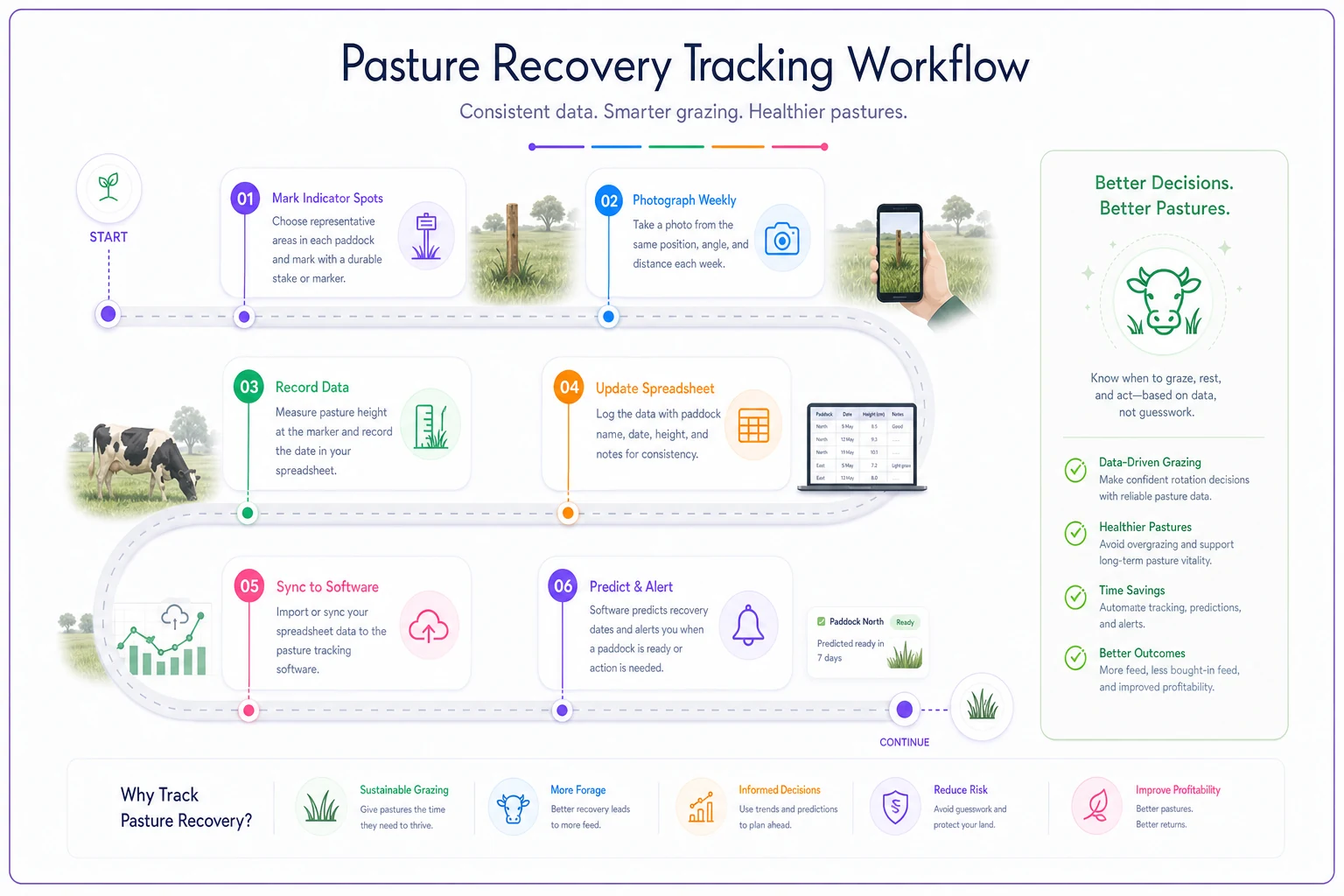
Mark one representative spot in each paddock and photograph it weekly to build a consistent record of recovery.
The data doesn't need to be complex. A basic spreadsheet tracking paddock number, last grazed date, current height, and projected ready date handles most decisions. When paddock 4 shows slower recovery than paddock 5 despite similar grazing dates, you know something needs attention - compaction, fertility, or species composition.
Modern operations increasingly use operational software to track these patterns. An AI-powered platform can automatically calculate recovery periods based on your inputs, alert when paddocks should be ready, and track seasonal patterns across years. This removes the guesswork and helps spot problems before they compound.
Creating contingency plans before grass runs out
Every August, the same panic calls happen. "We're out of grass. Should we graze the hay field? Start feeding? Ship pairs?"
Operations with working contingency plans don't make panic decisions. They have triggers and responses documented before the season starts.
-
If recovery extends beyond 45 days before August → Wean calves two weeks early
-
If three paddocks show recovery below 3 inches after grazing → Add supplemental feed immediately
-
If drought reduces carrying capacity below 70% → Sell bottom 20% of cows or all stockers
-
If spring growth delays past April 15 → Continue feeding, delay turnout 10 days minimum
The specifics matter less than having a plan. When grass gets short, emotion and hope cloud judgment. A predetermined trigger removes the temptation to "wait one more week" while pastures get destroyed.
Software that calculates rotation timing automatically
Manual rotation planning works until it doesn't. Missing a calculation, forgetting to account for slower growth, or simply getting busy during haying season leads to overgrazing.
Operational software designed for grazing management changes the entire process. Instead of spreadsheets and paper calendars, you input current conditions and the system calculates optimal rotation timing.
The software factors in historical recovery rates for each paddock, current growth conditions, stocking density, seasonal adjustments, and weather patterns. When conditions change, the software recalculates immediately. Drought slowing recovery? The system extends rotation automatically and alerts you to consider destocking options. Spring flush arriving early? It identifies which paddocks could be dropped from rotation for hay production.
The real value comes from pattern recognition across seasons. After two or three years of data, you can see which paddocks consistently recover slowly, which months create bottlenecks, and whether your stocking rate actually matches your land's production capacity.
Some platforms now incorporate AI automation to predict growth rates based on weather forecasts and historical patterns. This moves planning from reactive to proactive. You know two weeks ahead that recovery will likely slow, giving time to adjust before problems compound.
Building next season's template based on this year's failures
Every grazing season teaches expensive lessons. The paddock that didn't recover. The month when grass ran out. The decision to graze too early that haunted production all summer.
Smart operations document these lessons and adjust next year's template accordingly. This isn't about perfection - it's about incremental improvement.
-
Which paddocks consistently underperform
-
When recovery periods jumped unexpectedly
-
Where cattle congregation created problems
-
Which months had excess or insufficient forage
A cow-calf operation in Virginia discovered through careful tracking that their July bottleneck wasn't actually about summer slump. Their paddock layout forced cattle to trail through recovering areas to reach water. The daily traffic delayed recovery by 7-10 days. One winter waterline project solved three years of "drought" problems.
The difference between theory and working rotations
Textbook rotation plans assume uniform paddocks, consistent growth, and cattle that graze evenly. Real operations deal with hills, hollows, shade patterns, and cows that camp by the gate.
Successful rotation schedules account for reality. Some paddocks will always need longer recovery. Cattle will create sacrifice areas no matter your design. Weather will disrupt any fixed schedule. You'll need flexibility built into the system.
The operations that thrive long-term don't chase perfect rotations. They build robust systems that handle variation. They size herds conservatively. They maintain buffer paddocks. They adjust quickly when conditions change.
Most importantly, they track actual performance instead of hoping things improve. Each season's data improves next season's decisions. Software platforms accelerate this learning curve by automating calculations and pattern recognition, but the principle remains: measure, adjust, improve.
Your pastures will tell you what they need. Recovery takes the time it takes. Fighting that reality with aggressive rotations only depletes root reserves and reduces long-term productivity. Build your rotation schedule around actual recovery periods, not wishful thinking, and grass production improves dramatically.
The math isn't complicated once you accept that recovery drives everything else. Size your herd for your slowest recovery period, not your best month. Build more paddocks than seems necessary. Track actual performance. Adjust based on data, not tradition.
Pasture rotation schedules work when they reflect actual growing conditions and recovery needs. Everything else is just moving cattle around dying grass.
Ready to optimize your farm management?
Join hundreds of farmers using Barnyly to save time, improve animal health, and increase farm productivity.