

You know that sinking feeling when the milk truck pulls away and you suddenly remember the cow you treated three days ago? The one where you're not quite sure if her withdrawal period is up?
Most dairy operations lose money to dumped milk at least twice a year. Not because farmers don't care about withdrawal periods, but because medication tracking happens across barn walls, pickup truck dashboards, and whoever happens to be around when treatment decisions get made.
The real cost of scattered treatment records
A 120-cow dairy near Lancaster had their bulk tank rejected last spring. One treated cow ended up in the milking string four days too early. The actual mistake? Their treatment records lived in three places - the medicine cabinet clipboard, the herdsman's phone notes, and a calendar in the milk house that nobody updated after the first week.
Total damage: $8,400 in dumped milk, a warning letter from their co-op, and nearly losing their contract after a second close call two months later.
Medication tracking breaks down in predictable ways. The person giving shots isn't always the person moving cows. Morning milkers don't know what afternoon shift treated. Relief milkers on weekends work off memory. Everyone assumes someone else updated the main record.
Your vet prescribes different withdrawal times for off-label doses. The label says 96 hours for intramuscular, but you gave it subcutaneous at a different dose. Now you're guessing whether it's three days or five days. Most people add an extra day "just to be safe" and lose unnecessary production.
Generic medications have different withdrawals than brand names. You switched from Excede to generic ceftiofur last month to save money. Same drug, different withdrawal. Your crew still uses the old timing because nobody told them about the change.
Why paper templates create false security
Printable medication logs seem like they solve the problem. You download a nice template, laminate it, hang it in the parlor. Everyone's supposed to write down treatments.
Simplify farm operations and enhance animal care.
Barnyly helps you organize, track, and manage every aspect of your farm operations seamlessly.
- Comprehensive livestock tracking
- Automated health alerts
- Feed and resource scheduling
No credit card required
Reality looks different. The pen goes missing. Someone treats a cow at 2 AM and forgets to log it. Rain smears the ink. Pages get full and nobody prints new ones. The withdrawal calculation still happens in someone's head while they're doing six other things.
Paper templates work until they don't. Usually right when you need them most.
Withdrawal math nobody talks about
Calculating withdrawal gets complicated fast when you're dealing with real farm scenarios:
Combination therapy timing You give LA-200 (28-day meat withdrawal) on Monday, then add Banamine (4-day meat withdrawal) on Wednesday for pain. When can you actually ship that animal? Most people just add the withdrawals together, but that's not how it works.
Route changes everything Penicillin has a 48-hour milk withdrawal intramuscular, but you gave it subcutaneous because the cow was fighting. Now what? The label doesn't say. Your vet's not answering at 5 AM.
Dose adjustments Your 1,800-pound Holstein needs more than the label dose written for 1,000-pound beef cattle. You do the math, give the right amount, but now the withdrawal period needs recalculating too. Most farms just guess high and lose production days.
Building a medication workflow that actually works
Single point of entry Every treatment gets logged in one place, accessible from anywhere. Not three clipboards, not someone's memory, not scattered across different systems. Whether you're using paper, spreadsheet, or software - pick one system and make it the only system.
Automatic withdrawal calculation Stop doing withdrawal math in your head at 4:30 AM. Whether it's a laminated chart, a spreadsheet formula, or operational software, the withdrawal date should calculate automatically based on the drug, dose, and route.
Visual sorting systems Cows on withdrawal need to be obviously different from clean cows. Leg bands, tail paint, separate pen - whatever works for your setup. But the system fails if it relies only on people remembering to check lists.
Morning verification routine Before every milking, someone checks the withdrawal list against cows entering the parlor. Not sometimes. Every single milking. Takes two minutes, saves thousands.
Here's a quick visual of the workflow.
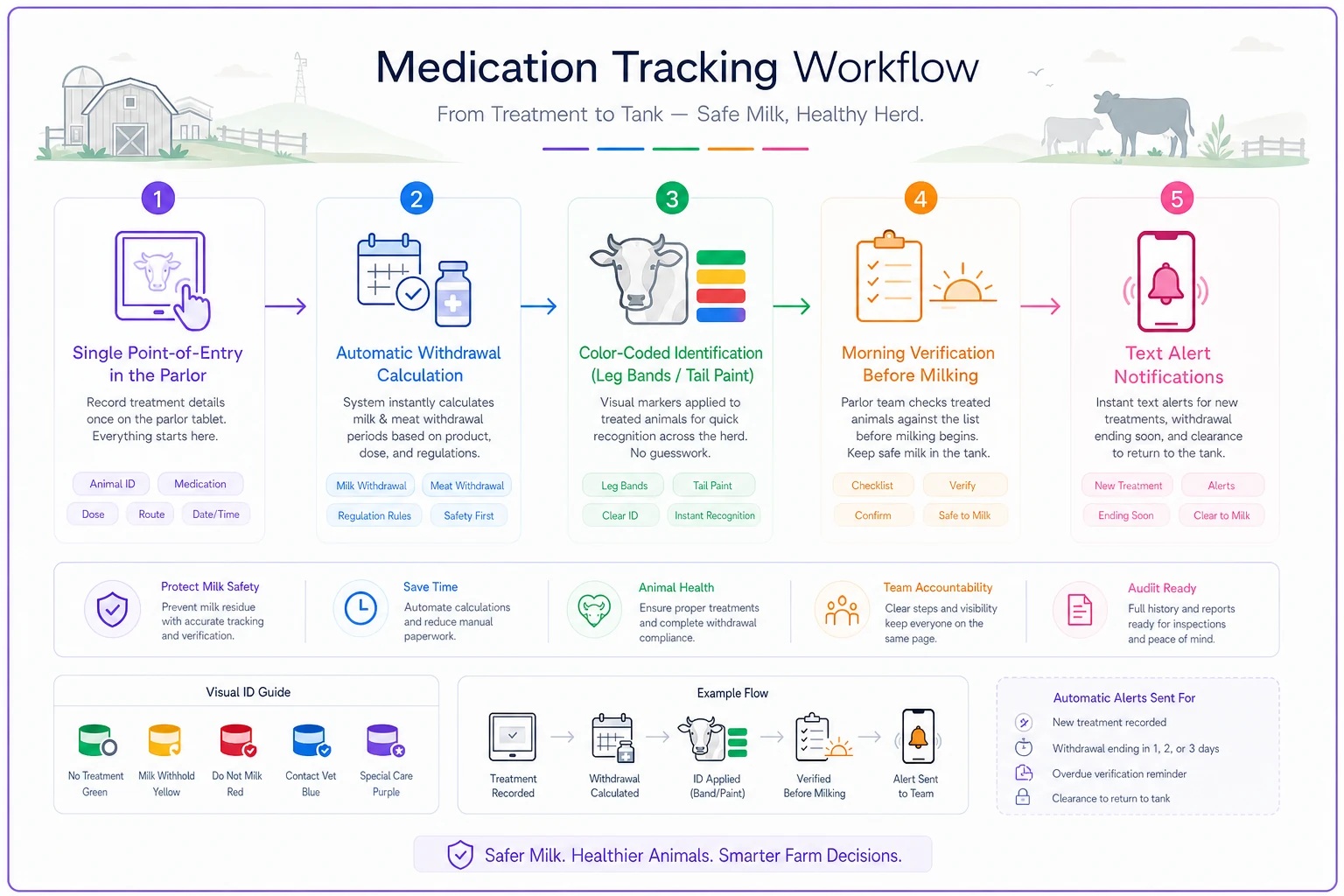
Standardize the single point of entry in a place everyone passes, like the parlor, so logging happens immediately.
The system needs to be simple enough that people actually use it every day.
When automated calculation makes sense (and when it doesn't)
Small operations with one person doing all treatments might manage fine with a good wall calendar and discipline. Once you have multiple people treating animals, different shifts, or more than about 30 head, manual tracking starts breaking down.
-
Multiple people administer treatments
-
You use various medications with different withdrawal periods
-
You ship milk or meat regularly and can't afford mistakes
-
Your operation has grown beyond what one person can remember
They're overkill when:
-
Same person handles all animal health decisions
-
You rarely treat animals
-
You only use one or two medications
-
You have time to double-check everything manually
Evaluate your operation honestly before deciding.
The hidden pattern in residue violations
Residue violations rarely happen because someone doesn't care. They happen during predictable situations:
Relief help doesn't know your system. Your neighbor covers milking while you're at a wedding. They don't know about the cow you treated Thursday. She goes through with everyone else.
End of month pressure changes decisions. Milk check's due, feed bill needs paying. That cow that might be clear? She definitely looks clear enough. Until she's not.
Communication gaps between shifts. Day crew treats, night crew milks, nobody talks to weekend crew. Information doesn't flow across shift changes.
New medications catch people off guard. You've used the same antibiotics for years, know the withdrawals by heart. Then supply chain issues force a switch. Different drug, different timing, same old habits.
Treatment station setup
Create a dedicated treatment recording spot. Not wherever you happen to be standing. One spot, with everything needed to record treatments properly. Waterproof clipboard, working pen on a chain, treatment log, withdrawal chart, marking supplies.
Every treated animal gets marked immediately. Not after you finish the whole group, not when you get back to the barn. Right then. Bright leg band, tail chalk, whatever you use - but it happens before you move to the next animal.
When cows move pens, their treatment status moves with them. Write it on the gate sheet. Text the next shift. Put it on the feed cart notes. However information moves in your operation, treatment status rides along.
Comparing tracking approaches
Compare methods to match your farm's size and staff.
| Method | Setup Cost | Daily Time | Error Risk | Works Best For |
|---|---|---|---|---|
| Wall calendar | $20 | 5 minutes | High | Single person, few treatments |
| Printed templates | $50 | 15 minutes | Medium | Small consistent crew |
| Spreadsheet system | $0-100 | 10 minutes | Medium | Tech-comfortable operators |
| Operational software | $30-80/month | 3 minutes | Low | Multi-person operations |
Choose the approach that fits your people and processes.
Real operation: 240-cow dairy in Wisconsin
This farm switched from paper logs to a workflow-based system after their second residue warning. Previous system: clipboard in the medicine cabinet, dry erase board in the parlor, everybody's personal notes.
Problems they faced:
-
Night milker didn't update morning crew
-
Relief milkers worked off memory
-
Withdrawal dates calculated differently by different people
-
Near-misses about once a month
New workflow:
-
Single tablet in parlor for all recording
-
Automatic withdrawal calculation based on drug database
-
Text alerts to all milkers when withdrawals expire
-
Color-coded leg bands that match the system
-
Morning check protocol before every milking
Results after 8 months:
-
Zero residue violations
-
Saved approximately 12 days of unnecessary withdrawal time
-
Reduced medication recording time from 15 minutes to 3 minutes daily
-
No more panic moments wondering about treatment dates
The key wasn't just the technology - it was standardizing the workflow so everyone follows the same process.
Making it work without perfect systems
Not every farm needs elaborate software. But every farm shipping milk or meat needs a medication withdrawal schedule farm system that actually works when it matters.
Start with fixing one thing. Maybe it's getting all treatments logged in one place. Maybe it's calculating withdrawals automatically instead of counting on fingers. Maybe it's making sure night shift knows what day shift treated.
Pick the biggest gap in your current system and fix that first. A partially better system beats a perfectly designed system that nobody uses.
The operations that avoid residue problems aren't necessarily the ones with the fanciest technology. They're the ones where medication tracking is a consistent workflow, not an afterthought. Where withdrawal calculation happens automatically, not in someone's tired brain. Where treatment information flows between people without relying on memory or luck.
Good medication records do more than prevent residue violations. They protect you when things go wrong.
Your processor questions a test result. You can show exact treatment dates, doses, and withdrawal calculations. Not scattered notes, but clear documentation.
State inspector arrives for a random check. Your records are ready, organized, and accurate. The inspection takes 20 minutes instead of two hours of scrambling.
Insurance claim for condemned meat or milk. You have documentation proving proper withdrawal times were followed. The contamination came from somewhere else.
Vet needs treatment history for a sick animal. You can pull up every medication, dose, and response from the last six months. Better treatment decisions, better outcomes.
Most farms only fix medication tracking after a problem. After the bulk tank gets dumped. After the warning letter arrives. After the close call that could have been worse.
But fixing it before disaster strikes isn't that complicated. It's about building workflows that assume people will be tired, distracted, or in a hurry. Systems that calculate withdrawal periods automatically. Processes that don't rely on one person's memory or one piece of paper staying readable.
Whether you use templates, spreadsheets, or operational software with built-in withdrawal calculators, the goal stays the same: removing human error from critical safety calculations. Making the right thing the easy thing. Building workflows that work when you're exhausted, short-handed, or dealing with three other problems at once.
That's when mistakes happen. And that's when good systems save you from disasters that take months to recover from.
The difference between farms that dump milk and farms that don't isn't about caring more. It's about having systems that work when caring isn't enough. When you're tired, stressed, or covering someone else's shift. When the relief milker doesn't know your animals. When treatment decisions happen at 2 AM.
Build those systems now, while you have time to get them right. Not after your first violation, when you're scrambling to prove you're taking it seriously.
Your milk check depends on it. Your meat sales depend on it. Your reputation definitely depends on it.
And honestly, once you have a real medication withdrawal schedule farm system in place, you'll wonder how you managed without it. The stress relief alone is worth the effort. No more lying awake wondering if you calculated that withdrawal right. No more panic when you can't remember who treated what when.
Just clear records, automatic calculations, and confidence that every animal shipping off your farm is clean. That's what good medication tracking gives you. Not just compliance, but peace of mind.
Ready to optimize your farm management?
Join hundreds of farmers using Barnyly to save time, improve animal health, and increase farm productivity.