

Three weeks into calving season, Marcus walked into the barn office and told me he was moving back to Oklahoma. Family emergency. Leaving tomorrow.
Marcus handled night checks, tracked which heifers needed watching, knew every cow's temperament, and had the entire vaccination schedule memorized. He'd been with the operation for four years.
Within 48 hours, we had a new guy trying to figure out which heifers were first-timers, guessing at feeding protocols, and calling me at 2 AM asking where we kept the calf pullers. The handwritten notes Marcus left on the whiteboard helped for about twelve hours until someone accidentally erased half of them.
That spring taught me something brutal about scaling livestock operations—your knowledge can't live in people's heads. Not when you're running 400 head. Not when seasonal workers rotate through. Not when a good hand can disappear overnight.
Why livestock operations hit the staffing wall harder than other ag businesses
Most farms can muddle through staffing gaps. Crop operations have seasonal peaks but also downtime. Equipment maintenance follows predictable schedules. But livestock operations run every single day, and the consequences of dropping the ball compound fast.
A dairy operation near us learned this when their milking parlor manager got COVID during their busiest season. The backup person knew the basics but not the subtle stuff—which cows kicked, who needed special handling, where they tracked mastitis treatments. Within a week, their somatic cell count spiked, two cows developed infections from improper milking procedures, and they lost their quality premium for that month. About $8,000 gone because one person's knowledge wasn't documented anywhere.
The staffing challenges in livestock hit different because animals don't pause. You can delay planting by a week if your crew's short. Equipment maintenance can wait until next month. But 300 head of cattle need feeding today, sick animals need treatment now, and that heifer showing signs of dystocia won't wait for your experienced calving hand to get back from vacation.
This gets worse as livestock operations grow. You start with family labor, add a full-time hand or two, then suddenly you need seasonal help for breeding, calving, or processing. Each growth stage breaks your existing communication systems. What worked when three people could talk over morning coffee falls apart when you're coordinating eight people across different shifts.
The roster problem nobody talks about until someone quits
Livestock operations build these elaborate mental maps of who does what, but never write them down properly.
Simplify farm operations and enhance animal care.
Barnyly helps you organize, track, and manage every aspect of your farm operations seamlessly.
- Comprehensive livestock tracking
- Automated health alerts
- Feed and resource scheduling
No credit card required
I visited a 600-head cow-calf operation last year that had seven employees. The owner could tell you exactly what each person handled—John did morning feeds and fence checks, Maria managed breeding records and AI scheduling, Tom handled equipment and worked cattle on processing days. But when I asked to see their actual roster or job descriptions, he laughed. "It's all up here," he said, tapping his head.
Six months later, Maria took a job at a larger ranch. They hired someone new who spent three weeks trying to piece together Maria's responsibilities from scattered notebooks, random spreadsheets, and asking other employees what they remembered about her daily routine. Turns out Maria also ordered vaccines, scheduled the vet, maintained the breeding calendar, and tracked which bulls went with which cow groups. Nobody knew she handled all that until she was gone.
A real roster system changes this. Not some generic HR template, but an operational roster that captures the actual workflow of your operation.
Start with shift coverage, but go deeper. Document who makes which decisions. Who can authorize medication treatments? Who knows the feed ration adjustments for different seasons? Who has relationships with your suppliers?
Build handover templates that capture the stuff people never think to mention.
-
Which gates stick and need wiggling.
-
Which waterer tends to freeze first.
-
Where you keep the spare ear tags.
-
Which cows are fence jumpers.
-
The vet's personal cell for emergencies.
The vet's personal cell for emergencies.
SOPs that actually work when you're knee-deep in mud
Standard operating procedures for livestock sound great until you're trying to follow a 10-page document while a stressed heifer is trying to calve backwards at 11 PM.
Operations that scale successfully build different types of documentation for different situations. You need the detailed version for training, but you also need the muddy-handed version for real-time reference.
Take medication administration. The full SOP covers everything—proper restraint, injection sites, dosage calculations, withdrawal periods, record keeping. But you also need a weatherproof chart in the handling facility showing common medications, dose-per-weight ranges, and withdrawal times. One ranch I know laminated theirs and zip-tied it to the squeeze chute.
Laminate quick-reference medication charts and attach them to the squeeze chute.
Your feeding protocols need similar treatment. The complete SOP explains ration formulation, adjustment factors for weather, mixing procedures. But your feed truck also needs a simple chart showing pounds per head for each pen, with clear notes about which groups get which supplements.
Most operations miss this: SOPs for problems, not just procedures. Document what to do when:
-
The feed mixer breaks mid-batch
-
Power goes out to the barn in winter
-
You find a cow with hardware disease symptoms
-
The water system freezes
-
A gate gets left open and groups mix
These problem-response SOPs save more money than any perfect-world procedure ever will.
Building seasonal surge capacity without chaos
Calving season. Breeding season. Weaning and shipping. Every livestock operation has surge periods where you need double the hands for a quarter of the year.
A beef operation I worked with ran 450 cows and needed four full-time people most of the year. But during their 60-day calving window, they needed eight to ten people for night checks, calving assistance, and calf processing. They used to scramble every January, calling around for help, bringing in whoever they could find, and spending the first two weeks of calving season basically training people while trying to save calves.
They fixed it by building what they called their "surge roster"—a documented pool of seasonal workers who'd helped before, with notes on their experience levels and specific skills. They created role-specific packets for seasonal positions.
The night check packet included:
-
A laminated card with signs of calving
-
Which cows were first-timers (marked with orange ear tags)
-
When to call for help versus handle solo
-
Where all equipment lived
-
Phone numbers in order of who to call
They started bringing seasonal workers in three days before calving started for hands-on training. Not classroom stuff—actual walk-throughs of the facilities, practice with the calving equipment, review of the previous year's calving records to understand the herd.
Their calf death loss dropped from around 4% to under 2%. Not because they had more people, but because those people knew what they were doing from day one.
When handovers prevent thousand-dollar mistakes
Every time someone new takes over a livestock responsibility, information gets lost. Sometimes it's minor. Sometimes it costs you.
A pig operation learned this after their farrowing manager went on maternity leave. The replacement knew pigs but not their specific protocols. Nobody mentioned that pen 6's heating pad had a short and needed unplugging during cleaning. Water got in, tripped the whole barn's breaker, and they lost heat to all farrowing crates for six hours on a 20-degree night. Lost eight piglets.
Real handover templates for livestock need to capture three things: the routine, the exceptions, and the relationships.
The routine is straightforward—daily tasks, weekly schedules, monthly requirements. But the exceptions kill you. Which animals need special handling. Which equipment has quirks. What shortcuts previous people figured out.
The relationships matter more than people think. Which feed dealer gives you extra time on invoices when cash flow's tight. Which vet tech is best with difficult cattle. Which processor saves you the prime dates. These relationships take years to build and seconds to damage with poor communication.
Technology changes the documentation game
Modern operations get a massive advantage over the old clipboard-and-binder systems. AI-powered operational software changes how you build and maintain these systems.
Instead of static documents that nobody updates, you get living procedures that evolve with your operation. When someone figures out a better way to handle something, they update it in real-time through their phone. When seasonal workers have questions, they search the knowledge base instead of calling the manager at midnight.
The medication example shows how this works. Your SOP lives in the system, but so do your actual treatment records. When someone needs to treat an animal, they scan its tag, the system shows them approved medications for that symptom, calculates the dose based on last recorded weight, and sets automatic withdrawal date alerts. The SOP isn't separate from the work—it's embedded in the workflow.
Seasonal rosters become dynamic tools. The system tracks who worked which seasons, what training they completed, their performance notes. When calving season approaches, you can instantly see who's available from your previous seasonal pool, who needs refresher training, and who learned specific skills since last year.
The real cost of knowledge hoarding
Small livestock operations often run on tribal knowledge. The owner knows everything, maybe one senior employee knows most things, and everyone else knows their narrow piece. This feels efficient until it isn't.
Calculate what happens when your experienced person leaves:
-
Time to train replacement
3-6 months of reduced efficiency
-
Mistakes during learning curve
medication errors, breeding mistakes, feeding problems
-
Lost relationships
supplier terms, vet trust, processor scheduling
-
Stressed animals from inconsistent handling
-
Owner time pulled from growth activities to fill gaps
One dairy figured they lost about $47,000 in the six months after their herd manager retired. Not from catastrophic failures, just from the accumulated inefficiencies of knowledge transfer. Slightly lower conception rates from timing issues. A few cases of mastitis from inconsistent milking procedures. Some feed waste from ration mistakes.
They could have avoided most of that with documented procedures and proper handovers. Instead, they learned everything the expensive way.
What actually works: A system built for mud and chaos
After watching dozens of operations try to scale, here's what separates the ones that succeed from the ones that constantly fight fires:
-
Training level
detailed, explains why
-
Reference level
quick lookup for experienced people
-
Emergency level
bullet points for crisis moments
Create role cards, not job descriptions:
-
Make wallet-sized cards for each role showing
-
- Daily must-dos
-
- Weekly tasks
-
- Who to call for what
-
- Where stuff lives
Document decisions, not just procedures:
-
- When to call the vet versus treat yourself
-
- When to move animals between groups
-
- When to adjust feed rations
-
- When to approve overtime
Make handovers systematic:
-
- Two-day overlap minimum
-
- Written notes on every animal group
-
- Walk-through of all facilities
-
- Introduction to all suppliers/service providers
-
- Review of recent issues and solutions
Build your surge system before you need it:
-
- Maintain a seasonal worker database
-
- Create role-specific training packets
-
- Schedule seasonal workers before your busy season
-
- Pay enough to get the same people back
Use technology where it matters:
-
AI automation helps with the stuff people forget to document. Treatment records auto-generate from actions. Feeding adjustments create SOP updates. Seasonal workers get prompted through procedures on their phones. The system captures institutional knowledge as people work, not as a separate documentation project.
A simple workflow showing how role cards, SOP levels, surge rosters and handovers tie together.
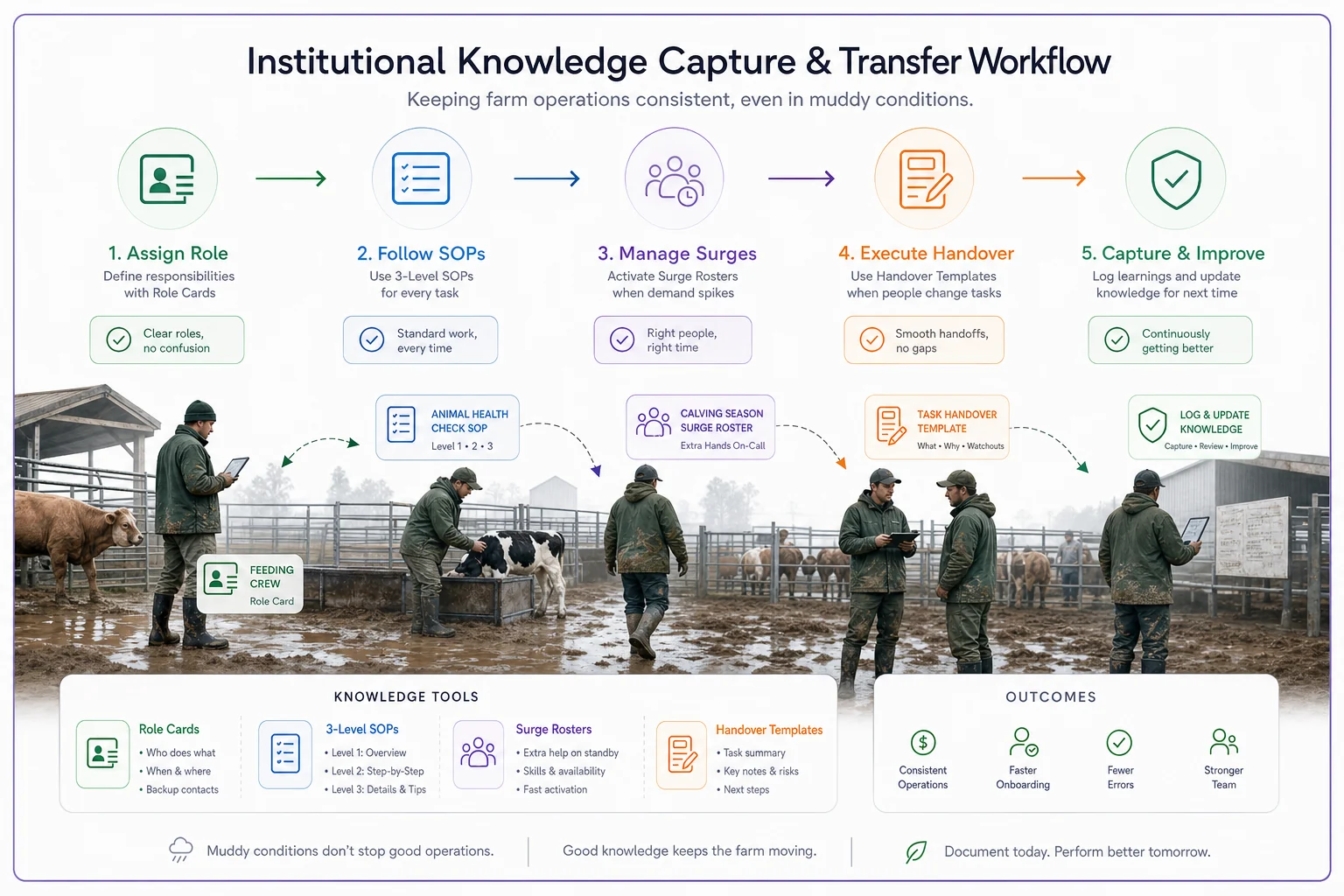
The system captures institutional knowledge as people work, not as a separate documentation project.
The path from chaos to scalable operations
You don't need perfect documentation tomorrow. Start with your biggest risk areas. For most operations, that's medication protocols, breeding procedures, and feeding systems. Get those documented first.
Then build your roster system. Not fancy, just functional. Who does what, when they do it, and who covers when they're gone.
Add seasonal surge planning next. Document what positions you need, when you need them, and what specific skills they require. Build your training materials during quiet seasons, not the week before calving starts.
Create handover templates for every key role. Test them by having people switch responsibilities for a day. You'll quickly discover what information is missing.
| Priority areas |
|---|
| medication protocols |
| breeding procedures |
| feeding systems |
The operations that scale successfully aren't the ones with perfect systems. They're the ones that capture enough knowledge that losing a key person is inconvenient, not catastrophic. Where seasonal surges are planned operations, not barely-controlled chaos. Where new people can contribute quickly instead of spending months figuring out unwritten rules.
Your best hand will quit someday. Probably at the worst possible time. When that happens, your operation's survival shouldn't depend on finding another person with the same five years of accumulated knowledge in their head. It should depend on systems that transfer knowledge, procedures that guide decisions, and workflows that maintain standards regardless of who's doing the work.
Build those systems now, while you have the expertise to document. Because the middle of calving season is a terrible time to realize nobody else knows how to run the operation.
Ready to optimize your farm management?
Join hundreds of farmers using Barnyly to save time, improve animal health, and increase farm productivity.