

Walk into any livestock operation running more than 150 head and you'll find the same pattern. Feed receipts stuffed in a filing cabinet. Health records scattered between the barn office and the house. Breeding logs in three different notebooks. Performance data trapped in software that doesn't talk to anything else.
The frustrating part isn't the mess itself. It's watching operations collect thousands of data points every month, then make million-dollar decisions based on gut feel because they can't connect their records to meaningful patterns.
The hidden cost of disconnected livestock data
A dairy operation near me tracked everything religiously for twelve years. Milk production per cow. Feed conversion rates. Breeding success. Veterinary treatments. They had data going back to 2012, all carefully recorded.
When feed prices jumped last spring, they needed to know which cows were actually profitable at current input costs. Simple question, right? Except their milk records lived in the parlor software, feed data sat in Excel sheets, and health costs were buried in QuickBooks entries. Took them three weeks to manually connect everything for just their top 50 producers.
By the time they figured out which cows were losing money, they'd already renewed feed contracts for another quarter. The delay cost them around $47,000 in unnecessary feed for underperforming animals.
This happens constantly. Beef operations tracking average daily gain but missing which bloodlines consistently finish two weeks faster. Swine farms monitoring feed efficiency without connecting it to specific genetic crosses. Sheep producers recording lambing percentages but unable to link them back to ram selection decisions from eighteen months earlier.
The data exists. It just exists in isolation, where it can't inform actual decisions.
Why standard livestock tracking fails at scale
Small operations get away with scattered records. When you're running 30 head of cattle, you remember which bull throws the best calves. You know which pastures produce better gains. Your operation runs on accumulated knowledge more than documented data.
Simplify farm operations and enhance animal care.
Barnyly helps you organize, track, and manage every aspect of your farm operations seamlessly.
- Comprehensive livestock tracking
- Automated health alerts
- Feed and resource scheduling
No credit card required
Everything breaks around 150-200 head. That's when you can't remember every animal's history. When seasonal patterns matter more than individual memories. When small percentage improvements translate to real money.
The breaking points hit predictably:
Your breeding program suffers first. Without connected lineage and performance data, you're essentially guessing which genetics to keep. One ranch I worked with discovered they'd been keeping bulls from a line that averaged 18% lower weaning weights than their other genetics. They just couldn't see the pattern across three years of scattered records.
Feed efficiency becomes invisible. Most operations track total feed costs and average animal performance. But connecting specific rations to specific groups over specific timeframes? That requires data infrastructure most farms never build. A 500-head feedlot was overfeeding their lighter cattle by roughly 12% because their grouped feeding data couldn't identify the inefficiency.
Health interventions turn reactive. When treatment records don't connect to performance outcomes, you miss which preventive protocols actually work. A cow-calf operation treated respiratory issues as they appeared for years. Once they connected treatment data to weaning weights, they discovered early intervention in specific weather patterns prevented 80% of cases and saved $35 per head in lost gains.
Market timing gets foggy. Without clear performance trajectories linked to input costs, you're guessing optimal sale dates. Miss your window by two weeks and watch margins evaporate.
Building record categories that actually matter
What separates data hoarders from data users: organizing records by decision points, not by convenience.
Most operations organize data by how it arrives. Feed records go in the feed folder. Health records go in the health folder. Financial records go to the accountant. This makes perfect sense for filing. It makes zero sense for decision-making.
Effective farm data strategies organize by operational questions:
Profitability per production unit requires connecting:
-
Individual animal or group performance metrics
-
Direct feed consumption and costs
-
Health treatment costs and labor
-
Overhead allocation per head
-
Market price at time of sale
Genetic selection decisions need:
-
Multi-generational performance data
-
Environmental factors during each generation
-
Health issue inheritance patterns
-
Feed efficiency across bloodlines
-
Market premium potential by trait
Operational efficiency tracking pulls from:
-
Labor hours per production phase
-
Equipment utilization rates
-
Facility throughput metrics
-
Waste and mortality patterns
-
Seasonal variation impacts
Stop thinking about data types. Start thinking about decision categories.
Ownership and retention schedules that prevent data graveyards
Every piece of farm data needs three things clearly defined: who owns it, who maintains it, and when it expires.
Ownership isn't about control - it's about accountability. On most livestock operations, nobody actually owns the data. The person feeding cattle records weights because the boss said to. The breeding technician logs services because that's the routine. The bookkeeper enters expenses because bills need paying.
But who ensures feed weight data connects to breeding records? Who validates that health treatments link to performance changes? Who makes sure five-year genetic trends are actually accessible?
Without clear ownership, data quality degrades fast. A poultry operation tracked mortality religiously for six years. When they finally tried analyzing patterns, they discovered three different people had been recording deaths differently. Some counted DOAs. Others didn't. Some recorded culls as mortality. Others tracked them separately. The data was worthless for trend analysis.
Smart operations assign data ownership by decision authority:
-
Production manager owns performance metrics
-
Herd manager owns health and breeding data
-
Feed manager owns nutrition and consumption records
-
Financial manager owns cost and revenue data
-
General manager owns integration points
Assign a single person to validate that records actually link across systems.
Then comes retention. Most farms keep everything forever or delete things randomly. Neither works.
Different data has different lifespans:
-
Daily operational data
18 months
-
Seasonal performance patterns
5 years
-
Genetic/bloodline records
Permanent
-
Financial records
7 years minimum
-
Environmental data
3-5 years
-
Market price history
10 years
A beef operation kept 15 years of detailed daily feeding records. Massive spreadsheets that took forever to load. They'd never analyzed anything beyond the current year. Meanwhile, they'd deleted five-year breeding trend data to "save space." Classic retention failure.
The migration roadmap from chaos to KPIs
Moving from scattered records to connected KPIs doesn't happen overnight. Most operations need 6-12 months to build a functioning data system. The practical sequence:
Month 1-2: Stop the bleeding Quit creating new scattered records. Pick one location for each data type. Doesn't matter if it's perfect. Just stop the proliferation. A 300-sow operation had employees recording breeding data in seven different places. Step one was simply declaring the barn laptop as the single source.
Month 2-3: Map your critical decisions List the ten most expensive decisions you make annually. Feed purchasing. Breeding selection. Marketing timing. Culling choices. Health protocols. For each decision, identify what data would make it better. This becomes your KPI framework.
Month 3-4: Connect historical patterns Take your highest-impact decision and manually connect one year of historical data. Just one decision, one year. A sheep operation started with ram selection. Connected breeding records to lambing percentages to weaning weights for one season. Found patterns that changed their entire breeding strategy.
Month 4-6: Build collection workflows Design data collection around natural workflow, not ideal organization. If your team feeds animals before checking health, build forms that match that sequence. A dairy forced milkers to enter health observations before production data. Compliance was terrible. Flipping the order to match workflow fixed everything.
Month 6-8: Automate the connections This is where operational software matters. Manual data connection works for historical analysis. It fails for daily decisions. You need systems that automatically link feed consumption to weight gains, health treatments to performance changes, genetics to outcomes.
Month 8-12: Develop decision rhythms Data without review schedules is just expensive storage. Build weekly, monthly, and seasonal review cycles. Weekly: operational efficiency metrics. Monthly: performance trends and health patterns. Seasonal: genetic progress and financial analysis.
A simple workflow visualization can make these steps easier to follow.
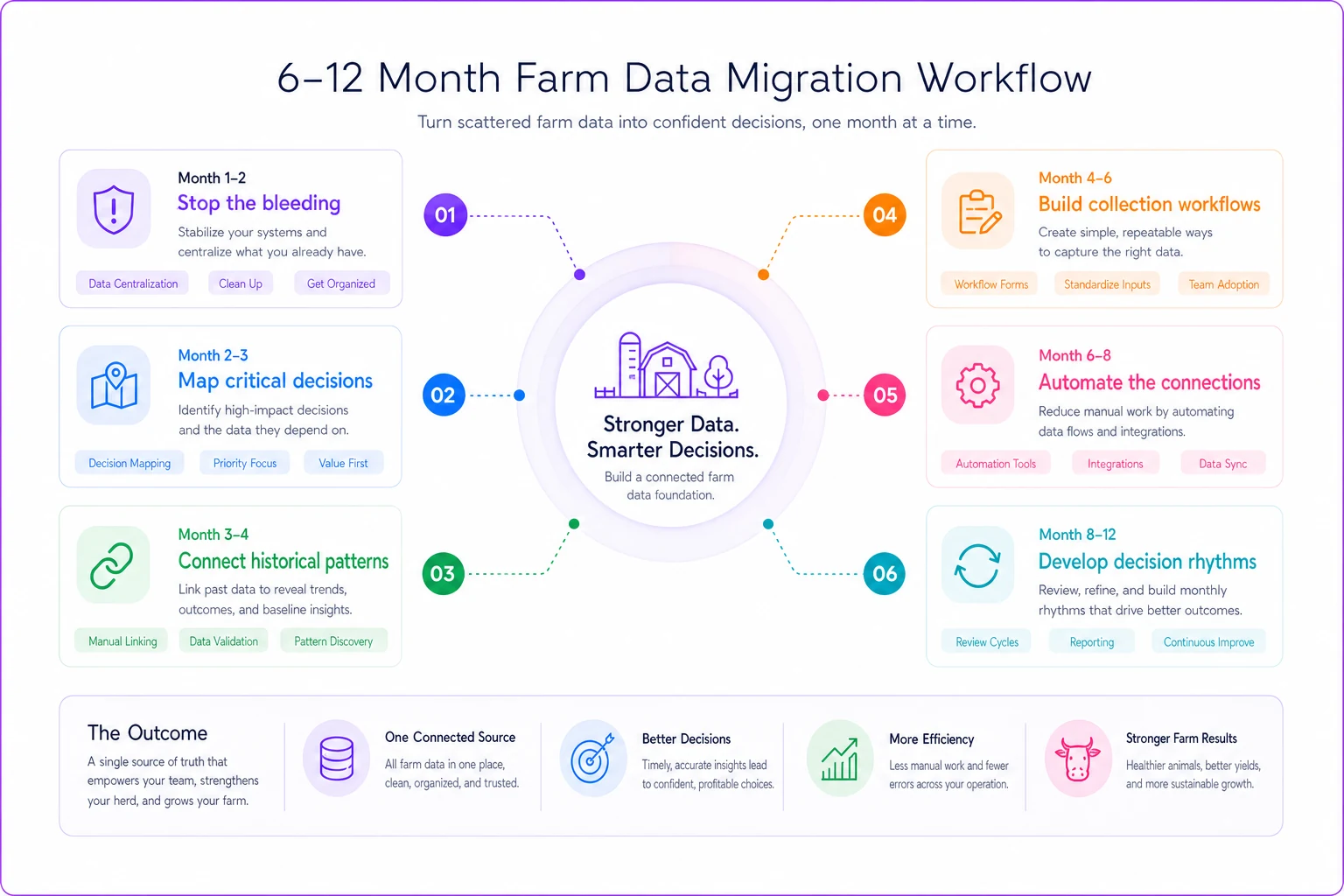
Data workflows move from stopping new fragmentation to automating connections and then setting regular review cycles.
Templates and tools for livestock data transformation
Generic spreadsheets fail because livestock operations have unique data relationships. A cattle weight-gain template won't work for layer hen production. Swine feed conversion tracking doesn't translate to sheep operations.
Performance Trajectory Template
-
Individual ID or group identifier
-
Starting weight/condition
-
Weekly or bi-weekly measurements
-
Feed protocol during period
-
Health events during period
-
Environmental factors (temperature, housing)
-
Projected versus actual outcomes
Genetic Selection Scorecard
-
Parent genetics (3 generations minimum)
-
Birth/hatch metrics
-
Growth curve data points
-
Health issue frequency
-
Feed efficiency scores
-
Market value indicators
-
Offspring performance (if applicable)
Input Efficiency Tracker
-
Input type and cost
-
Application/feeding date
-
Group/individual receiving input
-
Performance before application
-
Performance after application
-
ROI calculation
-
Environmental conditions
Health Intervention Matrix
-
Issue identification date
-
Symptoms observed
-
Treatment protocol used
-
Treatment cost (materials + labor)
-
Recovery timeline
-
Performance impact
-
Prevention opportunity flag
Templates should connect data points, not just collect them. Every entry should link to related decisions.
Common KPI frameworks by livestock type
Different livestock operations need different KPIs, but patterns emerge across successful farms:
| Livestock Type | Critical KPIs | Data Points Required | Update Frequency |
|---|---|---|---|
| Beef Cattle | Cost per pound gained | Feed intake, weight, health costs | Weekly |
| Dairy | Income over feed cost | Milk production, feed consumption, milk price | Daily |
| Swine | Piglets weaned per sow yearly | Breeding dates, litter sizes, mortality | Per batch |
| Poultry - Layers | Eggs per hen housed | Lay rates, mortality, feed consumption | Daily |
| Sheep/Goats | Lambing/kidding percentage | Breeding records, birth records, survival | Seasonal |
| Poultry - Broilers | Feed conversion ratio | Feed consumed, weight gained, mortality | Per flock |
But most operations miss this: secondary KPIs often drive primary ones.
A broiler operation obsessed over feed conversion ratios. Tracked them religiously. But they weren't monitoring house temperature variation, which was causing uneven growth and hurting their FCR. Adding environmental monitoring as a secondary KPI improved their primary metric by 8%.
When data infrastructure actually pays
Not every operation needs sophisticated data systems. A 20-head hobby farm probably doesn't need KPI dashboards. But specific situations make data infrastructure non-negotiable:
Multi-site operations - When animals move between locations, disconnected data creates blind spots. A cattle operation running stockers across four farms lost track of health treatments during transfers. Resulted in double-treating some groups and missing others entirely.
Contract production - When your payment depends on performance metrics, data precision equals profit. A contract poultry grower improved their settlement scores by 12% after implementing proper data tracking. That translated to an extra $31,000 annually on a four-house operation.
Genetic selection programs - Breeding decisions compound over generations. Without multi-year performance data, you're gambling with your genetic future. A sheep operation discovered their "best" ram was actually producing lambs with 15% higher mortality after tracking three generations.
Margin pressure situations - When feed costs spike or market prices drop, the difference between profit and loss sits in the margins. Operations with connected data can identify and cut inefficiencies fast. Those without it just hope things improve.
Scale transitions - Moving from 100 to 300 head isn't just triple the work. It's a completely different operational model. Data systems that worked at smaller scale break entirely. Better to build proper infrastructure before you need it.
The software question nobody asks (but should)
Uncomfortable truth about livestock software: most of it solves the wrong problem. Products focus on recording data, not connecting it to decisions.
You don't need software that creates prettier reports. You need systems that link Tuesday's feeding decision to Thursday's health event to next month's performance metrics to next year's genetic selections.
The evaluation framework that works:
Data connection capability - Can it link feed records to performance? Health events to productivity? Genetics to outcomes? If data sits in isolated modules, the software fails its primary purpose.
Workflow alignment - Does it match how your team actually works? Software that requires barn workers to stop and enter data mid-task gets abandoned within months.
Scale flexibility - Will it work when you're 50% bigger? 200% bigger? Systems that break at scale force painful migrations right when operations can least afford disruption.
Decision surfacing - Does it highlight what matters today? Most software shows you everything equally. Effective systems surface decisions that need attention now.
Modern operational software uses AI to handle these connections automatically. Instead of manually linking feed changes to performance shifts, the system identifies patterns and alerts you to decision points. This isn't about replacing judgment - it's about ensuring your judgment has complete information.
Why most farms fail at data strategy
The biggest failure pattern? Trying to fix everything at once. A cattle operation decided to "digitize" completely. Bought software. Trained everyone. Started collecting everything. Six months later, they had beautiful dashboards nobody looked at and decisions still happening on instinct.
Successful data strategies start narrow and expand. Pick one decision. Fix the data flow for that decision. Prove the value. Then expand.
A 400-head dairy started with just feed efficiency. Nothing else. Built simple tracking for feed delivery and milk production. Connected the two. Within three months, they'd identified a ration imbalance costing them $185 per cow annually. That success funded expansion into health tracking, breeding optimization, and eventually full operational integration.
The other critical failure? Confusing data collection with data strategy. Recording everything isn't a strategy. It's hoarding. Strategy means knowing which data drives which decisions and building systems to connect them.
The competitive reality of connected farm data
Operations running on connected data make fundamentally different decisions than those running on instinct and isolated records.
When market prices shift, data-driven operations know exactly which animals to sell, which to hold, and which to push harder. They can calculate break-even points by individual animal or group. They see profit margins, not just gross revenue.
During disease outbreaks, connected health and performance data reveals which preventive protocols actually work versus which are just expensive traditions. One swine operation cut their medication costs by 40% after data showed their preventive protocol wasn't reducing infection rates.
In breeding seasons, multi-generational performance data guides selection decisions that compound over years. The difference between average and optimized genetics can mean $50-150 per head in additional value.
Weather events and seasonal patterns become predictable impact factors instead of surprises. Operations with good environmental data know how a wet spring affects fall performance, how heat stress impacts breeding success, how winter housing changes feed requirements.
The operations thriving despite market volatility aren't necessarily bigger or better funded. They're the ones that turned their accumulated records into active decision tools. They know their numbers, trust their data, and make moves while others are still guessing.
Building versus buying your data infrastructure
Some operations try building custom systems. Usually starts with Excel. Grows into Access databases. Maybe evolves into custom software. The approach works until it doesn't.
A 1,000-head feedlot spent two years building their perfect tracking system. Complex spreadsheets with macros connecting everything. Worked great until their Excel expert quit. Now they had a system nobody could maintain, modify, or sometimes even open without crashing.
The build-versus-buy decision comes down to core competency. You're in the livestock business, not the software business. Time spent debugging spreadsheets is time not spent optimizing operations.
Modern AI-powered operational platforms handle the complexity while you focus on livestock. They connect data automatically, surface insights you'd miss, and evolve as your operation grows. The cost comparison isn't just software versus spreadsheets - it's the opportunity cost of decisions made without complete information.
Starting Monday morning
Forget the perfect system. Start with one question your operation needs answered better. What single decision would improve with better data?
Maybe it's which cows to cull this fall. Which breeding groups to expand. Whether that new feed additive actually works. Pick one.
Now identify the three to five data points that inform that decision. Where does that data currently live? How could you connect it? What would change if you could see patterns instead of points?
Build your data strategy one decision at a time. Connect records that matter. Create KPIs that drive action. Delete data that doesn't serve decisions.
Most importantly, assign someone to own the process. Not the IT person. Not the bookkeeper. Someone who understands operations and cares about outcomes. Give them authority to standardize collection, responsibility for quality, and resources to build connections.
Livestock operations that master data strategy don't just survive market cycles and industry changes. They use them as opportunities to expand while others contract. The difference isn't the data itself - it's the ability to transform records into decisions, patterns into predictions, information into action.
Your farm already generates the data. The question is whether you'll use it to drive decisions or let it sit in scattered files while you operate on instinct. In competitive livestock markets with tight margins and constant change, instinct isn't enough anymore. The operations that thrive will be those that turn their data graveyards into decision engines.
Ready to optimize your farm management?
Join hundreds of farmers using Barnyly to save time, improve animal health, and increase farm productivity.