

Most mixed-species farms don't fail at health tracking because they lack data. They fail because the data lives in four or five places that never talk to each other — a spiral notebook in the barn, a vet's PDF invoices, an RFID reader that dumps CSVs nobody opens, and a whiteboard that gets wiped every Sunday. When you run cattle, sheep, goats, and the occasional pig batch together, the species-specific quirks multiply that fragmentation fast.
This brief is about picking and standing up a system that pulls all of that into one place. It assumes you already know your vaccination protocols and withdrawal rules — if you're still building the actual calendar logic, the consolidated vaccination calendar and labor rules for mixed-species farms covers that groundwork. Here we're focused on the system that runs underneath it: what to buy, how to model your data, how to wire in RFID and lab feeds, and how to roll it out without a six-month disaster.
The three system archetypes, and why most farms pick wrong
There isn't one kind of "farm management system." There are roughly three, and they serve very different operations. Buying the wrong archetype is the single most expensive mistake in this space — migrating out of the wrong tool a year later costs more than the software ever did.
| Archetype | Best for | Health tracking depth | Typical weak spot |
|---|---|---|---|
| Spreadsheet-plus (DIY or templated) | Single-site farms under ~150 head, one species dominant | Shallow — manual entry, no alert engine | Breaks the moment two people edit at once |
| Species-specialized platform | Operations heavily weighted to one species (e.g., 90% cattle) | Deep for that species, thin for others | Forces your sheep/goats into cattle logic |
| General livestock/mixed-species platform | True mixed operations, multi-site, multiple handlers | Broad, configurable per species | Requires setup discipline; weaker defaults |
The pattern that comes up repeatedly: a farm that's 70% cattle and 30% small ruminants buys the slick cattle-specialized platform because the demo looked great. Six months in, the sheep and goats are still being tracked in a notebook because the system's dosing logic, age classes, and group structures were built around cattle. The health data is only "centralized" for the species that was already easy to manage.
If you genuinely run mixed species with meaningful numbers in each, the general platform is almost always the right call — even if any single species' feature set looks slightly less polished than a specialist tool. Centralization beats depth-in-one-silo when the whole point is one health picture.
The minimal data model you actually need
Before you compare vendors, write down the data model. Not a full schema — just the entities and the links between them. This is the cheapest hour you'll spend, and it instantly exposes which platforms are too rigid.
Simplify farm operations and enhance animal care.
Barnyly helps you organize, track, and manage every aspect of your farm operations seamlessly.
- Comprehensive livestock tracking
- Automated health alerts
- Feed and resource scheduling
No credit card required
-
Animal — unique internal ID (never the RFID number alone), species, breed, sex, date of birth or intake, current status (active/sold/dead/culled).
-
Group / Mob — a flexible container animals can belong to and move between (pasture mob, treatment batch, age cohort). An animal can sit in several groups at once.
-
Location — where the animal physically is, with a timestamp history so you can reconstruct exposure during a disease event.
-
Health event — the workhorse. Type (vaccination, treatment, exam, test, injury), product used, dose, route, administering person, date/time.
-
Product / Inventory item — vaccine or medicine with batch/lot, expiry, and a withdrawal period that varies by species.
-
Lab submission / result — linked to animal or group, sample type, lab reference, status, result payload.
-
Alert / Task — generated or manual, with due date, assignee, and resolution state.
Two design rules that aren't optional. First: withdrawal periods live on the product-species relationship, not on the product alone. The same antibiotic can carry a 14-day meat withdrawal in cattle and a different figure in goats — often with no label claim at all, meaning an extended vet-directed interval applies. Systems that store a single withdrawal number per product will quietly produce wrong clearance dates for your small ruminants. That's a residue violation waiting to happen, and it stays invisible until an inspector or processor finds it.
Second: give every animal a stable internal ID that is separate from its RFID tag. Tags get lost, re-read wrong, or re-used. If your entire health history is keyed to a tag number, a retagging event fractures the record. These two rules should be confirmed before you even open a vendor demo.
Must-have features versus nice-to-haves
Vendors will wave forty features at you. Only a handful actually determine whether the system centralizes health data or just adds another silo.
-
Per-species configuration for age classes, dose logic, and withdrawal intervals
-
Group/mob movements that cascade events (treat the mob, log every animal in it)
-
Batch/lot capture on every product administration, tied back to inventory
-
A real alert engine with configurable thresholds — not just a static calendar view
-
Offline capture on mobile with reliable sync (more on this below)
-
Export to the formats your processor, auditor, and vet actually accept
-
Role-based access so a seasonal handler can log treatments but not alter protocols
Nice-to-have (don't pay a premium for these up front):
-
Fancy dashboards and charts
-
Weather integration
-
Built-in financial/P&L modules
-
Genomics or breeding-index tooling
The mistake here is buying for the dashboard. Dashboards are downstream of clean capture. If capture is painful in the yards, the dashboard shows garbage no matter how polished it looks.
Integration patterns: RFID, lab feeds, and APIs
This is where "centralized" is won or lost in practice, so it's worth being specific about how each integration should actually behave.
RFID / EID. The realistic pattern is a Bluetooth stick or panel reader pushing reads into the mobile app while you're in the yards. The thing to verify in a demo: what happens when the reader scans a tag the system has never seen? A good system prompts you to create or assign the animal on the spot. A bad one silently drops the read or creates an orphan record. In real yard conditions you will scan unknown tags constantly — strays, mis-tags, newly purchased animals — and how the system handles that edge case determines whether your location and exposure history stays trustworthy.
Lab submission and results. Few farm platforms have true two-way lab API integrations, and honestly that's fine. The practical middle ground is structured submission records plus a result-attachment workflow, so each lab PDF lands against the right animal or group with a status you can filter on ("submitted / pending / resulted / actioned"). If your lab does offer an electronic result feed, confirm the matching key — results should auto-link by an accession or submission ID you control, not by animal name, which gets ambiguous fast across species.
APIs generally. Ask two direct questions: can I get all my data out via API or full export, and is that access included or a paid tier? Export capability is your insurance against vendor lock-in. A platform that makes bulk export awkward is telling you something about how hard leaving will be.
Example automation rules and alert thresholds
Automation only helps if the rules actually match how your farm runs. Over-triggering is worse than no alerts at all — handlers learn to ignore a system that cries wolf.
-
Withdrawal clearance guard when any animal has an active withdrawal period, flag it on any "mark for sale/slaughter" action. Hard block, not soft warning.
-
Vaccination due windows by species cohort generate a task when a cohort enters its due window, and escalate only if it's still open past the window's end — not daily from day one.
-
Booster gap detector if a primary dose was logged but no booster appears within the species-correct interval, raise a single task to the health lead.
-
Lab turnaround watch if a submission sits in "pending" beyond expected turnaround (5–7 days for most panels), nudge whoever submitted it.
-
Mortality cluster alert more than N deaths in a group within a rolling window triggers a review flag. Set N per species and group size, not as one global number — three dead lambs in a mob of 40 is a very different signal than three dead cows in a mob of 400.
-
Expiry sweep on inventory vaccines within 30 days of expiry surface on a weekly list so they get used or written off before they're wasted.
The discipline that makes this work: start with four or five rules, live with them for a season, then add more. Farms that switch on twenty automation rules on day one almost always end up muting the whole alert system by week three.
Deployment tradeoffs: cloud vs offline/mobile
The connectivity reality in your yards and back paddocks will decide this more than any feature list.
Cloud-only is clean, always backed up, and easy to pull up from the office or the vet's phone. It's also useless standing in a steel race with no signal, which is exactly where most health events need to be recorded. If your capture points have coverage gaps — and almost all do — cloud-only pushes handlers back to paper, and the paper never fully makes it into the system.
Offline-first mobile captures locally and syncs when connection returns. This is the right default for livestock work. The thing that separates good from bad offline implementations is conflict handling: when two handlers logged against the same mob while both offline, does the sync merge cleanly or overwrite one person's work? Test this deliberately before you commit. Have two people record events on the same animals with phones in airplane mode, then sync both and see what happens.
Test two-device sync by having two people record events offline then sync to validate conflict handling.
A quick decision guide:
-
Choose offline-first if any routine capture happens where signal is unreliable. That's most farms.
-
Cloud-only can work only if your handling facilities genuinely have solid connectivity and all capture happens there.
-
Avoid any "offline mode" that's really just a read-only cache — you need to create and edit records offline, not just view them.
Avoid any "offline mode" that's really just a read-only cache — you need to create and edit records offline, not just view them.
Compliance and export formats
Centralized data is only valuable if it leaves the system in the shape other parties need. Before buying, map your required outputs:
-
Movement / traceability records in your jurisdiction's format for official animal movement reporting.
-
Treatment and withdrawal summaries your processor or abattoir requires at consignment.
-
Audit packs for your assurance scheme — typically needing treatment justification, batch numbers, and the administering person.
-
Vet-shareable history so your vet sees the full timeline without you re-keying it.
Confirm the system exports to CSV/Excel at a minimum, plus any scheme-specific format you're obligated to produce. A system that only prints its own PDF reports will create re-entry work every time a third party needs the data in their own structure.
A real scenario
A family operation running about 220 cattle and roughly 180 sheep across three leased blocks had health records split between a cattle app, two notebooks, and the vet's emailed invoices. The breaking point was a residue near-miss: a group of cull ewes was drafted for sale while two were still inside a withdrawal interval that only existed in a notebook left at the home block.
They moved to a mixed-species platform over one autumn. Setup took about three weekends — mostly cleaning up IDs and entering per-species withdrawal data correctly. They started with five automation rules, offline-first capture on two phones, and nothing fancy on the dashboard side.
By the following season the measurable change wasn't dramatic revenue — it was friction gone. Withdrawal mistakes dropped to zero because the clearance guard hard-blocked any sale draft. Time spent assembling the annual audit pack went from the better part of two days to a couple of hours. The vet stopped getting calls asking "when did we last vaccinate the hoggets?" because the answer was now one filtered view away. The system paid for itself not in a headline number but in avoided residue risk and recovered weekends.
When a full platform is the wrong move
Not every operation should buy one of these. If you're running under roughly 100 head of a single species on one site with one person doing all the handling, a well-built spreadsheet with a disciplined routine may genuinely serve you better and cost you less. The overhead of configuring per-species logic and training handlers only pays off when there's real complexity — multiple species, multiple sites, or multiple people entering data.
And don't buy a platform to fix a discipline problem. If records aren't being kept now because nobody's committed to keeping them, software won't create that commitment. It'll just become an expensive, empty database. Fix the routine first, then digitize it.
Implementation checklist
Before you sign:
-
[ ] Written data model with entities and relationships
-
[ ] Confirmed per-species withdrawal handling (stored on product-species, not product)
-
[ ] Internal animal IDs separate from RFID tags
-
[ ] Tested RFID behavior on an unknown tag
-
[ ] Tested offline capture and two-device sync conflict handling
-
[ ] Confirmed full data export / API access and its cost
-
[ ] Verified every required compliance/export format
-
[ ] Role-based access for seasonal handlers
-
[ ] Shortlist of 4–5 starting automation rules only
Before you sign:
Phased rollout plan
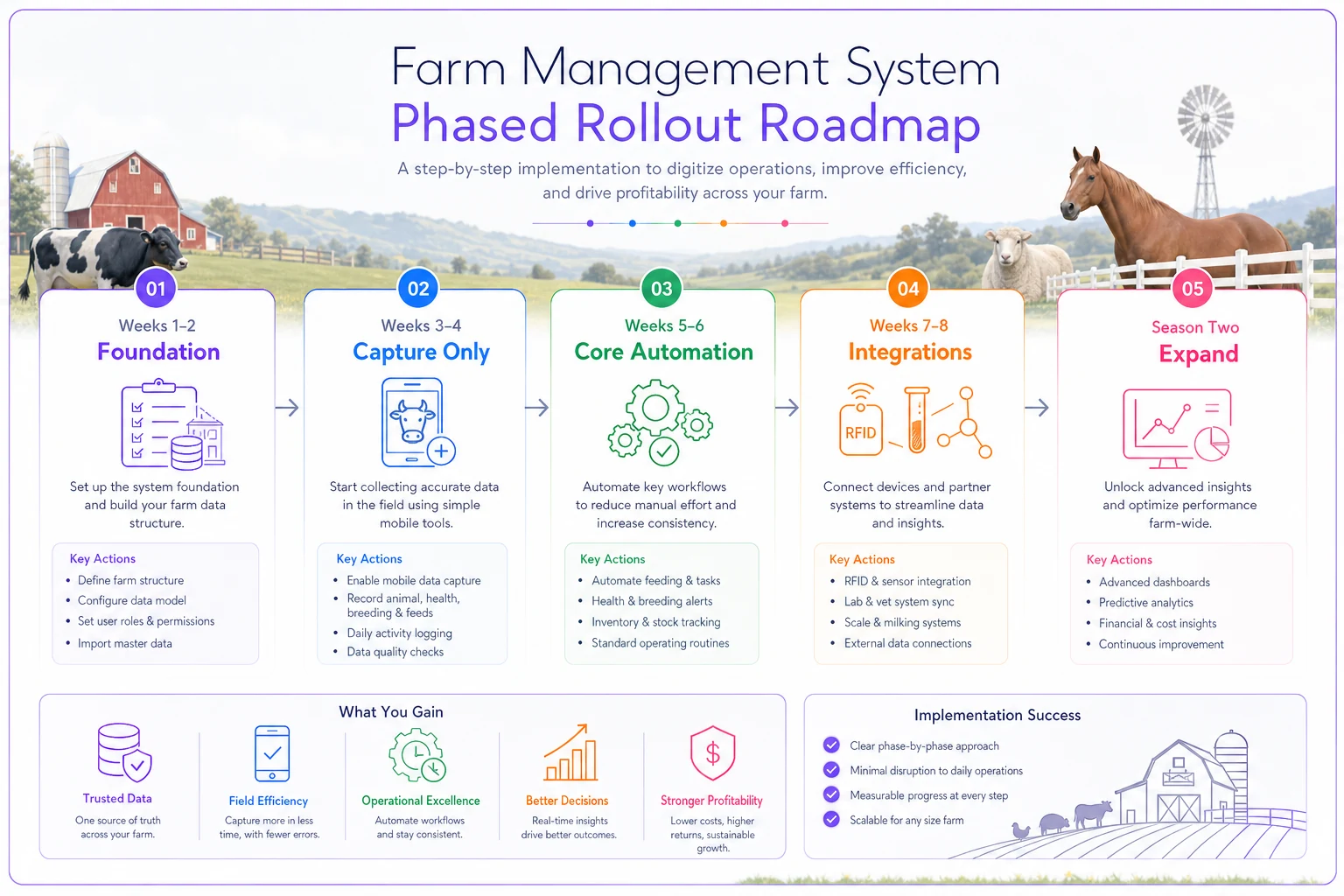
The sequence below is deliberate. Each phase only works if the one before it is stable.
-
Weeks 1–2 — Foundation. Load the data model, import animals with clean internal IDs, enter per-species product and withdrawal data. Don't rush this; everything downstream depends on it.
-
Weeks 3–4 — Capture only. Get handlers logging health events on mobile, offline-first, with no automation live yet. The only goal is confirming capture is fast enough that people actually do it in the yards.
-
Weeks 5–6 — Core automation. Switch on the withdrawal guard and vaccination due windows. Nothing else.
-
Weeks 7–8 — Integrations. Wire in RFID reads and the lab submission workflow once capture habits are solid.
-
Season two — Expand. Add remaining alert rules, exports, and dashboards based on what the first season actually exposed as gaps.
This visual shows the phased rollout as a clear sequence from foundation to expansion.
The farms that succeed treat rollout as a sequence of habits, not a software install. Capture discipline comes first; automation and reporting only earn their place once the data underneath them is trustworthy. Get the data model and the per-species withdrawal logic right at the start, and the rest of the system becomes genuinely useful instead of just another place your records go to get lost.
The farms that succeed treat rollout as a sequence of habits, not a software install. Capture discipline comes first; automation and reporting only earn their place once the data underneath them is trustworthy. Get the data model and the per-species withdrawal logic right at the start, and the rest of the system becomes genuinely useful instead of just another place your records go to get lost.
Ready to optimize your farm management?
Join hundreds of farmers using Barnyly to save time, improve animal health, and increase farm productivity.