

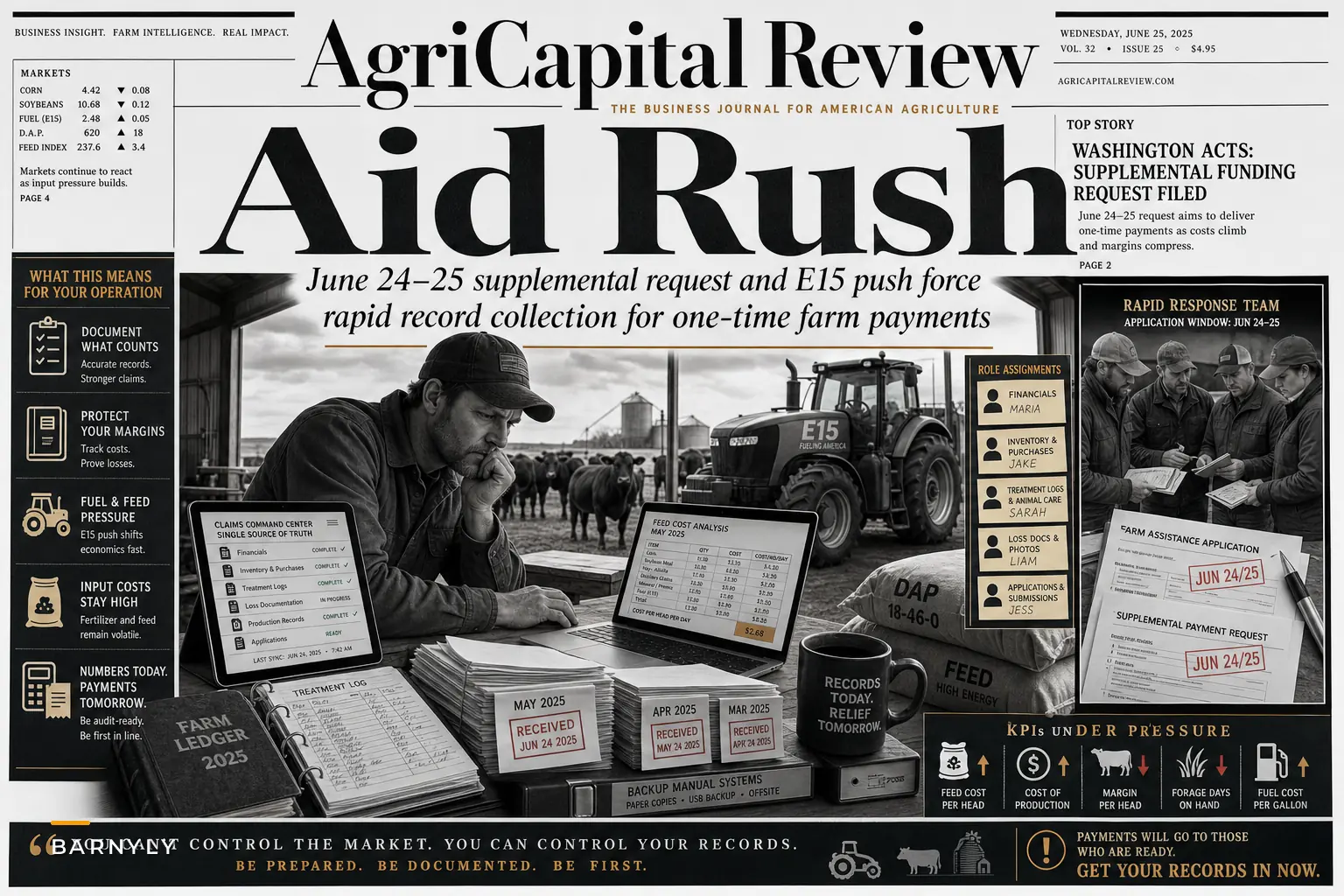

Last week's federal supplemental funding request from the White House includes roughly $11.1 billion earmarked for temporary assistance to agricultural producers. The official request to Congress specifically targets "sharply higher input costs" from fuel and fertilizer, plus localized storm damage recovery. There's also a push to codify year-round E15 ethanol sales, which could reshape fuel supply chains before harvest season.
For livestock operations, this isn't just about potential cash infusions. The real operational headache starts with proving eligibility, documenting losses, and adjusting budgets while input prices keep moving. Most farms discover their record-keeping gaps at exactly the wrong moment—when federal programs open applications with a two-week deadline and a stack of required documentation.
The bigger issue extends well beyond any single aid package. Feed costs jumped 23% last quarter according to regional co-ops, diesel sits around $4.12/gallon in most rural markets, and nitrogen fertilizer trades at levels that make pasture management budgets obsolete before the ink dries. When federal assistance becomes available, operations with solid baseline records capture significantly more in payments than neighbors scrambling to reconstruct purchase histories from crumpled receipts.
Documentation gaps that cost operations federal assistance eligibility
Federal farm programs follow strict documentation requirements that catch unprepared operations off-guard. The 2019 Market Facilitation Program rejected roughly 18% of initial livestock applications due to incomplete production records. The 2022 Emergency Relief Program had similar rejection rates, mostly from operations unable to prove baseline production levels or document input cost increases.
The pattern repeats because livestock operations treat record-keeping as compliance work rather than operational intelligence. A 500-head cow-calf operation in Nebraska lost out on approximately $42,000 in potential assistance because they couldn't document feed purchases from the prior year. Their nutritionist had the ration formulas, their accountant had total expenses, but nobody had itemized tonnage records linking specific feed deliveries to cattle groups.
What makes this worse is that most rejected applications had the data somewhere. Feed invoices existed in email folders. Scale tickets sat in truck gloveboxes. Production records lived in spiral notebooks. The information was there—it just wasn't organized for rapid retrieval when USDA opened a 14-day application window.
The operational reality gets messier when multiple enterprises run through the same farm. A diversified operation running cattle, row crops, and a small sheep flock needs separated cost accounting for each enterprise. Federal programs calculate assistance based on specific commodity losses, not whole-farm impacts. Mixed operations using shared equipment, labor, and facilities struggle to allocate costs accurately when applications demand enterprise-specific documentation.
Critical records to maintain for volatile input environments
Input cost volatility requires more granular tracking than traditional annual budgets capture. Most operations track feed costs monthly at best, but when corn futures swing 40 cents per bushel in three weeks, monthly averages hide the actual cost impacts on specific animal groups.
Simplify farm operations and enhance animal care.
Barnyly helps you organize, track, and manage every aspect of your farm operations seamlessly.
- Comprehensive livestock tracking
- Automated health alerts
- Feed and resource scheduling
No credit card required
-
Delivery dates and actual tonnage received
-
Price per ton or bushel at delivery
-
Which animal groups consumed each load
-
Storage location if using multiple facilities
-
Any quality adjustments or dockage
Fuel and equipment costs need similar precision. Track diesel purchases by date, gallons, price per gallon, and primary use (feeding, fieldwork, hauling). When federal programs calculate increased operating costs, they want documentation showing price changes over time—not just total annual fuel expenses.
Labor documentation matters more than most operations realize. Federal assistance calculations often include increased labor costs, but only with proper records. Track regular hours, overtime, seasonal workers, and any wage adjustments. Include non-monetary compensation like housing or beef shares that might qualify for cost basis adjustments.
For pasture-based operations, document stocking rates, rotation schedules, and any purchased forage or emergency feed. The USDA's June livestock outlook highlights regional drought impacts on grazing capacity. Operations that maintained detailed grazing records from normal years can better document reduced carrying capacity and the additional feed requirements that followed.
Medical and health management expenses deserve separate tracking beyond general herd health protocols. Individual treatment records, vaccination costs by group, pregnancy testing services, and veterinary consultations all factor into production cost calculations. Keep invoices that show both service dates and specific animal groups treated.
KPIs that actually predict margin compression
Traditional livestock KPIs like average daily gain and conception rates matter, but they don't capture the full picture during input volatility. The operations that navigate price swings successfully track leading indicators that predict margin compression before it hits the bottom line.
Feed conversion efficiency needs monitoring at shorter intervals. Instead of calculating feed-to-gain ratios quarterly, track them every 21 days for growing animals. A 0.2-point degradation in feed conversion at current prices adds roughly $18 per head in finishing costs. Catching it early allows ration adjustments before the full impact flows through.
Cost per pound of gain provides more actionable intelligence than simple feed costs. Calculate this weekly using actual delivered feed prices, not contract averages. Include all direct costs: feed, medical, labor, utilities, and allocated overhead. When this metric climbs above your historical 75th percentile, margin compression is coming—and operational adjustments need to happen now, not next month.
Death loss and morbidity percentages need age-specific tracking. A 2% death loss in newly received calves has different financial implications than 2% mortality in bred cows. Track these separately with associated treatment costs. Federal disaster programs often use historical mortality data as baselines, so maintaining multi-year records by animal class strengthens future applications.
Breakeven prices deserve constant recalculation. Most operations set breakevens annually and hope for the best. During volatile periods, recalculate monthly using actual input costs and forward production estimates. Include explicit calculations for different marketing endpoints—selling calves at weaning versus retaining ownership through finishing requires different breakeven models.
Cash flow timing becomes critical when margins compress. Track days inventory outstanding for all major inputs. How many days of feed inventory do you carry? What's your average payment period for purchased inputs? When receivables from livestock sales stretch beyond historical norms, it signals working capital pressure before bank statements show problems.
Building budgets that flex with extreme price movements
Static annual budgets fail during volatile periods. Operations managing current conditions successfully use rolling forecasts that update as prices change. This doesn't mean constant budget revisions—it means building flexibility into the original framework.
Create procurement triggers based on price thresholds rather than calendar dates. Instead of "buy winter feed in September," establish rules like "lock in hay contracts when prices drop below $180/ton or by August 15, whichever comes first." This requires monitoring local and regional markets consistently, but it prevents panic buying during shortage periods.
Create procurement triggers based on price thresholds rather than calendar dates.
Separate your budget into committed and flexible components. Committed costs include loan payments, insurance, base labor, and contracted inputs. Flexible components cover discretionary purchases, optional treatments, and timing-flexible activities. When margins compress, you know exactly which expenses can adjust without threatening core operations.
Build scenarios for 20% and 40% swings in major input categories. If diesel hits $5.50/gallon, which activities get postponed? If feed costs jump another 30%, what's the culling strategy? Having these scenarios pre-planned prevents emotional decision-making under pressure.
The budgeting process should connect directly to operational triggers. When feed costs exceed certain thresholds, specific protocols activate: accelerate culling of marginal producers, adjust rations to include more economical ingredients, or shift marketing timelines to avoid additional feeding periods. Not suggestions—automatic responses built into management systems.
Working capital reserves need explicit targets based on operational scale. A 200-head operation might need somewhere around $40,000 in accessible reserves to weather 90-day input spikes. Calculate your specific needs based on monthly cash burn rates during peak expense periods. Federal assistance helps, but applications and payments take months while bills arrive weekly.
Converting operational chaos into assistance-ready documentation
The scramble during assistance program announcements reveals how scattered most farm records really are. Converting operational data into application-ready documentation requires systematic organization before programs open—not during them.
Establish a single source of truth for each record category. Production records might live in management software, but designate one system as authoritative. When multiple people maintain different spreadsheets with conflicting numbers, applications get delayed or rejected.
Here's a simple workflow to organize records and responses when assistance windows open.
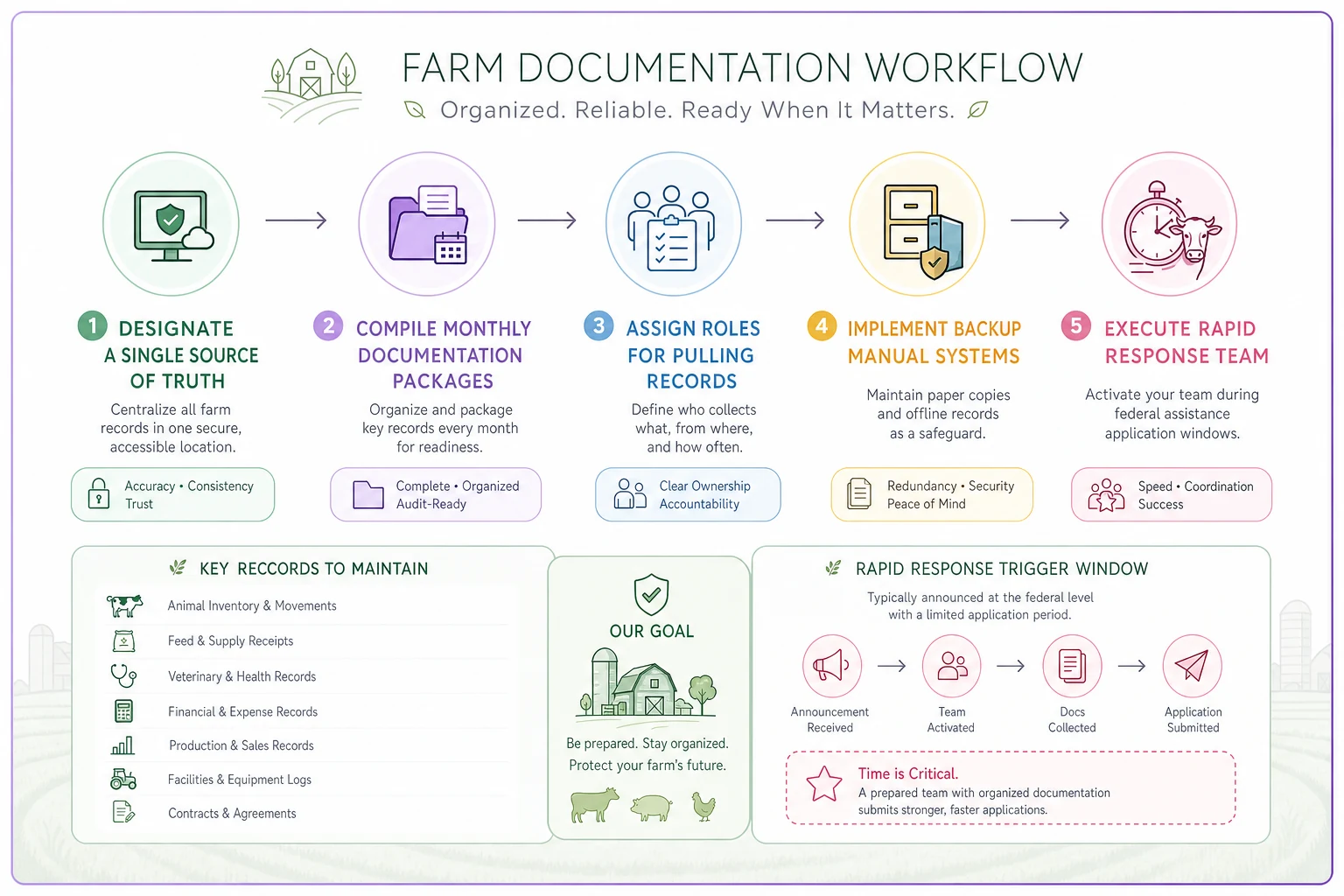
Use this as a checklist graphic for staff training so everyone understands their role in the workflow.
Create monthly documentation packages that compile key records. Include:
-
Inventory counts by animal class
-
Feed delivery summaries with tonnage and costs
-
Fuel purchase logs with gallons and prices
-
Health treatment records with medication costs
-
Sales records with weights and prices
-
Death loss reports with causes
These monthly packages become building blocks for any assistance application. When programs announce, you're assembling existing packages instead of hunting through files. Store both digital copies and organized paper backups—rural internet failures during application deadlines happen more often than people expect.
Standardize how different team members record information. The feed truck driver, the veterinarian, and the office manager all generate critical documentation. Without standard formats, combining their inputs creates reconciliation nightmares. Simple templates for common transactions prevent this kind of fragmentation.
Purchase and implement backup documentation systems. When the loadout scale computer crashes during harvest, handwritten weight tickets become federal documentation. Keep carbon-copy ticket books, backup calculators, and manual record sheets accessible. Train multiple people on backup procedures before failures occur.
Practical preparation checklist for current federal programs
The current federal request signals both opportunity and urgency for documentation preparation. According to Farm Policy News analysis, the package could provide $400–$900 per beef cow and proportional assistance for other livestock based on documented losses and increased input costs.
| Potential assistance range |
|---|
| $400–$900 per beef cow and proportional assistance for other livestock based on documented losses and increased input costs. |
Start with baseline establishment:
-
Calculate 3-year average production metrics (pounds weaned, death loss, conception rates)
-
Document 3-year average input costs by category
-
Compile current year actual costs with supporting invoices
-
Prepare enterprise allocation worksheets showing cost splits
-
Organize weather event documentation if applicable
Next, prepare required ownership and operation documents:
-
FSA farm number and associated tract numbers
-
Entity organization documents (partnership agreements, LLC papers)
-
Power of attorney forms if someone else will submit applications
-
Banking information for direct deposit setup
-
Tax ID numbers for all entities involved
For operations that haven't participated in federal programs recently, allow extra time for FSA office visits. Establishing initial records and farm numbers takes 2–3 weeks during busy periods. Don't wait until applications open.
Create a rapid response team with assigned roles. Designate who pulls production records, who compiles financial documentation, and who handles submission. Include backup assignments for each role. When application windows open at 8 AM on a Monday with a Friday deadline, role clarity prevents things from slipping through the cracks.
Protecting margins beyond government assistance
Federal assistance provides temporary relief, but sustainable operations need systematic approaches to input volatility. The farms weathering current conditions without desperate federal program dependence share common characteristics: diversified revenue streams, flexible production systems, and enough operational intelligence to make fast pivots when needed.
This connects directly to why a practical farm data strategy turns livestock records into predictable KPIs. Operations using integrated software platforms that centralize production, financial, and compliance records react faster to market signals. When feed prices spike, they know within days which animal groups are generating negative margins. When assistance programs open, they export required documentation in hours, not weeks.
The most resilient operations treat volatility as normal rather than exceptional. They maintain relationships with multiple input suppliers, carry strategic reserves of critical supplies, and adjust production intensity based on margin projections rather than chasing maximum output. Their record-keeping systems support both daily decision-making and emergency documentation needs simultaneously.
Some operations have found that AI-powered operational software removes the traditional tradeoff between detailed record-keeping and time. Automated data capture from scales, RFID readers, and GPS systems creates documentation without additional labor. Pattern recognition surfaces margin compression before monthly statements arrive. When federal programs require multi-year production histories, the data exists in queryable formats rather than filing cabinets.
The documentation reality check
Current market volatility and federal assistance discussions expose a harsh reality: most livestock operations can't quickly produce the documentation that protects their financial interests. The gap between operational knowledge ("we know our costs increased") and documented proof ("here's timestamped evidence of price changes") costs tens of thousands in missed assistance and poor margin management.
The immediate priority is capturing June and July input costs with unusual detail. Every feed delivery, fuel purchase, and medical treatment needs documentation that includes dates, quantities, prices, and allocation to specific production units. These records form the baseline for any federal assistance calculations and provide the intelligence needed for margin management through the rest of 2026.
Beyond current programs, systematic documentation prepares operations for future volatility. Farms that captured detailed records during 2019–2022 market disruptions navigated subsequent programs more successfully. They had established baselines, proven record-keeping systems, and staff who already knew the protocols.
Start building these systems now, while there's still time to establish baselines and train staff. Federal assistance helps, but operational discipline determines long-term survival in volatile markets.
Start building these systems now, while there's still time to establish baselines and train staff. Federal assistance helps, but operational discipline determines long-term survival in volatile markets.
Ready to optimize your farm management?
Join hundreds of farmers using Barnyly to save time, improve animal health, and increase farm productivity.