

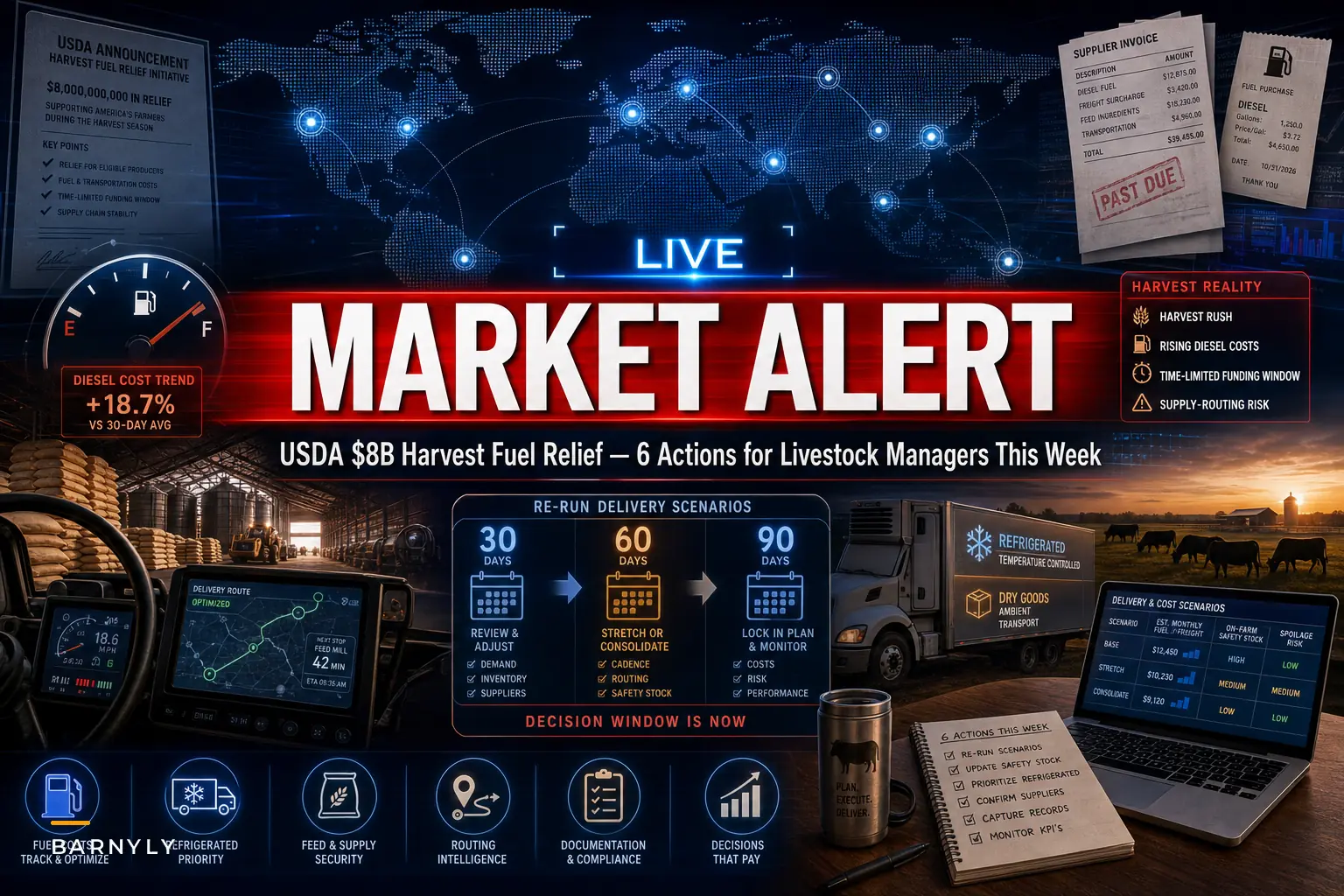

The $8 billion "Harvest Fuel Relief" program that USDA announced on October 19 landed in the middle of the worst possible timing for most livestock operations — peak harvest, peak diesel burn, peak transport demand. On paper it's good news. A one‑time payment to offset diesel costs is real money.
But the detail that actually matters isn't the dollar figure. It's the timing. Reuters reported that the aid is expected to arrive after the election, which means you're burning expensive diesel now and getting reimbursed later. That gap — between when you spend and when you're made whole — is where most of the real operational decisions sit.
So skip the press‑release summary. The useful question is: given that the money is coming but not yet here, what should you actually change about procurement, routing, and record‑keeping in the next seven days?
The underlying problem the relief payment quietly exposes
A one‑time payment designed to offset a variable cost tends to hide a structural weakness in how farms handle fuel‑dependent inputs.
The pattern is familiar. When diesel spikes, most operations react by cutting delivery frequency — fewer feed runs, consolidated vet supply pickups, delayed medicine orders until the truck "has a reason to come out." That saves fuel. It also quietly increases three other risks:
-
- Stockout risk on time‑sensitive inputs (vaccines, refrigerated meds, specific feed rations by life stage)
-
- Cold‑chain risk when you batch refrigerated shipments to save a trip
-
- Cashflow lumpiness when you front‑load large feed purchases to lock in delivery windows
The relief payment softens the diesel line. It does nothing for those second‑order effects. And because the money arrives later, front‑loading purchases on the assumption of reimbursement is exactly the kind of decision that feels smart in October and hurts in December if eligibility or timing shifts.
What the program actually does is give you a reason to re‑run your 30–90 day input scenarios now, while fuel is still the dominant cost pressure. That's the real opportunity — not the check itself.
Action 1: Re‑run your 30/60/90 day delivery scenarios before you change any orders
Before touching procurement, map what your current delivery schedule actually costs versus what it protects.
Simplify farm operations and enhance animal care.
Barnyly helps you organize, track, and manage every aspect of your farm operations seamlessly.
- Comprehensive livestock tracking
- Automated health alerts
- Feed and resource scheduling
No credit card required
Most operations never separate these two things. A weekly feed delivery isn't just a fuel cost — it's a safety‑stock strategy you've been running without calling it that. Stretch to biweekly and you're trading diesel savings for larger on‑farm inventory and more spoilage exposure.
A simple way to lay this out:
| Scenario | Delivery cadence | Est. monthly fuel/freight | On‑farm safety stock needed | Spoilage / excursion risk |
|---|---|---|---|---|
| Current | Weekly | Baseline | ~7–10 days | Low |
| Stretch A | Every 10 days | ~15–20% lower | ~14 days | Medium |
| Stretch B | Biweekly | ~25–30% lower | ~18–21 days | Medium‑High |
| Consolidated refrigerated | Biweekly cold items | Varies | Larger fridge load | High if cold‑chain thin |
Here’s a quick visualization of the decision workflow.
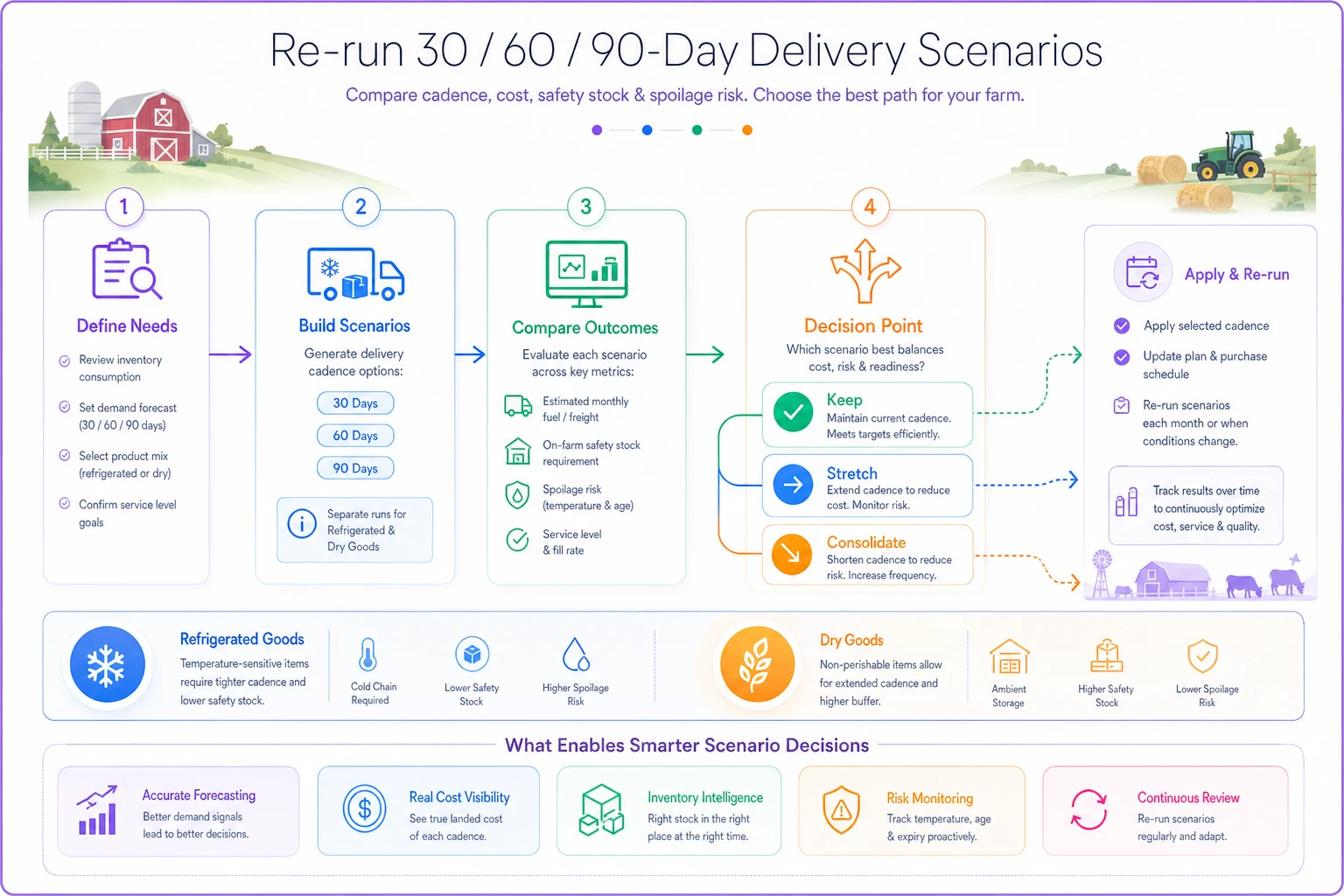
The point isn't to pick the cheapest row. "Cheaper" on fuel almost always moves risk somewhere else on your balance sheet. For a cow‑calf operation running tight on freezer and refrigeration capacity, Stretch B can quietly cost more in wasted vaccine than it saves in diesel.
Action 2: Separate your inputs into "fuel‑flexible" and "fuel‑rigid"
Not every input should get the same treatment when you adjust delivery frequency. Applying one delivery strategy across everything is where most farms make the costliest mistake.
Fuel‑flexible — can tolerate longer intervals and larger on‑farm storage:
-
Bulk feed and forage (if storage and spoilage allow)
-
Non‑perishable supplies
-
Mineral and supplement stock
Fuel‑rigid — tied to cold‑chain, shelf life, or unpredictable demand:
-
Vaccines and refrigerated medications
-
Short‑dated biologics
-
Emergency vet supplies you can't predict
Batch flexible dry goods but schedule dedicated runs for refrigerated meds to avoid hidden spoilage costs.
The rule that works in practice: batch the flexible, protect the rigid. Consolidate feed and dry‑goods runs to capture diesel savings. Keep vaccine and refrigerated med deliveries on their own cadence even if it costs more per trip. The math almost always favors this. A single spoiled vaccine batch can wipe out weeks of fuel savings, and you rarely get a warning before it happens.
Action 3: Lock in supplier delivery windows while you have leverage
The relief announcement changed supplier behavior too. Suppliers know farms are about to re‑examine order patterns, which makes this a decent window to renegotiate or at least confirm delivery terms.
What to confirm this week:
-
Guaranteed delivery windows for the next 60–90 days, in writing
-
Whether consolidated orders get freight concessions
-
Cold‑chain handling terms for refrigerated meds (who owns the risk in transit)
-
Minimum order thresholds that might trap you into over‑ordering
The trap looks like this in practice: a supplier offers "free delivery over $X," so you push your order above the threshold to save on freight. You've now tied up cash in inventory to save a freight charge the relief payment was supposed to cover anyway. Run the actual numbers before you chase a free‑delivery threshold.
Action 4: Capture the records that qualify you for the payment — now, not later
This is the part that bites people. One‑time programs almost always require documentation that's annoying to reconstruct after the fact. The Reuters reporting on the program's launch and intent made clear that eligibility and disbursement details were still settling even as the announcement went out — which means the smart move is to over‑document now and sort out what's actually needed later.
A practical capture checklist to start this week:
-
- [ ] Diesel purchase receipts with dates, gallons, and price per gallon
-
- [ ] Fuel use tied to operations (field, transport, equipment) where you track it
-
- [ ] Delivery and freight invoices for feed and supplies
-
- [ ] Acreage and production records that typically drive eligibility formulas
-
- [ ] Any existing enrollment info with USDA programs you already participate in
-
- [ ] A running log of refrigerated shipment costs, since those are fuel‑driven too
The operations that struggle with these programs aren't the ones missing paperwork — they're the ones with paperwork scattered across a glovebox, three email threads, and a notebook in the feed shed. If your fuel and delivery records already live in one place, this is a non‑event. If they don't, this program is a decent forcing function to fix that.
Action 5: Re‑prioritize routing for refrigerated and vet shipments
When fuel is expensive and you're consolidating trips, refrigerated and vet shipments quietly get deprioritized — folded into whatever run is already happening. That's backwards.
The correct priority order under fuel pressure:
-
1. Time‑ and temperature‑critical items first (vaccines, refrigerated meds) — these get their own protected cadence
-
2. Health‑critical, non‑refrigerated (treatment meds in active use)
-
3. Feed by immediate life‑stage need (neonatal, lactating, finishing animals that can't wait)
-
4. Everything flexible — batch and consolidate freely
The failure mode here is subtle. A farm consolidates a vaccine delivery into a biweekly feed run to save a trip. The refrigerated items ride too long in a warm truck bed. Nobody logs the excursion. Three weeks later you're dealing with vaccine failures you can't trace. The fuel savings on that one trip were maybe $40. The downstream cost is measured in re‑vaccination labor, product loss, and compromised herd protection.
Action 6: Set temporary safety‑stock triggers tied to the reimbursement gap
Because the money arrives later, your safety stock for the next 60–90 days should reflect the cashflow gap, not just normal lead times.
Tighten reorder triggers on fuel‑rigid items specifically. If a vaccine normally reorders at a 10‑day buffer, consider 14 during this window — because the real risk right now isn't price, it's the chance that a consolidated delivery schedule leaves you short at the wrong moment. This is temporary. Once deliveries stabilize and the payment lands, you can relax back.
If you want the fuller playbook on the inventory and routing side — the one that applies whether the pressure comes from relief‑program timing or an actual supply shock — the breakdown in our piece on immediate inventory and routing actions when diesel supply tightens covers the triggers and sequencing in more depth. The mechanics are the same; only the trigger changed.
A real scenario: a mixed‑species operation re‑running the numbers
A mid‑size operation running roughly 220 head of cattle plus a small sheep flock was on weekly feed deliveries and a batched, roughly biweekly pickup for vet and refrigerated supplies going into harvest.
When fuel climbed, the first instinct was the usual one: stretch everything to biweekly and ride out the season. On paper that looked like somewhere between $600 and $900 a month in freight and fuel savings.
When they actually split inputs into flexible versus rigid and re‑ran the scenario, the picture changed. The feed consolidation held up fine — storage could handle it, spoilage stayed low. But the batched refrigerated schedule had already cost them one partial vaccine loss earlier in the year that nobody had connected to the delivery change. Re‑pricing that single loss against the "savings" showed the consolidated cold‑chain run was roughly break‑even at best, and worse once you counted re‑handling labor.
The adjustment was unglamorous: keep the feed consolidation, pull refrigerated deliveries back onto their own tighter cadence, and start logging every fuel and delivery receipt in one place for the relief application. Most of the diesel savings preserved, the vaccine risk closed, and the paperwork handled as a byproduct rather than a scramble.
When consolidating deliveries is the right call — and when it isn't
It makes sense when:
-
You have real on‑farm storage and spoilage headroom
-
The inputs are genuinely fuel‑flexible
-
Your cold‑chain capacity isn't already stretched
It's a bad idea when:
-
You're batching refrigerated or short‑dated items to save a trip
-
Your refrigeration is near capacity and you'd be forcing larger loads
-
You can't actually log temperature and excursion events on longer transit
Who should probably not touch delivery frequency at all: small operations running thin refrigeration and no spare storage. For them, the diesel savings from consolidation are small, and the stockout or spoilage exposure is disproportionately large. Better to document fuel costs cleanly for the relief payment and leave the schedule alone.
Where record‑keeping quietly decides whether this helps you
The farms that get the most out of a program like this aren't necessarily the ones with the biggest diesel bills. They're the ones who can produce clean, organized records on demand — fuel purchases, delivery invoices, production data — without spending a weekend reconstructing them.
That's the unglamorous operational edge. When fuel, feed, and delivery records already live in one connected place rather than scattered across receipts and notebooks, re‑running delivery scenarios takes an afternoon instead of a week, and qualifying for programs like this becomes a matter of exporting what you already have. Operations that had already centralized this kind of record‑keeping before the announcement are treating this program as a straightforward reimbursement — not a documentation fire drill. AI-powered operational software makes that kind of centralization practical for farms that aren't running a dedicated admin team, automatically capturing fuel, delivery, and invoice data in one place so the records exist when you need them.
Bottom line for this week
The relief payment is a reason to act, not a reason to relax. The money softens the diesel line, but it arrives on a delay, and it does nothing about the cold‑chain, stockout, and spoilage risks that fuel‑pressure decisions create. Run your 30/60/90 scenarios, split your inputs into flexible and rigid, protect your refrigerated cadence even when it costs more per trip, lock in supplier windows while you have leverage, and start capturing records now. Do those six things this week and the payment, whenever it lands, becomes a clean win instead of a complicated one.
Ready to optimize your farm management?
Join hundreds of farmers using Barnyly to save time, improve animal health, and increase farm productivity.