
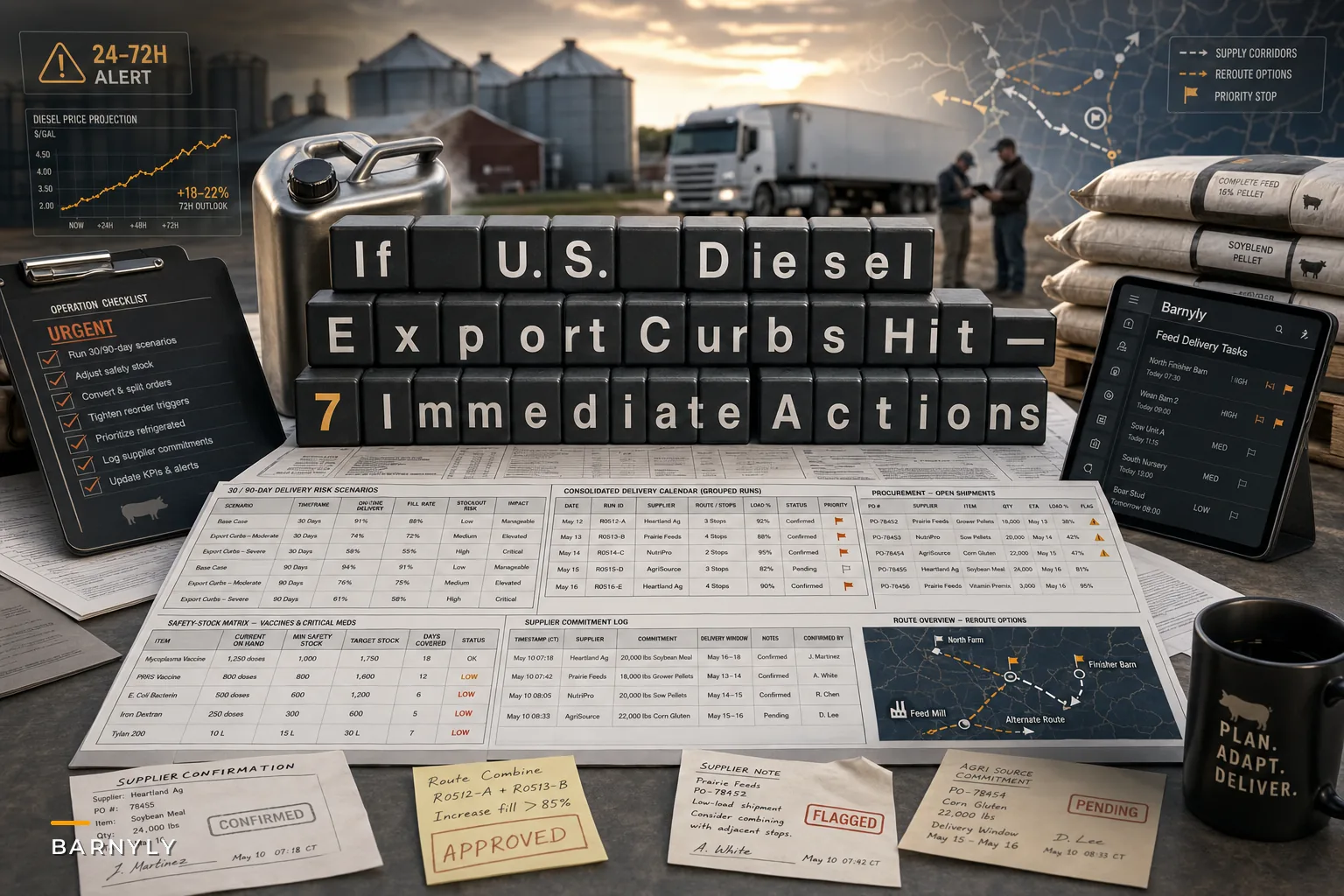

Right now there's enough noise around U.S. diesel policy to make any operation that moves a lot of freight nervous. Reuters reported the administration is still considering a temporary diesel export ban, and even the talk of it has widened the discount on U.S. crude futures as traders reprice supply. Whether or not a formal curb actually lands, the market is already twitchy — and that's what hits your operation first.
You don't get hurt by the policy announcement. You get hurt by the two-week window where your feed hauler quietly adds a fuel surcharge, your vet supplier pushes a refrigerated delivery from Tuesday to Friday, and the propane guy starts asking for larger minimum orders to justify the run. None of those are dramatic. They just stack, and if you're not watching inventory closely, you find out when a bulk bin runs low on a Sunday.
This isn't a "stock up on everything" post. Panic-buying diesel and feed is how you end up with cash tied up in a tank and spoiled product in a vaccine fridge. This is about running a few specific checks and decisions this week, in order, so you're positioned no matter which way prices and deliveries move.
First, understand what actually breaks on a livestock operation
Diesel isn't one line item for you. It's embedded in at least four separate things, and they fail in different ways on different timelines.
-
On-farm fuel for tractors, mixers, generators, and skid steers. This is the one most people think of first — and honestly it's the least fragile short-term, because you can ration your own usage.
-
Inbound feed and fertilizer freight, where fuel surcharges show up fast and delivery windows get less flexible.
-
Refrigerated transport for vaccines and medicines, which is the quietest failure point and the most expensive when it goes wrong.
-
Outbound livestock transport to sale barns, processors, or other sites, where a missed slot can cost you weight, premiums, or an entire marketing window.
The mistake is treating a diesel shock like a single problem with a single answer. In real operations, the refrigerated vaccine delivery and the feed truck have almost nothing in common except the fuel in the tank. One is a cold-chain integrity risk. The other is a cost and scheduling risk. They need to be managed differently.
A CNBC analysis of the potential ban noted that fuel price effects can move within days, not months. That speed is the actual operational problem. You're not planning for a slow-building trend — you're planning for a possible step-change you might get 48 hours of warning on.
The 7 actions, in the order you should run them
Do these roughly in sequence. The early ones inform the later ones, so skipping around wastes effort.
Simplify farm operations and enhance animal care.
Barnyly helps you organize, track, and manage every aspect of your farm operations seamlessly.
- Comprehensive livestock tracking
- Automated health alerts
- Feed and resource scheduling
No credit card required
1. Pull a true "days of cover" number on every critical input
Not dollar value. Not last month's usage. Actual days of cover at current consumption, per item, for the things that stop your operation if they run out.
That short list usually looks like:
-
Bulk feed and specific supplements by life stage
-
On-farm diesel and propane
-
Any vaccine or medicine with an active treatment protocol running
-
Mineral and anything you can't substitute quickly
Walk the bins and tanks and write the real number. A typical example: you think you've got "about two weeks" of starter feed, but when you actually gauge the bin and divide by daily draw, it's nine days. That four-day gap is exactly the difference between calmly reordering and paying a rush surcharge.
Operations consistently trust their mental estimate of inventory, and it's off by 20–40% on the items that move fastest. Under normal conditions that's survivable. During a supply shock it's the thing that bites.
2. Rank inputs by "pain if it runs out" — not by cost
Once you've got days of cover, sort everything into a simple grid. The two axes that matter are how hard the item is to replace and how bad it is if you run short.
| Input | Replaceability | Consequence of stockout | Priority |
|---|---|---|---|
| Active treatment meds / vaccines mid-protocol | Low | High — animal health, protocol restart | Protect first |
| Bulk feed for young stock | Medium | High — growth setback, welfare | Protect first |
| On-farm diesel | Medium | High — everything stops | Protect first |
| Mineral / supplements | Medium | Medium — degrades over weeks | Second tier |
| Routine / shelf-stable meds | High | Low | Monitor only |
| Fertilizer (off-season) | High | Low short-term | Defer |
Your most expensive inputs are usually not your most urgent ones. Fertilizer might be a big invoice, but if you're not spreading for weeks it can wait. A half-finished vaccination protocol with a cold-chain product is cheap by comparison and completely unforgiving if the delivery slips. Rank by pain, fund by pain.
3. Lock in cold-chain deliveries before anything else
If a refrigerated delivery is going to be disrupted, you want to know now — and you want it confirmed in writing. Call your vet supplier and distributor and ask two direct questions: are you anticipating any changes to refrigerated delivery windows, and what's your contingency if a reefer run gets cancelled?
The reason this jumps ahead of feed is simple. A late feed truck is a scheduling annoyance. A vaccine that sat on a warm dock because the reefer slot got consolidated is a total loss plus a protocol disruption. You can't ration your way out of spoiled biologics.
Don't pull forward product you can't store correctly.
Practical move: if you've got an active protocol and your supplier sounds uncertain, pull the next delivery forward a few days — if and only if your on-farm cold storage has verified capacity and a backup power plan. Don't pull forward product you can't store correctly. You'll just move the spoilage risk from the truck to your fridge.
4. Get fuel surcharge terms in writing from every freight partner
This is the step almost everyone skips and later regrets. Fuel surcharges during a volatile period get applied inconsistently, and sometimes retroactively. Before the next invoice cycle, ask each hauler:
-
Is there a fuel surcharge, and how is it calculated — flat, percentage, or indexed to a published diesel price?
-
When does it update — weekly, per load, monthly?
-
Is there a cap?
Two haulers can both say "we charge a fuel surcharge" and one is pegged to a transparent regional diesel index that updates weekly while the other sets it at the dispatcher's discretion. In a calm market you never notice the difference. In a spike, that difference can work out to several dollars a head on transport.
Getting the method in writing does two things. It lets you forecast, and it gives you a paper trail if you need to document cost increases for insurance, aid programs, or contract disputes down the road.
5. Consolidate and re-route to cut the number of fuel-dependent trips
If deliveries get scarcer or pricier, each trip has to earn its place. Look at your inbound and outbound schedule and ask where you're running half-loads or redundant runs.
-
List every scheduled delivery and pickup for the next 30 days.
-
Flag any that are below, say, 70% of full load capacity.
-
Group deliveries by supplier and by geography — can two near-dates combine into one run?
-
For outbound livestock, check whether a shared or backhaul arrangement with a neighbor is possible for the same sale window.
-
Rebuild the calendar around fewer, fuller trips.
One mixed cattle-and-sheep operation was running separate feed and mineral deliveries nine days apart from the same distributor. Combining them into a single run and bumping the order size slightly cut a full delivery out of the month. Under a fuel surcharge regime that's not a rounding error — it's one less surcharged trip, every month, for the cost of a phone call.
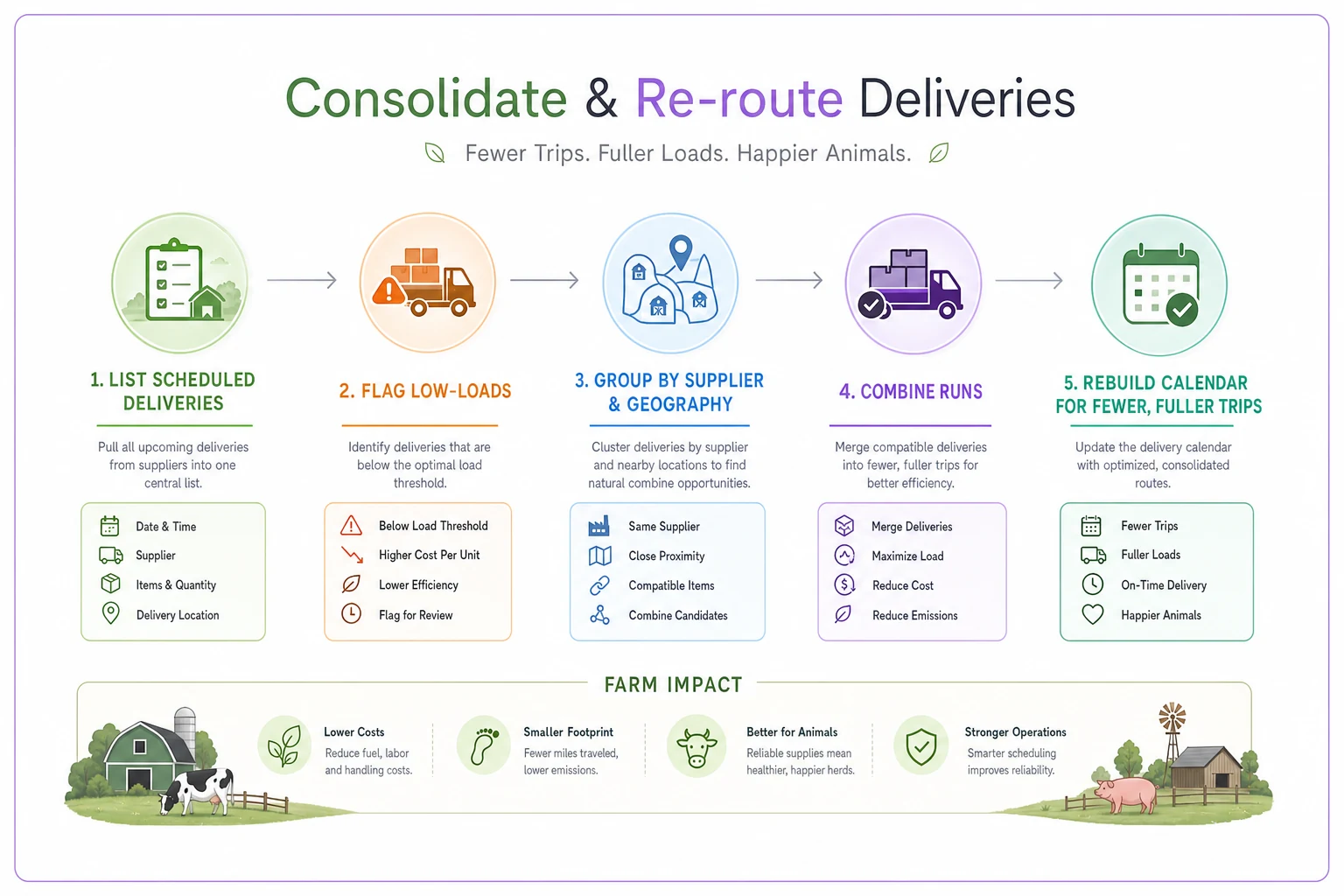
A quick visual of that consolidation workflow can make it easier to spot obvious combines.
6. Reset your safety-stock and reorder triggers for the shock scenario
Your normal reorder points were set for normal lead times. If deliveries might slip by several days, your reorder point needs to move up to absorb that — on the critical items only. Don't widen safety stock across the board. That's how you tie up cash and risk expiry on biologics.
-
Critical, low-replaceability items raise the reorder trigger to cover the longest plausible delivery delay you were quoted in steps 3 and 4.
-
Everything else leave it alone, or even stretch it slightly to free up cash and storage.
This is exactly the kind of situation where reorder automation earns its keep. When thresholds and lead times are tracked per item rather than living in someone's head, you can nudge the critical triggers up without manually babysitting every bin. If you haven't set that up yet, our breakdown on how to prevent stockouts with medicine, vaccine and feed reorder automation walks through the logic of per-item triggers and lead-time buffers — the same framework applies here, you're just temporarily tightening the buffers on your priority-one list.
7. Document every supplier conversation and price change as you go
This last one feels like paperwork, but it's the step that protects your margins after the dust settles. Keep a running log — date, who you spoke to, what they said about delivery and surcharges, and any price quoted.
Why it matters:
-
If a relief or aid program opens up tied to fuel-driven cost increases, you'll need evidence of what you actually paid versus baseline.
-
If a supplier applies a surcharge inconsistently, your own log is your leverage.
-
It turns a chaotic two weeks into a reconstructable record instead of a blur of phone calls.
The operations that come through supply shocks cleanly aren't the ones that bought the most diesel. They're the ones that can tell you, line by line, what changed and when.
A quick real scenario
A roughly 300-head cow-calf operation ran these steps the week diesel talk heated up. On the days-of-cover check, they found their on-farm diesel was lower than assumed — about six days, not the "week and a half" they'd have guessed — and a mineral supplement was closer to running out than any feed. Neither was obvious until they walked the tanks and bins.
They pulled one vaccine delivery forward after confirming fridge capacity, combined two separate distributor runs into one, and got written surcharge terms from their main hauler — indexed, weekly, capped, which was actually reassuring. Nothing dramatic happened. But when the hauler's surcharge did tick up a couple weeks later, they'd already rebuilt the delivery schedule around fewer trips, so the net transport cost barely moved.
The whole thing took maybe half a day of phone calls and bin-gauging. The payoff isn't heroic. It's the absence of a scramble.
When to tighten hard — and when to leave it alone
Not every operation needs to run all seven steps at full intensity.
-
Tighten hard if you've got active treatment protocols with cold-chain products, young stock on feed you can't easily substitute, or a marketing window you can't move.
-
Run the light version if you're between protocols, mostly on pasture, and have flexible sale timing — you still want the days-of-cover check and the surcharge terms, but you don't need to pull deliveries forward or overbuild safety stock.
-
Don't overreact if your storage is already near capacity and your inputs are shelf-stable. Buying ahead into a full barn just converts a price risk into a spoilage-and-cash risk.
The worst move in a shock like this is treating uncertainty as a reason to buy everything. Uncertainty is a reason to know your numbers and move deliberately on the few things that actually hurt when they fail.
Bottom line
A diesel export curb may or may not happen, and the market may settle on its own. Either way, the operations that stay calm this week are the ones that spent an afternoon getting honest days-of-cover numbers, protected their cold chain first, nailed down surcharge terms in writing, and cut a few unnecessary trips out of the calendar. None of that requires predicting policy. It just requires knowing exactly where you stand before the delivery schedule gets squeezed — because the cost of a supply shock almost always lands on the operation that was guessing at its inventory, not the one that could read it off a sheet.
Ready to optimize your farm management?
Join hundreds of farmers using Barnyly to save time, improve animal health, and increase farm productivity.