

Running out of oxytetracycline the morning you're processing 40 head is the kind of mistake that doesn't show up on any report. It just costs you a wasted crew morning, a two-hour drive to the co-op, or an emergency markup at the vet clinic. Nobody logs it. It quietly repeats three or four times a season.
The frustrating part is that stockouts on farm are almost never a supply problem. The distributor had the product. You just didn't know you were low until the box was empty. This is about closing that specific gap — the space between "we're running low" and "someone actually ordered more" — for medicines, vaccines, and feed inputs where timing and expiry both matter.
We're going to cover the actual field structure that makes reorder automation work, why most farm inventory setups collapse within a season, and how to tie reorder triggers to usage instead of guesswork. Narrow topic on purpose. Get this right and you stop the 2 a.m. "we're out" surprises.
Why most farm inventory tracking dies by June
Almost everyone starts with good intentions. A binder, a whiteboard in the med room, a shared spreadsheet with columns for every product. It works in April. By June it's abandoned.
The reason is consistent: the tracking system asks for too much data and gives nothing back. If a worker has to hand-count 30 SKUs every Friday and manually update quantities, they'll skip it the first busy week and never restart. A system that only records what you have — but never tells you what to do about it — is pure overhead.
The second failure is field bloat. People build inventory sheets with 20 columns per product: manufacturer, NDC number, lot, purchase price, supplier phone, storage temp, and so on. Nobody keeps 20 fields current. What you actually need is a small set of fields that drive decisions, and everything else lives on the product label or the invoice where it already exists.
So before automating anything, the real fix is deciding what's worth tracking at all.
The minimal inventory master: fewer fields, better decisions
Every product you stock needs a master record. The trick is keeping it lean enough that it stays accurate. Farm setups that actually maintain their inventory over a full season tend to collapse the master record down to these fields:
Simplify farm operations and enhance animal care.
Barnyly helps you organize, track, and manage every aspect of your farm operations seamlessly.
- Comprehensive livestock tracking
- Automated health alerts
- Feed and resource scheduling
No credit card required
| Field | Why it earns its place |
|---|---|
| Item name + form | "Draxxin 100ml injectable" beats "antibiotic" when three people are ordering |
| Category | Medicine / vaccine / feed additive — drives different reorder rules |
| Unit of use | Doses, mL, or bags — must match how you actually record usage |
| Current on-hand | The one number that has to stay true |
| Reorder point | The trigger level, set per season |
| Reorder quantity | How much to buy when triggered |
| Preferred supplier + lead time | Days from order to arrival |
| Expiry-sensitive (Y/N) | Flags items that need rotation rules |
| Storage location | Med fridge, dry shelf, feed room bin |
Nine fields. Notice what's not there: price history, full supplier contact cards, batch-level cost accounting. Those belong on invoices and packing slips, not in the daily master. Every extra field is one more thing that goes stale and one more reason a busy worker skips the update.
One thing that trips people up consistently: the unit of use must match how usage gets recorded. If you buy antibiotics by the 500ml bottle but treatments are logged in mL, your master needs to think in mL. Otherwise "on-hand: 3" is meaningless — three bottles? three doses? This mismatch is the single most common reason reorder math produces garbage.
Seasonal safety-stock rules, not fixed minimums
Fixed reorder points fail on a livestock operation because your usage isn't flat. Scour treatments spike during calving. Pinkeye products move in summer. Wormers cycle with your parasite calendar. A reorder point that's correct in January will either leave you short in spring or leave you sitting on expired product in the off-season.
The fix is safety stock that shifts by season. You're not recalculating constantly — you're setting two or three seasonal profiles and letting the reorder point move with them.
-
Reorder point = (average daily usage × lead time in days) + safety stock
-
Safety stock scales up in the season where that product gets used hard
-
Safety stock drops near end-of-season for anything expiry-sensitive, so you're not overbuying product you'll toss
A realistic example: say a scour treatment runs about 8 doses a week during calving but nearly zero the rest of the year. Lead time from your supplier is 4 days. During calving you might set the reorder point around 20 doses with a healthy safety buffer, reorder quantity of 30. Come July, you drop that reorder point to near zero so the system stops pushing you to restock something you won't touch until next spring.
The pattern worth internalizing: safety stock protects against the two things you can't control — demand spikes and supplier delays. Set it higher for products where a stockout genuinely stops work (calving-season antibiotics, breeding vaccines) and lower for things you can substitute or delay.
Reorder triggers tied to usage records, not manual counts
This is the part that actually kills the "we're out" surprise. The problem with reorder points based on manual counts is the count is always late — you find out you're below threshold three days after you crossed it.
The better approach: every time a product is used, the usage record decrements the on-hand automatically. You're already recording treatments and vaccinations for compliance and withdrawal tracking. That same record can subtract from inventory. Log a treatment → dose count drops → when on-hand hits the reorder point, a trigger fires.
The workflow, in plain terms:
-
A treatment or vaccination gets logged (animal ID, product, dose)
-
The dose amount is subtracted from that product's on-hand
-
The system compares on-hand against the current seasonal reorder point
-
If on-hand ≤ reorder point, a reorder task is generated with the preferred supplier and reorder quantity pre-filled
-
Someone approves and sends the order — or it routes for approval on higher-cost items
Diagram of the reorder-trigger workflow:
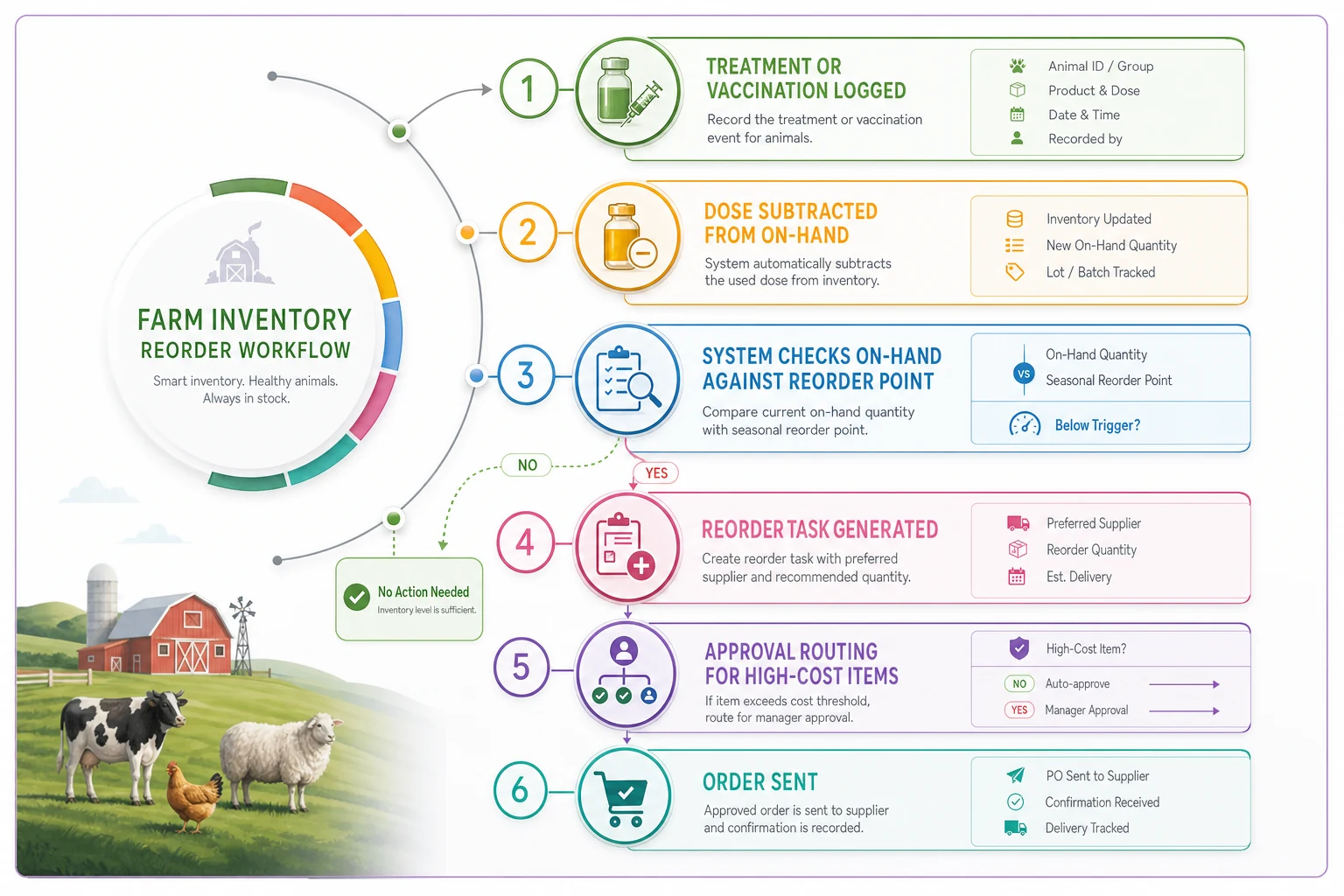
This works because it rides on records you're already keeping. If you've built out proper medication records with withdrawal tracking, the usage data is right there — the reorder trigger is basically free once the logging habit exists. Same entry, two outcomes. That's why the medication logging and withdrawal-compliance work pays off twice.
One caution: automation only fires on logged usage. If your crew pulls doses without recording them, the on-hand number drifts high and the trigger never fires. That's why the cycle count still matters.
Monthly cycle counts: catching the drift before it hurts
No usage-based system stays perfectly accurate. Doses get spilled, someone grabs product for a sick animal at midnight and forgets to log it, a bottle breaks. Small errors accumulate. A monthly cycle count is how you reset reality.
You don't count everything every month — that's how tracking dies. You count in rotation. Split your inventory into groups and count one group each week, so everything gets verified roughly monthly without it ever being a big job.
-
Prioritize by risk count expiry-sensitive and high-value items (vaccines, controlled meds) more often than shelf-stable feed additives
-
Count the same day each cycle — first Monday, or whatever sticks
-
One person counts, one number gets entered — no committee
-
Record the variance, not just the corrected number, so you can see if a product keeps disappearing
-
Investigate anything off by more than a small threshold — a consistent unlogged draw usually points to a workflow gap, not theft
Count expiry-sensitive and high-value items more often than shelf-stable feed additives to reduce the risk of waste or unlogged usage.
Variances aren't just corrections, they're diagnostics. If the same product is short every single month, the issue isn't your count — it's that usage isn't being logged, and your reorder triggers are running blind on that item.
For controlled substances the count is non-negotiable and the standard is tighter — reconciled quantities, documented discrepancies, and a real paper trail. If you're carrying anything on the controlled list, the custody-log workflow for on-farm veterinary controlled substances covers the reconciliation side in far more detail than a general cycle count.
Supplier QA checks: don't automate a bad order
Automating reorders means product shows up without a human thinking hard about it each time. That's the point — and the risk. If you're not checking incoming product, automation just means you receive bad inventory faster.
Every automated order still needs a receiving gate. At minimum, on arrival:
-
Confirm the product matches what was ordered (form, concentration, quantity)
-
Check expiry dating — reject anything with a short window on product you can't use fast enough
-
For cold-chain items, verify the shipment arrived within temperature range before it goes in the fridge
-
Record lot numbers on high-consequence products so you can trace them later
-
Only then update on-hand to reflect received stock
That last point matters: on-hand should increase when product is verified and received, not when the order is placed. Ordered-but-not-arrived is not inventory you can use.
Cold-chain receiving deserves its own discipline. A vaccine that spent six hours warm is worthless even if the box looks fine. The farm cold-chain SOP with placement maps and excursion triage walks through exactly how to check and log that on arrival — which is the step most farms skip when they're rushing to get product into the fridge.
Expiry-rotation rules linked to withdrawal compliance
Two things bite people on the expiry side. First, obvious: expired product is wasted money and a compliance liability if used. Second, less obvious: using the wrong bottle can wreck your withdrawal tracking.
Here's how the second one happens. You've got two bottles of the same antibiotic, different lots. Your records assume you're drawing from lot A. Someone grabs lot B. Now your treatment record points to the wrong lot and expiry date, and if that product is ever recalled or questioned, your traceability is broken.
-
Store product so the soonest-to-expire is front and reachable
-
Log the lot actually used on every treatment, tied to the animal and the withdrawal window
-
Flag any product within a set window of expiry so it gets used, returned, or disposed of before it's wasted
-
Never let a near-expiry bottle sit behind fresh stock
When expiry data lives in the same record as usage and withdrawal, three things line up: you use product before it expires, your withdrawal calculations reference the correct lot, and your reorder timing accounts for what you'll actually be able to use before it goes bad. That last connection is subtle but real — there's no point auto-reordering a vaccine six months before you'll use it if half of it will expire on the shelf.
When this level of automation makes sense — and when it doesn't
Not every operation needs usage-triggered reordering.
This makes sense when:
-
You stock more than a handful of medicines and vaccines
-
More than one person pulls product
-
You've had actual stockouts that cost you working time or forced emergency buys
-
You already log treatments and vaccinations (the usage data exists)
-
You carry expiry-sensitive or cold-chain inventory where waste adds up
This is probably overkill when:
-
You run a small operation with five or six products and one person managing everything
-
Your usage is predictable and low-volume
-
You buy seasonally in bulk and rarely reorder mid-season
Who should not start here: if your crew isn't reliably logging usage yet, fix that first. Reorder automation built on incomplete usage records is worse than a whiteboard, because it gives you false confidence in a number that's quietly wrong.
A real scenario
A cow-calf operation running around 220 head kept a spreadsheet for meds and vaccines that nobody updated past May. Over a typical year they'd hit stockouts on scour and pinkeye products a handful of times each spring and summer — each one meaning an unplanned co-op run or a marked-up emergency purchase from the vet. They were also throwing out roughly $400–$600 in expired product annually, mostly vaccines bought in bulk and never rotated.
They rebuilt around the lean master fields above, tied dose logging to on-hand counts, set two seasonal safety-stock profiles (calving and summer high, off-season low), and added a weekly rotating cycle count. Nothing complicated — reorder tasks landed in the same place they already logged treatments.
The mid-season stockouts effectively stopped. Expired-product waste dropped to almost nothing because the near-expiry flag pushed them to use bottles in order. The owner put the waste savings somewhere in the range of a few hundred dollars a year, plus the harder-to-quantify win of not losing crew mornings to emergency runs. Not a dramatic number on paper — but it was recurring, and the system held because it rode on logging they were already doing.
Bringing it together
The whole point of farm medicines inventory automation isn't a fancier spreadsheet. It's removing the moment where "we're getting low" depends on someone noticing and remembering to act. When usage records drive the counts, seasonal rules move the trigger points with real demand, and expiry rules keep your withdrawal tracking honest, reordering stops being a task someone forgets and becomes something that just happens in the background.
Start narrow. Get the nine master fields right, connect dose logging to on-hand, and run a rotating cycle count so the numbers stay real. Layer in seasonal safety stock and expiry rotation once the basics hold. You don't need to automate everything at once — you just need to stop finding out you're out of product at the worst possible moment.
The whole point of farm medicines inventory automation isn't a fancier spreadsheet. It's removing the moment where "we're getting low" depends on someone noticing and remembering to act. When usage records drive the counts, seasonal rules move the trigger points with real demand, and expiry rules keep your withdrawal tracking honest, reordering stops being a task someone forgets and becomes something that just happens in the background.
Ready to optimize your farm management?
Join hundreds of farmers using Barnyly to save time, improve animal health, and increase farm productivity.