
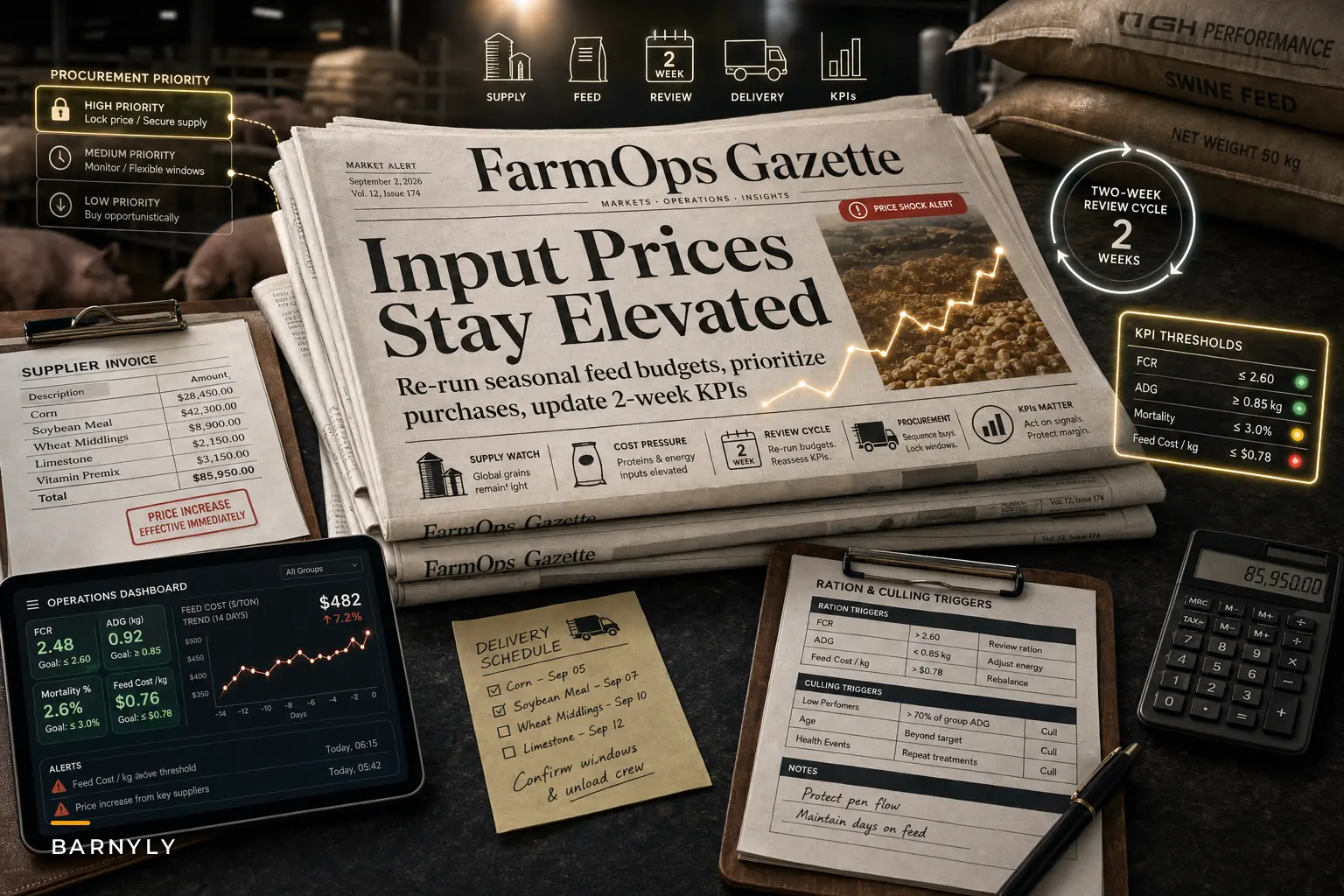

The August manufacturing read wasn't dramatic, but it carried a signal worth paying attention to. Reuters reported that U.S. manufacturing activity slowed in August while prices paid for inputs stayed stubbornly high. For most people that's a footnote. For anyone running livestock heading into fall, it's a heads-up: the mills, fertilizer suppliers, and freight lines sitting upstream of your feed bill are still absorbing elevated costs, and those costs move down the chain right around the time you're locking in winter rations.
The trap isn't the headline number. It's assuming your spring feed budget still holds. It almost certainly doesn't. The operations that get hurt aren't necessarily the ones facing the highest prices — everyone's facing higher prices. They're the ones running on a budget built two or three seasons ago that nobody's looked at since.
So this piece is less about the news and more about the recalibration. What to re-run, which numbers move first, and the short-horizon KPIs that tell you whether your margin is holding or quietly bleeding out.
What Actually Changes When Upstream Costs Stay High
Feed price at the mill is only part of what lands on your invoice. When manufacturing input costs stay elevated, the pressure shows up in three places that don't move at the same speed:
-
Ingredient cost — corn, soybean meal, byproducts, mineral packs
-
Processing and packaging — energy and materials to turn ingredients into feed
-
Freight — diesel, driver availability, delivery scheduling
Most feed budgets miss something here: these three don't peak together. Ingredient prices might soften while freight stays ugly, or the reverse. If your budget treats "feed cost" as a single line item, you can't see which lever is actually squeezing you.
A pattern that comes up in real operations: a manager sees delivered feed cost climb 8% and assumes commodity prices spiked. They start shopping alternative grains. But when you pull the invoice apart, the ingredient cost barely moved — it was delivery fees and a fuel surcharge doing the damage. Shopping grain doesn't fix that. Renegotiating delivery cadence or shifting to bulk pickup does.
Splitting the feed line into components isn't accounting busywork. It's the difference between fixing the right problem and burning a week on the wrong one.
The Budget Assumption That Quietly Breaks First
Most seasonal feed budgets carry a hidden assumption: that intake stays constant across the season. It doesn't. Cold weather pushes maintenance energy requirements up, and animals eat more to hold condition. A budget built on summer intake numbers will understate winter feed volume before you've even factored in price changes.
Simplify farm operations and enhance animal care.
Barnyly helps you organize, track, and manage every aspect of your farm operations seamlessly.
- Comprehensive livestock tracking
- Automated health alerts
- Feed and resource scheduling
No credit card required
So you're dealing with two moving pieces at once — higher cost per unit and higher volume per head. When both drift the same direction, a 6% price increase can turn into a double-digit hit on total winter feed spend. That's the number that surprises people in February, long after the buying decision that caused it.
This is where a life-stage-based budget earns its keep. Late-gestation cows, growing stock, and dry animals respond to cold and cost pressure very differently — lumping them together hides which animals are actually driving your feed bill. If you haven't rebuilt your budget by life stage recently, the intake math and scenario framing are worth working through in detail in our breakdown of seasonal feed budgets by life stage. Short version: you can't protect a margin you can't see, and a single blended feed line hides exactly the animals costing you the most.
Buy-Now vs. Wait: A Decision Framework, Not a Gut Call
Every fall, the same question: lock in feed now or wait for prices to ease? When input costs are elevated and uncertain, most people answer it emotionally — either panic-buying or freezing up.
| Factor | Lean toward buying now | Lean toward waiting |
|---|---|---|
| Storage capacity | You have dry, secure, adequate space | Space is tight or spoilage risk is real |
| Cash position | Comfortable, no near-term crunch | Cash flow is seasonal and thin right now |
| Price trend signal | Upstream costs still rising | Clear softening in ingredient markets |
| Volume needed | Large, predictable winter demand | Small or uncertain herd count |
| Spoilage/shrink risk | Low for your feed type | High — mold, pests, moisture concerns |
The mistake isn't picking wrong. It's treating this as one all-or-nothing decision. In practice, the strongest approach is usually laddering — locking a portion of your winter need now to cap downside, leaving room to buy the rest if prices ease. You're not trying to time the bottom. You're trying to avoid being fully exposed to a spike right before peak intake.
When buying the full winter supply now makes sense: you've got real storage, cash isn't tight, and every credible signal points to costs climbing further. In that specific setup, waiting is just gambling with your margin.
When it's a bad idea: storage is marginal, cash is seasonal, and you'd be committing to volume before finalizing culling decisions. Locking in feed for animals you might not keep is how you end up with paid-for grain and fewer mouths to feed.
The Short-Horizon KPIs That Actually Catch a Bleed
Annual budgets are too slow for a cost environment that moves month to month. What you need through fall and winter is a tight set of KPIs checked on a short cycle — every two weeks, not every quarter. The goal is early warning, not a year-end autopsy.
-
Delivered feed cost per head per day — the cleanest signal of whether your cost structure is holding. Track it by group, not blended across the herd.
-
Feed cost as a share of projected revenue per head — catches the trap where feed cost rises "acceptably" but your output price didn't move with it.
-
Feed conversion or gain-to-feed — if you're feeding for growth, this tells you whether the extra spend is producing gain or just disappearing.
-
Shrink and waste rate — quietly one of the bigger margin leaks when feed is expensive. A 5% waste rate you ignored at cheap prices becomes real money now.
Put the KPI pull on a repeating calendar and assign a short checklist so it's the same person, same day, every two weeks.
The pattern that separates operations that hold margin from ones that don't: the first group treats these numbers as a rhythm. Same day every two weeks, same person pulls them, same quick decision made. The second group only looks when something feels wrong — which means they're always reacting to a problem that's already three weeks old.
Where Culling and Labor Plans Quietly Shift
When feed gets expensive, your cull math changes and most people don't update it. An animal that was marginal-but-worth-keeping at last year's feed cost may now cost more to carry through winter than it'll return. The break-even on marginal producers moves with feed price, and it moves up.
A realistic way to run this: take your lowest-performing group — open cows, slow gainers, aged animals near the edge — and calculate their projected winter feed cost per head at current delivered price, then weigh that against their expected return. When feed was cheap, carrying a few marginal animals barely dented the budget. At elevated cost, that same group can quietly turn into a several-thousand-dollar drag over a single winter.
Labor shifts too, though it's easier to overlook. Tighter margins leave less room for the inefficiency of scattered feeding, poor storage management, or feed-out routines that generate waste. The operations that handle high-cost seasons well tend to consolidate feeding tasks and reduce the number of hands touching the process — not to cut people, but to cut variability. Every extra handoff in a feed-out routine is a place shrink hides.
A Quick Fall Recalibration Checklist
Before committing to any large feed purchase this season, run through this:
-
- [ ] Break your feed budget line into ingredient, processing, and freight components
-
- [ ] Rebuild intake projections by life stage, adjusted for cold-weather increases
-
- [ ] Pull your last three feed invoices and identify which component actually rose
-
- [ ] Recalculate the break-even on your marginal/cull-candidate animals at current delivered cost
-
- [ ] Decide your buy-now vs. ladder strategy using storage, cash, and price-trend factors
-
- [ ] Set your four short-horizon KPIs and pick a fixed two-week review day
-
- [ ] Assign one person to own the KPI pull and the buy/hold decision
-
- [ ] Review shrink and storage conditions before adding volume you'll hold for months
None of this is complicated. What kills operations isn't the difficulty — it's that the budget gets built once and never touched again while conditions shift underneath it.
A Real Scenario: Cow-Calf Operation, Roughly 180 Head
A mid-sized cow-calf operation went into fall running on a feed budget built in spring. Delivered cost had climbed, but they hadn't broken the invoice apart, so they assumed grain prices were the culprit and spent about a week pricing alternative rations — phone calls that went nowhere useful.
When they finally split the delivered cost into components, the ingredient cost had risen only modestly. The real jump was freight and a fuel surcharge on frequent small deliveries. Switching to fewer, larger bulk deliveries and adjusting their storage to handle the volume pulled delivered cost per head per day back down by enough to actually matter across a 180-head winter.
The second fix was culling. Running break-even on their marginal group at current feed cost flagged around a dozen animals that would cost more to carry through winter than they'd realistically return. Moving them before winter feeding started avoided somewhere in the range of a few thousand dollars in carrying cost. Neither fix required more money or more labor — just looking at the numbers the way they actually behaved this season, not the way they behaved last spring.
Keeping the Numbers Visible When It Counts
The hard part isn't the math. It's keeping it in front of you consistently while everything else on the farm competes for attention. A workflow platform that centralizes feed costs, per-group intake, and short-horizon KPIs earns its place here — not because it makes decisions for you, but because it keeps the delivered-cost-per-head number and the KPI rhythm from getting buried in a stack of paper invoices and half-remembered mental notes. When feed cost is squeezing your margin, having those numbers pull automatically from your records instead of rebuilding a spreadsheet every two weeks is the difference between catching a bleed early and finding it at year-end.
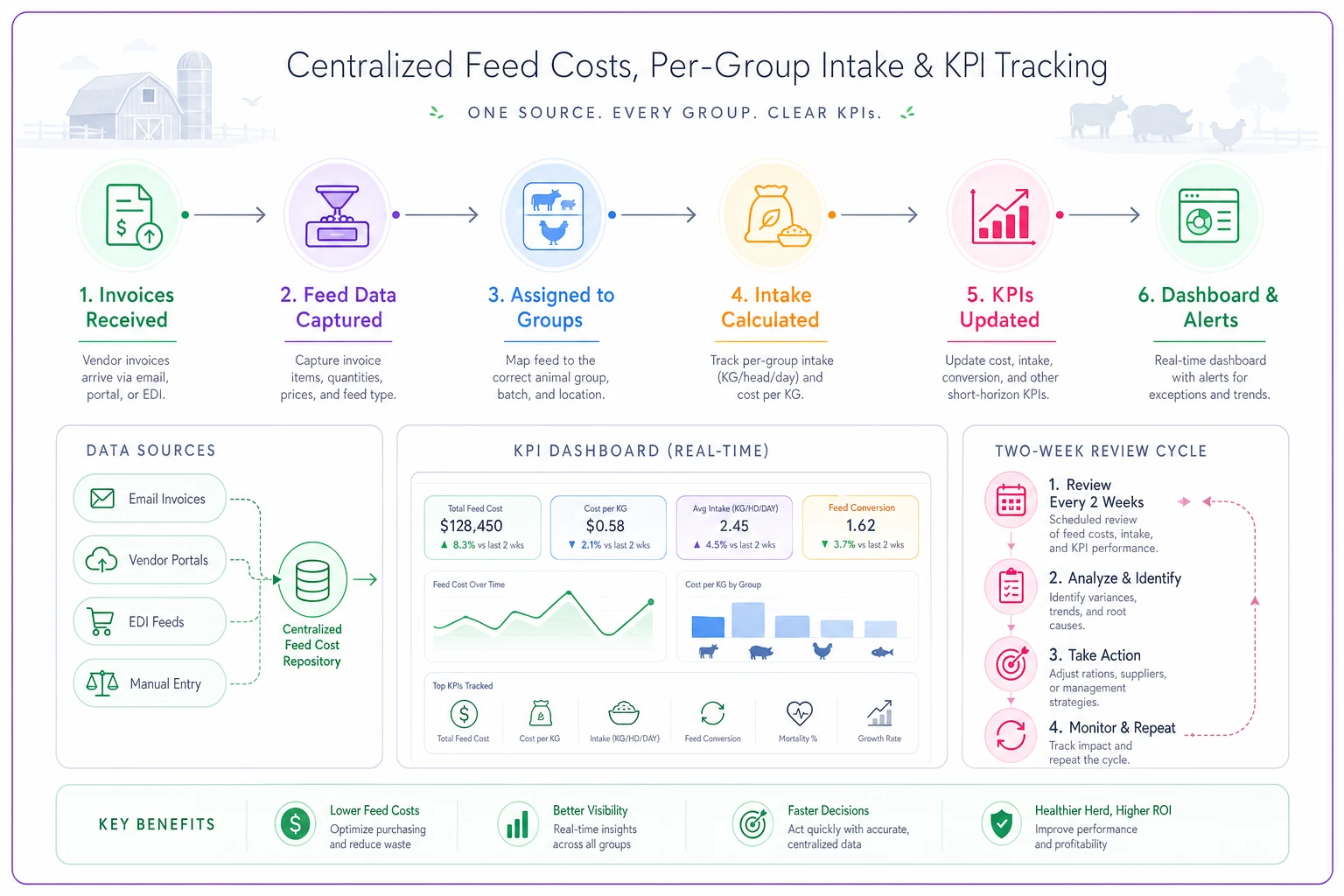
This simple workflow shows how invoices feed into dashboards and a two-week review cycle.
The tooling matters less than the habit, though. Whether you run it in software or on a whiteboard, the operations that come through an elevated-cost season intact are the ones that treated their feed budget as a living document and their KPIs as a rhythm.
The Takeaway
Elevated input prices upstream aren't something you control, and chasing the headline won't help. What you control is whether your feed budget reflects this season's delivered cost and intake, whether you're laddering your buying instead of betting everything on one direction, and whether you're checking a tight set of KPIs often enough to catch a problem while it's still small.
Re-run the budget by life stage. Split the invoice. Recheck your cull break-evens. Set the two-week review and give it an owner. The cost pressure is real — but the operations that get hurt worst aren't the ones facing high prices. They're the ones running on stale numbers and finding out too late.
Elevated input prices upstream aren't something you control, and chasing the headline won't help. What you control is whether your feed budget reflects this season's delivered cost and intake, whether you're laddering your buying instead of betting everything on one direction, and whether you're checking a tight set of KPIs often enough to catch a problem while it's still small.
Ready to optimize your farm management?
Join hundreds of farmers using Barnyly to save time, improve animal health, and increase farm productivity.