
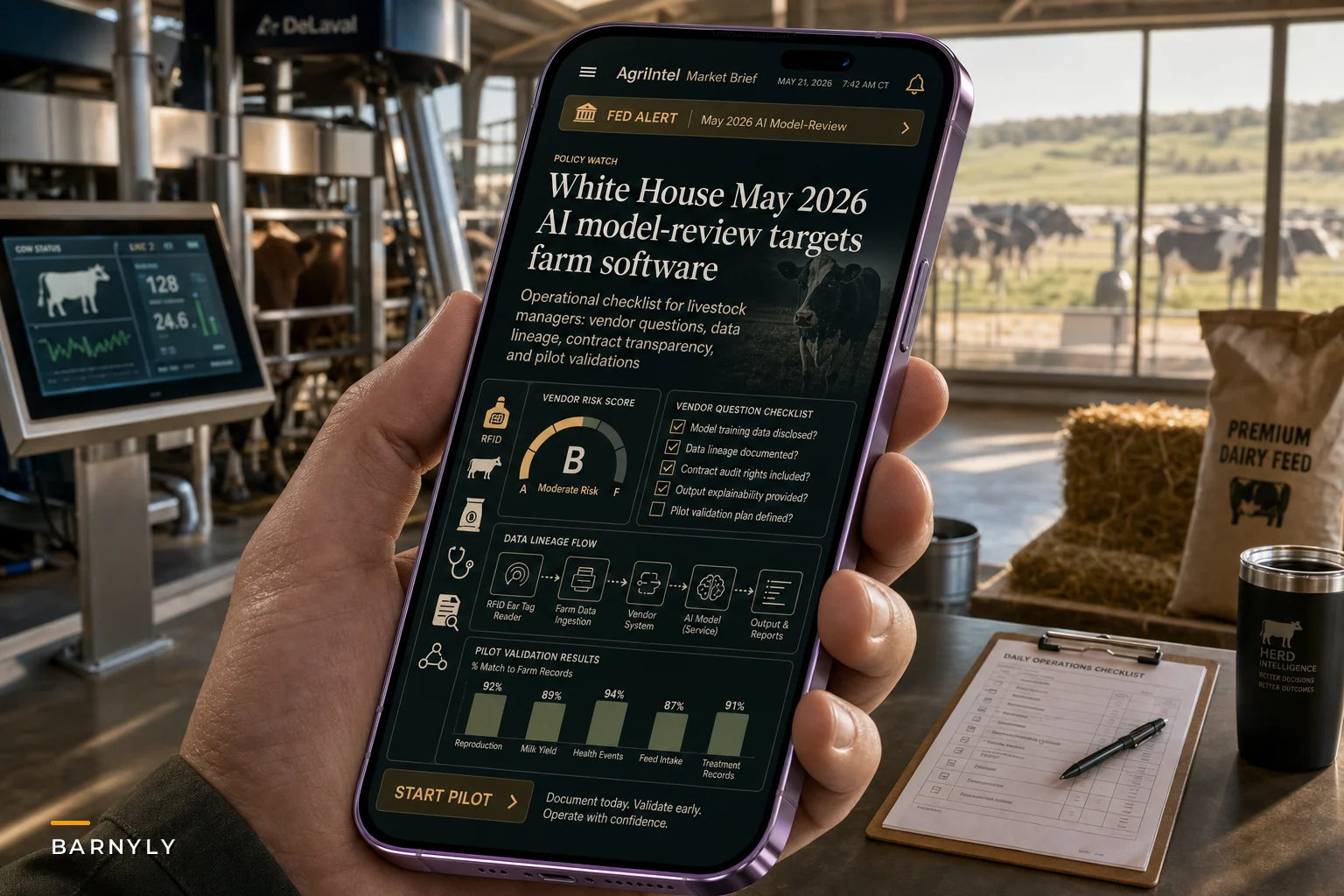

Last week, the White House briefed major AI companies about a planned executive order that would establish voluntary pre-release model reviews and early government access to advanced AI systems, according to reports from Reuters. While the order targets major AI developers directly, the ripple effects will hit every farm operation using software with embedded AI features—from automated health alerts to feed optimization algorithms.
Most livestock operations haven't considered this: when your farm management software flags a potential mastitis outbreak or recommends adjusting feed rations, you're making operational decisions based on AI model outputs that your vendor might not fully control or understand themselves. Once federal oversight starts requiring transparency about model training data and validation procedures, you need answers about how those recommendations actually work—before an inspector, insurance adjuster, or plaintiff's attorney starts asking the same questions.
The vendor accountability gap nobody's talking about
Most farm management platforms now embed third-party AI models for everything from computer vision in sorting gates to predictive analytics for breeding programs. Your vendor probably licensed these models from companies like OpenAI, Anthropic, or specialized agricultural AI firms. This creates a documentation chain that looks something like:
-
Your operation relies on the software's recommendation
-
The software vendor relies on a third-party model
-
That model provider relies on training data they might not fully disclose
-
Federal oversight now wants visibility into all three layers
A 2,800-head dairy operation in Wisconsin ran into this exact scenario last month. They'd been using AI-powered health monitoring for eighteen months when their milk buyer's quality assurance team started asking about the algorithm's training data sources. The farm couldn't answer because their vendor couldn't answer—the model was a black box licensed from another company. The buyer didn't reject their milk, but they did flag it as a compliance risk for their largest retail contracts.
Federal model review requirements will formalize what forward-thinking buyers and insurers are already asking informally. Your vendor won't be able to dodge these questions anymore.
What happens when model decisions meet compliance audits
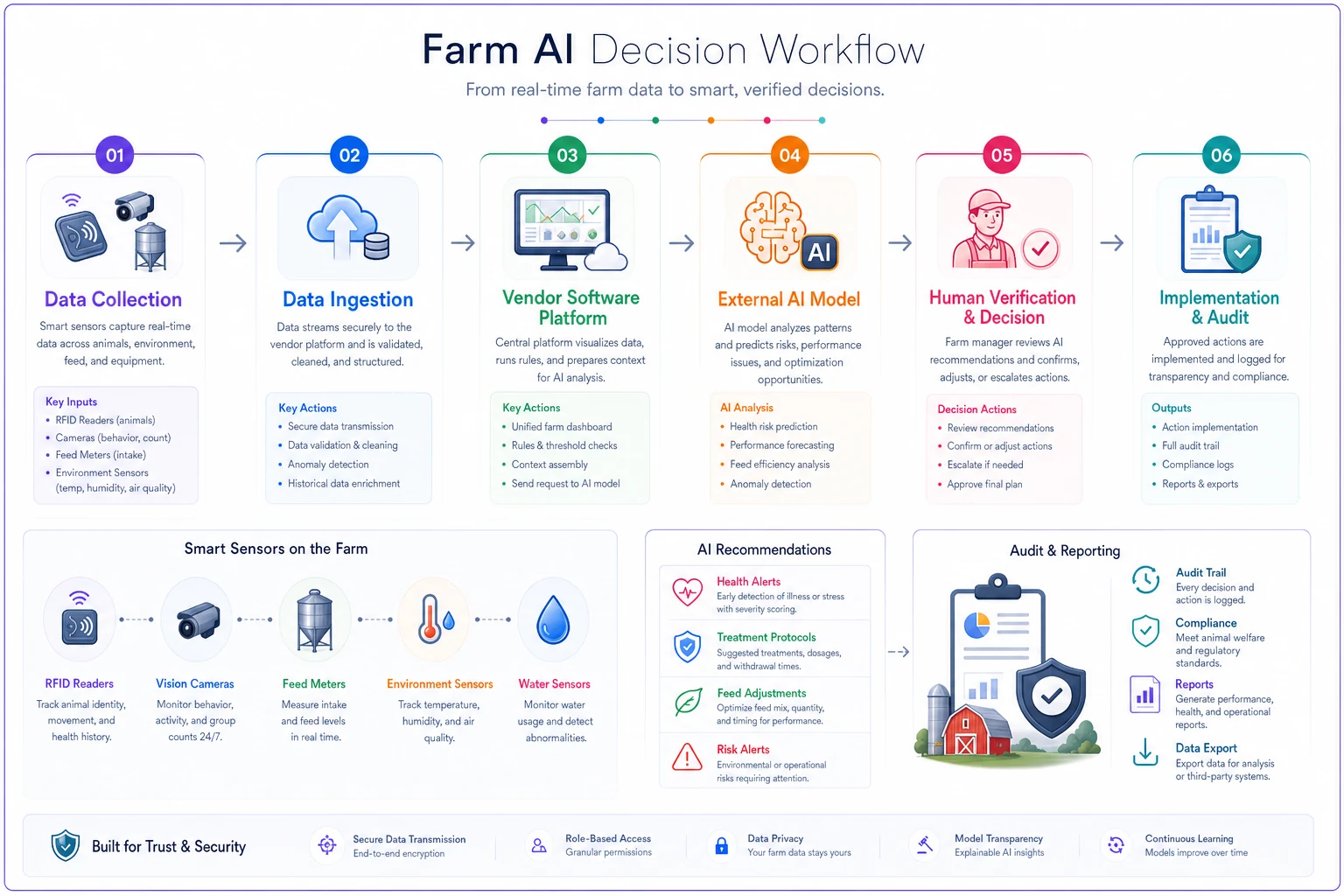
Consider how AI recommendations flow through actual farm operations. Your herd management software analyzes movement patterns from RFID readers and flags three heifers for potential respiratory issues. The system recommends isolation and generates a treatment protocol based on historical outcomes. You follow the recommendation, administer antibiotics, and log everything in the system.
Simplify farm operations and enhance animal care.
Barnyly helps you organize, track, and manage every aspect of your farm operations seamlessly.
- Comprehensive livestock tracking
- Automated health alerts
- Feed and resource scheduling
No credit card required
Six months later, during a routine audit, an inspector asks why those specific animals were treated. Your answer: "The AI flagged them." The follow-up questions get uncomfortable fast:
-
What data trained the model to identify respiratory symptoms?
-
How often does the model generate false positives?
-
Were the training farms similar in climate and herd genetics to yours?
-
What's the model's accuracy rate for your specific operation?
Most vendors can't answer these questions comprehensively. New federal requirements will likely mandate documentation that explains model decision-making in terms regulators and auditors can evaluate. Operations that can't provide this documentation face a credibility gap affecting everything from organic certification to export eligibility.
Here's a simple workflow showing how model outputs move from sensors and records to recommendations and potential audits.
The liability question gets messier. If an AI model recommends a treatment protocol that later proves inappropriate—maybe flagging lameness when the issue was actually nutritional—who bears responsibility? Your operation followed software guidance in good faith, but the decision trail leads through multiple vendors and model providers. Without clear documentation about model limitations and validation procedures, you're running blind on liability exposure.
Three operational changes that protect your farm regardless of vendor readiness
Start with decision documentation that goes beyond logging what the AI recommended. Create a simple verification protocol where any AI-triggered intervention gets a human check within 24 hours. This doesn't mean ignoring the software—it means building a paper trail that shows professional judgment, not blind automation.
A beef operation in Nebraska developed this approach after their feeding software recommended a ration change that would have exceeded safe nitrate levels for pregnant cows. They now require a "verification note" for any AI recommendation affecting more than 10% of the herd or involving medication decisions. Takes about five extra minutes per decision, but it saved them from a $47,000 mistake when the model misinterpreted drought-stressed corn silage data.
Second, establish data governance rules for your operation before regulators establish them for you. Document what information flows into your farm management system and where it comes from. This becomes critical when connecting AI recommendations back to your core farm data strategy. If you're feeding three years of treatment records into a system that makes health predictions, you need to know whether that historical data was clean, complete, and relevant to current operations.
Map out which decisions currently rely on AI assistance versus human judgment:
| Decision Type | Current Process | AI Involvement | Validation Method |
|---|---|---|---|
| Breeding timing | Heat detection sensors + AI prediction | High - 70% of decisions | Weekly pregnancy check correlation |
| Treatment protocols | Symptom observation + software recommendation | Medium - assists but doesn't determine | Vet review for any systemic treatments |
| Feed adjustments | Nutritionist plan + optimization software | Low - validates human decisions | Monthly feed testing against recommendations |
| Culling decisions | Performance data + predictive modeling | Medium - flags candidates | Management review before any action |
Third, demand specific vendor commitments now, while you still have negotiating leverage. Don't wait for federal requirements to force these conversations. Ask your farm management software vendor:
Require a "verification note" for any AI recommendation affecting more than 10% of the herd or involving medication decisions.
-
Which components use AI models versus rule-based algorithms?
-
Are models trained on general agricultural data or livestock-specific datasets?
-
How often are models updated and what triggers retraining?
-
What happens to our farm's data—does it train future models?
-
Can you provide model performance metrics specific to operations like ours?
-
What documentation will you provide if regulators request model validation?
-
Who bears liability if model recommendations cause operational losses?
Don't wait for federal requirements to force these conversations.
The contract amendments you need before renewal
Your current software agreement probably doesn't address AI model transparency at all. Most farm management contracts were written when "AI features" meant basic predictive analytics, not the sophisticated decision engines embedded in today's platforms.
Model transparency clause: Vendor must disclose when AI models significantly influence any recommendation, alert, or automated action. "Significantly" means the AI contribution exceeds 30% of the decision weight.
Audit support provision: If regulatory inspection requires documentation about AI-driven decisions, vendor provides necessary validation documents within 5 business days.
Training data disclosure: For any model making health, treatment, or breeding recommendations, vendor identifies whether training data included operations from similar climate zones, herd sizes, and production systems.
Performance benchmarking: Quarterly reports showing model accuracy rates for key predictions (health events, breeding success, feed efficiency) specific to your operation's data.
Liability allocation: Clear language about responsibility when following AI recommendations leads to adverse outcomes—particularly for medication decisions affecting milk withdrawal periods or meat residue risks.
A 450-cow dairy in Vermont negotiated similar terms last quarter after their insurer started asking about AI-related operational risks. The vendor initially resisted, claiming proprietary concerns. The dairy's response was simple: provide transparency or we'll find a vendor who will. They got their amendments within two weeks.
When switching vendors makes more sense than fixing what you have
Sometimes the smartest response to new AI oversight isn't demanding more from your current vendor—it's recognizing when they're fundamentally unprepared for what's coming.
Warning signs your vendor won't meet new requirements:
-
The company treats AI features as mysterious "black boxes" even to their own support team. When you ask how the software determined something, they can't explain beyond "the algorithm decided."
-
Updates happen without notification or explanation. You log in one day and recommendations suddenly work differently, with no documentation about what changed or why.
-
The vendor acquired AI capabilities through acquisition rather than development. This often means disconnected systems with limited integration and even less transparency about how models actually function.
-
Your contract lacks any mention of data governance, model updates, or algorithmic transparency. Vendors serious about AI integration addressed these issues years ago.
-
Support deflects questions about AI accuracy to generic responses about "continuous improvement" and "machine learning optimization" without providing specific metrics or timelines.
Support deflects questions about AI accuracy to generic responses about "continuous improvement" and "machine learning optimization" without providing specific metrics or timelines.
Building operational resilience beyond any single software platform
The smartest operators are building hybrid systems where AI assists but doesn't control critical decisions. They're using software recommendations as one input among several, maintaining independent verification processes that would continue functioning even if every AI model failed simultaneously.
A custom heifer operation in Texas structured their workflow this way: AI-powered growth tracking suggests optimal breeding dates, but final decisions require reviewing actual body condition scores, not just model predictions. Their breeding success rate runs around 84%—only marginally better than before AI assistance—but their documentation stands up to any audit because human judgment validates every decision.
This approach also protects against model drift, where AI recommendations gradually become less accurate as conditions change. Maybe your software trained on data from conventional operations but you're transitioning to organic. Maybe climate patterns shifted and your forage quality varies more than historical models expect. When you maintain independent validation, you catch these divergences before they become expensive mistakes.
Operational software platforms that will thrive under new oversight are those that enhance human decision-making rather than replacing it. They provide clear reasoning for recommendations, show confidence levels, and flag when situations fall outside normal parameters. More importantly, they generate documentation that satisfies both operational needs and regulatory requirements.
Moving forward with eyes open
Federal AI oversight isn't targeting agriculture specifically, but farms using AI-powered software will feel the impact through vendor requirements and liability concerns. Operations that prepare now—asking hard questions, demanding transparency, and building verification processes—will navigate these changes without disrupting daily operations.
Start with one simple step: pick your most critical AI-assisted decision (health monitoring, breeding, feeding) and document exactly how that recommendation gets made. Follow the data from sensor to suggestion. Ask your vendor to explain each step. If they can't or won't, you've identified your biggest operational risk.
The goal isn't abandoning AI-powered tools that genuinely improve operations. It's ensuring you understand and can defend the decisions these tools help you make. Because when federal oversight arrives, "the computer said so" won't be an acceptable answer anymore.
Your operation's data, decisions, and outcomes need to remain yours to control and explain, regardless of how sophisticated the software becomes. Build that operational independence now, while you still have time to do it right.
Ready to optimize your farm management?
Join hundreds of farmers using Barnyly to save time, improve animal health, and increase farm productivity.