

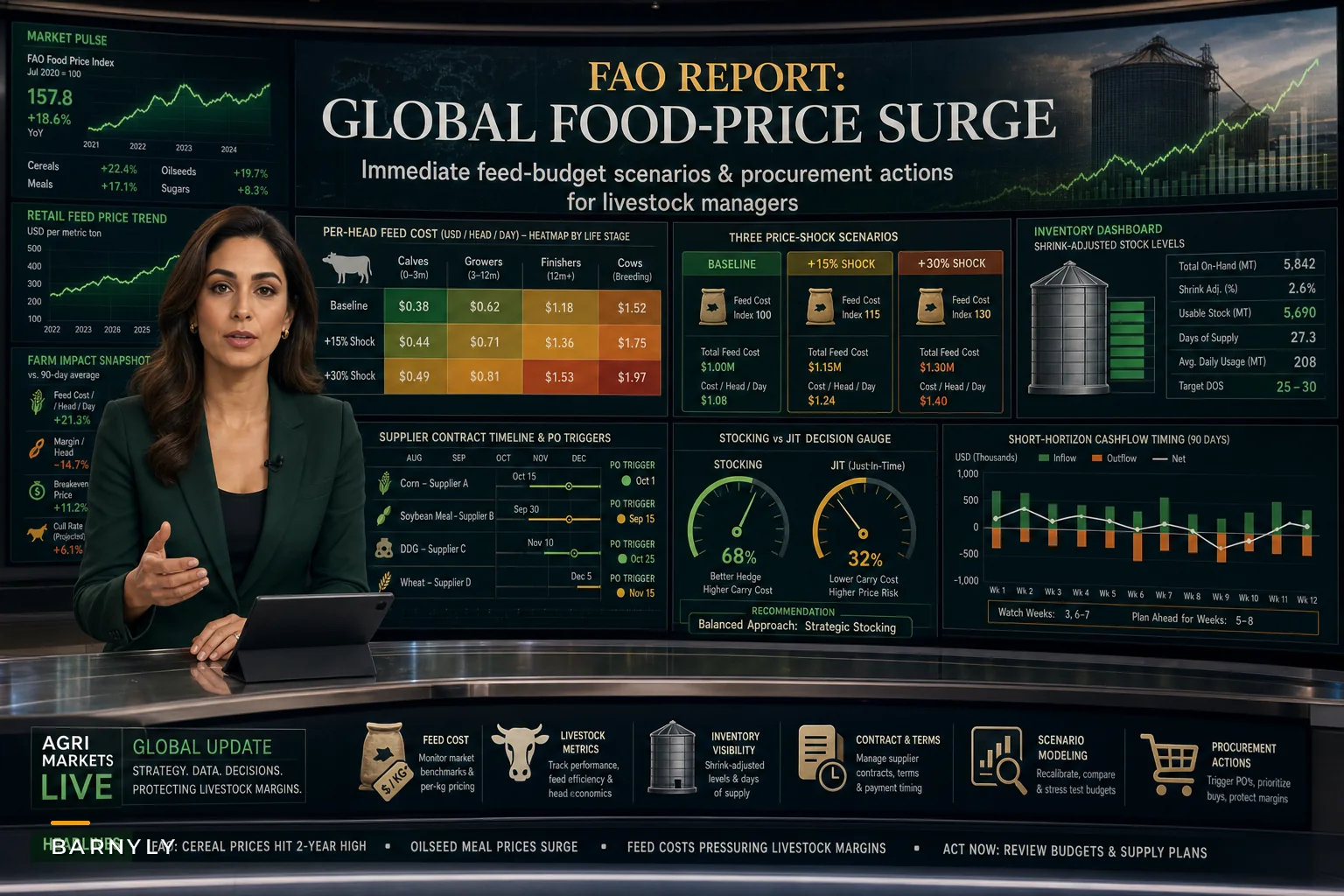

The FAO's warning on August 5 wasn't a surprise to anyone who's been watching input costs since spring. In a recent Reuters report, the agency flagged a renewed global food‑price surge driven by weather disruption tied to El Niño risk, ongoing conflict, and general supply pressure. For most people reading the news, that means slightly more expensive groceries. For anyone feeding livestock, it's a direct hit to the single largest line item on the operation.
A price warning by itself changes nothing on your operation, though. What matters is whether your feed budget is built to flex when corn, soybean meal, or hay contracts move 15–25% in a single buying window. Most aren't. They're built around last year's average price, updated maybe once, and then quietly ignored until the bill shows up.
This post isn't really about the FAO forecast. It's about what you do in the 30–60 days after a warning like this lands — when suppliers get twitchy, forward contracts tighten, and every decision about stocking versus waiting has a real cost attached.
The real problem a price spike exposes
A feed‑price surge doesn't create operational problems. It reveals the ones already sitting there.
When margins are comfortable, you can overbuy, waste a little, feed slightly rich rations, and never really notice. A 4% shrink loss in the hay barn doesn't sting when hay is cheap. But the moment input costs jump, every soft spot in your procurement and inventory process turns into a measurable loss.
-
They budget feed as a single annual number, not by life stage or class of animal, so they can't tell where the cost pressure actually lands.
-
They buy reactively — topping off when the bin runs low — which means every purchase happens at whatever the spot price is that week.
-
They have no trigger points written down for when to switch from just‑in‑time buying to forward contracting or bulk stocking.
That third one is the quiet killer. Without pre-defined triggers, every decision becomes an argument in the moment, usually made under pressure, usually with incomplete price information. Whether to lock in 90 days of feed at a slightly elevated price versus waiting for prices to ease shouldn't be a decision you're making in the truck on the way to the co-op.
Step one: recalibrate the budget before you touch procurement
You can't make good buying decisions on top of a stale budget. The order matters — budget first, then procurement, then inventory. People tend to do it backwards, panicking about supplier availability before they even know what their revised cost tolerance is.
Simplify farm operations and enhance animal care.
Barnyly helps you organize, track, and manage every aspect of your farm operations seamlessly.
- Comprehensive livestock tracking
- Automated health alerts
- Feed and resource scheduling
No credit card required
If you already build feed budgets by life stage, this recalibration is faster. If you don't, that's the foundational work, and it's worth reading through the full method on accurate seasonal feed budgets by life stage before going further, because everything below assumes you can break your feed cost down by animal class.
-
Pull your current per‑head feed cost by class. Cows in maintenance, replacement heifers, finishing steers, lactating ewes — whatever your groups are. You need the baseline, not a farm-wide average.
-
Apply three price scenarios, not one. A mild scenario (say, +8–10%), a moderate one (+18–22%), and a stress scenario (+30% or more on your most exposed ingredient). Run them all.
-
Identify which classes break first. In most beef operations, finishing animals feel a grain price spike hardest because energy demand is highest. On dairy, it's the lactating string. Knowing which group breaks even at which price tells you where to defend margin.
-
Set a per‑head cost ceiling for each class — the point where the animal stops being profitable to feed at current sale prices. That number is your line in the sand.
-
Recheck sale-price assumptions. A feed spike often coincides with herd-size shifts that move cattle prices too. Don't budget rising input costs against flat revenue if the market's actually moving in your favor.
The output of this isn't a prettier spreadsheet. It's a set of numbers that tell you, for each group of animals, at what feed price you should be ration-adjusting, forward-buying, or considering selling early.
Feed-budget scenarios: what the three cases actually look like
Running scenarios is where most producers stop short. They'll acknowledge prices might rise but only plan for the middle case. The problem is the middle case rarely happens cleanly — you either get a mild bump you overreacted to, or a real spike you weren't ready for.
| Scenario | Feed cost change | Per‑head winter feed cost | Primary action | Timing |
|---|---|---|---|---|
| Mild (+9%) | Small bump | ~$5–7 higher/head | Hold JIT buying, monitor weekly | No urgency |
| Moderate (+20%) | Meaningful | ~$14–18 higher/head | Lock 60–90 days forward, tighten rations | 2–3 weeks |
| Stress (+32%) | Severe | ~$25–30 higher/head | Bulk stock storable feed, cull marginal animals, renegotiate contracts | Immediate |
The gap between the moderate and stress rows is where the real decisions live. In the moderate case, you're protecting margin. In the stress case, you're protecting cash position, and that sometimes means feeding fewer animals better rather than all of them thin.
One pattern worth flagging: producers who only planned for the moderate case tend to freeze when the stress case actually arrives, because they never gave themselves permission ahead of time to cull. Writing the stress-case action down in advance removes most of the emotional weight from the decision later.
Procurement: stocking vs. just‑in‑time when prices are volatile
The instinct during a price warning is to buy everything now. Sometimes that's right. Often it isn't, and the difference comes down to storability, cash position, and how much of your ration the ingredient actually represents.
When bulk stocking makes sense:
-
The ingredient stores well without quality loss (whole grains, some byproduct feeds, hay under cover).
-
It represents a large share of your ration cost.
-
You have the cash or credit to buy without straining operating capital.
-
Storage loss is genuinely low — not just assumed low.
When just‑in‑time still wins:
-
The feed degrades quickly or attracts pests in storage.
-
Your storage shrink historically runs above 5–6%.
-
Cash is tight and locking it up in inventory risks your ability to cover payroll or vet bills.
-
The price signal is mild and prices could just as easily ease back.
When bulk stocking is a bad idea:
Buying six months of a feed you've never stored at scale, on credit, into barns that leak. That's not a hedge — that's a gamble with a moisture problem attached. The number of operations that lost more to spoilage than they saved on price is not small.
A cleaner middle path most people overlook: partial forward contracting. Lock in 50–60% of your projected need at a known price, leave the rest flexible. You cap your downside without betting the whole operation on a price direction. This works especially well when your budget scenarios show a clear per‑head ceiling — you contract enough to keep the core herd under that ceiling and stay nimble on the rest.
Consider locking 50–60% of projected need to cap downside while keeping flexibility on the remainder.
This works especially well when your budget scenarios show a clear per‑head ceiling — you contract enough to keep the core herd under that ceiling and stay nimble on the rest.
Inventory decisions: know what you actually have before you buy more
Almost universal and almost invisible: operations make procurement decisions without an accurate read on current inventory. They buy against a rough guess of what's in the barn.
-
Physical count of every storable feed — not the number in your head from last month.
-
Adjusted for realistic shrink — measure it if you can, don't assume the label weight is what's left.
-
Days-of-supply per class at current feeding rates, so you know exactly how long each group is covered.
-
Quality and spoilage flags on anything stored more than a season.
-
Reorder trigger points tied to days-of-supply, not to "the bin looks low."
Operations that handle a price spike calmly are almost always the ones who already know, on any given day, how many days of feed each animal group has left. That single number turns panic buying into planned buying.
Where centralized records quietly change the outcome
Most of what's above depends on having your numbers in one place. Per‑head feed cost by class, current inventory with real shrink figures, supplier contract terms, sale-price assumptions — when these live in four different notebooks and one person's memory, running three scenarios in a week is basically impossible. You end up defaulting to a single guess because assembling the data takes longer than the price window allows.
This is the practical case for keeping feed budgets, inventory counts, and per‑head cost KPIs inside a connected operational system rather than scattered spreadsheets. When your inventory tracking and your budget scenarios pull from the same underlying records, recalibrating after a price warning becomes an afternoon's work instead of a week of reconstruction. Some platforms now use AI-assisted forecasting to flag when a class of animals is approaching its per‑head cost ceiling, or when days-of-supply drops below a reorder trigger — not replacing your judgment, just surfacing the number before it becomes a problem.
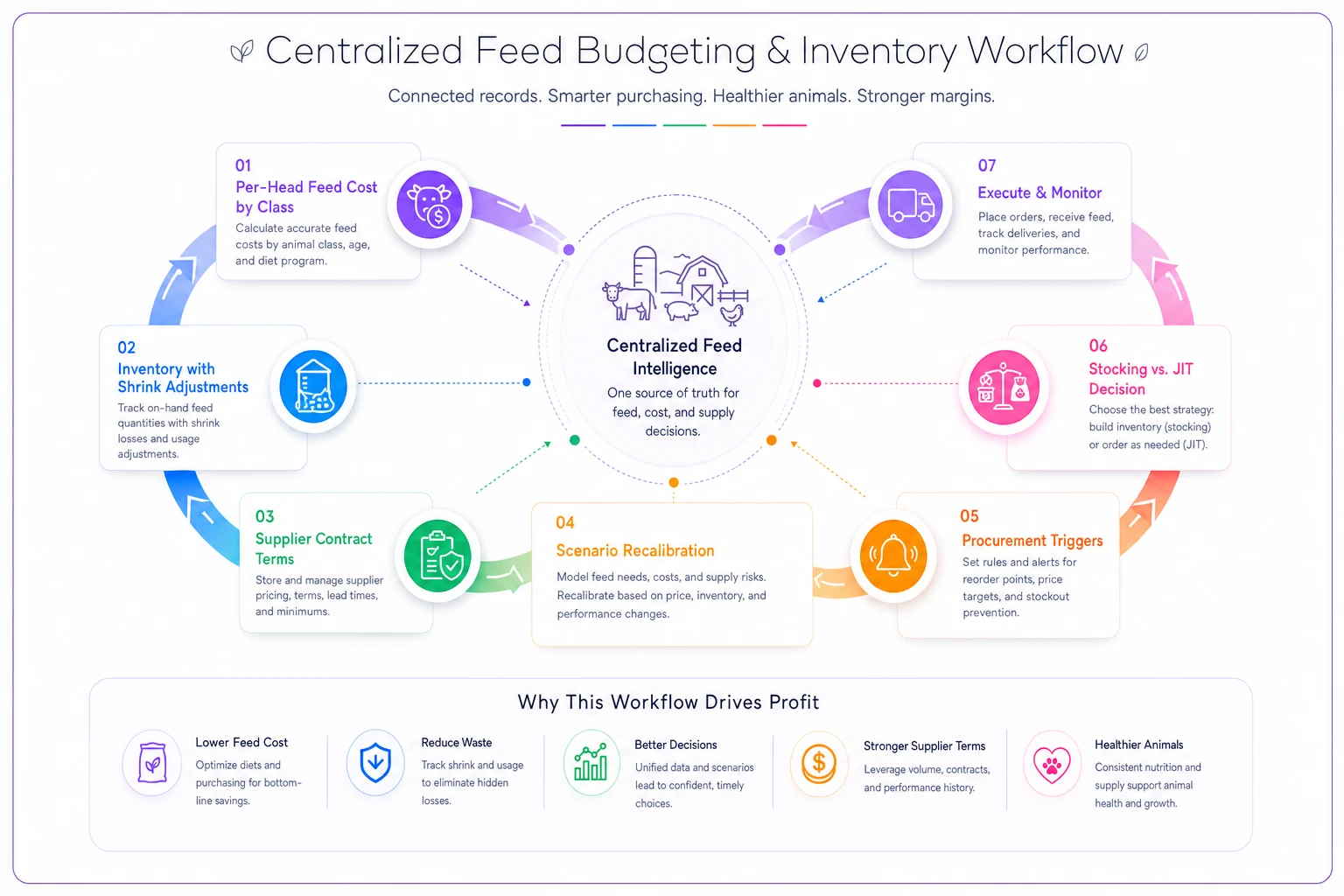
The diagram above shows how records, scenarios, and procurement triggers connect so you can act quickly.
That said, the tooling only matters if the underlying discipline exists. A system full of stale or guessed numbers produces confident-looking garbage. Get the budget-by-class habit right first; the software just makes it faster to repeat.
A real scenario: mixed sheep and beef operation
A combined operation — roughly 140 ewes and 60 beef cows in the upper Midwest — went into last winter carrying a single farm-wide feed budget built on the prior year's grain price. When soybean meal and corn both jumped through the fall buying season, they were feeding a rich finishing ration to lambs without any group-level cost visibility.
Once they broke the budget down by class and ran the three scenarios, the finishing lambs showed up as the group blowing past the per‑head ceiling — energy-dense ration, spiking grain cost, thin margins. The cows in maintenance were fine. The response wasn't across-the-board panic; it was targeted. They forward-contracted about 60% of the finishing grain need, tightened the maintenance ration slightly with more forage substitution, and marketed a small group of lambs two to three weeks earlier than planned rather than feeding them through the peak price window.
The net effect over the winter was somewhere around $2,600–$3,400 in avoided feed cost and spoilage compared to the prior year's reactive approach. Not a dramatic turnaround — but the difference between a break-even winter and a modestly negative one. More importantly, the next price warning won't require the same scramble, because the budget structure is already in place.
What to actually do this month
If the FAO warning has your attention, here's the honest priority order:
-
Break your feed budget down by animal class if you haven't. Everything else depends on it.
-
Run the mild/moderate/stress scenarios and set a per‑head cost ceiling for each group.
-
Do a physical inventory count with realistic shrink figures.
-
Decide your stocking vs. JIT position per ingredient — and consider partial forward contracting instead of an all-or-nothing call.
-
Write down your triggers now, while you're calm, so the next decision isn't made under pressure.
A price surge is only a crisis for operations that have to figure everything out mid-spike. If your budget already flexes by scenario, and you know your inventory and per‑head ceilings cold, a 20% feed jump is a management event, not an emergency. The FAO warning is worth exactly this much: a reason to do the recalibration work before prices force you to.
A price surge is only a crisis for operations that have to figure everything out mid-spike. If your budget already flexes by scenario, and you know your inventory and per‑head ceilings cold, a 20% feed jump is a management event, not an emergency. The FAO warning is worth exactly this much: a reason to do the recalibration work before prices force you to.
Ready to optimize your farm management?
Join hundreds of farmers using Barnyly to save time, improve animal health, and increase farm productivity.