

Most of the biosecurity attention on a working farm goes to the animals themselves — intake quarantine, vaccination timing, treatment records. That's fair. But a surprising amount of disease introduction risk never shows up in a herd health record because it arrives at the perimeter: a feed truck that was on three other operations that morning, a well-meaning neighbor who "just wanted to look at the heifers," a family of raccoons working the grain shed every night for two weeks.
The perimeter is where you have the most control and, oddly, the least documentation. When an inspector, a packer's auditor, or a disease traceback investigator asks "who and what came onto this property in the 14 days before the index case," almost nobody can answer with real evidence. They can guess. Guessing doesn't hold up.
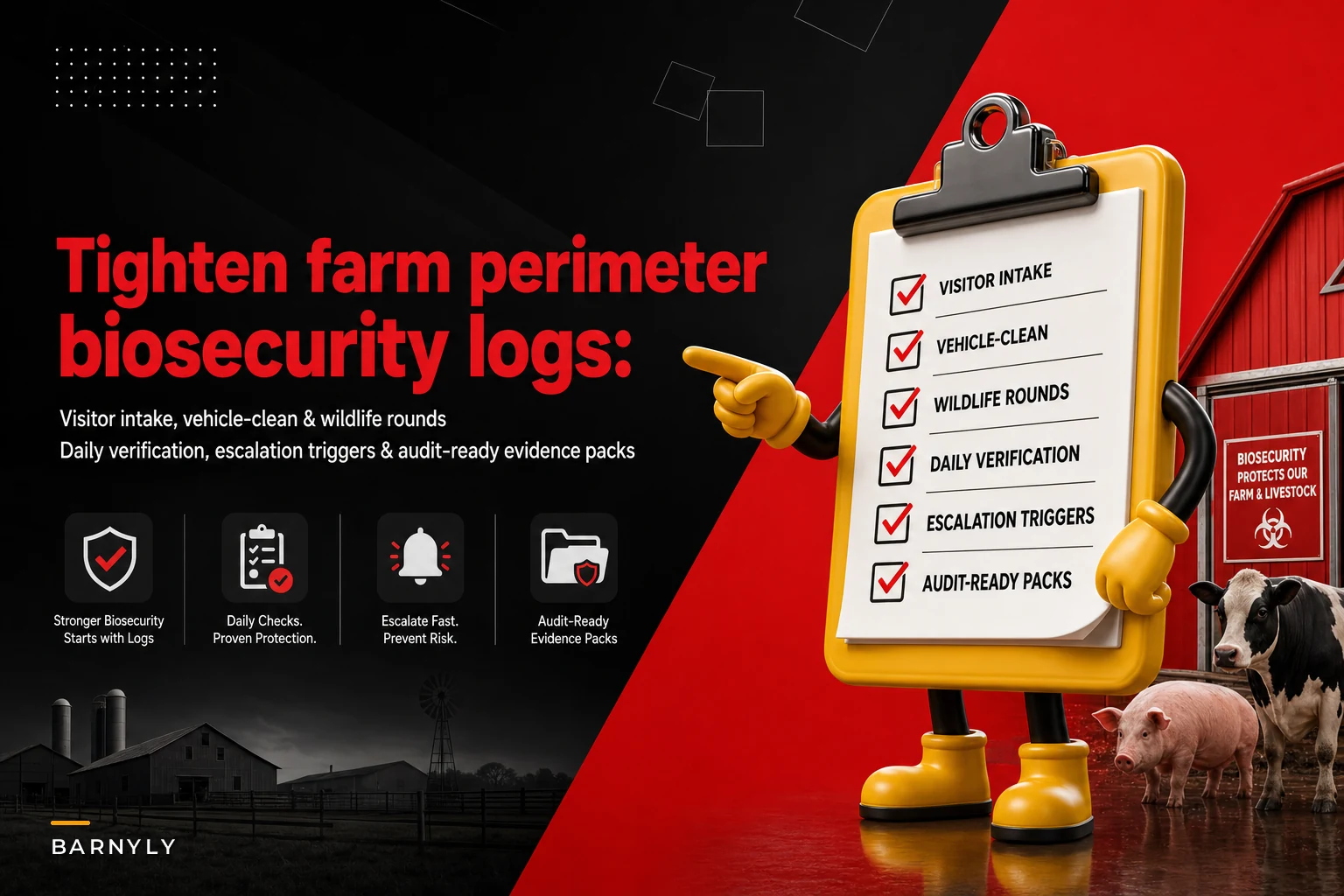
This post is about building a tight, repeatable perimeter SOP — visitor intake, vehicle cleaning, wildlife-proofing rounds, daily verification, and escalation triggers — that produces an evidence trail you can actually hand over. Not a binder of blank forms. A living record.
Why the perimeter is the gap nobody logs
Walk most operations and you'll find decent animal records and almost nothing at the entry point. There's usually a sign that says "Biosecurity Area — Report to Office," and that sign has been weathering for six years. No one reports to the office. There is no office.
The pattern is predictable. Perimeter controls feel like overhead with no payoff — until the day they're the only thing standing between you and a stop-movement order. Nobody wants to make the AI tech from the breeding company sign a log. Nobody wants to tell the propane driver to drive through a tire bath. So the controls exist on paper and evaporate in practice.
What people miss is that the perimeter is the one place where a single bad decision scales to the whole herd. A missed treatment hurts one animal. A contaminated vehicle that drives the length of your feed alley exposes every head you own. The leverage is completely lopsided, and the documentation effort is almost nothing by comparison.
A typical example looks like this: a cow-calf operation runs roughly 220 pairs, has solid vaccination and new-animal intake records, and then has an abortion storm move through. The vet asks about perimeter traffic in the prior month. The answer is a shrug and a credit card statement showing when the feed delivery hit. That's not an evidence pack. That's a reconstruction project under stress.
The four logs that actually matter
You don't need a 40-page biosecurity manual. You need four streams of evidence that reconcile against each other. When they agree, you have a defensible record. When they disagree, you've found a gap before it bites you.
Simplify farm operations and enhance animal care.
Barnyly helps you organize, track, and manage every aspect of your farm operations seamlessly.
- Comprehensive livestock tracking
- Automated health alerts
- Feed and resource scheduling
No credit card required
| Log | What it captures | How often | Who owns it |
|---|---|---|---|
| Visitor intake | Every person who crosses the clean line, their last farm contact, vehicle, purpose | Per event | Whoever's on site |
| Vehicle-clean checklist | Wash/disinfect status before entry, tire bath use, undercarriage for high-risk vehicles | Per entry | Driver + verifier |
| Wildlife-proofing rounds | Entry points, bait station status, fresh sign, carcass/feed spill findings | Scheduled (2–3x/week) | Named person |
| Daily verification | Did the above actually happen, exceptions, gate/lock status | Daily | Shift lead |
The magic isn't in any single log. It's that the daily verification sits on top and asks one simple question every day: did we actually do the things we said we do? That's the layer almost everyone skips, and it's the layer an auditor trusts most.
Visitor intake that people will actually fill out
The reason visitor logs fail is friction. If signing in takes more than 30 seconds, it won't happen when the owner isn't standing there. Design for the worst case: a delivery driver in the rain who doesn't care about your biosecurity program.
-
Date and arrival time
-
Name and company
-
Last livestock contact (which operation, how many days ago) — this is the field that matters most and the one people leave off
-
Vehicle and plate
-
Purpose and which areas they'll enter
-
Did they cross the clean/dirty line? (yes/no)
-
Boots
own/provided/plastic covers
-
Departure time
The last-livestock-contact field is the whole game. A vet who was at a TB-positive herd that morning is a completely different risk than one coming straight from home. A visitor who hauled cattle yesterday and parks next to your working chute is the scenario that keeps traceback investigators up at night.
One thing worth more than it sounds: tier your visitors in advance. Routine low-risk traffic — parcel delivery to the house, the propane guy who never goes near the stock — gets a light-touch log. Anyone entering the animal zone gets the full intake and a provided pair of boots or covers. If you treat the UPS driver and the embryo transfer tech the same way, you'll end up treating neither of them seriously.
Vehicle-clean checklists: the undercarriage is the blind spot
Vehicles carry more risk than people and get logged less, because asking a driver to clean up feels confrontational. But the manure wedged in a tire tread or a trailer floor is a far better disease vector than a boot sole.
-
High-risk (livestock trailers, rendering, other-farm vehicles) visual check of tires and wheel wells, undercarriage if visibly soiled, trailer floor cleaned and disinfected before entry, log wash time and product used.
-
Medium-risk (feed trucks, vet vehicles, equipment on loan) tire bath or wheel-wash on entry, keep to the designated route, no entry to animal housing.
-
Low-risk (parcel, mail, personal vehicles staying on the clean side) stay in the designated parking area, no further control needed.
Fix the geography first: one controlled entry, everything else chained or gated, before you worry about the perfect disinfectant.
The failure mode here is almost always the same: there's one entry point designed for control and three informal ones nobody manages. The neighbor cuts across the back gate. The hay delivery comes in the field entrance because it's easier. You can have the best tire bath in the county and it does nothing if half your traffic routes around it.
A $15 chain closes a bigger hole than a $400 wash station on the wrong road.
Wildlife-proofing rounds that find problems while they're small
Wildlife pressure builds slowly, which is exactly why it goes unnoticed until it's a real problem. Rodents don't trip an alarm. They just quietly move into the feed room over a month, and by the time you're finding droppings in the mineral, the population is established and you've got a Salmonella or Leptospira exposure route running through your stored feed.
-
Bait station status and takedown (which stations are getting hit, how hard)
-
Fresh rodent sign near feed storage and in stock housing
-
Bird access to feed bunks and stored grain
-
Standing water and spilled feed (the two things that invite everything)
-
Perimeter fence integrity where wildlife crosses
-
Any carcass found and how it was disposed
A single round tells you almost nothing, but four weeks of rounds tell you everything. When station 3 by the grain shed goes from light to heavy takedown over ten days, that's a trend you can act on before it's an infestation. A one-off glance never shows you a trend. The log is what turns observation into early warning.
Spilled feed deserves its own mention. It's the single most fixable wildlife magnet on most operations, and it gets treated as cosmetic. It's not cosmetic. It's a buffet with a biosecurity bill attached.
The daily verification layer — where evidence packs are born
Every day, a shift lead runs a 90-second verification: were visitors logged, did any vehicles come through and were they handled by tier, were the scheduled wildlife rounds done, are gates and locks as they should be. Exceptions get noted. That's it.
This does two things. First, it catches drift immediately — the day someone realizes "we haven't done a wildlife round since Tuesday" is the day before it becomes a three-week gap. Second, and this is the quiet payoff, it builds a continuous, dated, cross-referenced record. When you have a visitor log, a vehicle log, and a daily verification that all agree, you've got something an investigator can trust, because the three streams corroborate each other.
Escalation triggers: deciding in advance, not in panic
-
A visitor reports livestock contact within the last 48 hours → full boot/clothing protocol, restrict to perimeter, note in daily verification.
-
Wildlife rounds show heavy bait takedown at feed storage for two consecutive rounds → pest control call, feed storage inspection, trend logged.
-
A high-risk vehicle enters without the clean checklist completed → immediate note, route affected areas flagged, supervisor informed same day.
-
Any carcass found inside the perimeter → documented disposal, source check, round frequency temporarily increased.
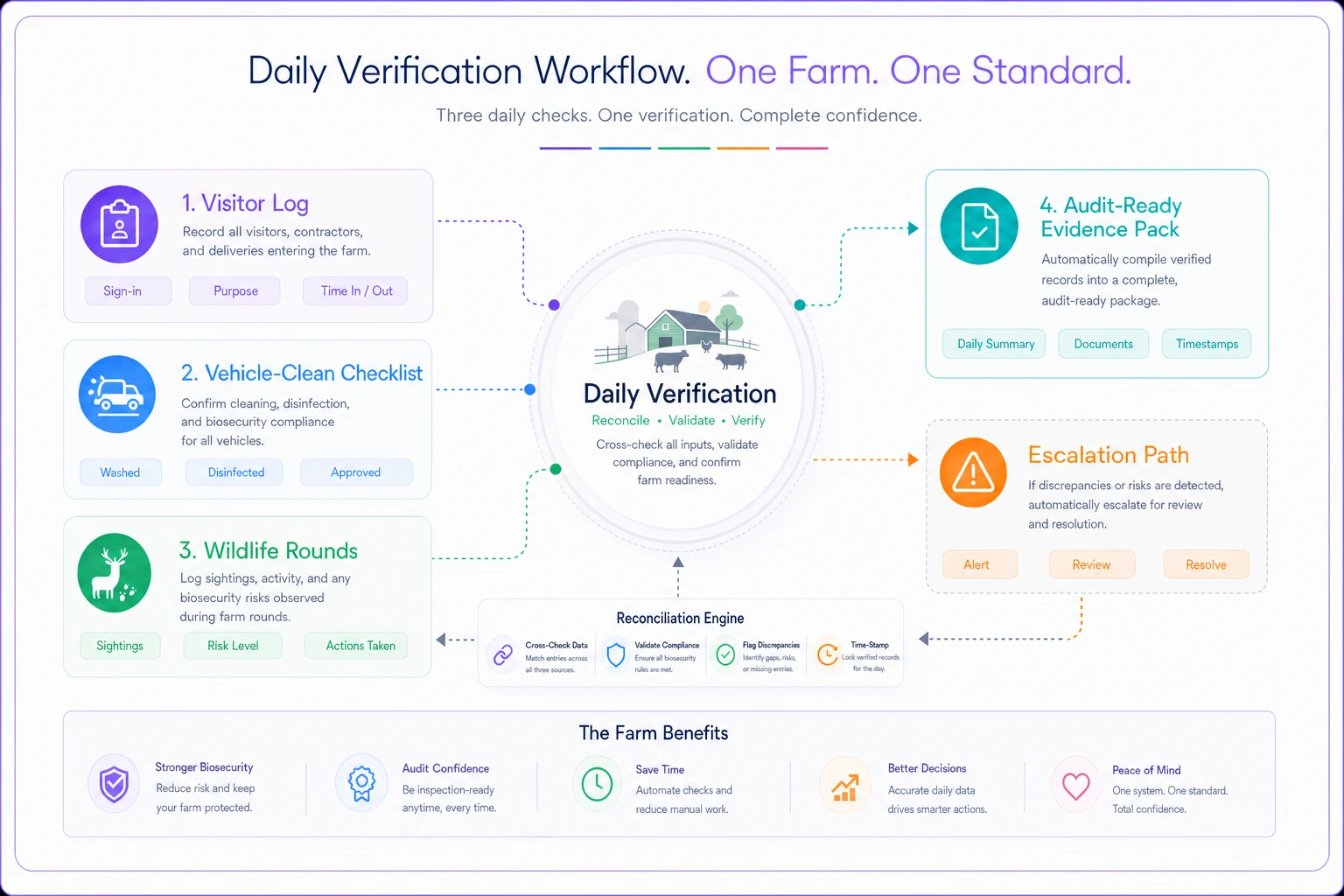
A simple visual of how the three logs feed into daily verification and create the evidence pack.
Writing these down ahead of time is what stops the "I didn't want to make a big deal of it" reaction that lets small events become outbreaks.
A real scenario: the feedlot that couldn't answer the question
A mid-size backgrounding operation — somewhere around 900 head across several pens — had clean animal records but no perimeter documentation to speak of. After a BRD spike worse than their usual seasonal pattern, their buyer's auditor asked for 21 days of entry records. They had nothing but memory and a few delivery texts.
They put in the four-log system. No fancy infrastructure — one controlled gate, a provided-boots bin, a laminated visitor sheet, a vehicle tier card for the driver to initial, and twice-weekly wildlife rounds logged on a clipboard, with a daily 2-minute verification by the pen rider. Setup took an afternoon and maybe $200 in gates, a boot bin, and signage.
The first month surfaced things they genuinely didn't know. Two different livestock haulers had been parking inside the perimeter and walking the alley. Bait takedown by the commodity shed was heavier than anyone realized. Both got fixed without drama. By the following year's audit, they handed over a clean, reconciled evidence pack in about ten minutes instead of scrambling for days. The disease didn't vanish — biosecurity isn't magic — but the unexplained introductions dropped, and they stopped being the operation that couldn't answer the basic question.
When this is worth it — and when it's overkill
When it makes sense: Any operation with regular outside traffic — deliveries, vets, haulers, breeding techs — and any operation selling into a supply chain that audits. If you move animals on and off, or you have high-value genetics, the perimeter log is cheap insurance against an expensive problem.
When it's lighter-touch: A closed, remote operation with almost no outside traffic can run a stripped-down version — a simple visitor note and periodic wildlife rounds, without the full vehicle tiering. Match the controls to the actual traffic.
Who should not overbuild this: Don't build a 12-field intake form and a three-station wash bay for a place that sees two visitors a month. Over-engineered systems don't get used, and an unused system is worse than a simple one because it creates false confidence. Start with the minimum that actually gets filled out, and add only when a real gap shows up.
Keeping the logs from dying in a drawer
The honest risk with any paper system is decay. The clipboard gets rained on, entries thin out when the owner's away, and the "evidence pack" becomes a stack of half-finished sheets. The daily verification layer fights this, but on multi-site operations or when staff rotate, a lightweight digital record — one where the visitor log, vehicle checklist, and wildlife rounds live in one place and the daily verification flags anything missed — removes most of the friction that kills paper systems.
The point isn't the software. The point is that the three streams reconcile automatically and nothing quietly goes unlogged for three weeks.
Whatever tool you use, the discipline is the same: capture at the gate, verify daily, and let the logs corroborate each other. Strong farm perimeter biosecurity isn't a wash station or a sign — it's a boring, consistent record that proves, on the day it matters, exactly who and what crossed your line. The animals are the asset. The perimeter is where you protect them, and the log is how you prove you did.
Ready to optimize your farm management?
Join hundreds of farmers using Barnyly to save time, improve animal health, and increase farm productivity.