

Most disease introductions on well-run farms don't come from bad luck. They come from the animals you brought in on purpose — the sale-barn heifers, the bull you leased for the season, the club lambs coming back from a show. The intake gate is the single riskiest doorway on your whole operation, and it's usually run off memory and a whiteboard that hasn't been updated since spring.
The problem isn't that farmers don't quarantine. It's that quarantine gets treated as a duration ("keep 'em separate for a couple weeks") instead of a workflow with checkpoints, timelines, and a paper trail you can actually release against. That gap is where things go sideways.
This is a practical breakdown of how to build a livestock quarantine checklist that actually holds up — one that tracks isolation timelines, scores where animals came from, sets a sampling cadence, and produces intake and release logs you can print and hang on the pen.
Start with source risk, not isolation length
The mistake that quietly wrecks intake protocols: everybody gets the same 14 or 21 days. A ranch-raised replacement heifer from a herd you know personally gets the same treatment as a mixed lot of feeder calves that passed through two sale barns and a broker's lot in five days. Same pen, same timeline, same casual attention.
Those are not the same risk. Not close.
Risk scoring is just a way to sort incoming animals before they hit the ground so you know how hard to watch them and how long to hold them. In real operations, this usually happens on the trailer ramp — you already know most of what you need to score the load. Where did it come from? How many times did it change hands? Did it commingle? Is there any health history at all?
A simple scoring grid does most of the work:
| Factor | Low risk (0–1 pts) | Medium risk (2–3 pts) | High risk (4–5 pts) |
|---|---|---|---|
| Source type | Known direct farm | Reputable single seller | Sale barn / broker / auction |
| Commingling before arrival | None | One group | Multiple groups / unknown |
| Health records provided | Full vax + treatment history | Partial | None |
| Transport time & stops | Direct, <4 hrs | One stop | Multiple stops / long haul |
| Prior show or fair contact | None | Regional | Multi-state show circuit |
Add it up. Under 6 is low-risk, 6–12 is medium, above 12 is a hold-them-hard group. The number itself isn't magic — what matters is that it decides the isolation timeline and sampling cadence for you, so intake decisions stop depending on how tired you were the day the trailer showed up.
One pattern worth flagging: the "known source" line lies to people constantly. A neighbor's herd you trust can still ship you a persistently infected BVD calf that looks perfect. Trust lowers the score, it doesn't zero it out.
Match isolation timelines to the score
Once you've scored the animals, the isolation window becomes a decision instead of a debate.
Simplify farm operations and enhance animal care.
Barnyly helps you organize, track, and manage every aspect of your farm operations seamlessly.
- Comprehensive livestock tracking
- Automated health alerts
- Feed and resource scheduling
No credit card required
-
Low risk (score under 6) 14 days minimum, single visual check daily, one sampling event at intake.
-
Medium risk (6–12) 21–30 days, twice-daily observation for the first week, sampling at intake and again before release.
-
High risk (over 12) 30 days minimum, extended if anything looks off, sampling at intake, mid-hold, and pre-release, plus a hard rule that the clock resets if a new animal is added to the pen.
That last rule catches more people than any other. Someone brings in a second load three days into a 21-day hold and drops them in the same quarantine pen "since it's already dirty anyway." Now you've got a rolling exposure and your original release date is meaningless. The isolation clock resets to the newest animal, every time. No exceptions, or the whole timeline is theater.
Physical separation matters more than most intake plans admit. Downwind placement, shared water lines, shared fence contact, and equipment that moves between the quarantine pen and the main herd all break isolation even when the animals never touch. If your "quarantine pen" shares a waterer with the home paddock, you don't have quarantine — you have two pens that are epidemiologically the same pen.
Set a sampling cadence you'll actually follow
Sampling is where good intentions die. Everybody agrees testing matters; almost nobody has a cadence written down, so it happens once at intake and then never again because the animals "looked fine."
-
1. Intake sample (day 0–1) baseline for the pathogens relevant to your species and region — the ones your vet actually cares about, not a shotgun panel.
-
2. Mid-hold sample (medium/high only, around day 10–14) catches animals that were incubating on arrival.
-
3. Pre-release sample (day of release or 48 hrs prior) the clearance test that gates the release log.
-
4. Trigger samples any animal showing fever, nasal discharge, scours, lameness, or a drop in intake gets pulled and sampled immediately, and its hold clock restarts.
The sampling schedule falls apart the moment it isn't attached to a date and a name. "We'll retest in a couple weeks" is not a cadence. "Retest lot #14 on the 22nd" is. Put the sampling dates on the same log as the isolation timeline so they can't drift independently.
This is also where your vaccination scheduling has to line up with intake, because doubling up or missing boosters during quarantine is common when two calendars aren't talking to each other. If you run multiple species, the coordination gets harder fast — it's worth aligning intake sampling with your broader plan the way you would in a consolidated vaccination calendar for mixed-species farms.
Don't skip the boring parts: visitor logs and sanitation checkpoints
Two things get left out of almost every intake protocol, and they're both the cheap ones.
Visitor logs. Anyone who enters the quarantine area — hired help, the AI tech, the neighbor who stopped to look at the new bull, the vet — is a potential vector on their boots and clothes. A visitor log for the quarantine zone isn't bureaucracy; it's the thing you'll desperately want if something breaks out and you need to trace how. Name, date, what pens they touched, whether they came from another livestock operation that day. Thirty seconds of writing that saves you a week of guessing later.
Sanitation checkpoints. These are the physical control points where contamination actually moves: the boot wash at the pen entrance, the dedicated tools that never leave quarantine, the order-of-work rule that says you feed and handle the main herd first and quarantine last. That work-order rule is one of the most effective and most ignored controls on any farm. When someone does chores in reverse — hits the sick pen first because it's closer to the truck — they carry whatever's in there straight into the healthy herd.
-
Dedicated boots or boot covers at the pen gate
-
Boot wash / disinfectant foot bath, refreshed on a set schedule (not "when it looks dirty")
-
Quarantine-only feed buckets, halters, sorting sticks, and needles
-
Handle main herd first, quarantine last — every single day
-
No equipment crossover without cleaning and disinfection between zones
-
Written cleaning log for shared alleys or chutes after quarantine animals move through
Keep a weatherproof clipboard at the gate so visitor and cleaning entries are quick and visible.
The sanitation log matters as much as the animal records here. If an inspector or your vet ever asks how you kept quarantine clean, "we were careful" is worthless and a dated disinfection log is gold. This ties directly into the kind of documentation covered in audit-ready traceability record templates — intake is one of the highest-value places to have that paper trail already built.
The release decision: gate it with a log, not a feeling
Release is the moment the whole protocol either pays off or gets wasted. And the most common failure is releasing animals because the calendar said the hold was over, not because the animal cleared every checkpoint.
A release log forces the question: did this animal actually pass everything? Not "has it been 21 days" — did it pass the pre-release sample, is it eating normally, has it been symptom-free for the full window, and was the clock never reset by a late addition?
A printable release log should require a yes on every line before the animal leaves quarantine:
-
[ ] Full isolation window completed (clock not reset in final period)
-
[ ] Pre-release sample collected and results reviewed
-
[ ] No fever, discharge, scours, or lameness in final 7 days
-
[ ] Normal feed and water intake confirmed
-
[ ] Required vaccinations/boosters given and recorded
-
[ ] Visitor and sanitation logs complete for the hold period
-
[ ] Release approved by
Date:
The physical log is doing something psychological too. When there's a printed sheet on the gate with unchecked boxes, releasing early feels like breaking a rule — because it is. A whiteboard with a date on it feels like a suggestion. That difference in friction is most of why paper logs outperform mental notes.
A real scenario
A cow-calf operation running around 180 head kept buying replacement heifers each fall from a couple of regular sources plus whatever looked good at the local sale. Their "quarantine" was a back pen, a rough two-week hold, and no testing unless something looked sick. Over two seasons they had two separate respiratory outbreaks in the main herd that tracked back to fresh intakes — treatment costs, a handful of losses, and weeks of extra labor pulling and doctoring animals.
They rebuilt intake as a scored workflow. Sale-barn animals got flagged high risk, a 30-day hold, and a three-point sampling cadence; direct-farm heifers got 14 days and a single intake test. Boot wash at the pen, dedicated tools, quarantine handled last, a visitor sheet on the gate, and a printed release log that had to be fully checked before anything joined the herd.
The next fall they caught two incubating animals on the mid-hold sample that would've cleared under the old "looks fine" system. No herd-wide outbreak that year. Their vet bill for intake-season respiratory treatment dropped by roughly two-thirds, and the labor savings from not chasing a spreading outbreak was honestly bigger than the vet number. The animals didn't change. The workflow did.
When this level of rigor makes sense — and when it doesn't
Full risk-scored intake with three-point sampling isn't free. It costs pen space, lab money, and labor, and it's worth being honest about when it's overkill.
When it makes sense: you're buying from sale barns or brokers, bringing animals back from shows, running a closed high-value herd you can't afford to expose, leasing breeding stock, or you've already had one introduced outbreak. Any operation with breeding genetics or a disease-free status to protect should run the full protocol.
When you can dial it back: small direct transfers between herds you genuinely know, animals with complete health histories and no commingling, and single low-risk additions. Score them, hold them the shorter window, sample once — don't burn 30 days and three lab bills on a heifer from your brother-in-law's clean herd.
Who should NOT skip it entirely: anyone buying at auction, anyone with a show string coming and going, and anyone who's already paid the price of an outbreak once. If that's you, the intake gate is the cheapest insurance on the farm.
Making it stick
Intake protocols fail because they live in someone's head and depend on that person being sharp the day the trailer arrives. The fix is boring and durable: score the source, let the score set the timeline and cadence, checkpoint the sanitation, log the visitors, and gate every release against a printed sheet that has to be fully checked before an animal walks out of the pen.
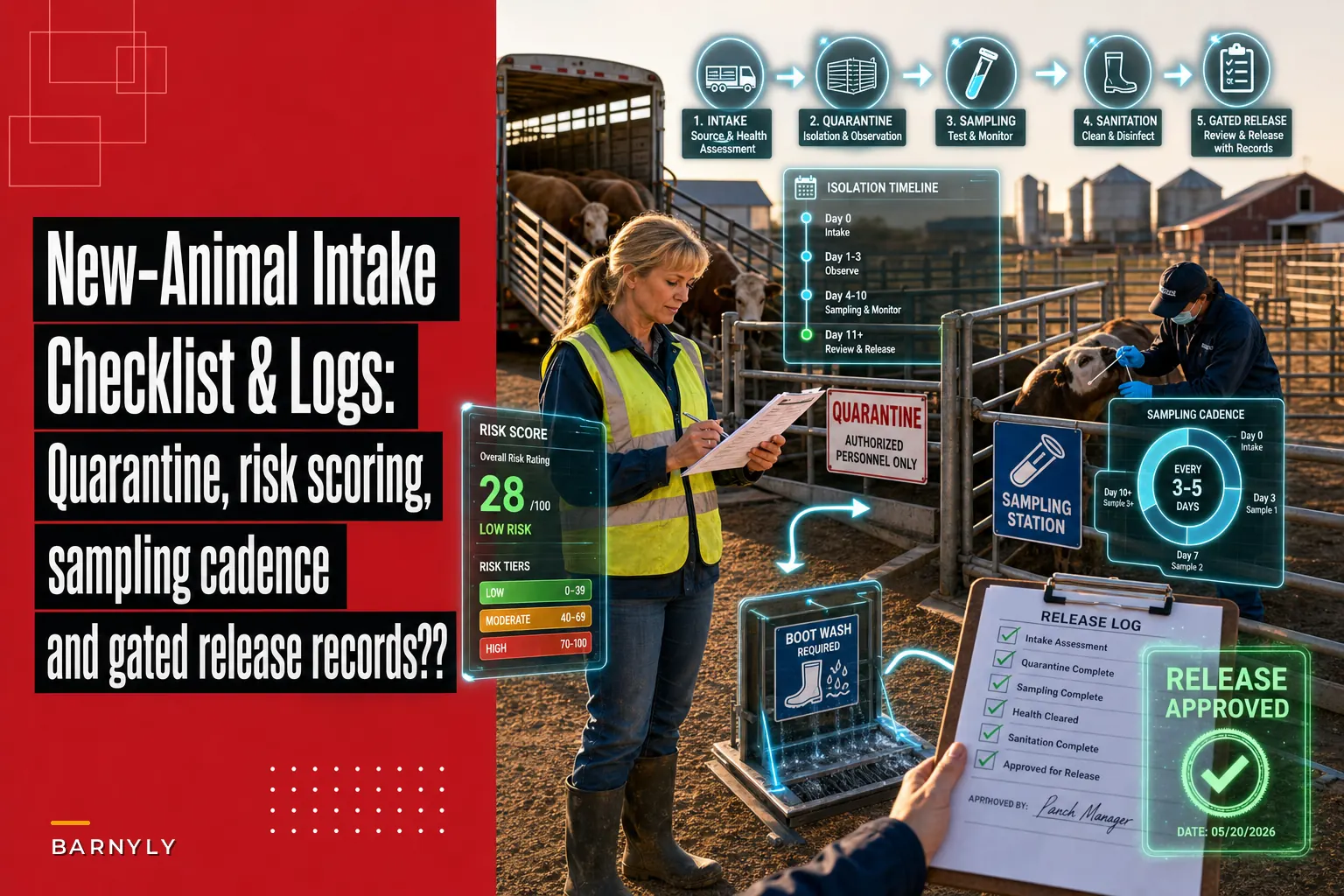
A quick visual of the intake workflow helps teams follow the steps consistently.
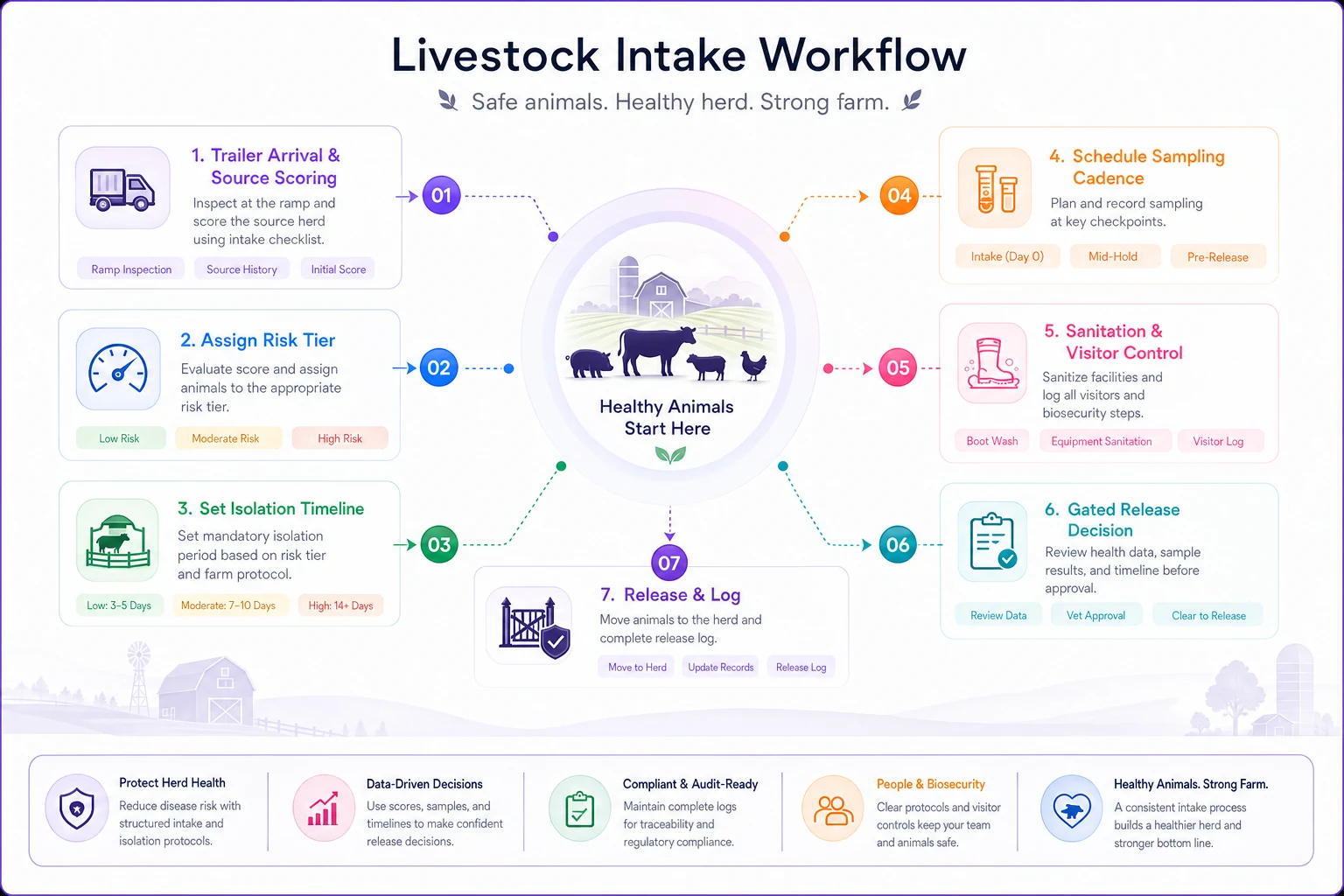
Keeping the scoring grid, sampling dates, visitor entries, and release checklists in one place — instead of spread across a whiteboard, a notebook, and three people's memories — is what turns intake from a recurring gamble into something you run the same way every time. Whether that's a binder with printed logs or a system that timestamps the isolation clock and flags the sampling dates automatically, the principle is the same: the gate should never depend on whether you happened to remember. It should depend on whether the boxes are checked.
Keeping the scoring grid, sampling dates, visitor entries, and release checklists in one place — instead of spread across a whiteboard, a notebook, and three people's memories — is what turns intake from a recurring gamble into something you run the same way every time. Whether that's a binder with printed logs or a system that timestamps the isolation clock and flags the sampling dates automatically, the principle is the same: the gate should never depend on whether you happened to remember. It should depend on whether the boxes are checked.
Ready to optimize your farm management?
Join hundreds of farmers using Barnyly to save time, improve animal health, and increase farm productivity.