

Most contract problems don't show up at signing. They show up about six weeks before delivery, when someone finally cross-checks the pen counts against what's owed and realizes the math doesn't work. The cattle are ten days behind on weight, or the group that was supposed to fill a December load is sixty head short because you pulled replacements out of it back in August and never updated anything.
This is the gap that rarely gets talked about: the forward sales side of the operation runs on paper and memory, while the herd side runs on biology. The two almost never sync up on their own. Livestock contract delivery forecasting is the discipline of keeping those two realities pointed at each other so you stop finding out about shortfalls when it's already too late to fix them.
The quiet drift between your herd and your contracts
A contract says: deliver 180 head, 1,350–1,450 lb, between January 5 and January 20. Simple enough on the page.
Your herd says something much messier. You've got a fall-weaned group gaining about 2.6 lb/day on the current ration, a slower back-end draft closer to 2.1, and a handful already flagged as culls-not-finishers. Weaning happened over three separate days in September depending on the paddock. Nobody wrote down which calves came off which cows in which group, so the "180 head" you promised is really a soft estimate sitting on top of a dozen smaller assumptions.
The drift happens because every herd event quietly changes the delivery picture, but almost nobody re-runs the forecast after each one. Weaning early to save a thin pasture pulls the finishing window forward. A respiratory outbreak in one pen pushes a subset back three weeks. You sell twenty head opportunistically because a buyer showed up with cash. Each decision makes sense on its own. Stacked together over a season, they turn a signed contract into a guess.
What tends to happen is that the people making day-to-day herd calls — the ones weaning, sorting, treating — aren't the same people tracking the contract calendar. So the information that should trigger a forecast update lives in one person's head and never reaches the spreadsheet where delivery dates actually matter.
Why "we'll have enough" is the most expensive sentence on the ranch
The real cost isn't the shortfall itself. It's what the shortfall forces you to do.
Simplify farm operations and enhance animal care.
Barnyly helps you organize, track, and manage every aspect of your farm operations seamlessly.
- Comprehensive livestock tracking
- Automated health alerts
- Feed and resource scheduling
No credit card required
When you come up short on a delivery window, you've got three bad options and no good ones:
-
Buy-ins at market to fill the load, usually at a worse basis than your own cost of gain
-
Push underweight animals into the delivery and eat the price slide on light cattle
-
Renegotiate or default, which costs you credibility with a buyer you probably want to sell to again next year
A typical example looks like this: a cow-calf-to-finish operation contracts roughly 200 head for a late-winter window. By delivery they're about 35 short of weight spec because a July heat event knocked gains back for most of a month and nobody adjusted the finishing timeline. They buy 35 head to cover, paying somewhere around $90–$120 a head over their own cost of gain, plus freight. Call it a $4k–$5k hit on one contract. Not ruinous. But it was also completely predictable six weeks earlier, and nobody looked.
The deeper problem is that none of this shows up in your P&L cleanly. It gets buried as "market purchases" or "freight" and never gets traced back to the weaning decision that actually caused it. If you want the full picture of how herd events ripple into cash timing, the logic behind mapping herd events to your P&L is worth sitting with — contract forecasting is really just the operational front end of that same financial reality.
Mapping herd events to contract milestones
The fix starts with a map, not software. You need to write down, for each contract, which group of animals is supposed to fill it and what has to be true for that to happen.
Think of every contract as having milestones that depend on biological events, not calendar dates alone:
| Contract milestone | Depends on herd event | What drifts it |
|---|---|---|
| Group identified | Weaning + sorting complete | Late weaning, re-sorts, cull pulls |
| On target for weight | Finishing window / ADG holding | Disease, heat, ration changes, feed quality |
| Ready to ship | Final weight check vs. spec | Slower back-end draft, weather delays |
| Delivered + reconciled | Load-out + count confirmed | Last-minute shrink, held-back animals |
The point of the table isn't to look organized. It's to force the question that never gets asked: which specific event, if it slips, breaks this contract? Once you can name that event per contract, you know exactly what to watch.
For most finishing contracts, the two events that matter most are the weaning date (it sets the clock) and the mid-finish weight check (it's your first honest signal of whether ADG is holding). Everything else is downstream of those two.
Building a delivery-forecast calendar off life-stage records
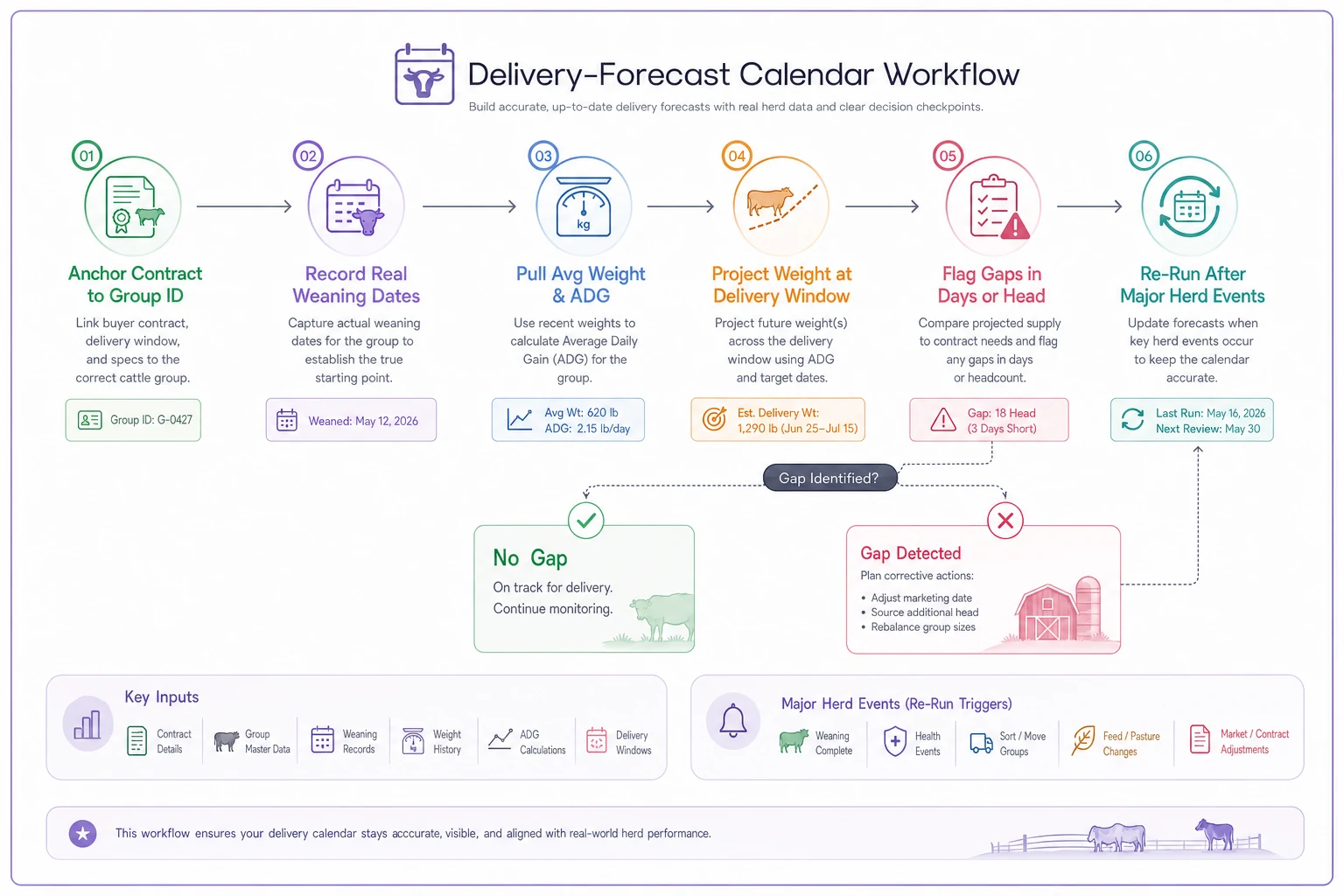
A delivery-forecast calendar is just your contract dates projected backward through life-stage records to see whether the biology actually supports the commitment.
Here's the process that holds up on the ground:
-
Anchor each contract to a group ID, not a vague headcount. "Group N-3, pen 4 and 5" beats "the fall steers."
-
Record the real weaning date per group — the actual date, not when you intended to. This is your forecast's starting line.
-
Pull a current average weight and ADG for the group. Even a monthly weigh-up on a representative draft beats guessing.
-
Project weight at the delivery window using current ADG, then compare to spec. If the group needs 1,400 lb by Jan 10 and the projection says 1,355, you have a problem you can see in October.
-
Flag the gap in days or head. Either you're short on weight ("needs 20 more days") or short on count ("14 head won't make spec"). Both are fixable early, neither is fixable late.
-
Re-run after every major herd event. Weaning, re-sort, outbreak, ration change, opportunistic sale. Each one updates the projection.
Here's a quick workflow illustration.
The weigh-up cadence is where people cut corners and pay for it. You don't need to weigh every animal every week. But a group filling a contract should get a real weight check at mid-finish and again about three to four weeks out from delivery. That three-to-four-week check is the last point where you can still change the ration or shift animals between contracts and have it actually matter.
If your ration assumptions are shaky, the forecast is shaky, because ADG is only as reliable as the feed behind it. Tightening up feed budgets by life stage feeds directly into this — a projection built on a ration you can't sustain through winter is just optimism with a date on it.
Reallocation rules: the part everyone skips
This is where forecasting turns into actual operations. When a forecast flags a gap, you need rules decided in advance for how to respond, because the worst time to invent a reallocation policy is the week of delivery when you're already stressed and running out of options.
Reallocation rules answer one question: when headcount or timing changes, how do animals move between contracts?
A few that hold up in practice:
-
Weight-spec contracts get first claim on the fastest-gaining group. If you have a tight-window, tight-weight contract and a looser one, don't let the loose contract eat your best cattle.
-
Short on one contract, long on another? Shift within tolerance before buying in. If contract A is 15 head short and contract B has 20 head that'll finish early, move them — assuming spec and buyer allow it. Buying from yourself is always cheaper than buying from the market.
-
Set a "cut-off to decide" date per contract. For a mid-January delivery, you might set December 10 as the day you commit to the plan: fill from inventory, buy in, or renegotiate. After that date, you're just reacting.
-
Protect the relationship contract over the spot contract. When you genuinely can't cover both, keep the buyer you want next year and take the pain on the one-off.
Set your per-contract cut-off dates at least three weeks before delivery so you have time to reallocate or buy in.
The reason reallocation rules matter is that headcount always changes. Deaths, culls, opportunistic sales, a group that outperforms and finishes a week early. A static plan assumes a static herd, and no herd is static. The rules let the plan flex without a meeting every time a number moves.
Operations that write reallocation rules down almost never end up buying cattle to fill contracts. Not because they forecast perfectly, but because they catch the shortfall while they still have internal room to move. The rules force the early look.
A real scenario
A mixed cow-calf and finishing operation running roughly 600 head carried three forward contracts across a winter delivery season. For years the pattern was the same: one of the three contracts came up short most seasons, and they'd scramble to cover with market buy-ins, usually losing somewhere in the $4k–$8k range per bad contract once you counted premium and freight.
The change wasn't dramatic. They started doing one thing consistently: assigning each contract to a named group at weaning, logging the actual weaning dates, and running a weight projection at mid-finish and again about a month before each window. When the mid-finish check showed a group tracking light, they had time to either bump the ration or shift a dozen early-finishing head over from a looser contract.
Over two seasons the buy-ins basically stopped. They still had the occasional light group, but they were catching it in October instead of January. The money saved wasn't really the headline — it was that they stopped burning goodwill with their two repeat buyers, both of whom started offering slightly better basis the following year because deliveries were showing up on spec and on time. That relationship effect ended up being worth more than the buy-in savings.
When this is worth the effort — and when it isn't
This discipline earns its keep when you're running forward contracts with real weight or window specs, especially if you've got more than one contract competing for the same pool of animals. Multiple contracts plus a variable herd is exactly the situation where reallocation rules pay off.
It's probably overkill if you sell everything at auction with no forward commitments and no spec to hit. There's nothing to forecast against. You're a price-taker on delivery day, and a projection calendar doesn't change that.
It's also the wrong first move if your underlying records are a mess. If you can't reliably say which animals are in which group, or you don't have even a rough handle on ADG, build that foundation first. A delivery forecast sitting on top of guessed weights and fuzzy group assignments just gives you false confidence — which is worse than no forecast at all.
Where tools fit, lightly
You can run all of this on a whiteboard and a spreadsheet, and plenty of good operations do exactly that. The spreadsheet starts to break down when herd events and contract dates live in separate places and nobody remembers to re-run the projection after each weaning or re-sort. That's the actual failure point — not the math, but the updating.
This is where operational software genuinely earns its place: when life-stage records and contract milestones share the same system, a weaning entry or weight check can automatically flag which contracts just moved out of spec. The shortfall surfaces on its own instead of waiting for someone to notice. The value isn't in fancy prediction — it's in removing the human step where the update gets forgotten, which in practice is where almost every missed delivery actually comes from.
The tool is secondary, though. The thinking is the point: name the group per contract, log the real weaning dates, project weight backward from the window, re-run after every herd event, and decide your reallocation rules before you need them. Do that with a notebook if you want. The operations that deliver on spec year after year aren't the ones with the best software — they're the ones who look at the gap while there's still time to close it.
Ready to optimize your farm management?
Join hundreds of farmers using Barnyly to save time, improve animal health, and increase farm productivity.