

Point-of-care tests are useful right up until someone treats a result as more certain than it actually is. A cow-side ketone reading, a snap test for BVD, a refractometer number on colostrum, a California Mastitis Test paddle — every one of these produces a number or a color, and every one of them can lead you badly astray without rules attached to it.
The problem isn't the tests. It's the missing layer between "here's a result" and "here's what I did about it." Most farms run tests inconsistently, interpret them from memory, and skip confirmatory steps whenever things get busy. Then three months later a vet or an inspector asks why you treated an animal, and the answer is a shrug and a half-remembered reading.
This is a decision-tree problem. You need a repeatable path from sample to interpretation to action — thresholds written down, confirmatory rules that trigger automatically, and a short list of record fields captured every single time. Get that right and your on-farm point-of-care testing SOP stops being a guessing game.
The specific failure: a good test, a wrong action
Here's how it actually goes wrong. A heifer looks off two weeks after calving. Someone grabs a handheld ketone meter, gets a blood BHB reading of 1.4 mmol/L, and decides she's got subclinical ketosis. She gets propylene glycol, gets logged (maybe), and everyone moves on.
Except 1.4 sits right in the gray zone. Depending on your reference, subclinical ketosis starts around 1.2–1.4 mmol/L, and clinical closer to 3.0. A single reading at 1.4 could mean a mild transient bump, or it could be the front edge of a real problem. Treating it as a hard diagnosis on one number, from one meter, on one morning, is where farms get into trouble — either over-treating animals that didn't need it or missing the ones sliding toward displaced abomasum.
The same pattern shows up elsewhere:
-
A refractometer reads colostrum at 21% Brix (right at the 22% pass line) and the calf gets fed it anyway with no plasma follow-up.
-
A CMT paddle shows a "trace" reaction and the quarter gets dry-treated when it should've had a culture first.
-
A fecal egg count from a single animal gets used to deworm the whole group.
None of these are testing failures. They're decision failures — the test worked fine, the rule around it didn't exist.
Why farms end up here
Thresholds live in people's heads. The person who knows that colostrum Brix under 22% needs a plasma-transfer check is the same person who's out at 5 a.m. and unavailable when the night calver runs the test. When the number isn't written next to the test, everyone applies their own version — or none at all.
Simplify farm operations and enhance animal care.
Barnyly helps you organize, track, and manage every aspect of your farm operations seamlessly.
- Comprehensive livestock tracking
- Automated health alerts
- Feed and resource scheduling
No credit card required
Confirmatory testing feels optional under time pressure. A confirmatory step (a second reading, a culture, a lab submission) always costs time you don't have in the moment. So the "run again to confirm" step quietly disappears, and single borderline readings become treatment decisions.
Records get written after the fact, if at all. A result scribbled on a glove or remembered hours later loses the context that makes it useful — which animal, which sample, what time, which meter, what the calibration status was. Without that, you can't compare today's reading to last week's, and you definitely can't defend it later.
What you see across a lot of livestock operations is that the farms with the best diagnostic accuracy aren't running fancier tests. They've just moved the judgment out of the stressful moment and into a written decision-tree they follow the same way every time.
The consequences add up quietly
The cost of a bad on-farm diagnosis is rarely dramatic. It's a slow leak.
Over-treating borderline ketosis cases wastes product and labor and masks the real metabolic picture in your fresh-cow group. Feeding marginal colostrum without a follow-up transfer check produces calves that look fine at day two and fall apart at day fourteen with scours or pneumonia — and now you're chasing a downstream problem you could've caught at the source. Deworming off a single fecal that wasn't representative accelerates resistance you'll be fighting for years.
Then there's the audit angle. When you record a treatment, the justification behind it matters. If your medication and treatment records can't point to a test result with a threshold behind it, your whole case for using the product gets shaky — which is exactly the problem covered in turning antimicrobial records into defensible audit packs. A test result without a decision rule attached isn't evidence. It's just a number you happened to write down.
The decision-tree structure that fixes it
Build each common test as a small decision-tree with four fixed parts: the threshold, the confirmatory rule, the mandatory record fields, and the escalation trigger. Every test gets the same four. That consistency is the whole point.
Here's how those four pieces look across a handful of common on-farm tests:
| Test | Interpretation thresholds | Confirmatory rule | Escalation trigger |
|---|---|---|---|
| Blood BHB (ketosis) | <1.2 normal · 1.2–2.9 subclinical · ≥3.0 clinical | Re-test borderline (1.2–1.4) same animal within 24h before treating | Any clinical (≥3.0) + off-feed → vet call for DA/metabolic check |
| Colostrum Brix | ≥22% pass · <22% marginal/fail | Second reading if within 1% of cutoff | Fail + no backup colostrum → escalate to plasma/transfer protocol |
| Calf serum total protein (transfer) | ≥5.5 g/dL adequate · <5.5 failure of passive transfer | Confirm meter reading against a second calf in group | Group-wide low readings → vet review of colostrum program |
| CMT (mastitis) | Neg/trace normal · 1–3 reaction abnormal | Milk culture before dry/antibiotic treatment | Systemic signs (fever, off-feed) → vet, don't wait for culture |
| Fecal egg count | Species/season dependent thresholds | Composite or repeat sampling before whole-group treatment | Rising counts post-treatment → resistance testing at lab |
Notice what the confirmatory column does: it stops single borderline readings from turning into actions. That one habit prevents most of the bad diagnoses.
The mandatory record fields (capture these every time)
The record fields aren't paperwork for its own sake. They're what makes a result comparable, defensible, and actually useful next week. Skip a field and you often can't interpret the reading at all.
-
Animal/group ID — exact, not "the fresh heifer in the north pen"
-
Date and time of sample
-
Test type and device used (meter serial or paddle lot if relevant)
-
Calibration/control status — when was the meter last checked, did controls pass
-
Raw result — the actual number or reaction, not your interpretation of it
-
Interpretation applied — which threshold band it fell into
-
Confirmatory result — if the rule triggered one
-
Action taken — treatment, re-test, escalate, or watch
-
Operator — who ran it
The calibration field is the one people skip and regret. A ketone meter or refractometer that drifted gives you numbers that look real and aren't. If you can't confirm the device was working, you can't trust the reading — and you can't defend the decision you made off it.
A workflow that runs the same at 5 a.m. or 5 p.m.
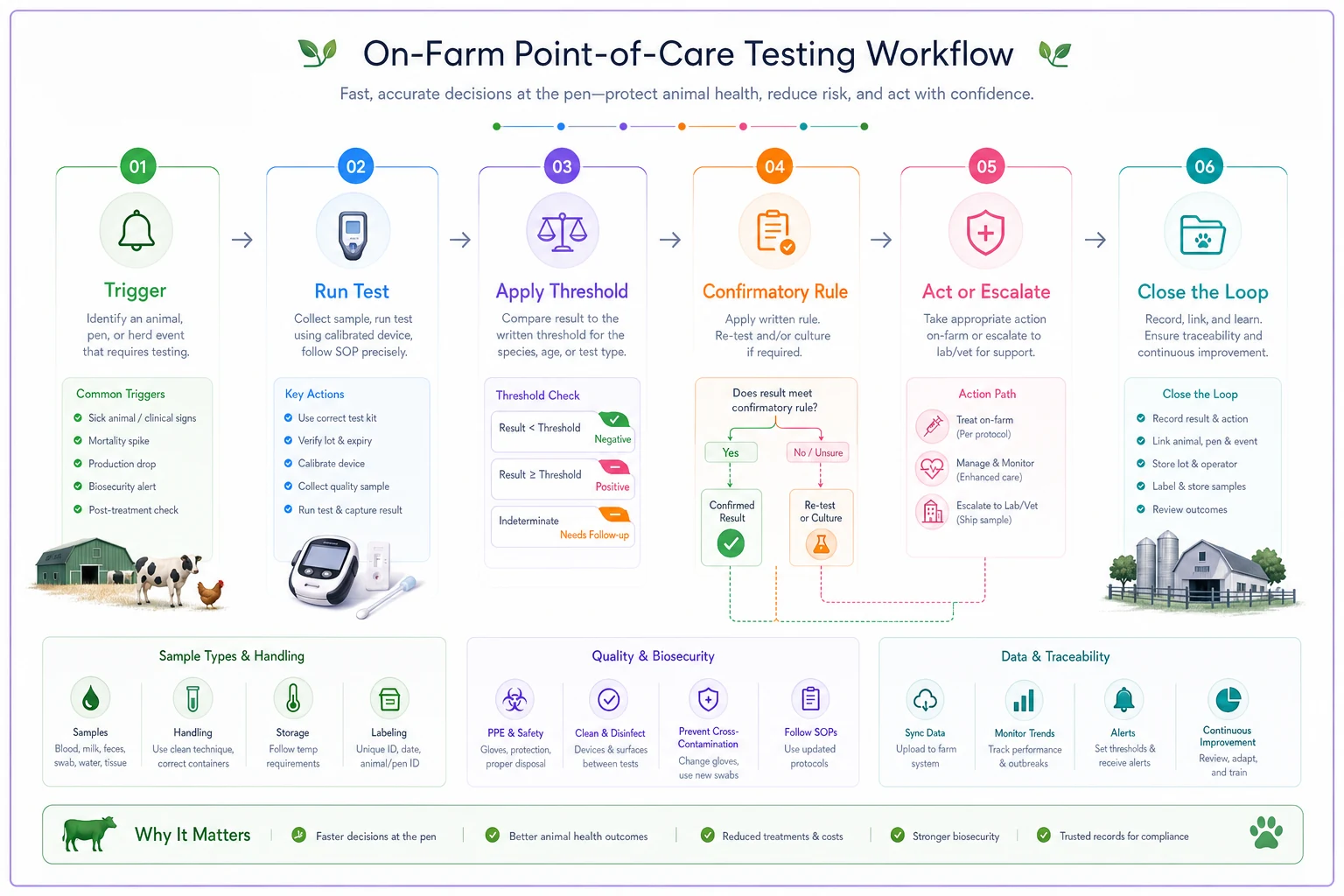
The tree only works if the workflow around it is dead simple. Here's the path from animal to action:
-
Trigger. Something prompts a test — a sick animal, a fresh-cow protocol, a scheduled screen. The reason gets logged first, before the result, so you're not reverse-justifying.
-
Run the test to protocol. Same technique, same device, controls checked. Raw result recorded immediately.
-
Apply the written threshold. Not memory — the actual threshold card for that test. Borderline results get flagged, not guessed at.
-
Check the confirmatory rule. If the result is borderline or triggers a rule, the tree tells you to re-test, culture, or hold. You don't decide this in the moment; the rule already decided it.
-
Act or escalate. Clear result inside normal range → routine action. Escalation trigger met → the sample or animal goes to lab or vet, with a submission form already started.
-
Close the loop. Action taken gets logged against the original result, and any lab/vet follow-up gets linked back.
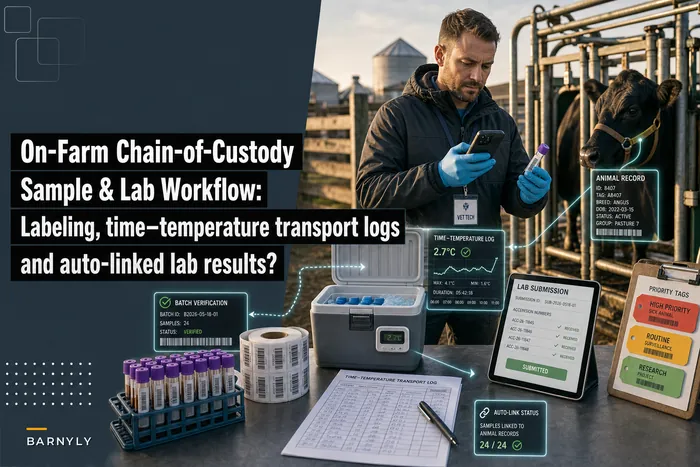
When escalation means sending something off-farm, the sample's value depends entirely on how it's handled and labeled — which is its own discipline, walked through in this on-farm chain-of-custody and lab-submission workflow. A borderline reading that triggers a lab confirmation is worthless if the sample arrives mislabeled or degraded.
A real scenario: the dairy that stopped over-treating ketosis
A mid-size dairy running around 200 milking cows was testing fresh cows for ketosis inconsistently. Different people used the meter, nobody logged calibration, and borderline readings around 1.3–1.5 mmol/L got treated with propylene glycol roughly as often as they got ignored, depending on who was working that shift.
They weren't tracking it closely, but they were burning through a lot of propylene glycol and still seeing fresh-cow problems downstream. Some cows got treated who probably didn't need it; some real subclinical cases got missed because a single low-ish reading got waved off.
They put in a simple three-part rule: test every fresh cow at day 3–5, record the raw BHB plus calibration status, and re-test any reading between 1.2 and 1.4 within 24 hours before treating. Anything at 3.0 or above plus off-feed went straight to a vet call rather than another dose of glycol.
Over the next couple of months, treatment volume for borderline cases dropped noticeably — a chunk of the "just in case" treatments disappeared because the confirmatory re-test brought a lot of those 1.3s back under threshold the next day. More importantly, the genuine cases sliding toward displaced abomasum got caught earlier because the ≥3.0 escalation rule forced a vet conversation instead of more propylene glycol. Product use went down and fresh-cow outcomes got steadier. The change wasn't a better test. It was the confirmatory step nobody had bothered to write down.
When this level of structure makes sense — and when it doesn't
When it's worth it: Any farm where more than one person runs tests, where test results feed treatment and medication decisions, or where you're subject to audit for antimicrobial use. The more hands touching the meter, the more you need thresholds out of people's heads and onto a card.
When it's overkill: If you're a very small operation, one person runs every test, and you genuinely apply the same threshold and confirmatory habits every time — you may not need a formal tree. But be honest about whether that consistency is real or just assumed. Most people overestimate how consistent their memory-based decisions actually are.
Who should not skip this: Anyone deworming off single samples, anyone dry-treating off CMT without ever culturing, and anyone whose treatment records currently can't point back to a test result. Those are the exact patterns that produce both bad outcomes and indefensible records.
Keeping the tree from rotting
A decision-tree written once and never revisited drifts out of date as fast as any other SOP. Thresholds change with new references, meters get replaced, seasons shift fecal thresholds. The tree needs an owner and a review schedule — even a quick annual check with your vet to confirm the threshold bands still match current guidance for your region and species.
Store decision-trees in a shared system so confirmatory rules can prompt automatically and thresholds stay in sync.
This is where keeping everything in a shared operational system, rather than a laminated card in the barn, starts to matter. When thresholds, record fields, and escalation rules live in the same place as your treatment records and lab submissions, confirmatory rules can prompt automatically, borderline results can get flagged without relying on memory, and a result that triggers escalation can pre-fill the submission or vet-referral record instead of waiting for someone to remember to start one. The point isn't the software — it's that the decision-tree actually runs the same way every time, even when the person holding the meter changes.
Bad on-farm diagnoses almost never come from bad tests. They come from good tests with no rules attached — a borderline number treated as certainty, a confirmatory step skipped under pressure, a result recorded without the context that makes it mean anything.
Build each common test as a small tree: a written threshold, a confirmatory rule that stops single borderline readings from becoming actions, a fixed set of record fields, and a clear escalation trigger to lab or vet. Do that, and your on-farm point-of-care testing SOP stops depending on how sharp your judgment was that particular morning — and starts producing decisions you can trust and defend, no matter who's holding the meter.
Ready to optimize your farm management?
Join hundreds of farmers using Barnyly to save time, improve animal health, and increase farm productivity.