

Most antimicrobial records on farms aren't wrong. They're just thin. A date, a drug, a dose, maybe an ear tag. That's enough to satisfy the label and enough to feel like you did your paperwork. It's nowhere near enough when a vet, a processor auditor, or a certification reviewer asks the real question: why did you reach for that drug, that day, for that animal?
That gap — between "I wrote it down" and "I can defend it" — is where farms lose points on stewardship audits. And it's getting more expensive to ignore. Buyers, integrators, and certification schemes increasingly want to see judgment, not just administration. They want to see that you tried something else first, that you had a threshold for calling the vet, and that you checked whether the animal actually got better.
This is about building records that answer why and what happened next, not just what and when.
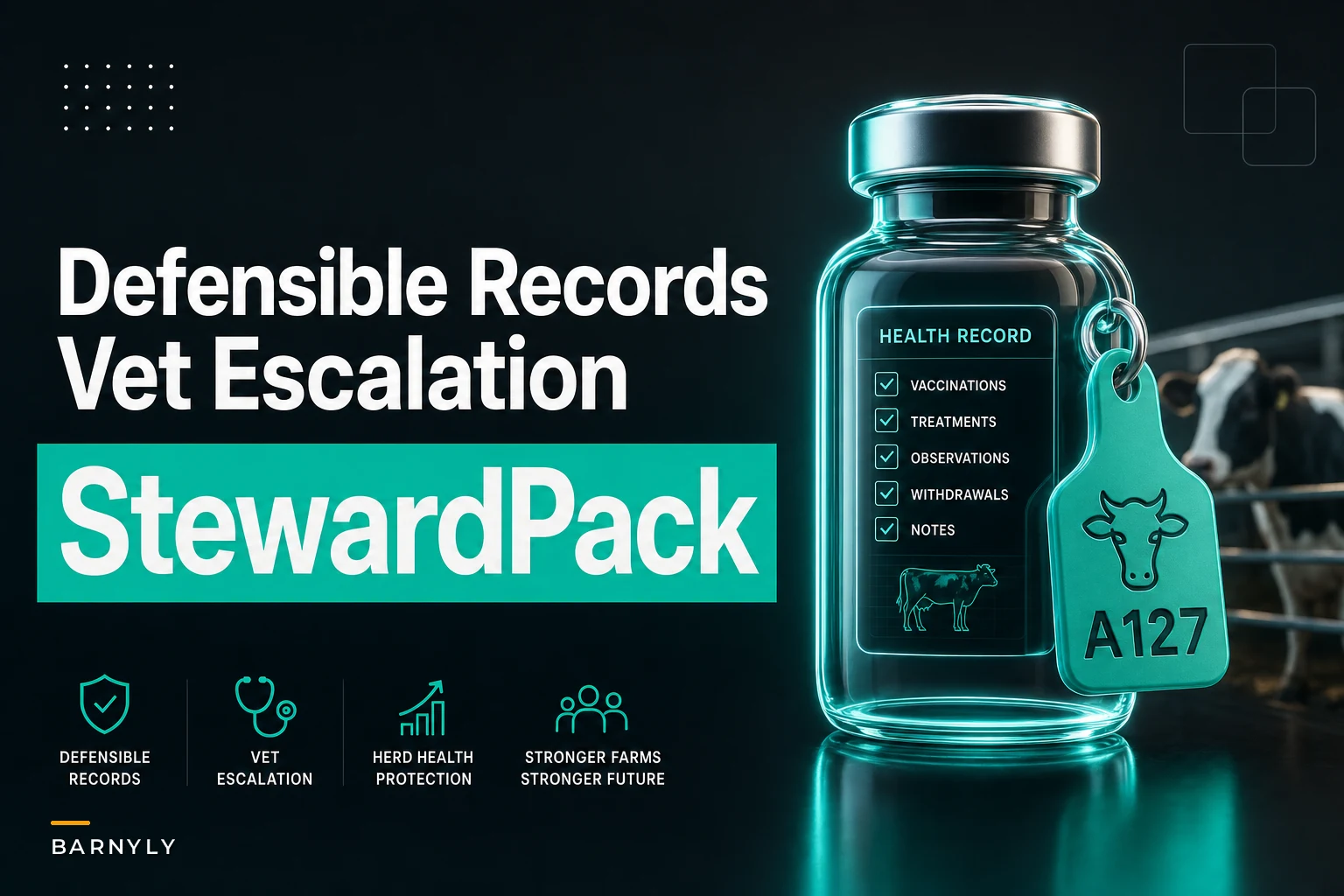
What a "defensible" record actually looks like
There's a real difference between a compliant record and a defensible one. Compliant means you logged the treatment. Defensible means the log tells a story a reviewer can follow and agree with — months later, without you standing there to explain it.
Same event, two ways.
| Field | Thin record (compliant) | Defensible record |
|---|---|---|
| Animal | Cow #418 | Cow #418, 3rd lactation, DIM 62 |
| Date/time | Mar 14 | Mar 14, 07:20 |
| Clinical signs | — | Off feed ~24h, drop in yield, rectal temp 40.1°C |
| Suspected condition | Mastitis | Clinical mastitis, LR quarter, clots + swelling |
| Alternatives tried | — | Frequent stripping + NSAID started Mar 13, no improvement in 24h |
| Justification | — | Systemic signs + fever after supportive care failed; culture pending |
| Drug/dose/route | Antibiotic | [product], label dose, IMM + systemic per protocol |
| Escalation | — | Vet phoned Mar 14 08:00, plan confirmed |
| Outcome check | — | Recheck scheduled Mar 17 |
| Withdrawal | — | Milk + meat dates logged, flagged on tank board |
The thin version is technically fine. But it can't answer a single follow-up question. The defensible version shows you didn't reach for antibiotics first, you had a reason, you looped in your vet, and you planned to verify the outcome. That's the whole game.
The extra fields aren't clinical genius. They're just the questions an auditor will ask anyway — pre-answered at the moment you still have the information, instead of reconstructed from memory three months later.
Why records go thin in the first place
Nobody sets out to keep weak records. It happens because of when the recording occurs.
Simplify farm operations and enhance animal care.
Barnyly helps you organize, track, and manage every aspect of your farm operations seamlessly.
- Comprehensive livestock tracking
- Automated health alerts
- Feed and resource scheduling
No credit card required
Treatment decisions happen in the worst possible conditions for documentation. It's early, it's cold, the animal is fighting the crush, and you've got three more jobs stacked behind this one. You do the treatment and tell yourself you'll write the details later. Later, you remember the drug and the tag. The reasoning — the part that makes it defensible — is gone within hours.
The second reason is that most record formats don't ask for justification. If your logbook or app only has fields for drug, dose, and date, that's exactly what you'll fill in. A blank "notes" box gets skipped the vast majority of the time because it demands effort with no obvious structure. People fill labeled fields and skip the ones that aren't.
Third, alternatives-tried almost never gets recorded because it happened before the treatment. The supportive care, the wait-and-see, the fluids or NSAID you tried yesterday — by the time you're logging the antibiotic, that earlier effort feels like a separate event, so it never makes it into the same record. But that's the single most valuable line for stewardship: proof that antibiotics weren't the first reflex.
The four fields that turn a log into an audit pack
If you change nothing else, make these four fields mandatory on every antimicrobial entry. Not optional. Mandatory — the record isn't considered complete until they're filled.
-
1. Justification. One or two lines
what clinical signs, what suspected condition, why this treatment now. "Fever 40.1, off feed 24h, mastitis with clots" is enough. No need for a paragraph.
-
2. Alternatives tried. What you did before reaching for the antimicrobial, or an honest "none — acute presentation requiring immediate treatment." Even "none" is defensible when the reason is stated.
-
3. Escalation flag. Did this cross a threshold that needed vet involvement? Yes/no, plus who and when. This is where a vet-escalation rule earns its keep.
-
4. Outcome check date. A scheduled recheck. Not "monitor." An actual date — because a date can be followed up and "monitor" can't.
Those four fields, attached to the drug/dose/route data you already collect, produce a record that reads as a decision rather than a transaction.
Vet‑escalation triggers: writing the rule down before you need it
The weakest part of most stewardship stories isn't the treatment — it's the moment the vet should have been involved and wasn't, or was, but there's no record of it.
The fix is defining escalation triggers in advance, as part of your protocol, so the decision to call isn't a judgment call made under pressure every single time. These are conditions that automatically require vet contact before or alongside treatment.
-
Any use of a higher-priority or critically important antimicrobial
-
Treatment failure — no improvement within a defined window (e.g., 48–72h) on first-line therapy
-
More than a set number of animals showing the same signs within a short period (possible outbreak)
-
Any treatment of an animal in a group already treated recently for the same condition
-
Systemic signs — high fever, down animal, rapid deterioration — rather than localized
-
Anything off-label or outside the standing herd health plan
The value here is twofold. First, you stop treating in situations where a vet genuinely should be making the call. Second, when the trigger fires and you log the contact, you've created a record that shows your farm has rules, not just habits. Auditors respond very differently to "we call the vet when treatment fails at 48 hours" than to "we usually ring him if it seems bad."
Here's a simple workflow diagram of triggers, vet contact, and logging steps.
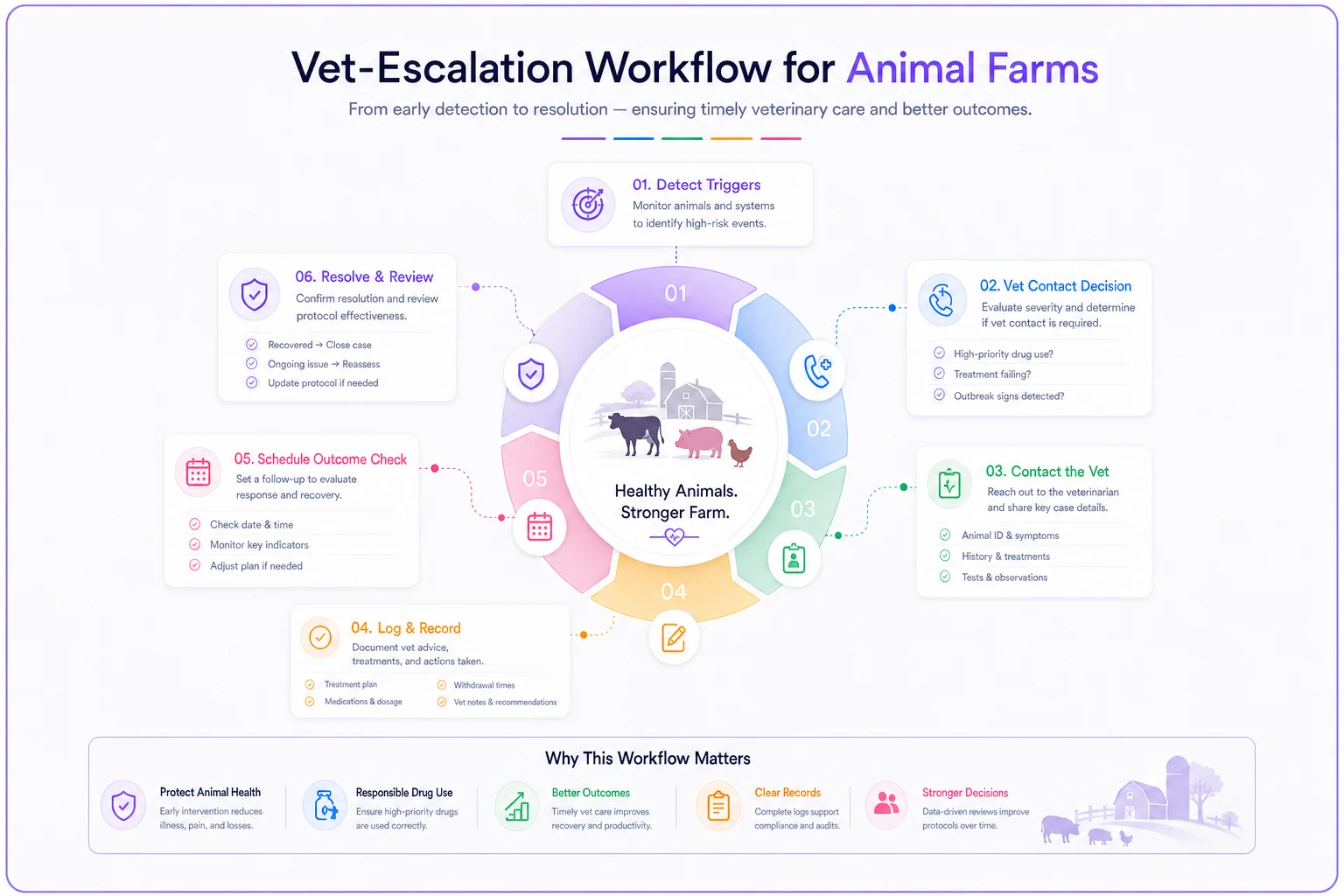
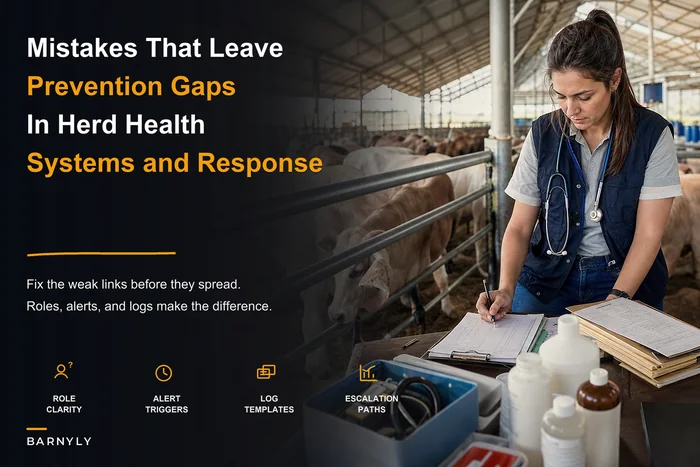
Write the triggers into the same protocol that defines your first-line treatments. If you've already worked on tightening your herd-health protocols, this is a natural extension — and it plugs directly into the kinds of gaps covered in common herd-health system mistakes, where a missing escalation step tends to be one of the more damaging blind spots.
Outcome checks: the field everyone forgets
Farms record treatments carefully and then never record whether the treatment worked. So the file is full of antibiotic administrations and completely empty on results.
That's a problem for two reasons. Operationally, you can't tell if a product is failing on your farm — you might be repeating a drug that stopped working months ago. And from an audit standpoint, a stewardship program with no outcome data looks like you're treating on autopilot.
Schedule the recheck date at the time of treatment so the follow-up is a discrete task rather than a vague reminder.
A scheduled outcome check fixes both. Set a recheck date at the moment of treatment — 3 days, 7 days, whatever fits the condition. On that date, log one of three outcomes: resolved, improved – continuing, or failed – escalated. Three states, checked against a date.
Over a season, those outcomes become genuinely useful data. If a first-line mastitis treatment is showing "failed" on a significant portion of cases, that's a conversation to have with your vet about the protocol — not something to discover next year. Outcome logging turns your treatment records into a feedback loop instead of a filing cabinet.
A short real scenario
A mixed dairy-and-beef operation running around 240 head kept perfectly adequate treatment records — drug, dose, date, tag — for years. During a buyer-driven stewardship review, the reviewer pulled fifteen antimicrobial entries at random and asked, for each, what was tried first and whether the animal recovered.
They could answer maybe three from documentation. The rest were memory-based guesses. The review didn't fail them outright, but it came back with a corrective-action note and a re-review scheduled for the following quarter — which meant staff time, a follow-up vet visit to sign off on a revised protocol, and the quiet stress of being flagged.
The change they made was small. They rebuilt their treatment record around the four mandatory fields, wrote three escalation triggers into their herd health plan, and started setting a recheck date on every entry. No new software at first — just a redesigned paper form with the fields printed on it so they couldn't be skipped.
At the re-review, the reviewer pulled records the same way. This time the answers were on the page. The corrective action was closed. The actual treatments hadn't changed much. What changed was that the reasoning was captured at the moment it existed.
Where paper starts to break
Redesigned paper forms get you a long way, and for smaller herds they may be all you need. But two things tend to push operations toward software.
The first is retrieval. When a reviewer asks for "all fluoroquinolone use in the last twelve months" or "every treatment recorded as failed," flipping through paper is slow and error-prone. The second is enforcement. Mandatory fields only stay mandatory on paper if a human notices they're blank — and under pressure, they often don't.
This is where a workflow-based approach helps, and it's worth being honest about what it does and doesn't do. AI-assisted operational platforms won't make your clinical decisions — they shouldn't. What they do well is enforce structure and remove memory from the equation: refusing to close a treatment record until the justification and alternatives fields are filled, flagging an escalation automatically when an entry matches a trigger you defined, and generating the outcome-check task on the recheck date so it lands on someone's list instead of disappearing.
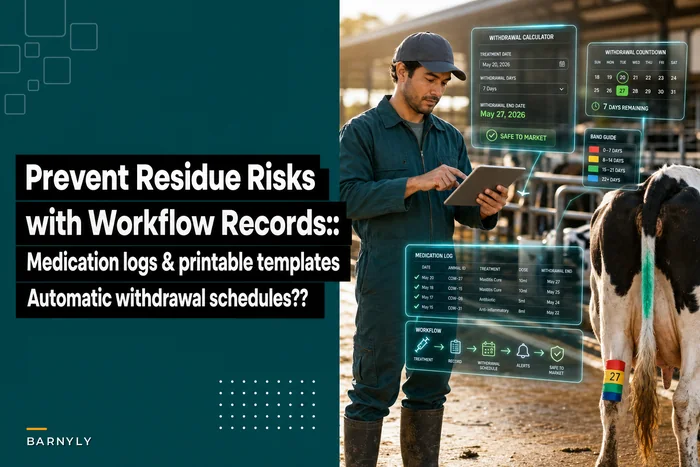
It's the same logic behind pairing medication logs with automatic withdrawal calculators — the tool handles the part humans reliably miss under time pressure, and leaves the judgment to you. When an audit request comes in, "pull every failed first-line treatment with vet escalation from the last year" becomes a filter, not a weekend project.
When this level of rigor makes sense — and when it's overkill
When it's worth it: You sell into a supply chain with stewardship requirements, you're pursuing or maintaining a certification, you run enough head that memory genuinely can't hold the detail, or you've already been flagged once. In those cases, the four fields and the escalation rules pay for themselves the first time you're reviewed.
When it's probably overkill: A very small operation treating a handful of animals a year, with a close working relationship with a vet who's involved in nearly every decision anyway. If your vet is effectively the escalation trigger every time, the formal ruleset matters less — though even then, the outcome-check habit is cheap and useful.
Who should not half-do this: Don't add the justification field but leave it optional. A record system that sometimes captures reasoning is arguably worse than one that never claims to, because the gaps look like you had something to hide. If you commit to the fields, make them mandatory and hold that line.
The takeaway
An on-farm antimicrobial stewardship workflow isn't about writing more. It's about capturing the reasoning at the exact moment it exists — the signs, the alternatives, the threshold that made you call the vet, and the check that told you whether it worked. Those four things are the entire difference between a record that satisfies a label and a record that survives a reviewer reading it cold.
The farms that handle audits calmly aren't the ones with the neatest handwriting. They're the ones whose records answer the follow-up question before it's asked.
Ready to optimize your farm management?
Join hundreds of farmers using Barnyly to save time, improve animal health, and increase farm productivity.