

A blood tube that sat in a warm truck cab for six hours doesn't tell you much. Neither does a fecal sample labeled "brown cow, back pasture" when you've got forty brown cows. The frustrating part is that the sampling itself usually goes fine. It's everything after the needle comes out that quietly kills the diagnostic value — the handling, the labeling, the transport, and the intake on the lab side.
This is a narrow problem, and I want to keep it narrow. Not herd health strategy, not disease response planning. Just the physical and record trail a sample travels through, and how to build an on-farm diagnostic chain of custody that survives the drive to the lab and lands the result back on the correct animal record without a human squinting at a spreadsheet.
Where the diagnostic value actually leaks out
Most farms don't lose sample quality in one dramatic failure. It's a slow bleed across four handoffs, and each one has a predictable weak spot.
The first leak is time-to-cold. A serum tube for a metabolic panel needs to spin or chill reasonably quickly, but on a real working day the samples ride around in a bucket while you finish the rest of the group. By the time they hit a cooler, hemolysis has already started. You won't see it. The lab will, and they'll either flag it or run it anyway with a quiet asterisk you never notice.
The second leak is labeling that made sense in the moment. In the chute, "third one, sore foot" is perfectly clear. Two hours and thirty animals later, it's noise. People label to their memory, not to a system, because in the moment their memory feels bulletproof.
The third leak is the transport gap — the stretch between the farm and the lab where nobody's watching temperature and nobody's logging time. A cooler with no ice pack, a Friday-afternoon submission that sits over a weekend, a sample left on a loading dock in July.
The fourth leak is intake on the lab side and result routing back. Even if everything upstream was perfect, results come back as a PDF or a portal entry that someone has to manually match to an animal. If the sample was labeled loosely, this is where the whole trail collapses into "which cow was #4 again?"
The consequence isn't just a bad test — it's a bad decision
A degraded or misattributed sample doesn't just waste the $18–$40 you paid for the panel. It wastes the decision you were going to make with it.
Simplify farm operations and enhance animal care.
Barnyly helps you organize, track, and manage every aspect of your farm operations seamlessly.
- Comprehensive livestock tracking
- Automated health alerts
- Feed and resource scheduling
No credit card required
A typical example looks like this: a producer suspects trace mineral deficiency across a group of yearlings, pulls blood from six animals, and the samples get warm before shipping. Copper and selenium values come back borderline. Now you're stuck — do you supplement the whole group based on numbers you half-trust, or do you re-sample and lose another two weeks? Either way you've paid for information you can't act on cleanly. The re-draw, the second shipping, the labor, the delay in treatment — that's easily $200–$400 in real cost for what should have been a clean answer the first time.
Misattribution is worse because it's invisible. A result gets stapled to the wrong animal's record, and now that animal carries a false history. Six months later someone makes a culling or breeding call based on a lab value that belonged to a different cow. You never trace it back, because nothing looked broken.
Build the label standard before you build anything else
Everything downstream depends on the label being unambiguous. Not "cleaner handwriting" — a standard that removes interpretation entirely.
-
Permanent animal ID — the same ID that lives in your records, not a chute-order number. Ear tag, EID, whatever is your source of truth.
-
Sample type — serum, whole blood, fecal, milk, tissue, swab. One code per type.
-
Date and time collected — time matters more than people think for time-sensitive panels.
-
Collector initials — so you know who to ask when something's ambiguous.
-
Test intent or panel — what you're actually asking the lab to look for.
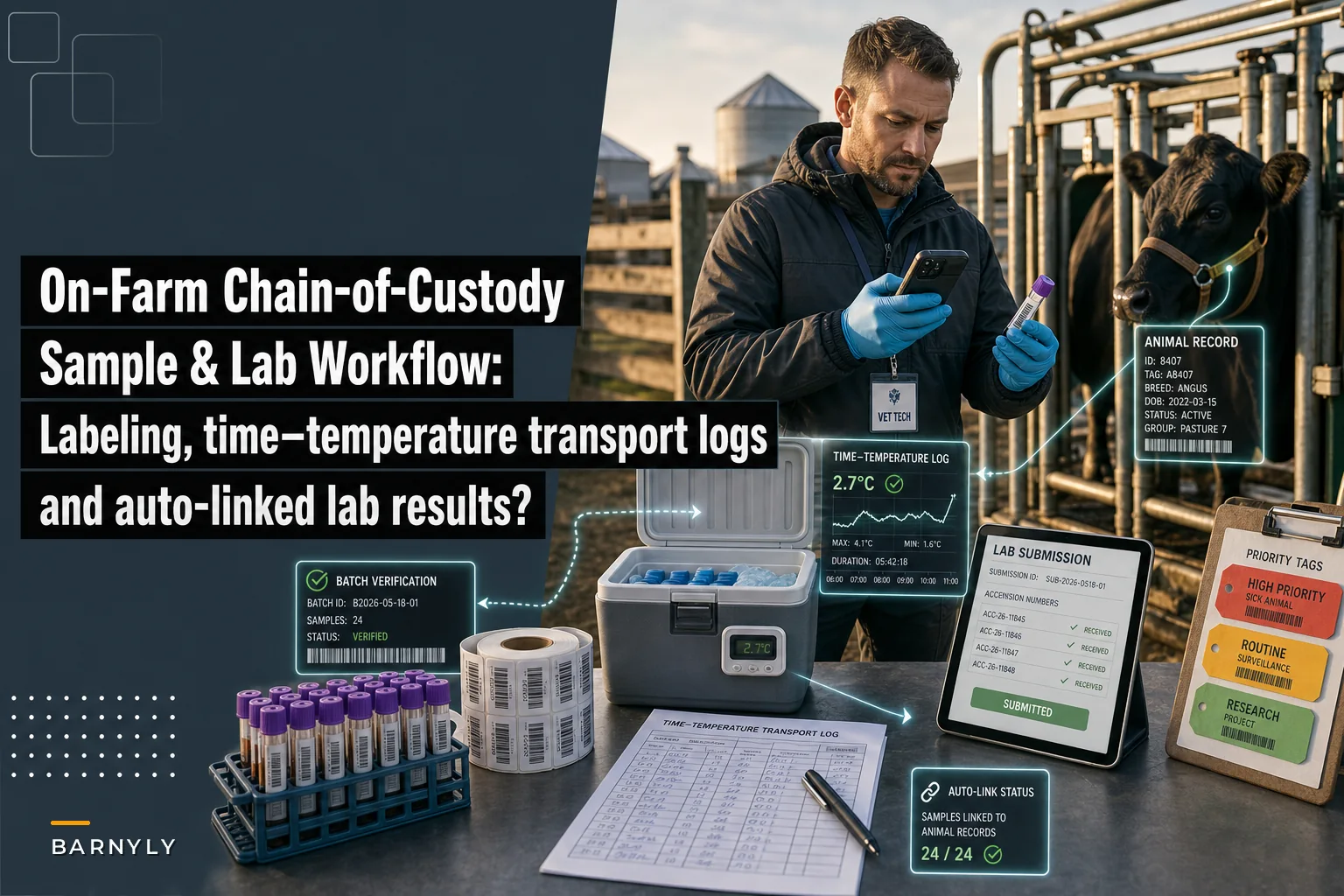
The single biggest upgrade here is moving from handwritten tags to pre-printed or scannable labels tied to the animal's real ID. When the label carries a barcode or the exact ID string from your records, the matching problem on the back end mostly disappears. You're not re-typing anything; you're scanning what you already recorded.
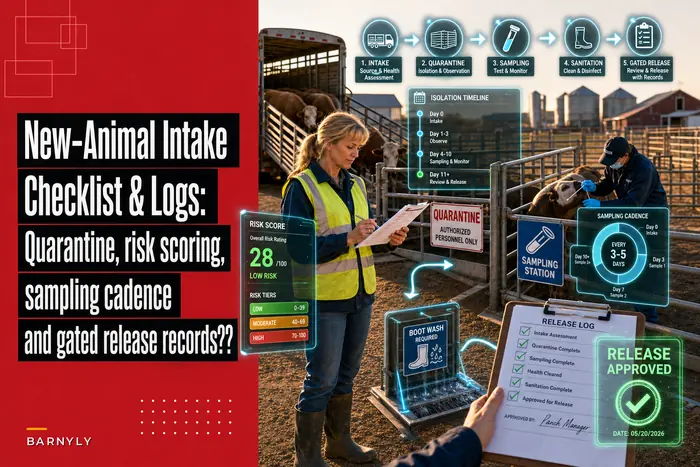
One pattern worth borrowing: farms that already run a disciplined new-animal intake checklist with sampling cadence and release logs tend to have the ID discipline baked in already. If you can label a quarantine sample correctly, you can label a chute-day diagnostic sample the same way. Use the same standard for both.
The time–temperature transport log nobody keeps (but should)
This is the piece most operations skip entirely, and it's the cheapest one to fix.
A transport log answers three questions: when did the sample leave the animal, what temperature range did it stay in, and when did it reach the lab. Those three data points are what let you — or the lab — judge whether a borderline result is real or an artifact of handling.
A simple log looks like this:
| Field | Example entry | Why it matters |
|---|---|---|
| Collection time | 08:14 | Starts the clock on time-sensitive samples |
| Sample type | Serum ×6 | Different types have different tolerances |
| Cooler check / temp | Ice packs, ~4°C | Confirms cold chain held |
| Departure time | 09:40 | Gap between collection and cooling |
| Lab arrival time | 11:25 | Total transit exposure |
| Handler notes | "One tube slightly hemolyzed at draw" | Flags problems before the lab does |
You don't need a data logger for most submissions, though a cheap min/max thermometer in the cooler is worth it for anything shipped or held overnight. What matters is that the log exists and travels with the samples. When a result comes back weird, the first question is always "how was it handled," and if the answer is a shrug, you've lost the ability to trust either interpretation.
Keep a cheap min/max thermometer in the cooler for overnight submissions so you can flag any excursions immediately.
The log isn't for the good days. It's for the one submission a quarter that goes sideways, where it tells you whether to re-sample or believe the number.
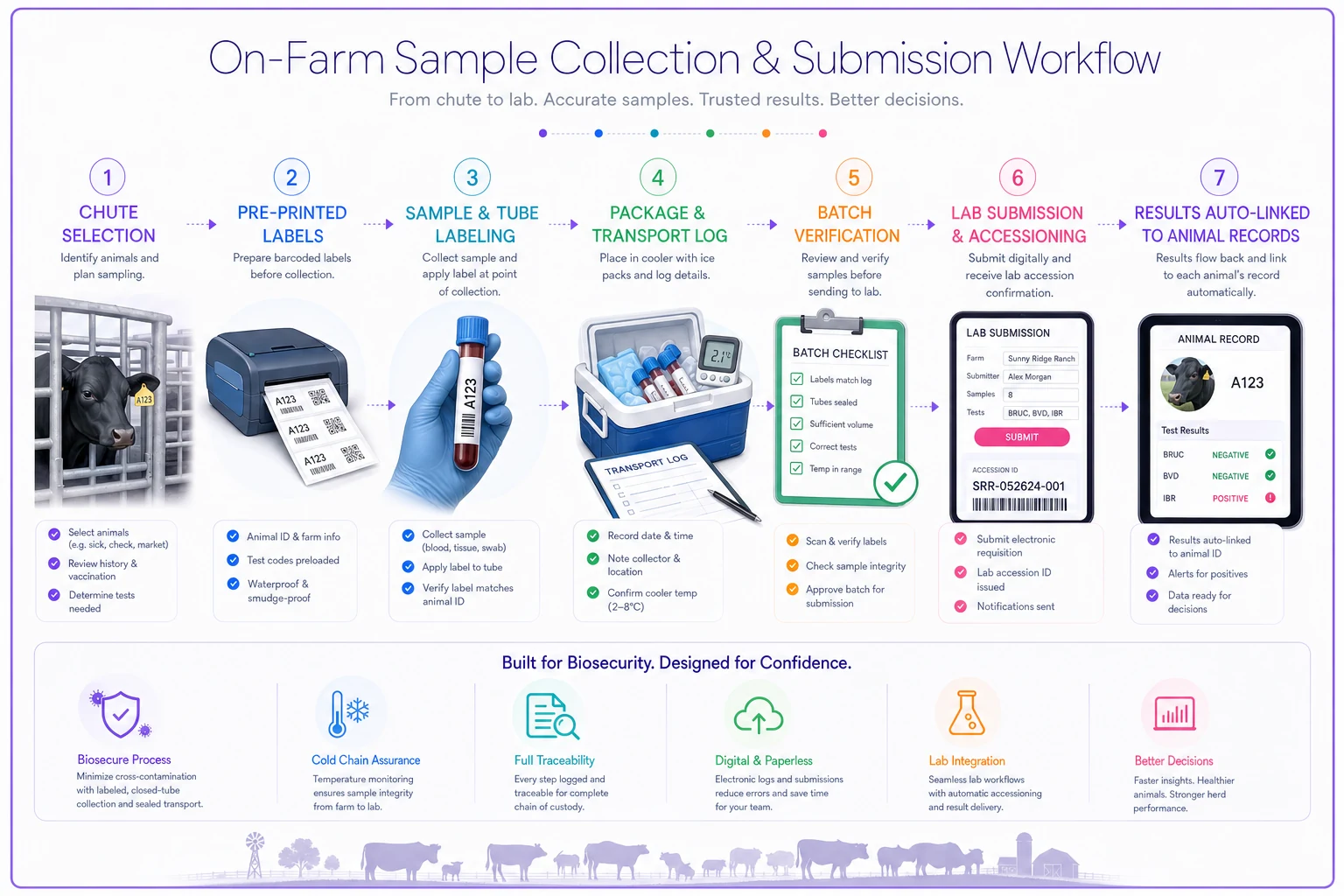
A step-by-step submission workflow that holds up
Here's the sequence that keeps the chain intact from chute to result. Deliberately boring, because boring is what survives a busy day.
-
Pre-stage labels before the animals come in. Print or generate labels tied to the IDs you expect to sample. Doing this at the computer, calmly, prevents the majority of labeling errors that happen at the chute under pressure.
-
Label the tube, not the bag, at the moment of collection. Immediately, before the next animal. This is the discipline that breaks memory-based labeling.
-
Start the transport log at first collection. Note collection time and get samples into the correct temperature environment as fast as the panel requires.
-
Batch and verify against your list. Before anything leaves the farm, count samples against the expected list. A missing or extra tube is far cheaper to fix now than after shipping.
-
Complete the lab submission form using your intake template. Same IDs, same test intent, same sample codes. No translation between what's on the tube and what's on the form.
-
Log departure and confirm cold chain. Ice packs in, thermometer in, times recorded.
-
Record arrival and submission confirmation. Note the lab's accession or submission number — this is the thread that ties their result back to your sample.
-
On result return, match by ID, not by memory. Because the label carried the real animal ID and you captured the accession number, the result attaches to the correct record cleanly.
The one step people cut when they're rushed is #4 — the verify-against-list step. It's also the step that catches the expensive mistakes. Don't cut it.
A simple visual summary of the workflow:
The one step people cut when they're rushed is #4 — the verify-against-list step. It's also the step that catches the expensive mistakes. Don't cut it.
Priority-tagging: not every sample deserves the same urgency
A subtle failure mode is treating all submissions as equal priority, which means the urgent ones don't get the attention they need and the routine ones get overhandled.
-
Priority / STAT — sick animal, suspected reportable disease, time-critical treatment decision. Ship same day, call the lab ahead, expedite.
-
Standard — routine health monitoring, planned panels, pre-breeding work. Normal shipping cadence.
-
Batch / surveillance — bulk screening, herd-level baseline sampling. Can wait for a full batch to reduce per-sample shipping cost.
The value of tagging isn't just speed. It forces a decision at collection time about why you're pulling this sample, which sharpens the test intent you write on the form. Vague intent is one of the quiet reasons labs run the wrong panel or you get a result that doesn't answer your actual question.
Auto-linking results back to the animal record
The back-end match is where most of the manual pain lives, and it's also where the whole chain either pays off or falls apart.
The workflow that holds up: the animal's real ID is on the label → that same ID is on the submission form → the lab's accession number gets recorded against that ID in your records → when results return, they attach automatically because the identifiers already line up. No one is reading a PDF and typing values into a health record by hand.
When farms move from manual result entry to a system where lab results auto-link to the animal record — because the identifiers were consistent from the start — two things change immediately. Transcription errors drop to near zero since nobody's re-keying values. And the result becomes searchable in the context of that animal's full history, so a borderline mineral value sits right next to last season's and the trend is obvious instead of buried.
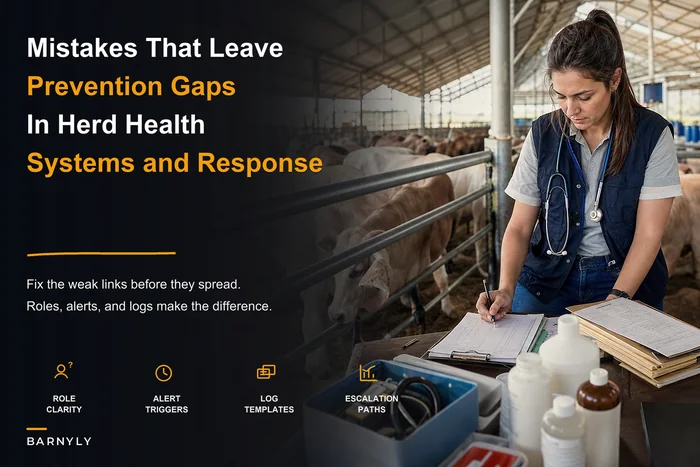
This is also where record-keeping gaps compound. If you've read about the herd-health system mistakes that leave prevention and response gaps, the pattern is the same — data that never makes it back into the animal's record in a usable form. A lab result trapped in a PDF folder isn't a health record. It's a lost decision waiting to happen.
The tooling doesn't need to be fancy. What matters is that the identifier on the sample matches the identifier in your records, and that whatever platform you use can pull results in against that ID rather than making a person do the matching. Operational software that handles this in the background is the difference between results that inform decisions and results that pile up unread.
A real scenario, before and after
A cow-calf operation running around 180 head was doing periodic bloodwork for herd health monitoring — maybe five or six submissions a year, a dozen or two samples each time. Their process was handwritten tags, no transport log, and results that came back as PDFs someone eventually filed somewhere.
The problem showed up in two ways. Roughly one in six or seven submissions had at least one sample the lab flagged for handling — usually hemolysis from samples sitting warm too long. And result entry was a chore nobody wanted, so the PDFs stacked up and animal records went months without their lab data actually attached.
They didn't overhaul anything dramatic. Pre-printed labels with real ear tag IDs, a one-page transport log per submission, a $20 min/max thermometer in the cooler, and recording the lab accession number against each animal so results could be matched instead of re-typed.
Within a couple of sampling cycles the flagged-sample rate dropped to something rare — one bad tube across several submissions instead of one per submission. Re-draws mostly stopped, which alone saved a few hundred dollars a year in shipping, labor, and lost time. And because results now matched cleanly by ID, the health records stayed current instead of drifting months behind. Not a revolution — just a chain that stopped leaking.
When this level of rigor makes sense — and when it's overkill
When it's worth it: any time-sensitive panel (metabolic, trace mineral, some serology), any submission tied to a treatment or culling decision, anything reportable, and any operation big enough that memory-based labeling has already burned you once. If you're sampling for surveillance across dozens of animals, the ID discipline and auto-linking pay for themselves fast.
When it's overkill: a single sample from one sick animal you're standing next to, hand-delivered to a vet twenty minutes away. You don't need a transport log with min/max temps for a sample that never leaves your sight. Match the rigor to the stakes and the distance.
Who should not overthink this: very small operations with a handful of animals and a close relationship with a local vet who processes samples same-day. The chain-of-custody discipline scales with herd size, sample volume, and transit distance. If all three are low, a clean label and a cold cooler cover you.
The takeaway
The samples are usually fine. The diagnostic value is lost in the boring space between the chute and the lab bench — the warm cooler, the vague tag, the untracked drive, the PDF that never got matched to an animal. Fix the label standard first, keep a transport log even when it feels unnecessary, tag priority honestly, and make sure the identifier on the tube is the identifier in your records so results come back attached to the right animal. Do that, and the money you spend on testing actually buys you decisions you can trust.
Ready to optimize your farm management?
Join hundreds of farmers using Barnyly to save time, improve animal health, and increase farm productivity.