

The freezer or dorm fridge sitting in your vaccine shed is probably the single most expensive appliance on the property that nobody manages like an asset. A season's worth of clostridial, respiratory, and reproductive product can easily run $2,500–$6,000 in a mid-sized cow-calf or mixed sheep/goat operation. And most of the losses don't come from a dramatic power outage. They come from slow, quiet drift nobody caught because there was no log, no map, and no clear rule for what to do when the number looked wrong.
This is a tight, usable farm vaccine cold chain SOP — not a lecture on cold chain theory. You already know vaccines need to stay cold. The gap on most farms is the operational scaffolding: where product physically goes inside the unit, how temperature gets recorded without becoming a chore nobody does, and what happens in the ten minutes after you realize the fridge read 52°F this morning.
The three failure points that actually kill product
The door shelf. Most dorm-style fridges — the exact kind sitting in half the vaccine sheds in the country — have the widest temperature swing right in the door. People stack vaccine there because it's easy to reach. That shelf can run 6–10°F warmer than the middle of the unit and swings hard every time the door opens. Modified-live product loses titer here first, and you'd never know.
The back wall and freezer coil area. The opposite problem. In cheaper fridges the back near the cooling plate can drop below freezing overnight, especially when the unit is nearly empty. Freezing kills most inactivated and adjuvanted vaccines outright — and unlike heat exposure, freeze damage is often invisible. The bottle looks fine. The animal just doesn't get protected.
The "I'll deal with it later" excursion. Somebody notices the fridge feels warm, or a min/max thermometer shows it hit 48°F overnight. There's no decision rule, so the product goes back in and gets used anyway, or gets tossed in a panic. Both are expensive. One risks unprotected animals and residue-adjacent record problems; the other throws away product that was probably still fine.
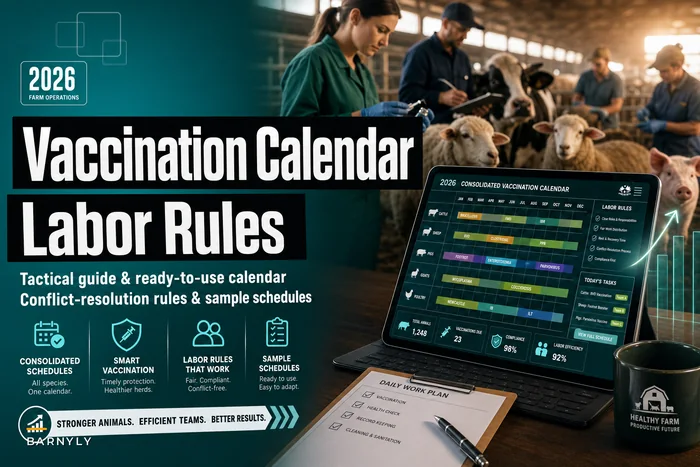
Mixed-species operations make all of this worse — more SKUs, more suppliers, different stability tolerances, same undersized unit. If you're already juggling a consolidated vaccination calendar across species, the storage side needs the same discipline, otherwise the calendar tells you to vaccinate on time with product that's already compromised.
Step one: map the unit before you log anything
A temperature log tells you the unit's average condition. It doesn't tell you where inside the unit product is safe. That's why the placement map comes first.
Simplify farm operations and enhance animal care.
Barnyly helps you organize, track, and manage every aspect of your farm operations seamlessly.
- Comprehensive livestock tracking
- Automated health alerts
- Feed and resource scheduling
No credit card required
-
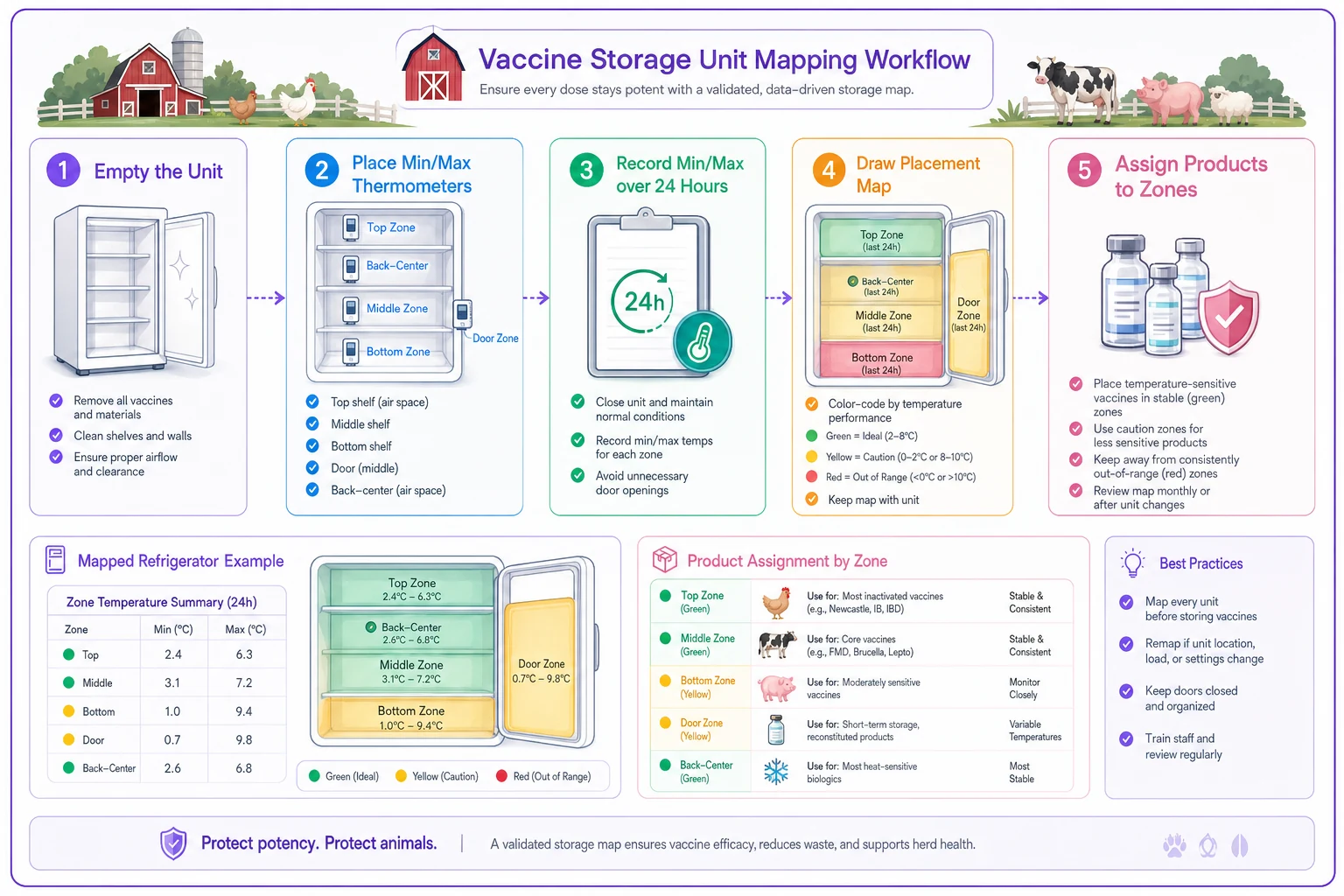
Empty the unit (or do this before your next big vaccine order arrives so you're not risking product). Let it run stable for a few hours.
-
Put a cheap min/max thermometer in each zone for 24 hours
top shelf, middle shelf, bottom, door, and back-center. If you only have one thermometer, move it and log each zone across a few days.
-
Record the min and max for each zone. You're looking for which zones stay reliably inside 35–46°F (2–8°C) and which ones drift or freeze.
-
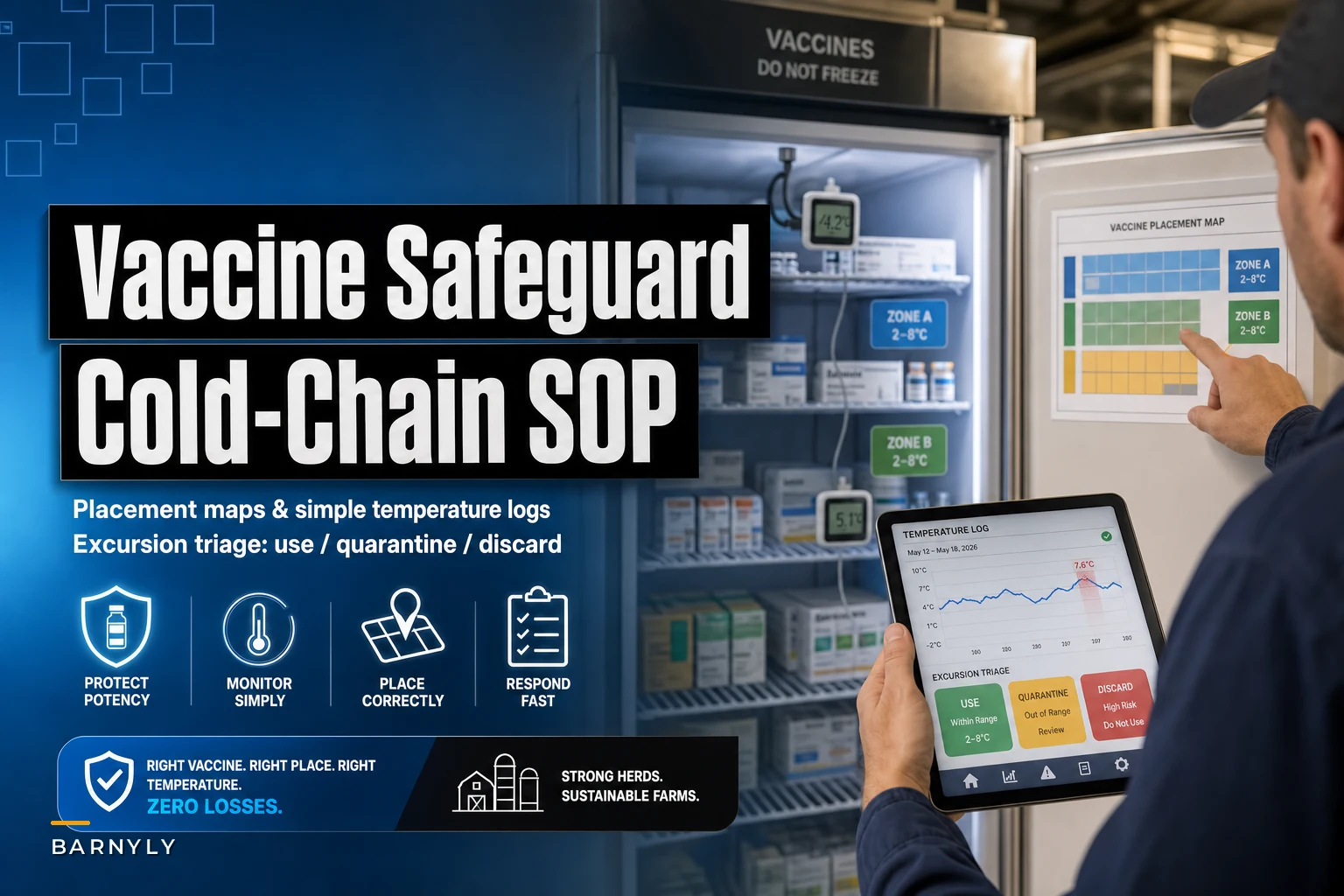
Draw the map. Literally sketch the shelves on paper or tape a printed diagram to the door. Mark the safe zone green, the marginal zone yellow, and the door/back-coil "never store here" zones red.
-
Assign product to zones. Freeze-sensitive inactivated and adjuvanted vaccines go center-middle, away from the coil. Fast-turnover product can live in yellow. Nothing lives in the door except things that aren't vaccine.
One thing worth noting: units that are half-empty swing far more than full ones. Filling dead space with sealed water bottles stabilizes temperature and buys you more time during a power blip. It's the cheapest cold-chain insurance you can buy — a few gallon jugs.
Step two: a temperature log people will actually fill out
The reason most farm temperature logs die by week three is that they ask for too much. Twice-daily readings, initials, a signature, a notes column — it becomes a paperwork tax, so it gets backfilled from memory or skipped.
| Date | Time | Current °F | Overnight Min | Overnight Max | In range? (Y/N) | Action taken | Initials |
|---|---|---|---|---|---|---|---|
| 3/12 | 7:10a | 40 | 37 | 44 | Y | — | JR |
| 3/13 | 6:55a | 41 | 34 | 43 | Y | reset min/max | JR |
| 3/14 | 7:20a | 51 | 39 | 53 | N | excursion triage | JR |
Two things make this reliable in practice. First, one reading a day beats two readings that don't happen. Morning check, tied to an existing habit — same time you feed or check water — sticks far better than a schedule that assumes someone is free at 6pm. Second, the min/max matters more than the spot reading. A fridge can read a perfect 40°F when you open it at 7am and still have hit 55°F at 2am when the compressor was struggling. The overnight low/high catches the problem the spot check hides.
One reading a day beats two readings that don't happen.
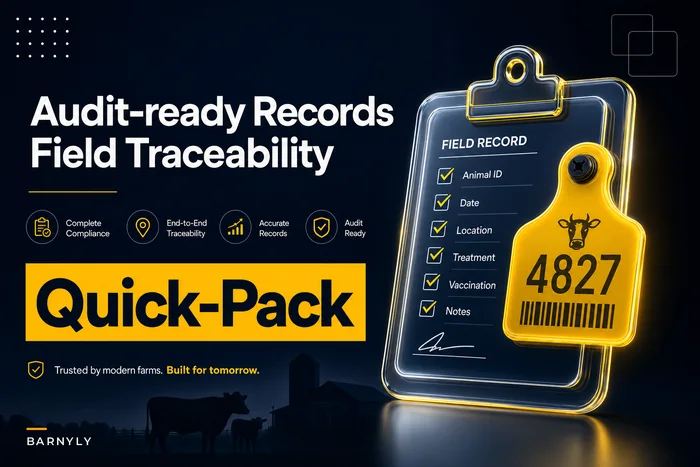
For farms running multiple storage points — a shed fridge, a barn freezer, a fridge in the truck for processing days — paper starts to break down because nobody's cross-checking whether logs are current. A digital log earns its place here: a phone entry that timestamps automatically, flags a missing day, and keeps every unit's history in one spot instead of on three clipboards you have to physically walk to. The same record discipline you'd want for audit-ready traceability applies here — if a batch of animals underperforms, being able to pull the storage history for the exact lot you used is what separates a solvable question from a shrug.
Step three: the excursion triage tree
This is the part almost nobody has written down, and it's the part that determines whether an excursion costs you $0 or $4,000. When you find an out-of-range reading, panic pushes people toward one of two bad extremes. A decision tree removes the panic.
-
Stop using the product immediately and move it to a known-good unit. Don't decide anything yet. Get it stable first. Mark it clearly — masking tape, "HOLD — do not use," dated.
-
Figure out the exposure. How far out of range, and for how long? Your min/max reading and the timestamp of your last in-range check bracket this. "Read 52°F this morning, last checked 40°F yesterday at 7am" means up to roughly 24 hours of unknown exposure, peaking around 53°F.
-
Determine the direction. Was it a heat excursion (compressor failure, door left open, power loss) or a freeze excursion (unit too cold, product against the coil)? These triage completely differently.
-
Check the product's stated tolerance. This is where the supplier matters — many manufacturers publish stability data for short excursions, and some will confirm a specific product tolerates X hours at Y temperature. You can't guess this; product chemistry varies.
Here's the triage logic in plain form:
| Situation | Decision | Why |
|---|---|---|
| Brief heat excursion, within manufacturer's published stability window | Use — but log it and flag the affected lots | Product is likely fine; documentation protects you if outcomes lag |
| Heat excursion beyond published window, or duration unknown | Quarantine — hold, call supplier before using or discarding | Don't guess in either direction; supplier data decides |
| Any freeze exposure on inactivated/adjuvanted product | Discard — do not use | Freeze damage is usually irreversible and invisible; not worth the risk to the animal |
| Modified-live exposed to heat, unknown duration | Quarantine → likely discard | MLV loses titer fast and silently; err toward discard if you can't confirm |
| Reconstituted/mixed product exposed at all | Discard | Already unstable once mixed; no excursion tolerance |
The single most useful rule buried in that table: freeze excursions on inactivated product default to discard, heat excursions default to a supplier call. Farmers instinctively fear heat and shrug at cold — the biology runs the opposite direction for a lot of the product sitting in your fridge.
The notification templates you'll wish you'd written in advance
When an excursion happens, you're usually mid-processing, hands full, and not in the mood to draft a careful email. Having fill-in-the-blank templates ready turns a 40-minute scramble into a two-minute send. For mixed-species farms this matters more, because you may be notifying multiple suppliers and possibly your insurer for the same event.
Supplier notification (per product): > Product: [name / lot number] > Quantity affected: [# bottles / doses] > Storage unit: [ID] > Excursion type: [heat / freeze] > Temperature reached: [min/max] > Duration: [approx hours, or "unknown since last verified reading at (date/time)"] > Request: Please confirm whether this product remains usable, and provide stability guidance in writing for our records.
Insurer notification (when the loss is large enough to claim — power outage, equipment failure): > Date/time of event: [ ] > Cause: [power outage / compressor failure / etc.] > Products affected and estimated replacement value: [itemized list, lot numbers] > Temperature evidence: [min/max readings, log attached] > Mitigation taken: [moved product to backup unit / etc.]
Two things worth noting here. Suppliers respond faster and more favorably when you give them lot numbers and duration up front — a vague "my vaccines got warm" gets a slow generic answer. And insurers care about the temperature evidence trail. A dated log showing the unit was in range right up until the failure is the difference between a paid claim and a denied one. The log isn't just for you; it's your evidence.
A real scenario
A cow-calf operation running about 180 head, also keeping a small flock of ewes, stored everything in one dorm fridge in an unheated shed. No log, no map. Over a winter the fridge — sitting against an exterior wall — was dropping to around 28–30°F overnight when nearly empty. They didn't find out until spring, when a chunk of the adjuvanted clostridial product was suspected of having been freeze-damaged. Best guess on wasted or ineffective product: somewhere in the $1,800–$2,200 range, plus the harder-to-quantify cost of calves that may not have been properly protected.
The fix was almost embarrassingly cheap. A $12 min/max thermometer, a placement map taped to the door moving freeze-sensitive product off the back wall, gallon water jugs filling the empty space to stabilize temperature, and a one-line-a-day log tied to morning chores. The following season they caught two excursions early — one a door left ajar, one a brief power flicker — and both resolved to "use, documented" after a quick supplier check instead of a blind toss or a risky guess. The unit itself got moved off the exterior wall. Total cost of the fix was under $40 and an afternoon.
When paper is enough, and when it isn't
Paper works fine if you have one storage unit, one person who reliably does the morning check, and a low SKU count. Don't over-engineer it. A thermometer, a taped map, and a daily row on a clipboard genuinely covers a small single-species operation.
Paper starts failing when you've got multiple storage points, seasonal help doing the checks, or enough product value that a missed excursion is a four-figure hit. The failure mode is always the same: logs go stale on clipboards nobody consolidates, and by the time you notice a gap, the exposure window is already unknowable. A digital log that timestamps entries, flags missed days, and keeps every unit in one view fixes the specific weakness paper has — not because digital is fancier, but because it removes the "who forgot to write it down" problem. AI-powered operational software built for farm record-keeping can handle this layer without adding much overhead — automatic timestamps, alerts when a check is missed, and a searchable history by lot number if you ever need to trace back through a season.
If you buy product in small batches, use it within a week, and never store overnight, the full map/log/triage system is overkill. Get a thermometer, keep product out of the door, and move on.
Getting it running this week
If you do nothing else, do these five things before your next vaccine order arrives:
-
Put a min/max thermometer in the center of the unit today and read it tomorrow morning.
-
Sketch a placement map and move freeze-sensitive product off the back wall and out of the door.
-
Fill empty fridge space with sealed water jugs.
-
Start a one-row-a-day log tied to an existing chore.
-
Print the triage table and tape it inside the door, so the decision is made before you're standing there with a warm fridge and a syringe in your hand.
The product in that fridge represents real money and real protection for animals you've already invested in. The whole system above costs less than one bottle of the vaccine it protects — and the first excursion it saves you from pays for it several times over.
The product in that fridge represents real money and real protection for animals you've already invested in. The whole system above costs less than one bottle of the vaccine it protects — and the first excursion it saves you from pays for it several times over.
Ready to optimize your farm management?
Join hundreds of farmers using Barnyly to save time, improve animal health, and increase farm productivity.