

Most farm software problems don't show up on day one. They show up at year three, when you go to pull five years of treatment records for an audit and discover the export only covers 18 months, or the EID data comes out in a format nobody can read, or the vendor who sold you the system got acquired and the support line now routes to a different continent.
By then you're not shopping for software. You're trapped in it.
The governance piece—the contractual SLA, the validation schedule, the exportability guarantees—is the part almost nobody reads carefully, and it's exactly the part that determines whether your data stays yours. This is the boring stuff that saves you when things go sideways. So treat farm software vendor SLA governance like the operational discipline it actually is, not a legal afterthought you skim once and file away.
The surprise isn't the bug. It's what the contract doesn't cover.
When farmers describe a software disaster, they usually describe a symptom: the mobile app went down during weaning, the sync broke, withdrawal dates stopped calculating. Those are real problems. But the actual damage usually traces back to what the agreement never promised in the first place.
A typical example looks like this. A cow-calf operation runs four years on a herd platform without major issues. Then pricing doubles and they switch providers. They request a data export and get a CSV with maybe 60% of the fields they actually logged—treatment notes truncated, EID history flattened into a single column, withdrawal logs missing the original dose and route. The data technically "exported," so the vendor met their obligation. The problem is nobody ever defined what a complete export looked like.
That's the pattern behind almost every bad outcome. It's rarely dramatic. It's a slow realization that the vendor's definition of "support," "uptime," "backup," or "export" is narrower than yours—and there's nothing in writing to argue with.
Governance closes that gap before money changes hands. It's the difference between hoping the vendor behaves well and having a document that holds them to it.
What actually breaks as you scale
A single-site operation with one person entering data can survive a weak vendor relationship. You know the workarounds. You keep paper backups out of habit. If the system hiccups, you sort it out yourself.
Simplify farm operations and enhance animal care.
Barnyly helps you organize, track, and manage every aspect of your farm operations seamlessly.
- Comprehensive livestock tracking
- Automated health alerts
- Feed and resource scheduling
No credit card required
That stops working the moment you add sites, staff, or regulatory complexity.
-
Multi-site data drift. Two locations on the same platform start logging the same event slightly differently because nobody validated the field definitions. By the time you notice, you've got two years of inconsistent records and no clean way to reconcile them.
-
Staff turnover exposes undocumented dependencies. The one person who understood how the EID reader talked to the software leaves. Nobody else knows the sync sequence, and the vendor's "documentation" is a 2019 PDF that hasn't been updated since.
-
Regulatory asks get bigger. A single-herd withdrawal query is manageable. A traceback request covering three species across four years, pulled in a format an inspector will actually accept, is where thin exportability turns into a genuine compliance crisis.
-
The vendor changes underneath you. Acquisition, pricing shifts, discontinued features, a pivot away from livestock entirely. At scale you can't just absorb these as minor inconveniences—they hit payroll, compliance, and cashflow simultaneously.
Small operations fail softly. Large ones fail loudly and expensively. Governance is how you buy down that risk ahead of time rather than discovering it under pressure.
Build the SLA around operational tasks, not uptime percentages
Most SLAs you'll be handed talk about "99.5% uptime" and not much else. For farm software, uptime is almost beside the point. What actually matters is whether the specific operational tasks you depend on keep working and keep producing usable records.
Write—or demand—an SLA mapped to the tasks that actually run your operation. A few that consistently matter:
| Operational task | What the SLA should guarantee | Why it bites you if it doesn't |
|---|---|---|
| EID exports | Full field-level export in a documented, open format, on demand, within a set timeframe | You can't switch vendors or respond to a traceback without complete tag history |
| Withdrawal log retention | Retained for the full legal retention window plus a buffer, exportable with dose/route/date intact | Residue audits reach back years; partial logs are useless |
| Record export completeness | A documented schema of every exportable field, not just "CSV export available" | "Export" means nothing if half your fields disappear |
| Backup frequency & restore test | Defined backup cadence and a proven restore—not just "we back up" | Untested backups fail exactly when you need them |
| Support response by severity | Tiered response times with a defined path for data-loss events | A weaning-day outage can't sit in a generic ticket queue for three days |
| Change / deprecation notice | Minimum notice before any feature or format change | Silent format changes break downstream workflows with no warning |
Uptime is the vendor's internal risk to manage. Task continuity and data completeness are your risk—and those are the things you put in writing.
Periodic validation: don't trust it, verify it on a schedule
Signing a strong SLA and then never checking it is almost as bad as having no SLA at all. Vendors change. Features get quietly refactored. An export that worked perfectly last year can drop a field after an update nobody told you about.
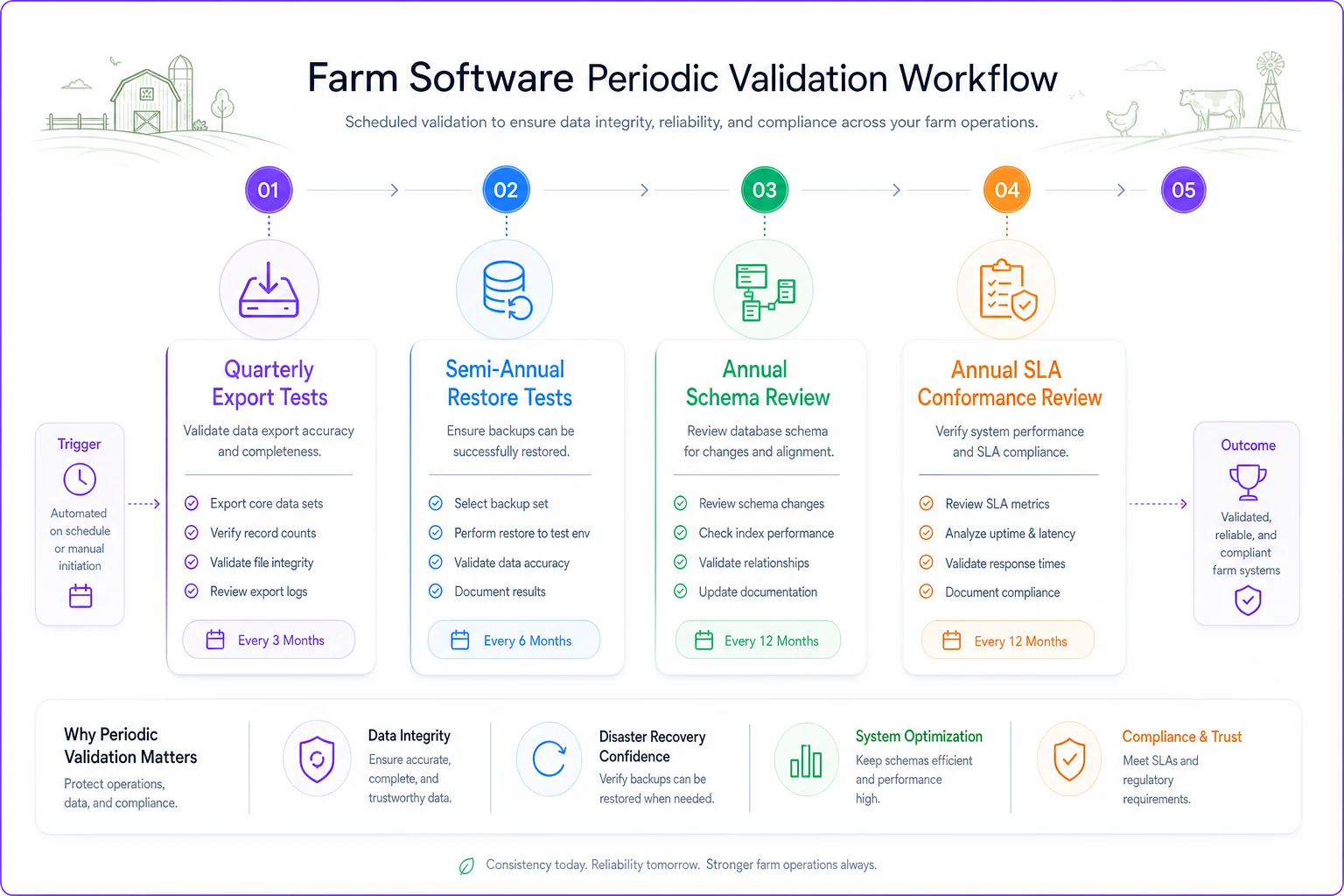
Periodic validation belongs on your calendar the same way vaccination schedules and compliance deadlines do. A practical rhythm:
-
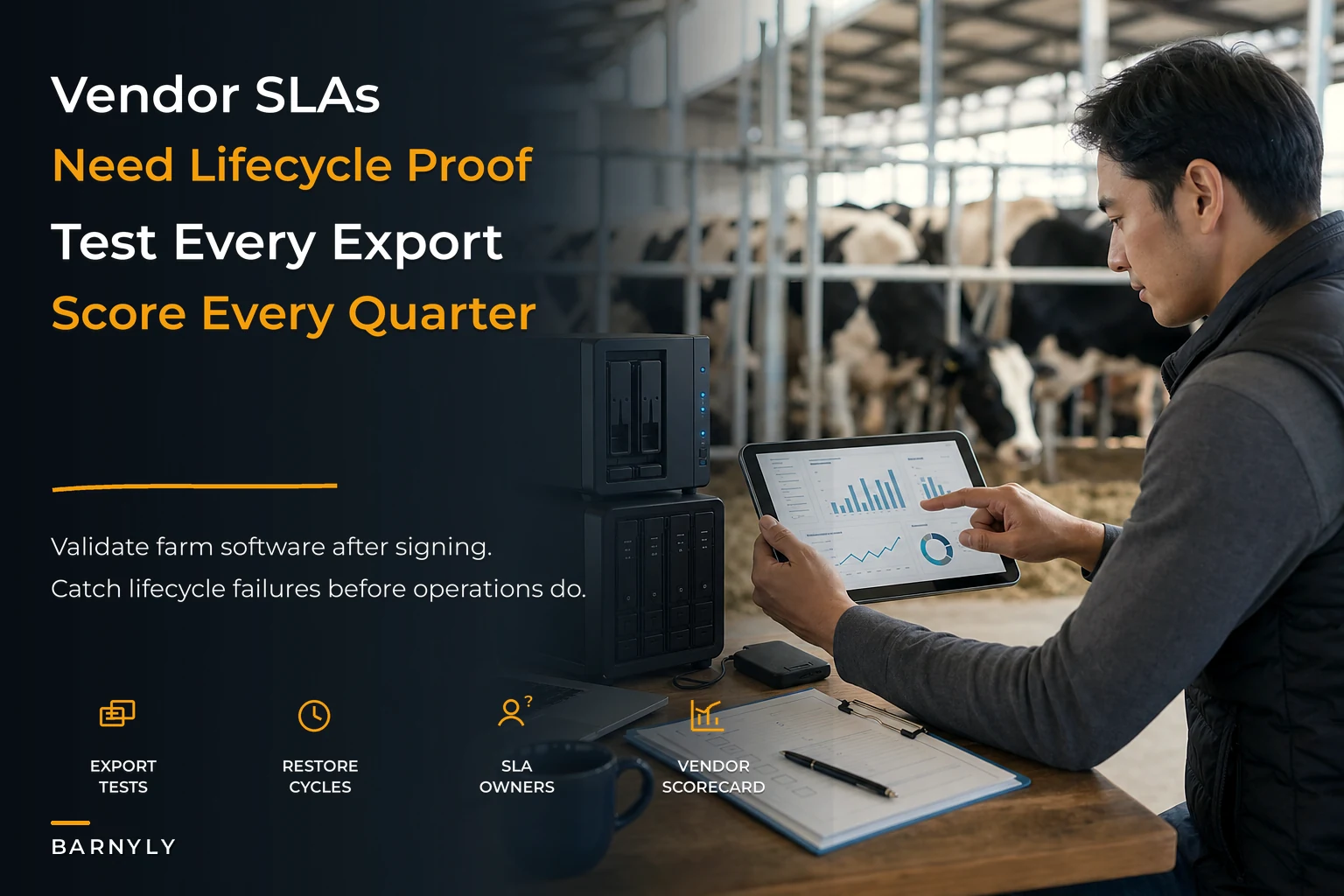
Quarterly export test. Pull a real export of EID and withdrawal data. Open it. Confirm every field you log is actually present and readable. Takes an hour. Saves a disaster.
-
Semi-annual restore test. Ask the vendor to demonstrate a restore from backup, or restore a test dataset yourself if the platform allows it. A backup you've never restored is basically a rumor.
-
Annual schema review. Request the current documented field schema and compare it against last year's. Any silent changes get flagged and followed up on.
-
Annual SLA conformance review. Walk through each SLA clause and check real performance against it—actual support response times, actual notice given before changes, actual export turnaround.
Schedule the quarterly export test on the same week every quarter so it becomes routine rather than an afterthought.
Here's a simple workflow to visualize the validation cadence.
The operations that survive vendor transitions smoothly are almost always the ones that ran these checks quietly all along. The ones that get burned treated the signed contract as a finish line.
The evidence pack: what "exportable" should actually mean
When an auditor, buyer, lender, or new vendor asks for your records, you shouldn't be scrambling to assemble them from three systems and a folder of spreadsheets. The goal is a repeatable evidence pack—a defined bundle you can generate on demand.
-
- [ ] Full EID history export with tag, movement, and lifecycle events intact
-
- [ ] Withdrawal logs with product, dose, route, administration date, and calculated clearance date
-
- [ ] Treatment and medication records tied to individual or group IDs
-
- [ ] Vaccination history with product lot/batch where captured
-
- [ ] Mortality and disposal records with dates and reasons
-
- [ ] A documented data dictionary explaining every field and code
-
- [ ] Export timestamp and the software version that produced it
-
- [ ] File format documentation so the next person can actually read it
That last point gets skipped constantly. A pile of correct data in an undocumented format is nearly worthless to anyone who didn't build it. The data dictionary is what makes your records portable across people and systems—not just technically "exported."
If you've built disciplined medication and withdrawal workflows where clean data flows in automatically, most of this pack assembles itself. If you're still reconstructing it by hand each time someone asks, that's your signal that the underlying system isn't doing its job.
A vendor scorecard that reflects reality
Vendor selection usually comes down to demo polish and monthly price. Both are weak predictors of how the relationship feels at year three. A scorecard forces you to weigh the things that actually determine long-term pain, and it gives you something defensible when two options look similar on the surface.
-
Export completeness — Can you get everything, field-for-field, in an open format?
-
Retention guarantees — Does retention cover your full legal window with margin to spare?
-
Restore track record — Have they demonstrated a restore, not just described a backup process?
-
Change-notice discipline — Written commitment to notice periods before format or feature changes?
-
Support responsiveness by severity — Real tiered response, with a data-loss escalation path?
-
Business stability — How likely are they to still exist and still serve livestock operations in five years?
-
Offline resilience — Does it keep working when connectivity drops in the back paddock?
-
Interoperability — Does it play nicely with EID readers, lab systems, and your vet's tools?
Weight these to your operation. A single remote site might weight offline resilience heavily. A multi-species operation facing regular audits weights export completeness and retention above almost everything else. The point of the scorecard isn't the final number—it's that it drags the quiet, expensive factors into the conversation before you sign anything.
A real scenario
A mixed sheep-and-cattle operation running two sites had been on a herd platform for about three years. Decent system, no major complaints. Then they got hit with a residue traceback request tied to a batch of treated lambs.
When they went to pull the records, the withdrawal logs exported fine—but the route of administration field, which they'd been diligently entering, wasn't included in the standard export. The vendor confirmed the data was stored but said it wasn't "currently available in the standard export format." Getting a custom extract took nearly two weeks of back-and-forth, right in the middle of a compliance window that didn't care about anyone's product roadmap.
Nothing was lost permanently. But the scramble cost them several days of management time, a tense week wondering if they'd fail the traceback, and a hard lesson about the difference between data that's stored and data that's actually exportable.
Afterward they rebuilt the relationship around governance. They added a quarterly export test, got the full field schema documented in writing, and renegotiated the next contract with export completeness spelled out explicitly. The following year a similar request came in. They generated the complete evidence pack in under an hour. Same operation, same vendor—completely different outcome because of the governance layer they'd added.
Where tooling helps (and where it doesn't)
No software contract fixes a messy data habit. If your people are logging treatments inconsistently, no SLA clause will save the export. Governance assumes the underlying records are already clean.
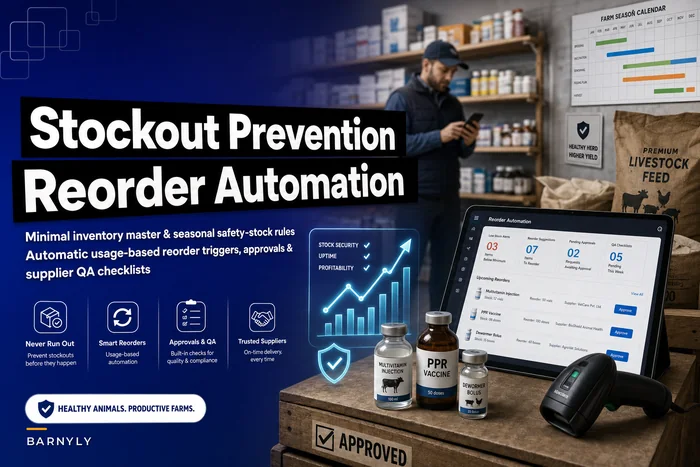
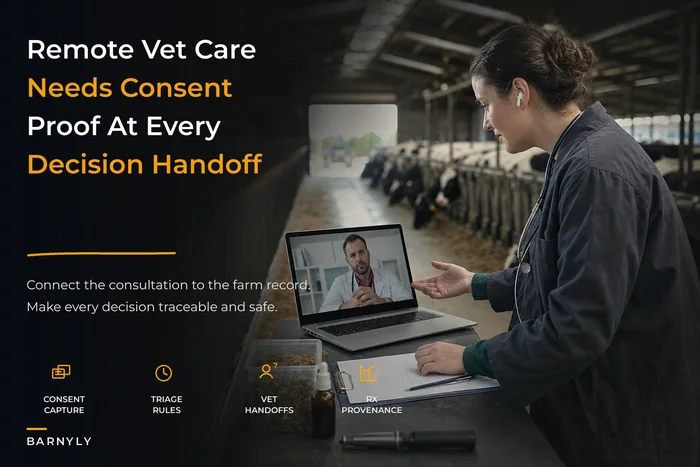
That said, the right platform makes this whole discipline far less painful. Systems built around structured workflows—where a treatment entry automatically captures dose, route, and withdrawal clearance, and feeds into inventory and reorder logic—mean your evidence pack is mostly a byproduct of normal daily work rather than a quarterly fire drill. If you've connected your medicine, vaccine and feed reorder automation to the same records that drive withdrawal calculations, you're already most of the way to an exportable, audit-ready dataset. Operations running proper telemedicine workflows tied to on-farm records tend to have cleaner prescription provenance as well, which is exactly what shows up in a strong evidence pack when an auditor comes looking.
The software's job is to make good records effortless to capture and complete to export. The governance's job is to make sure the vendor can never quietly take that away from you.
When this level of rigor makes sense—and when it's overkill
Worth the effort: Multi-site operations, anyone facing regular audits or traceback exposure, operations handling controlled substances or tight withdrawal windows, and any farm where a vendor change would genuinely disrupt the business. The more your records carry regulatory and financial weight, the more governance pays for itself.
Probably overkill: A very small single-site operation that still runs mostly on paper, or a hobby-scale setup where the software is a convenience rather than a dependency. You still want basic export ability and a sane backup—but quarterly validation schedules and weighted scorecards are more machinery than you need.
Who should not skip this: If you're about to sign a multi-year contract, migrate between systems, or hand the operation to the next generation, this is non-negotiable. Transitions are precisely when thin governance turns into lost records.
The quiet discipline that pays off loudest
Vendor surprises feel like bad luck when they hit, but they're almost always predictable in hindsight. The export that was never fully specified. The backup that was never restored. The format change nobody got warned about. The contract that promised uptime while saying nothing about the data you actually care about.
Treating farm software vendor SLA governance as an ongoing operational routine—mapped SLAs, scheduled validation, documented evidence packs, an honest vendor scorecard—turns those surprises back into manageable paperwork. And boring is exactly what you want from the system holding years of your herd's history. Set it up once, check it on a schedule, and you keep control of your records no matter what the vendor decides to do next.
Treating farm software vendor SLA governance as an ongoing operational routine—mapped SLAs, scheduled validation, documented evidence packs, an honest vendor scorecard—turns those surprises back into manageable paperwork. And boring is exactly what you want from the system holding years of your herd's history. Set it up once, check it on a schedule, and you keep control of your records no matter what the vendor decides to do next.
Ready to optimize your farm management?
Join hundreds of farmers using Barnyly to save time, improve animal health, and increase farm productivity.