
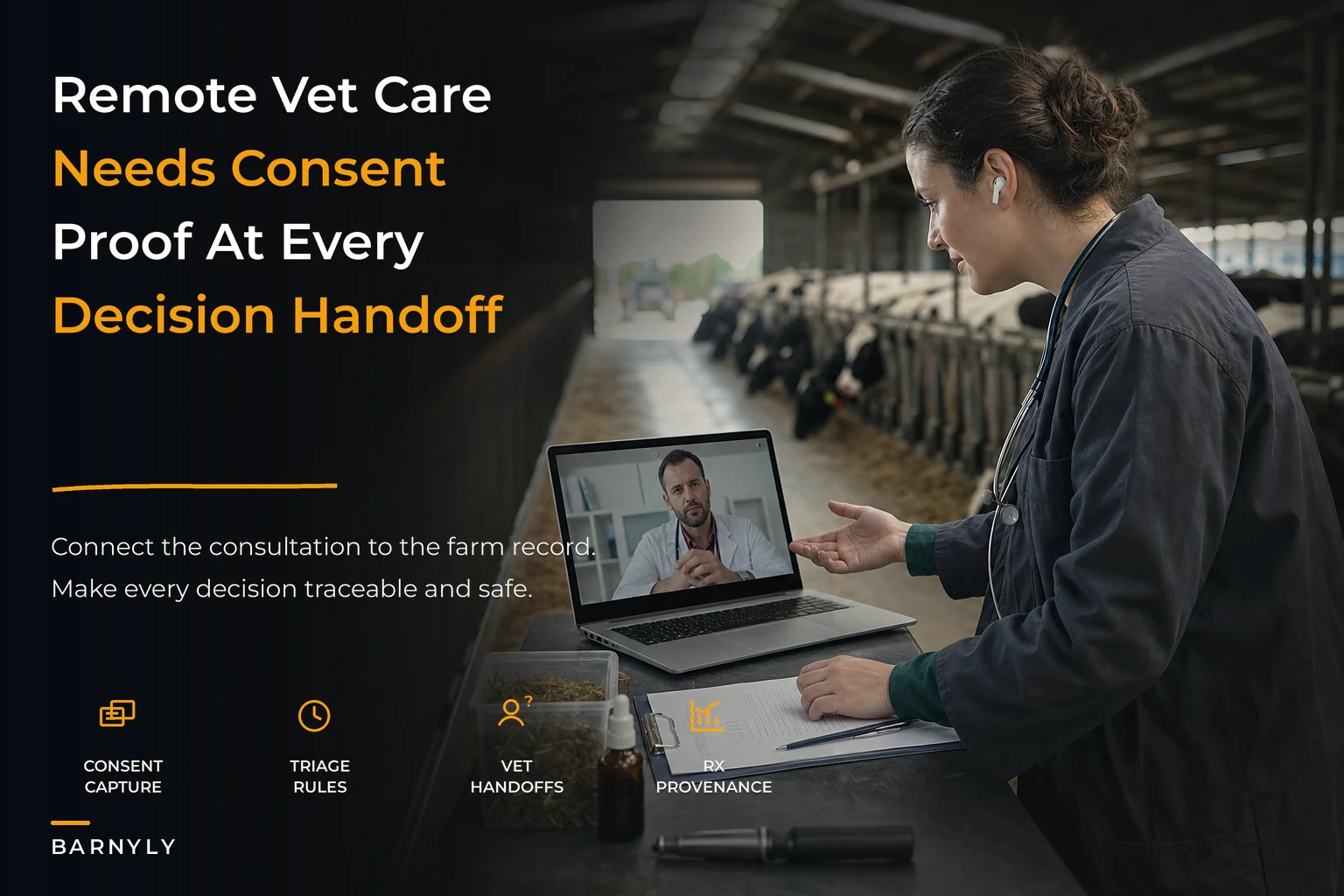

The awkward truth about vet telemedicine on most farms is that the video call works fine. The animal gets looked at, a plan gets made, maybe a script gets called into the co-op. What falls apart is everything around the call — the note that never made it into the animal's history, the consent nobody can produce six months later, the prescription that shows up in your inventory with no record of who authorized it or why.
That gap is where telemedicine stops being an efficiency win and starts being a compliance liability. A remote consult that isn't tied back to the on-farm record is basically a phone call you can't defend later. And when you're running livestock, "later" tends to arrive in the form of an audit, a residue trace-back, or an insurance claim where somebody wants to see the paper trail.
This isn't a piece about which video app to use. It's about the plumbing underneath — the workflows that connect an external vet's clinical judgment to the records already sitting on your farm, in a way that holds up when someone asks you to prove it.
Why the records break even when the medicine is fine
The core issue is that telemedicine introduces a second system of record that almost never talks to your first one.
Your on-farm records live in one place — herd software, a whiteboard, a treatment logbook, whatever you've got. The vet's records live in their practice management system. When the consult happens over video, the clinical note gets written on the vet's side. The consent, if it's captured at all, sits in an email thread. The prescription flows through a pharmacy or distributor. Three separate systems, three separate timestamps, zero shared reference number.
In real operations, this usually surfaces when someone tries to reconstruct a treatment decision months after the fact. You know a heifer got treated. You've got the drug in your withdrawal log. But the justification — the clinical reasoning, the vet's authorization, the fact that a valid vet-client-patient relationship existed at the time — lives in the vet's notes, and you don't have a copy. During a normal season nobody notices. During a trace-back, that missing link is the whole problem.
The other reason it breaks: telemedicine feels casual. A quick video call to look at a lame cow doesn't feel like a formal clinical event, so nobody treats it like one. But regulators don't care how the consult happened. If a prescription came out of it, they expect the same provenance you'd have from an in-person visit — diagnosis, authorization, dose, animal identity, withdrawal period. The informality is exactly what creates the exposure.
What actually needs to be captured (and where it usually goes missing)
Before you can build a workflow, you have to be honest about what a defensible remote consult actually generates. It's more than most people think.
Simplify farm operations and enhance animal care.
Barnyly helps you organize, track, and manage every aspect of your farm operations seamlessly.
- Comprehensive livestock tracking
- Automated health alerts
- Feed and resource scheduling
No credit card required
| Record type | Who creates it | Where it usually lives | Where it *should* live |
|---|---|---|---|
| Consent to telemedicine consult | Farmer | Verbal / email | Attached to the animal or group record |
| Clinical note & diagnosis | Vet | Vet's practice software | Synced copy in on-farm history |
| Prescription authorization | Vet | Pharmacy / distributor | Linked to the treatment record |
| Prescription provenance (who, when, why) | Vet + farmer | Nowhere, usually | The animal's medication log |
| Escalation / triage decision | Vet or on-farm staff | Nobody's memory | Time-stamped in the case thread |
| Handover to in-person follow-up | Both | Verbal | Written handover note |
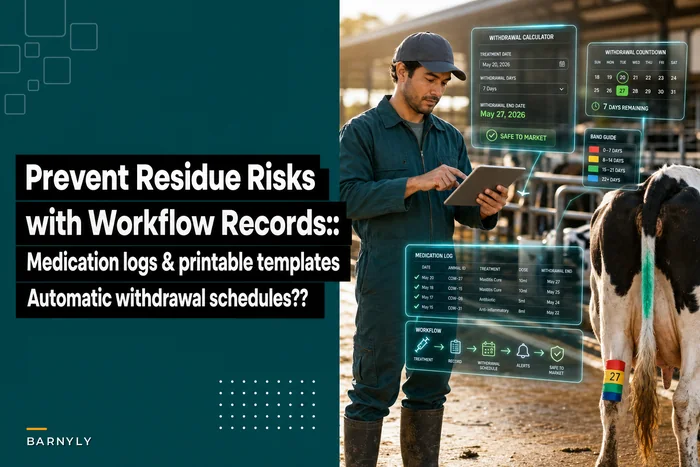
The row that causes the most trouble is prescription provenance. Everyone logs the drug. Almost nobody logs the chain that connects the drug to the specific remote consult that authorized it. That's the difference between "we have medication records" and "we can prove every dose was justified" — a distinction worth understanding in more depth around workflow-based medication records and withdrawal calculators.
The consent row is the quiet one. Most farms have never captured explicit consent for a remote consult because it never occurred to them it was needed. In practice it's a two-line acknowledgment — the farmer agreeing to be examined remotely and to the vet acting on visual and verbal information rather than a hands-on exam. Cheap to capture. Expensive to be missing.
The end-to-end workflow, start to finish
The point isn't the steps themselves — it's that each one produces a record that references the same case, so nothing floats free.
-
Trigger and intake. On-farm staff flags an animal or group needing a remote consult. Before the call, the animal's current record — ID, history, recent treatments, symptoms — is pulled and shared with the vet. This is where most telemedicine already fails: the vet is examining an animal with no history in front of them.
-
Consent capture. A short, logged consent for the remote consult, tied to the specific animal or group. One record, timestamped, stored where the treatment will be recorded.
-
The consult and clinical note. The vet examines remotely and writes the note. Critical detail: the note needs to land in the on-farm history, not just the vet's system. A synced copy, an exported PDF attached to the animal record, whatever — but it has to exist on your side.
-
Diagnosis and decision. The vet either resolves it remotely, prescribes, or escalates. Whatever the decision, it gets recorded against the case with reasoning attached.
-
Prescription provenance (if applicable). If a drug is authorized, the record captures who prescribed it, for which animal, at what dose, why, and the withdrawal period — linked back to the consult that generated it. Not a separate inventory line. A connected one.
-
Escalation or handover. If the case moves — to an in-person visit, a different vet, or on-farm follow-up — a handover note travels with it so the next person isn't starting from zero.
-
Close-out and outcome. The case gets closed with an outcome logged. Did the animal recover? Was follow-up needed? This closes the loop and turns the consult into data you can actually use.
Assign a case reference on the farm before the consult so every record the vet produces can be linked back immediately.
A visual of the workflow helps make the chain obvious and shows where each record must attach.
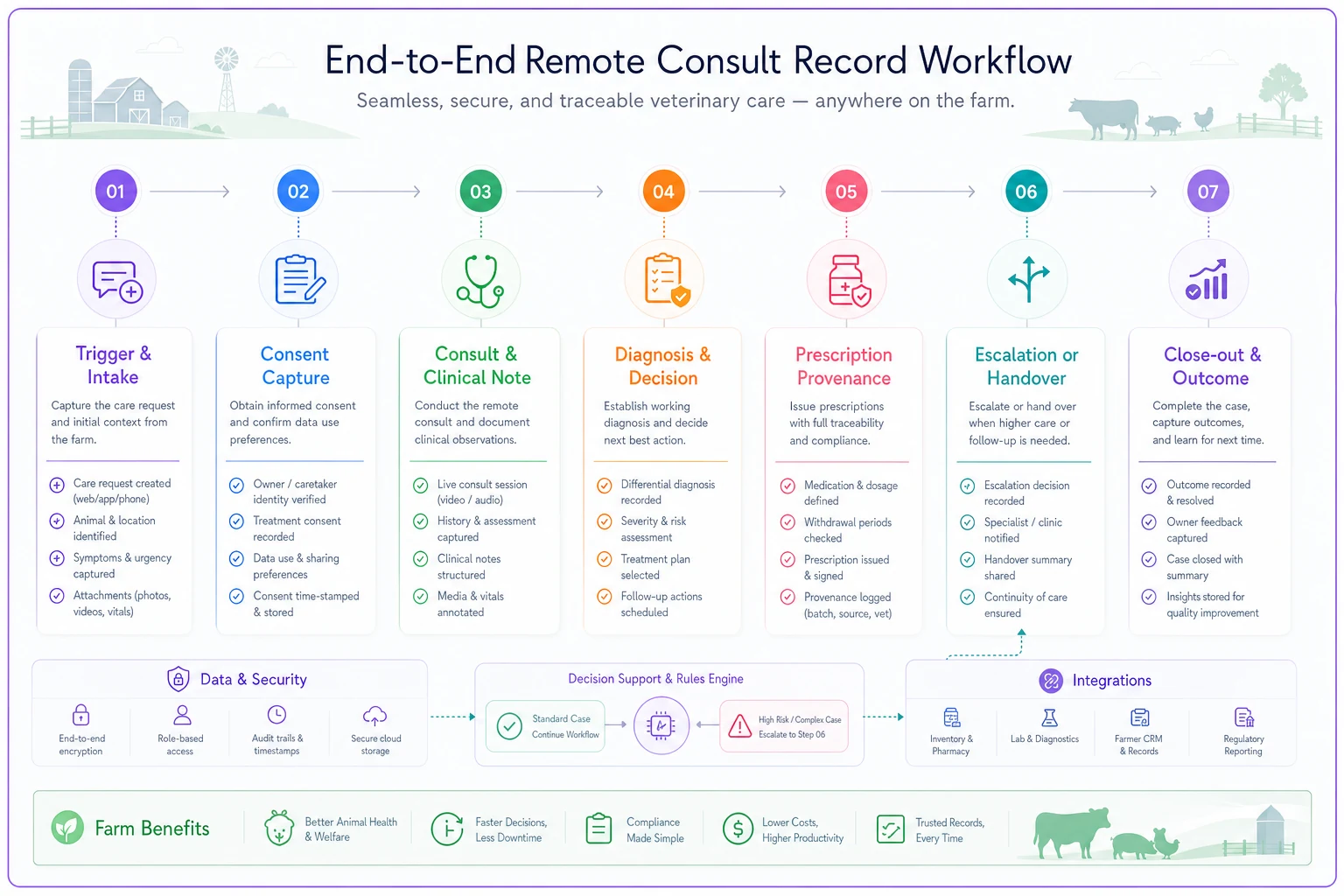
Steps 1, 3, and 5 are the ones that break most often, and they're the ones that require your on-farm records and the vet's records to actually connect. That's the whole ballgame.
Tele-triage: the rules that decide what happens remotely and what doesn't
Not every problem should be handled over video, and the farms that get telemedicine wrong are usually the ones with no clear line between "handle it remotely" and "get someone out here." Without triage rules, you get two failure modes: escalating things that could've been resolved on a call, or not escalating things that needed hands-on care until it's too late.
A workable triage framework doesn't need to be complicated. It needs to be written down and consistent, so the person doing the initial assessment — often not a vet — knows which bucket a case falls into.
-
Handle remotely minor, visually assessable issues; medication questions; follow-up checks on known conditions; group observations where trend matters more than individual exam.
-
Remote-first, escalate if no improvement conditions with a clear time window. Set the window explicitly — "if no improvement in 24 hours, escalate" — so it's a rule, not a judgment call made under pressure.
-
Immediate in-person anything with rapid deterioration, suspected reportable disease, difficult calving or lambing, or a situation where a hands-on exam materially changes the diagnosis.
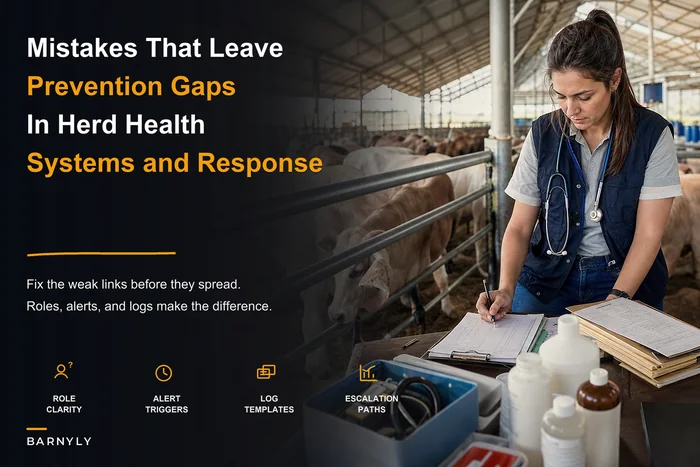
The most common mistake is a triage process that lives entirely in one experienced person's head. It works fine until that person is on vacation, and then a green employee is staring at a down cow with no framework. Writing the escalation triggers down — the same way you'd write herd-health protocols to close prevention and response gaps — is what makes remote triage survive staff turnover.
One more pattern worth flagging: escalation delays are almost always communication delays, not clinical ones. The vet said "watch it for a day," the day passed, and nobody circled back because there was no reminder tied to the case. A triage rule with a time window is only as good as the follow-up mechanism attached to it.
A real scenario: mixed cattle-sheep operation, roughly 600 head
A family operation running cattle and a sheep flock started using remote consults with a vet practice about two hours away, mostly to cut down on call-out fees during lambing and to get faster answers on routine issues.
The medicine side worked immediately. What didn't work: after about four months, they went to renew farm insurance and the insurer asked for treatment justification on a handful of animals. The consults had happened. The drugs were in the log. But the clinical notes were all in the vet's system, the consents didn't exist in any retrievable form, and connecting a given prescription back to the specific video call that authorized it meant emailing the vet and waiting.
It took the better part of two weeks and several back-and-forths with the practice to assemble records for maybe eight animals. Nothing was wrong clinically — but they couldn't prove it cleanly, and that's what made it stressful.
The fix wasn't more technology on the call. It was a shared case number. Every remote consult got assigned an ID on the farm side before the call. The vet's note, the consent, the prescription, and the outcome all got logged against that ID in the farm's own records. The next time they needed to produce a treatment history, it was a matter of pulling the case — minutes instead of two weeks. The prescriptions traced cleanly to a specific authorized consult, which is the thing the insurer and any inspector actually wants to see.
The real cost saved wasn't a dollar figure. It was the removal of a scramble that happens at the worst possible time — when someone external is already scrutinizing you.
Where connected records make the difference
The through-line in all of this is a single idea: a remote consult should generate the same defensible record as an in-person visit, and that record should live where the rest of your animal history lives.
This is where an operational platform that ties the pieces together earns its keep — not by running the video call, but by making sure the consent, the vet's note, the prescription provenance, and the outcome all attach to the same animal and the same case. When those records share a home, retrieving a full treatment history stops being an archaeology project. AI-assisted workflows can handle the parts people forget under pressure: flagging when a prescription was logged without a linked clinical note, reminding staff that a "watch for 24 hours" window has elapsed, or surfacing consults that were never closed out.
The value isn't automation for its own sake — it's that nothing important falls through the crack between the vet's system and yours. The farms that do this well aren't the ones with the fanciest telemedicine setup. They're the ones treating a remote consult as a formal clinical event with a full paper trail, handled with the same discipline they'd apply to a controlled substance log or a lab submission.
When remote care makes sense — and when it doesn't
Telemedicine is a genuine operational win for routine follow-ups, medication guidance, group-level observations, and getting a fast professional opinion before deciding whether a call-out is warranted. It's especially valuable if you're far from your vet, or if lambing and calving season stacks up more small questions than a vet can drive out to answer.
It's a bad fit for anything time-sensitive or physically diagnostic. Difficult births, rapid deterioration, suspected reportable disease, and anything where the hands-on exam itself changes the answer — those need someone on the ground. Using remote care to delay an in-person visit that should have happened is the single most dangerous way to use it.
Any operation that hasn't sorted out its record-keeping before adding remote consults should hold off. Telemedicine layered on top of already-messy records just creates a second messy system that doesn't connect to the first. Get your on-farm records connected and retrievable first. Then the remote consults have somewhere to land.
The bottom line
Remote vet care isn't risky because the medicine is worse over video. It's risky because the records scatter — the note in one system, the consent in an inbox, the prescription in a distributor's file, the reasoning in nobody's file at all.
Assign a case reference before the call. Capture consent. Get the clinical note onto your side, not just the vet's. Link every prescription to the consult that authorized it. Write your triage and escalation rules down so they survive a staff change. Close the loop with an outcome. Do that consistently, and telemedicine becomes what it should be — faster access to good clinical judgment, without trading away the paper trail you'll eventually be asked to produce.
Assign a case reference before the call. Capture consent. Get the clinical note onto your side, not just the vet's. Link every prescription to the consult that authorized it. Write your triage and escalation rules down so they survive a staff change. Close the loop with an outcome. Do that consistently, and telemedicine becomes what it should be — faster access to good clinical judgment, without trading away the paper trail you'll eventually be asked to produce.
Ready to optimize your farm management?
Join hundreds of farmers using Barnyly to save time, improve animal health, and increase farm productivity.