

Most producer groups don't think they have a data problem until a buyer asks for a single file covering every member farm.
Before that, sharing is informal and it works fine. Members send the coordinator a spreadsheet, a photo of a calving book, or a text with a head count. The coordinator knows who's reliable and who needs chasing, and the co-op's whole data system lives in one person's inbox and memory. Then someone signs a premium program, or a processor wants age and source verification across 30 herds, or a state vet calls about a disease trace. Suddenly the group has a pile of data that belongs to everyone and no one, in a dozen formats, and nobody is clearly responsible for whether it's true.
Cooperative farm data governance is how you get ahead of that, before it costs you a premium, a member, or a buyer relationship. It covers who owns what, which fields everyone agrees on, who checks what, what goes to an auditor, and who can see member records. Below is how co-op data setups usually develop and where each stage cracks, followed by a build order a small producer group can adopt one piece at a time without hiring a data team.
How co-op data usually develops, and where each stage cracks
Groups move through roughly the same sequence. Some are beef marketing groups, some are dairy goat co-ops selling to one cheesemaker, some are lamb producers pooling for a branded program. The details differ, but the cracks show up in about the same order, so figuring out which stage you're in tells you what to fix first.
Stage one: the handshake era (roughly 5–15 members)
Data moves on trust. A member says their calves are weaned and nobody asks for the weaning record. The coordinator merges spreadsheets by hand every quarter and fixes column names as they go.
Honestly, this isn't wrong at this size. A coordinator who knows every member personally is a better verification system than most software. The weakness is that none of that knowledge is written down. Nobody has agreed in writing what the co-op may do with member data, and nobody has agreed what "weaned" means. If the coordinator steps back, the group loses its whole system and doesn't notice until later.
People assume informal means low-risk. It does, right up until the first disagreement, when nobody can point to what was agreed.
Stage two: the first program or buyer claim
This is where most groups first feel real pain. The co-op signs onto something with a claim attached: never-ever, grass-finished, age-verified, welfare-certified, a lower-carbon supply program. The buyer or certifier now wants evidence that each animal meets the claim, traceable to the farm.
The merged spreadsheet stops holding up here. Field definitions clash. One member records birth date as the actual day, another records the week the calving group started, a third writes "spring 2023." One member logs treatments in a vet book, another only logs them if they bought the drug that month. The coordinator spends weeks reconciling all this into something defensible, and every judgment call along the way goes undocumented.
The usual outcome is that the co-op quietly excludes animals it can't prove instead of fixing the records. Members get paid less than they should and often never learn why. Trust starts eroding from there, even though nobody did anything dishonest.
Stage three: growth past the coordinator's capacity (roughly 20–40+ members)
More members, maybe a second program, maybe a part-time field rep. The coordinator can't personally vouch for everyone anymore, and new members show up with their own record-keeping habits. Some use farm software, some use paper, and one writes on a whiteboard in the shop and photographs it once a month.
Verification gets muddy. The field rep who recruits new members is often the same person who checks their records, and field reps are often paid or judged on volume, which is a quiet conflict of interest. Nobody thinks of it that way until an auditor finds a member who was enrolled and verified by the same person on the same afternoon.
Access gets messy too. A board member asks for benchmarking data and gets the full member file, names attached. A member finds out their neighbor saw their death loss numbers. It doesn't take many incidents like that before a few good producers leave.
Stage four: the stress event
Sooner or later something tests the system. A few common ones:
-
A disease trace requires the co-op to produce movement and origin records for a set of animals within days
-
A member leaves on bad terms and demands their data back, or demands it be deleted, including from packs already sent to buyers
-
A buyer finds a non-conforming animal and claws back a premium, and the co-op has to work out whether it was one farm's error or a systemic one
-
A carbon or sustainability program wants to use pooled member data to generate credits or claims, and members want to know who owns the result
With governance in place, each of these is survivable. Without it, each one turns into a board fight.
Why the same failures show up across very different groups
It's tempting to blame specific members, or the coordinator, or the software. The pattern is more structural than that.
Simplify farm operations and enhance animal care.
Barnyly helps you organize, track, and manage every aspect of your farm operations seamlessly.
- Comprehensive livestock tracking
- Automated health alerts
- Feed and resource scheduling
No credit card required
Co-ops inherit farm-level habits and assume they'll merge cleanly. Every farm has a record system that makes sense on that farm. None of them were designed to be combined, and a co-op is a combination problem from day one. Most groups don't treat it like one until the combination fails.
Data ownership is assumed, not written down. Most members believe they own their data. Most coordinators act like the co-op owns the merged file. Both assumptions can coexist for years, until a member leaves or a buyer wants the data for something new.
Verification gets bolted on per program. Each new buyer brings a checklist, so the co-op ends up with three overlapping verification routines and no single view of which members are reliable across all of them.
The person doing the data work has no authority. Coordinators are told to "get the records in" but can't refuse a bad record or hold a member's animals out of a program. Governance without that authority is just begging.
Underneath all four, the co-op's data rules exist only as habits of particular people. Governance means turning those habits into written agreements that outlast whoever set them up.
The build order: five layers, in sequence
Groups that try to do all of this at once usually stall. Order matters because each layer leans on the one before it. Canonical fields don't help if members haven't agreed the co-op can use them, and audit packs don't help if verification duties are fuzzy.
-
Data-sharing agreement. Get written consent and clear ownership terms before collecting anything new. Version it.
-
Canonical fields. Agree on a small shared set of fields, with strict definitions, that every member submits regardless of their own system.
-
Verification duties. Assign who checks what, at what sampling rate, with separation between recruiting and verifying.
-
Shared audit-pack templates. Build one pack structure that every program and buyer draws from, with an exceptions log built in.
-
Access and consent model. Define the data tiers, who sees what by default, what needs per-purpose consent, and what the emergency override is.
Steps 4 and 5 can run in parallel once 1–3 are solid. Don't jump to 4 because a buyer is pushing you. A nice-looking audit pack sitting on undefined fields is the most dangerous thing a co-op can hand over, because it looks verified when it isn't.
The layers are covered below, with more space on the parts groups usually get wrong.
Layer one: the data-sharing agreement
Most co-ops either have no data agreement or have one paragraph buried in the membership agreement that says something like "member agrees to provide records as required." That paragraph protects nobody. It doesn't say what the records can be used for, who else sees them, or what happens when the member leaves.
A useful agreement is short, maybe three or four pages, written so a producer can read it at the kitchen table. In the U.S., the Core Principles for Agricultural Data (the farm-group-led principles from the mid-2010s) are a decent reference for what producers expect: ownership stays with the farmer, purpose is disclosed, and data is portable. You don't need to copy them, but most members will recognize the ideas, and that helps adoption.
The clause that causes the most trouble later is what happens to data that's already been used. A member can reasonably withdraw consent for future use. They can't un-send an audit pack a buyer relied on to pay a premium last year. If the agreement doesn't say so, the first member exit becomes a dispute over whether the co-op has to recall records from buyers. Write it down: withdrawal applies going forward, and records already included in delivered claims stay with the recipient for whatever retention period that program requires.
Another one people miss is minimum aggregation size. If the co-op publishes benchmarks like average weaning weight or mortality, and only four members fall in a category, anyone can work out who's who. Set a floor, commonly five or more farms, below which no aggregate gets shared.
Agreement clause checklist
-
Ownership statement
member retains ownership of farm-level records; co-op gets a defined license to use them
-
Purpose list
each permitted use named (marketing programs, traceability, benchmarking, disease response, grant reporting)
-
Onward sharing
which third parties can receive data, and whether it's identified or aggregated
-
Minimum aggregation size for any shared benchmark
-
Consent per program, separate from general membership
-
Withdrawal terms, including the "already-delivered claims" rule
-
Exit and portability
format and timeline for returning a member's data (30–60 days is common)
-
Retention
how long the co-op keeps records after exit, tied to the longest program or regulatory retention requirement
-
Breach notice
who gets told, how fast
-
Verification consent
member agrees to spot checks, record requests, and on-farm visits on defined notice
-
Version number and date, with a rule for how members accept updated versions
That last item matters more than it looks. Agreements change as programs change, and if the co-op can't tell which version each member signed, every update reopens old questions. A simple register does the job: member, version signed, date.
Layer two: canonical fields at the co-op level
A farm's internal record model and the co-op's shared field set are different things. A farm might track 80 fields. The co-op should require maybe 15 to 25, and define each one so tightly there's no room for interpretation.
The point isn't to change how members keep their own records. It's to define the shape records take when they cross the farm gate into the co-op. Members can keep their notebook. They just have to be able to produce these fields in this form.
A few things separate field sets that hold up under audit from ones that don't.
Event date and entry date are separate fields. A treatment given March 4 and written down March 19 is a different quality of record than one entered the same day. Auditors know this. If your field set has only one date, you can't show the difference, and every late entry looks like it could have been invented.
Dates carry a precision flag. Birth dates are the classic case: "exact," "within 7 days," "within 30 days," "estimated by dentition." Age-verification programs often accept only a specific precision. Without the flag, the coordinator guesses which records qualify, and the guess isn't recorded anywhere.
Claim attributes are derived from records, not ticked as boxes. This is the big one. If "antibiotic-free eligible" is a checkbox a member fills in, it's a self-attestation with nothing behind it. If it's computed from treatment records ("no antibiotic treatment events for this animal ID since birth"), it's defensible. Same for "grass-finished," "never confined," and the rest. Wherever a claim can be derived from underlying events, derive it.
Every record has a recorded-by and an evidence reference. Who wrote it, and where's the proof (vet invoice number, photo, purchase receipt, scale ticket)? Not every record needs evidence attached, but every record should have somewhere to point.
Animal identity uses both official and management IDs. Official EIDs or tags for traceability, management tags because that's what members actually read in the pen. The mapping between the two is a common failure point. A retagged animal with a lost official tag breaks the chain unless the replacement event is recorded.
Keep the canonical set small at the start. Groups that try to standardize everything at once lose members. Begin with what your current programs need plus what a disease trace would need, and add fields only when a new program genuinely requires them.
Layer three: verification duties
Verification is where co-op governance either earns buyer trust or quietly loses it. A lot of groups think verification means "someone looked at it." That stops being enough somewhere past a couple dozen members.
A workable model splits verification into tiers, each with a clear owner:
-
Member self-check. The member confirms their submission against the canonical fields before sending. Simple validation rules catch most problems here: missing IDs, impossible dates, treatment dates after sale dates.
-
Coordinator reconciliation. Cross-farm checks the member can't do alone. Animals that appear on two farms' lists, transfers out that don't match transfers in, head counts that don't match delivery records.
-
Field spot-check. On-farm or remote review of a sample of records against source evidence. This is the tier that needs the conflict-of-interest separation.
-
Third-party audit. Whatever the program or certifier requires.
The thing that helps most is risk-weighted sampling. Don't spot-check every member at the same rate. New members, members with exceptions in the last 12 months, and members whose records are mostly late entries get checked more often. A member with three clean years and same-day entries can be checked less. That frees up field time for where it matters, and it gives members a reason to keep good records.
Separate the roles, too. Whoever recruits a member or manages their marketing relationship shouldn't sign off on that member's verification. In a small co-op with one field rep, rotate. A board member or a rep from a neighboring group can verify a sample once a year. It isn't perfect, but it's defensible, and auditors notice when it's been thought about.
One more thing: verification findings need to go somewhere. If a spot-check turns up a problem and the only record is a note in the field rep's truck, then as far as an auditor is concerned it didn't happen. Every check, clean or not, should produce a line in a verification log: member, date, records sampled, result, follow-up.
A workflow walk-through: from farm record to audit pack
Tracing one record through the whole system shows how the layers connect.
Here's a simple workflow diagram showing the key steps from farm record to audit pack.
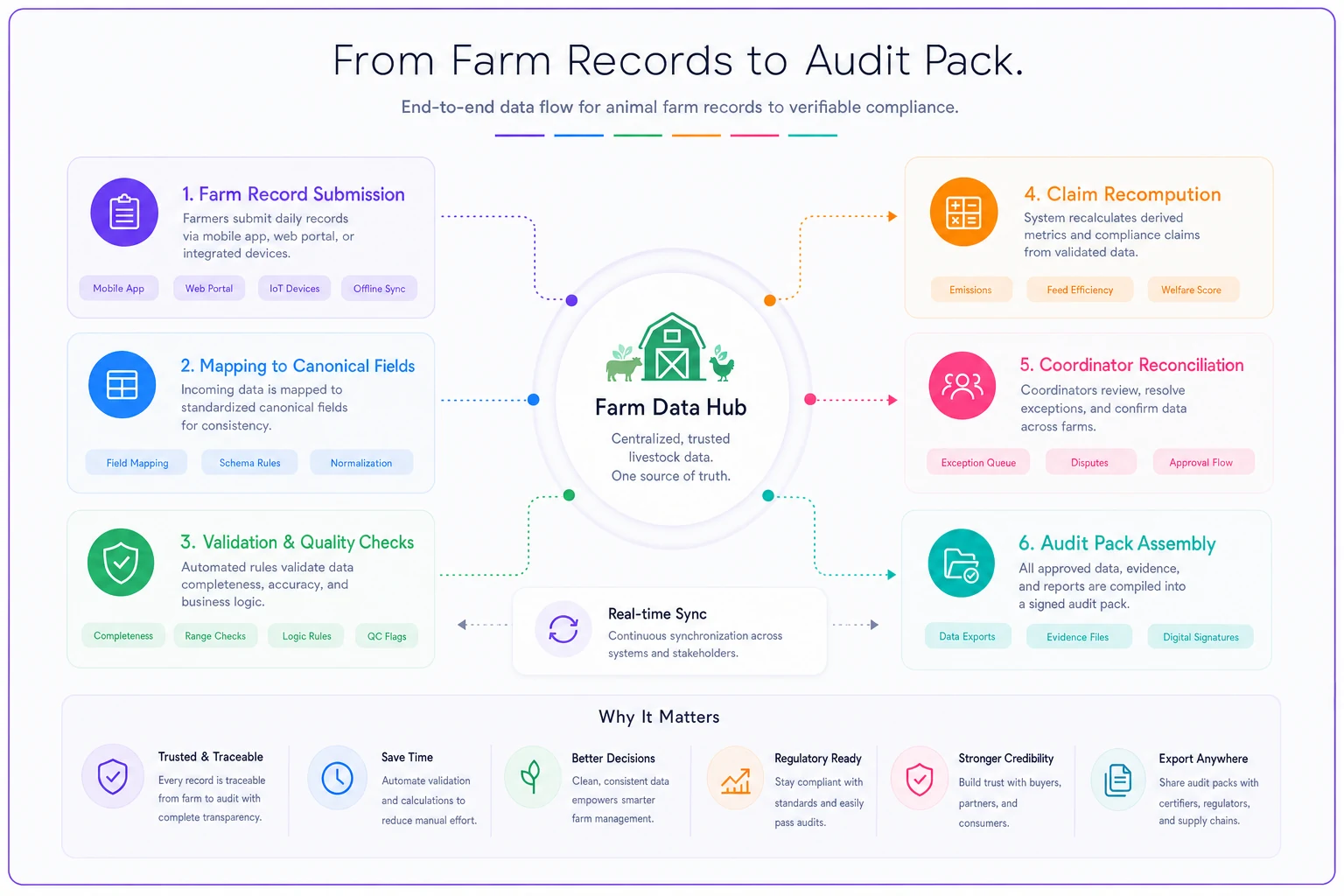
A member treats a steer for foot rot on a Tuesday. They log it that evening in their own system, whether that's an app, a barn sheet, or whatever they use. The record includes the animal's management tag, the product, the dose, the date, and who gave it.
By the end of the week, the member's records sync or get submitted to the co-op. On the way in they're mapped to canonical fields: management tag resolved to official ID, event date and entry date captured separately, product mapped to a standard drug list, and the record flagged as an antibiotic treatment event.
Validation runs automatically. Is the animal ID active on this member's roster? Is the event date before the entry date and after the birth date? Is the product on the approved list for this species? Anything that fails goes back to the member with a specific reason, not a vague "please fix."
The claim engine then recomputes that steer's eligibility. He was on the never-ever list, and now he isn't. The change gets logged with the triggering record, so if anyone asks later why the steer was pulled, the answer is right there. The member sees the status change on their side too, which matters, because nobody likes finding out at delivery that an animal was excluded.
At the coordinator level, reconciliation picks up the change in eligible head count for that member's next delivery window. If the member committed to a certain number of eligible animals, the coordinator now knows there's one fewer, weeks ahead instead of at the scale.
When the buyer's audit comes around, the pack for that program pulls this member's roster, the eligibility status of each animal, the exceptions (including this steer, with the treatment record as evidence), and the verification log entries for this member. The steer shows up in the exceptions section, correctly excluded, with evidence. That's what a clean pack looks like. It isn't a pack with no exceptions, it's one where every exception is explained.
Layer four: shared audit-pack templates
Co-ops running more than one program often build a separate audit pack for each buyer, from scratch, every time. That's where weeks of coordinator time disappear.
Better to have one master pack structure, with program-specific sections pulled from the same underlying data. Most buyers and certifiers want the same core things, just arranged a bit differently.
A shared template usually includes:
-
Scope statement
program, period covered, member count, animal count
-
Member roster with agreement version signed and program consent date
-
Animal list with canonical fields and current claim status
-
Exceptions log
every animal excluded or flagged, with reason and evidence reference
-
Verification log
every check done in the period, by tier, with results and follow-ups
-
Evidence index
where each supporting document lives, so auditors can request specific items without asking for everything
-
Change log
any corrections made to records after initial submission, who made them, and why
Auditors tend to go to the exceptions log first. A pack with zero exceptions across 2,000 animals doesn't look clean, it looks like nobody checked, and experienced auditors will dig harder. A pack with a few dozen exceptions, each documented, signals a system that actually catches problems.
Groups resist the change log because it feels like admitting mistakes. It's the opposite. Corrections without a log look like tampering, and corrections with one look like quality control.
Welfare-linked programs are a good test of whether your template holds up, since they tend to mix animal-level records with farm-level practice evidence. If you're building those packs, the structure in our audit-ready animal welfare KPI framework slots into the shared template as a program-specific section rather than a separate pack.
Layer five: a simple access and consent model
This layer is what keeps members in the co-op. Producers will share a lot if they trust where it goes. The first time it goes somewhere they didn't expect, they quietly stop sharing, or leave.
Keep the model simple enough to explain at an annual meeting in five minutes. Four tiers usually cover it:
| Data tier | Examples | Who sees it by default | Requires per-purpose consent | Never shared |
|---|---|---|---|---|
| Member-private | Financials, input costs, individual animal performance, death loss detail | Member only; coordinator for validation if needed | Benchmarking by name, sharing with lenders | Other members, by name |
| Co-op operational | Rosters, eligible head counts, delivery forecasts, verification results | Coordinator, field staff, board (aggregated) | Board access to named member results | Other members' operational detail |
| Program-shared | Animal list, claim status, exceptions, evidence for the specific program | Named buyer/certifier, for that program only | Each new program or buyer separately | Data from programs the member didn't join |
| Emergency | Movement, origin and premise records for disease tracing | Animal health authorities when a trace is triggered | Pre-consented in the agreement; member notified after | Not applicable |
A few rules make this work in practice.
Consent is per purpose and per program, not blanket. A member who joined the grass-finished program didn't consent to their data going to a carbon program. If the co-op signs a new carbon or sustainability deal, members opt in separately. Carbon is especially sensitive, because members reasonably ask who owns the reductions and any credits generated from their herd records. Settle that before any data moves. If your group is heading that way, the approach in livestock carbon accounting tied to daily herd records shows what data a carbon program actually needs, which helps members see exactly what they're consenting to share.
The board sees aggregates, not names, by default. Board members are usually members too, which makes them competitors and neighbors. Named access should require a specific reason, and the reason should be logged.
Every access to identified data is logged. Who looked, when, and why. Hardly anyone will ever read the log, but having it changes behavior.
The emergency tier is pre-agreed. In a disease trace you don't want to be collecting consent forms. Put the emergency use in the data-sharing agreement up front, limit it to movement and origin records, and commit to notifying members afterward.
Real scenario: a 31-member beef marketing group
Business type: Cow-calf and backgrounding marketing co-op, 31 member herds, selling calves into an age-and-source verified program with a never-ever premium tier. One part-time coordinator, one field rep.
The problem: Audit prep for each program cycle took the coordinator roughly three weeks of near-full-time work, mostly reconciling birth date formats, chasing treatment records and rebuilding the animal list. Around 15–20% of submitted calves were being excluded from the never-ever tier at delivery, often because records were incomplete rather than because the calves had actually been treated. Two members had left in the prior year, and one cited "not knowing what happened to my data" as part of the reason.
What they changed, over about five months:
-
Rewrote the membership data clause into a four-page agreement with per-program consent and explicit exit terms. All but two members signed in the first round.
-
Cut their canonical set to 19 fields, added a birth date precision flag and separate event and entry dates, and switched never-ever eligibility from a member checkbox to a status derived from treatment records.
-
Moved to risk-weighted spot checks. Members with clean recent history got checked about once a year; new members and members with recent exceptions roughly quarterly. The field rep stopped verifying members they had recruited, and a board member from outside the region took a share of checks instead.
-
Built one audit-pack template covering both the age-and-source program and the premium tier.
After roughly two program cycles:
-
Audit prep dropped to about four to five working days, most of it spent reviewing rather than reconciling.
-
Never-ever exclusions at delivery fell to somewhere around 5–7%. More importantly, nearly all the remaining exclusions were flagged weeks earlier, so members knew ahead of time.
-
The co-op picked up three new members, two of them specifically because the data terms were written down.
-
The auditor's main comment was a request for more detail in the change log, which is about the best audit feedback a group can get.
The premium itself didn't change. The co-op just stopped losing it on animals that qualified but couldn't be proven.
When this makes sense
A full stepwise governance build pays off when one or more of these is true:
-
The co-op sells into any program with a verifiable claim attached
-
Membership is past about 15 farms, or growing quickly
-
More than one person handles member data
-
The group is considering carbon, sustainability, or grant programs that use pooled data
-
A member has ever left angry about data, or a board member has ever seen something they shouldn't have
At that point the cost of not having governance shows up as lost premiums, coordinator burnout and member churn. Those costs are real even if they never appear as a line item.
When this is a bad idea (or at least premature)
Very small groups, say under eight or ten farms, selling on reputation with no formal claims, probably don't need four-tier access models and verification logs. A short written data agreement and a shared spreadsheet template with agreed definitions will do. Anything more just adds paperwork members will resent.
Building governance as a top-down board exercise and handing it to members finished is also a bad idea. The agreement in particular needs member input, or you get signatures without buy-in, and that kind of consent tends to collapse at the first dispute.
And don't let a buyer's checklist drive the whole design. Build around one buyer's audit format and you'll rebuild it when the next buyer arrives. Design around your own canonical fields, then map each buyer's requirements onto them.
Who should not do this
If the coordinator has no authority to hold back non-conforming records, skip the verification tiers until that changes. Verification without consequences is theater.
Same goes for co-ops where a few large members dominate and won't accept the same rules as smaller ones. Governance only works if it applies evenly. If the biggest supplier gets an exemption from spot checks, every other member notices, and the system loses credibility faster than if you'd never built it.
Where software fits, and where it doesn't
Most of this is agreements and roles, and no software can sign those for you. The day-to-day mechanics are another story, and that's where an operational platform with some AI-assisted automation earns its keep.
The parts that drain coordinators are mapping member submissions into canonical fields, running validation rules, recomputing claim eligibility when a treatment record lands, assembling audit packs from live data, and enforcing who-can-see-what at query time. All of it is rule-driven and repetitive, which is exactly where errors creep in when it's done by hand at 10pm before an audit. A workflow platform can handle it consistently. AI assistance helps with the messy edges, like reading a photographed barn sheet into structured fields or flagging records that look off compared to a member's usual pattern, so a person can take a look.
What software shouldn't do is make the verification calls itself or decide what members consented to. Those decisions belong to people, with the system recording what was decided and by whom.
Pulling it together
The order matters more than the polish. Get the agreement signed, lock down a small set of fields, assign who checks what, and only then build the packs and access tiers on top. A co-op that does those five things in sequence over a few months, even roughly, ends up in a very different position from one that scrambles every time a buyer asks for evidence.
Expect the first version to be imperfect. Fields will need adjusting after the first audit, someone will find a gap in the consent tiers, and the exceptions log will be longer than anyone hoped. That's fine. What you're aiming for is a system where problems surface early and get written down, and where members can see the rules apply to everyone the same way. Groups that get there tend to keep their members and their premiums. Groups that don't usually lose one or both.
Ready to optimize your farm management?
Join hundreds of farmers using Barnyly to save time, improve animal health, and increase farm productivity.