

Your livestock emergency response plan probably focuses on getting animals to safety. That's the visible part. The invisible part—proving losses, maintaining chain-of-custody records, coordinating scattered staff, and rebuilding operations from fragmented information—is what actually determines whether you recover in months or struggle for years.
Most farms discover their continuity gaps during recovery, not during the event itself. The wildfire passes, the flood recedes, the disease outbreak gets contained. Then you're sitting across from an insurance adjuster who needs documentation you never created. Your staff doesn't know which animals went where. Treatment records got destroyed. Movement logs exist in three different formats across five people's phones.
The farms that recover quickly almost always had governance-level continuity systems in place before anything went wrong.
Risk registers expose the gaps you'll wish you'd seen
A proper risk register for livestock operations goes beyond listing "fire" or "flood" as potential threats. The farms that bounce back fastest map specific vulnerabilities to specific responses—with specific documentation requirements for each.
Take a 400-head beef operation near the Colorado-Wyoming border. Their original emergency plan listed "wildfire evacuation" as a single line item. After watching a neighboring ranch grind through insurance claims for 18 months, they rebuilt their approach around documentation pathways.
Their wildfire risk now breaks into distinct documentation steps:
-
Pre-evacuation animal inventory (location, health status, ownership)
-
Transportation documentation (which animals on which trailers)
-
Temporary housing agreements (written, not verbal)
-
Chain of custody forms for each movement
-
Daily condition logs at temporary sites
-
Return transportation records
-
Post-event health assessments
Every risk category gets similar treatment. Disease outbreak? The register maps testing protocols, quarantine boundaries, movement restrictions, disposal documentation. Equipment failure during winter? It tracks which animals depend on automated systems, manual backup procedures, emergency supplier contacts.
The register itself lives in three formats: digital primary, physical backup, and cloud-synced mobile access. Because finding out your single-format risk register got destroyed along with everything else is a brutal lesson.
What separates useful risk registers from compliance theater is the connection between risk identification and operational response. Each identified risk needs:
-
Specific trigger conditions (not "if flooding occurs" but "if water reaches the 420-foot elevation marker")
-
Role assignments that account for staff availability
-
Documentation requirements that insurers actually accept
-
Recovery timelines based on actual operational capacity
The more specific the register, the more useful it is under pressure. Generic risk lists give people something to point to. Specific registers give people something to do.
Staged playbooks beat heroic improvisation
Emergency response in livestock operations typically relies on experienced managers making rapid decisions under pressure. That works until your experienced manager is evacuating their own family, dealing with their own losses, or simply unreachable.
Simplify farm operations and enhance animal care.
Barnyly helps you organize, track, and manage every aspect of your farm operations seamlessly.
- Comprehensive livestock tracking
- Automated health alerts
- Feed and resource scheduling
No credit card required
Staged event playbooks create decision trees that less-experienced staff can execute. Not generic instructions—specific operational sequences built around your actual facilities, your actual inventory, your actual resources.
A dairy with 800 milking cows can't use the same evacuation playbook as a cow-calf operation with 200 pairs spread across 3,000 acres. The dairy needs hourly milking decisions, cooling system protocols, feed inventory protection. The cow-calf operation needs gathering sequences, trailer loading priorities, pasture-by-pasture evacuation timing.
Here's how staged playbooks break down in practice:
Stage 1: Threat Identified (48–72 hours out)
-
Inventory verification protocols
-
Supply positioning (feed, medical, transport)
-
Staff notification trees
-
Documentation backup procedures
-
Preliminary animal grouping
Stage 2: Threat Imminent (24–48 hours out)
-
Go/no-go decision matrices
-
Animal prioritization (breeding stock, young stock, market animals)
-
Loading sequences with trailer assignments
-
Destination confirmation protocols
-
Final documentation creation
Stage 3: Active Response (0–24 hours)
-
Evacuation execution with contingencies
-
Real-time documentation (photos, videos, written logs)
-
Staff safety checkpoints
-
Animal welfare monitoring
-
Communication protocols with authorities
Stage 4: Immediate Post-Event (24–72 hours)
-
Damage assessment procedures
-
Animal accounting protocols
-
Mortality documentation
-
Temporary care arrangements
-
Insurance notification requirements
The playbooks work because they get tested quarterly, not filed away.
Test playbooks under realistic timing to uncover hidden bottlenecks.
A sheep operation running 1,200 ewes found during a drill that their calculated loading time exceeded their realistic evacuation window by six hours. They pre-positioned portable panels at strategic gathering points and cut actual loading time by around 40%.
Insurance evidence collection starts before you need insurance
The gap between what you lost and what insurance covers often comes down to documentation quality. Not whether you had coverage, but whether you can prove your losses in ways insurers actually accept.
Routine inventory documentation Regular photos and videos of animals, facilities, equipment. Date-stamped, location-tagged, organized. A rancher who lost 180 cattle in flooding had weekly drone footage showing exact animal locations. Their claim processed in roughly two months instead of the more typical eight to twelve.
Third-party verification records Veterinary reports, brand inspection certificates, sale receipts, breeding records. These prove animal value beyond your own word. Keep originals, certified copies, and cloud backups.
Financial flow documentation Purchase records, sales records, feed invoices, medical expenses. Insurance adjusters need to see the economic reality of your operation, not just animal counts.
Operational capability evidence Facility photos at capacity, productivity records, historical revenue documentation. This establishes that you can actually support the operation you're claiming to rebuild.
Here's a quick reference for what to capture, how often, and where to store it:
| Evidence Type | Frequency | Storage Format |
|---|---|---|
| Animal inventory photos/video | Weekly | Cloud + local backup |
| Vet and health records | Per visit | Digital + paper copies |
| Feed and supply invoices | Per delivery | Accounting system + cloud |
| Facility condition photos | Monthly | Cloud + physical binder |
| Brand inspection / sale receipts | Per transaction | Originals + certified copies |
| Production and revenue records | Monthly | Accounting system + cloud |
The shift worth making: evidence collection becomes part of routine operational workflows, not a separate task you remember only when something goes wrong. Every vet visit generates documentation. Every feed delivery creates records. Every animal movement builds your evidence trail.
Evacuation workflows that maintain chain of custody
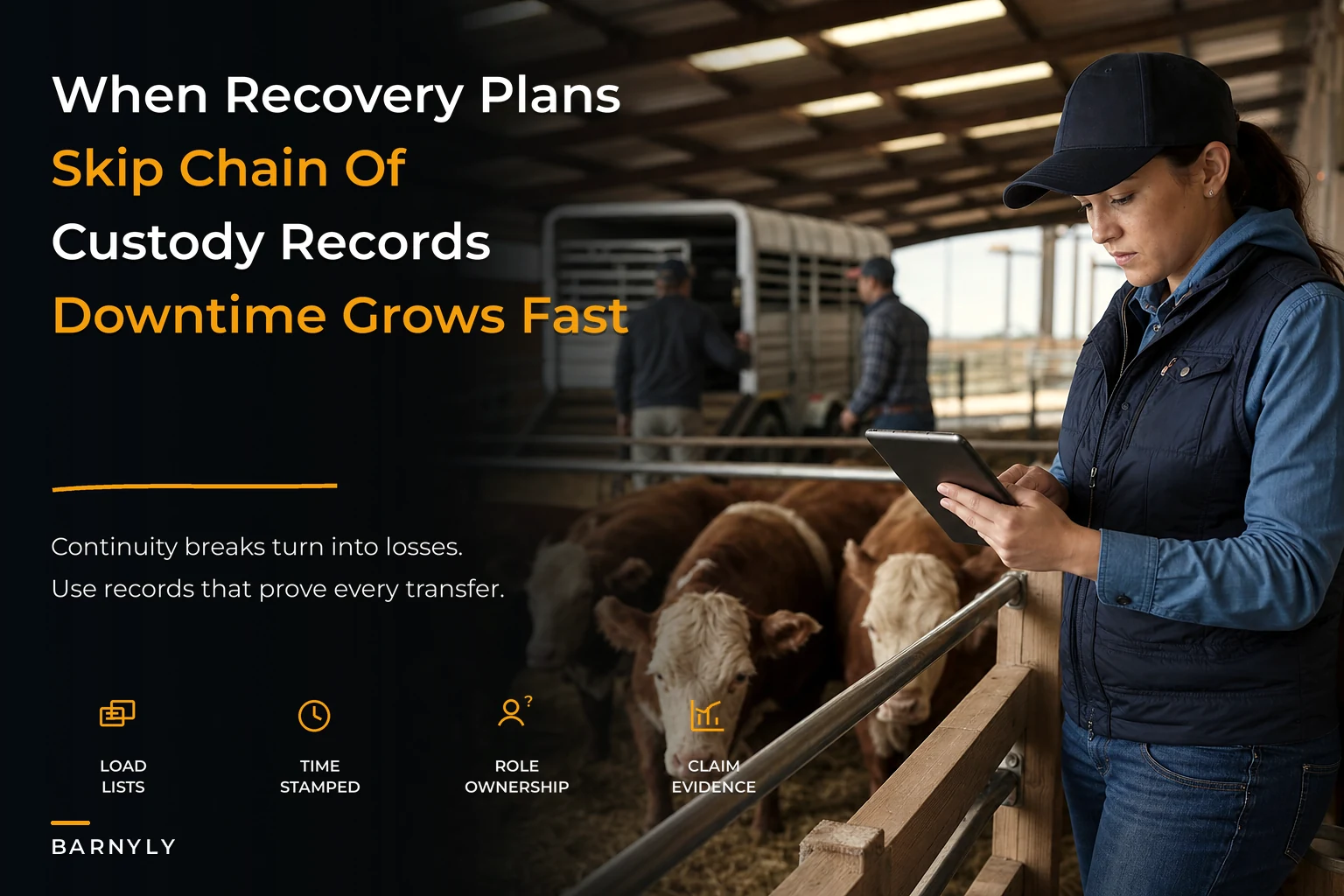
Moving 500 animals during an emergency is hard. Proving where those 500 animals went, who handled them, and what happened to each one is what determines whether you get them back—and whether insurance covers any losses along the way.
Functional evacuation workflows document every transfer point through a defined process:
-
Create loading lists with individual animal identification before any animal moves
-
Log transportation details—driver, vehicle, route, departure time
-
Confirm arrivals with receiving party signatures
-
Execute written temporary housing agreements with liability terms already established
-
Submit daily status reports from temporary locations
-
Document return transportation the same way you documented departure
A goat dairy evacuating 300 milking does learned the hard way that verbal agreements with neighboring farms meant nothing when 40 animals disappeared during temporary housing. No signatures, no proof, no recourse.
The complexity multiplies with mixed-species operations. Chickens don't evacuate like cattle. Pigs need different transportation than sheep. Each species needs its own workflow branch while maintaining overall coordination. This isn't something you want to figure out after the evacuation order has already been issued.
The following workflow visual summarizes the transfer points and documentation steps.
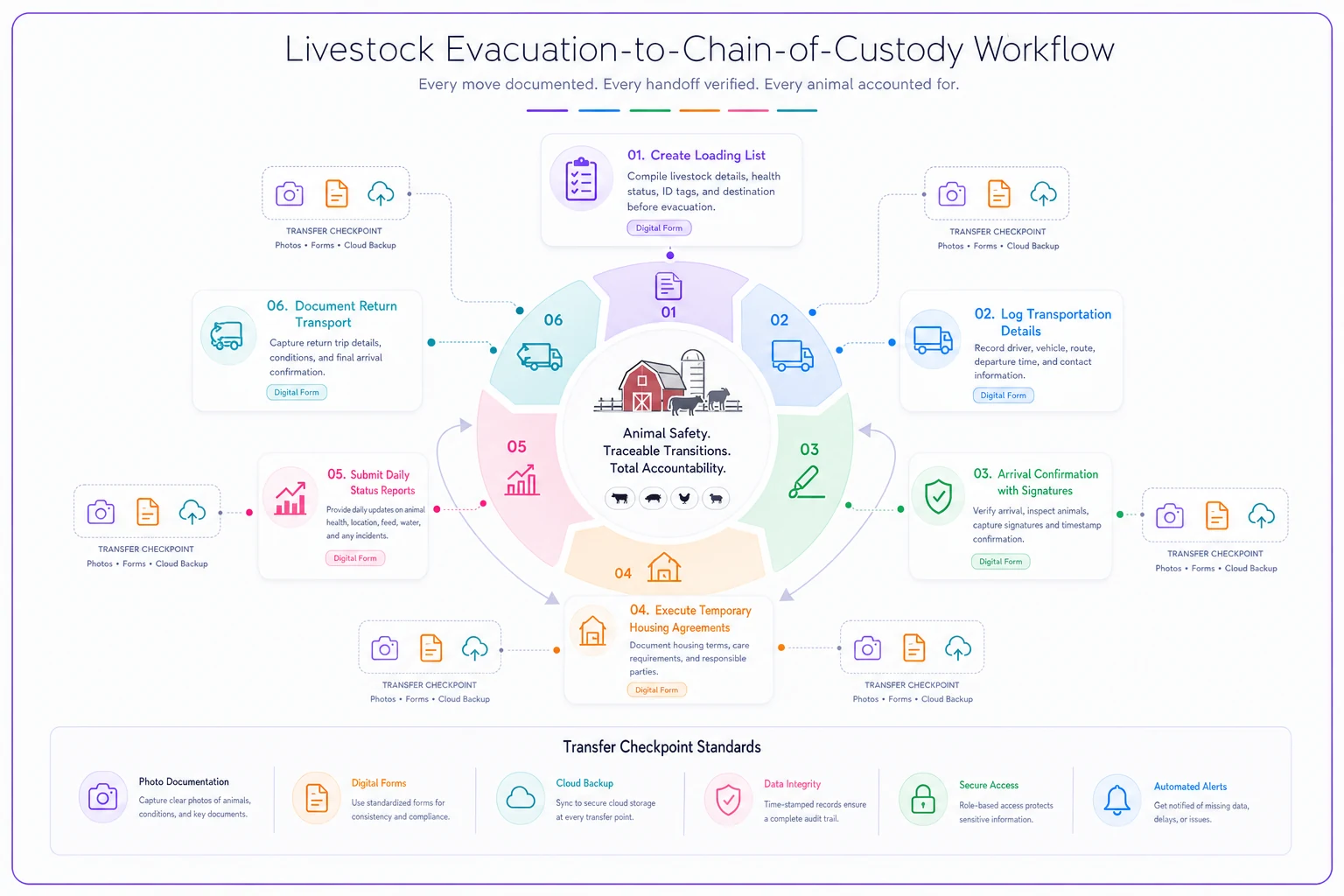
Smart operations pre-stage evacuation relationships with written agreements. They know which neighbors will take which animals, have backup locations identified, and have already sorted out liability terms. When evacuation orders come, they execute agreements—they don't negotiate them.
Staff role templates that work when key people aren't available
Your head stockman knows every animal, every gate, every quirk of your operation. But what happens when they're dealing with their own evacuation? Role templates create knowledge redundancy before you need it.
Effective templates go beyond job descriptions. They map specific tasks with step-by-step procedures, decision authorities with escalation triggers, documentation responsibilities with formats, communication requirements with contact trees, and handoff protocols when shifts change.
A feedlot with 5,000 head on feed learned this during a blizzard that trapped key staff at home. Their "anyone can execute" templates included feeding sequences with specific pen orders, water system monitoring with freeze prevention steps, health check priorities with treatment protocols, and emergency contact activation with authority levels.
Templates need to live in multiple formats. Physical binders in multiple locations, digital copies on local drives, cloud access through mobile devices, QR codes on gates linking to procedures. Single-format anything fails during disasters.
Testing reveals the gaps. Running different staff members through emergency procedures shows which templates actually work versus which ones assume knowledge that was never written down. A 500-cow dairy that thought their templates were solid discovered during testing that nowhere did they document which valve controlled water to which pen—something their senior staff just knew but had never bothered to write down.
Traceability systems that accelerate recovery
Recovery speed often depends on proving where animals were, what treatments they received, and who handled them. Operations with robust traceability systems rebuild faster because they can answer those questions without digging through boxes of paperwork.
But traceability during disasters needs different architecture than routine traceability. The systems that work during normal operations—centralized databases, networked readers, cloud-dependent platforms—might not survive the event or stay accessible during recovery.
Resilient traceability layers multiple capture methods:
-
Primary digital systems with automated capture
-
Backup paper forms with manual entry protocols
-
Photographic documentation of animal identification
-
Multiple staff trained in each method
-
Synchronization procedures when systems reconnect
A sheep operation that lost their barn office and primary computer in a fire still reconstructed complete animal records because they'd implemented triple-redundancy: cloud-synced database, paper backup sheets, and weekly photo documentation of ear tags sorted by production group.
The system also needs to handle irregular movements. During normal operations, animals move through predictable patterns. During emergencies, they might go to temporary locations, get mixed with other herds, receive treatments from unfamiliar veterinarians. A traceability system that can't capture those exceptions without falling apart isn't really resilient—it's just convenient during calm stretches.
Recovery timelines grounded in operational reality
Most emergency plans include optimistic recovery timelines. "Resume normal operations within 72 hours." But recovery doesn't mean getting animals back to familiar pastures—it means rebuilding the operational systems that make production possible.
Realistic recovery planning acknowledges infrastructure dependencies. Power has to come back before refrigeration systems work. Roads need to be passable before feed can be delivered. Water quality requires testing before consumption. Fences need repair before grazing rotation resumes. Documentation needs reconstruction before you can make sales. Staff have to be available before you can run full production.
A broiler operation producing 50,000 birds per cycle built their recovery timeline around these dependencies:
| Dependency | Estimated Time |
|---|---|
| Power restoration and verification | 14 days |
| Feed supply chain reconnection | 7 days |
| Processor scheduling | 21 days |
| Cleaning and sanitation | 10 days |
| Total before placing new birds | ~45 days |
That realistic timeline shaped their insurance coverage, their contracts, their customer communication. When flooding actually hit, they recovered almost exactly on schedule—because they'd planned for actual operational requirements, not wishful thinking.
Insurance claim acceleration through operational software
The farms recovering fastest from disasters increasingly share one thing: they'd already centralized their operational data before anything went wrong. Not special emergency management software—regular operational platforms that happen to capture exactly what insurance requires.
Modern operational software with AI automation helps by consolidating information that typically lives in scattered formats. Animal inventories update as you work. Treatment records sync from mobile devices. Movement logs generate as you load trailers. Financial records tie into operational data.
When disaster strikes, you're not scrambling to compile evidence from memory and shoeboxes. It already exists in a format insurers can work with. A cattle operation using integrated operational software settled their wildfire claim in about eight weeks because they could immediately produce:
-
Historical inventory reports with individual animal details
-
Treatment records proving animal health and value
-
Movement logs showing evacuation compliance
-
Financial records establishing economic loss
-
Production records documenting operational capacity
The automation piece matters because it captures information without adding burden during a crisis. Staff dealing with evacuation don't need to stop and manually create documentation—the system builds it as they work. None of this works if the technology isn't already embedded in daily operations. Trying to implement new systems mid-disaster fails every time. The operations that recover fastest are the ones whose normal operational software already doubles as their emergency documentation system.
Building continuity that actually continues
The best continuity plans are the ones you barely notice during normal operations. They're embedded in daily workflows, tested through regular drills, updated based on real events—not binders that collect dust until something goes wrong.
Start with the highest-impact, lowest-effort improvements:
-
Photograph your animals monthly
-
Create staff role cards for critical tasks
-
Map your actual evacuation routes with realistic timing
-
Test one emergency procedure quarterly
-
Build documentation into normal workflows
Then layer in more systematic improvements over time—risk registers for specific scenarios, staged playbooks for likely events, evidence collection protocols, redundant traceability systems, and recovery timelines grounded in your actual infrastructure dependencies rather than optimistic guesses.
The operations that bounce back from disasters aren't necessarily the largest or best-funded. They're the ones that built continuity into their operational foundation before they needed it. When the flood comes, the fire spreads, or the disease strikes, they execute plans that already existed.
Your livestock emergency response plan needs to go beyond moving animals to safety. It needs to ensure your operation can prove its losses, maintain its records, coordinate its people, and rebuild its systems. When you're standing in a muddy field trying to account for 500 scattered animals while an insurance adjuster asks for documentation that no longer exists, you'll understand why continuity planning isn't really about the dramatic moment of evacuation. It's about the mundane work of building systems that survive when everything else doesn't.
Ready to optimize your farm management?
Join hundreds of farmers using Barnyly to save time, improve animal health, and increase farm productivity.