


The box arrives. Somebody signs for it. It goes in the fridge or on the shelf. Done.
That's the version of receiving that gets farms in trouble. Not because the medicine was bad, but because when a residue question, a vaccine failure, or an audit shows up later, there's no proof of what condition the product was in when it landed on your property. The supplier says it left their dock cold and complete. You have nothing to argue otherwise. The burden sits on you.
Incoming inspection is the one point where you still have leverage over quality. Once you accept a product and it enters your workflow, every problem becomes your problem. This piece is about tightening that single moment — the receiving dock, the fridge door, the acceptance decision — and building a paper trail specific enough that a vet or an auditor reading it two years later understands exactly what you received and why you kept or rejected it.
Why the acceptance moment is where liability shifts
A supplier's responsibility for cold chain and product integrity technically ends when you accept the shipment. Your signature is the handoff. Most farms treat that signature as a formality — proof the box showed up — when it's actually a legal statement that the product was acceptable at that moment.
In real operations, this goes wrong quietly. A vaccine order arrives on a hot afternoon. The gel packs are soft, maybe fully melted. The person receiving it is mid-task, signs, and stacks the boxes in the walk-in to "sort later." Three months on, a batch of calves doesn't seroconvert the way they should. Now you're trying to reconstruct whether the vaccine ever worked — and the only record you have is a delivery signature that says everything was fine.
Reputable distributors will replace a compromised shipment if you flag it at delivery. But the window is narrow, and the claim depends on documentation at the point of receipt. Miss the inspection, and you've paid for product you can't trust and can't return.
Build the checklist around a hard accept/reject decision
A receiving checklist that just says "check the temperature" is useless because it doesn't tell the person what to do with what they see. Every line needs a threshold and an action. The question isn't "is this okay?" — it's "does this meet the criteria to accept, or does it trigger a rejection?"
Simplify farm operations and enhance animal care.
Barnyly helps you organize, track, and manage every aspect of your farm operations seamlessly.
- Comprehensive livestock tracking
- Automated health alerts
- Feed and resource scheduling
No credit card required
-
Match the delivery to the order first. Product name, strength/concentration, pack size, quantity, and — critically — the species and indication on the label. Before you even look at temperature, confirm you got what you ordered. Wrong-species labels and near-name substitutions (a 200mg/mL vs 100mg/mL formulation) are more common than people expect.
-
Read the expiry and batch/lot numbers off the actual vials, not just the outer carton. Cartons get repacked. Record the lot number now; you'll need it if there's ever a recall, and matching it later is a nightmare.
-
Assess cold-chain evidence for anything temperature-sensitive. Gel pack state, presence and reading of any in-box temperature indicator or data logger, and the physical state of the product — frozen vaccine that should be chilled, separation, discoloration, cloudy diluent.
-
Inspect packaging integrity. Crushed cartons, punctured seals, leaking vials, broken cold-chain indicators. A cracked seal on a multi-dose bottle is an automatic reject.
-
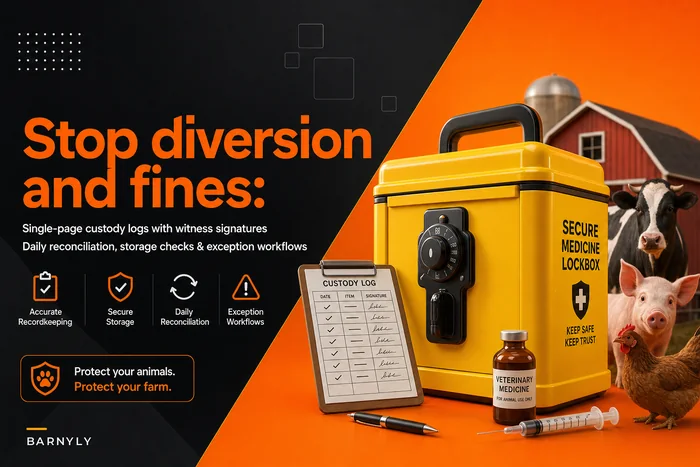
Check documentation completeness. Certificate of analysis where applicable, correct withdrawal-period info, and a legible supplier invoice with lot numbers. For controlled or prescription-only products, the paperwork requirements are stricter — the receiving log ties directly into your custody records, which is a separate discipline covered in the on-farm controlled substances custody-log workflow.
The insight most farms miss: the checklist should force a written outcome for every line — accept, accept-with-note, or reject. A blank checkbox is not a record. "Gel packs soft, product still cold to touch, accepted with note, photographed" is a record.
The checklist should force a written outcome for every line — accept, accept-with-note, or reject.
Here's a simple visual of the receiving workflow:

Use this as a guide for the sequence your receiving person should follow, from initial match to final decision and quarantine if rejected.
Acceptance criteria: draw the lines before the truck arrives
The mistake is deciding acceptability at the moment of delivery, under pressure, with a driver waiting. By then you're negotiating with yourself. The criteria need to be set in advance so the receiving person is just matching reality against a fixed standard.
| Inspection point | Accept | Accept with note | Reject |
|---|---|---|---|
| Cold-chain product temp | Within labeled range, logger confirms | Brief excursion within stability window, documented | Frozen when should be chilled; logger shows extended breach |
| Gel packs / coolant | Firm, cold | Partially softened, product still cold | Fully melted, product warm |
| Expiry dating | Adequate shelf life for your use | Short-dated but usable before expiry | Expired or expiring before you can use it |
| Packaging | Intact, sealed | Minor outer carton damage, vials sound | Punctured seal, leaking, broken vial |
| Product appearance | Normal per label | Minor settling that resuspends | Discoloration, particulates, separation that won't mix |
| Documentation | Complete, lot numbers match | Minor invoice discrepancy, resolvable | Missing CoA where required, no lot traceability |
"Short-dated" deserves a note because it's the criterion farms handle worst. A distributor clearing near-expiry stock isn't necessarily a bad deal — but if you receive a vaccine expiring in six weeks and your vaccination window is three months out, that's a reject even though the product is perfectly good today. Acceptance criteria have to account for your usage timeline, not just the printed date.
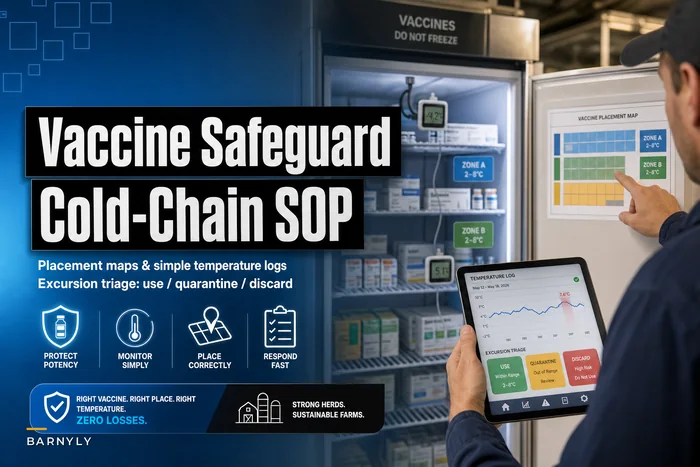
For anything temperature-sensitive, your thresholds should mirror the same logic you use inside the operation. If you've already built a cold-chain SOP with temperature logs and excursion triage, incoming inspection is the front door of that same system — the point where an excursion either gets caught or gets locked into your inventory unnoticed.
The rejection workflow nobody sets up until it's too late
Accepting is easy. Rejecting is where farms freeze, because rejecting means friction — a driver who wants to leave, a reorder delay, a conversation with the supplier. So marginal shipments get accepted "to avoid the hassle," and the hassle just moves downstream where it costs more.
-
Do not sign for acceptance. Note "received, subject to inspection" or refuse per the criteria. This single distinction preserves your claim.
-
Photograph everything. Melted gel packs, the logger reading, the damaged carton, the label, the invoice. Timestamped photos are the strongest evidence you'll have in a supplier dispute.
-
Segregate immediately. Rejected or questionable product goes into a physically separate, labeled quarantine spot — never back into the working fridge where someone might grab it. A "DO NOT USE — HOLD" bin prevents the worst outcome, which is a rejected vaccine getting drawn up by accident.
-
Log the rejection with reason codes. Not a note. A structured entry: date, product, lot, quantity, reason (temperature breach / damage / expiry / wrong product), action taken, who was notified.
-
Notify the supplier within the claim window and record the response. Reference number, who you spoke to, what they committed to.
-
Track resolution to close. Credit issued, replacement received, or dispute escalated. An open rejection with no resolution is a hole in your records.
Farms that reject well aren't the ones with stricter rules — they're the ones where the receiving person has permission and a script. When the workflow is written down, a part-time worker at the gate can refuse a bad shipment confidently. When it isn't, even the owner accepts things they shouldn't because the alternative feels like a personal confrontation.
The record fields that actually satisfy an auditor or vet
Auditors and vets don't want your reassurance. They want fields they can read independently and reconstruct the decision. A receiving record that a vet can interpret without calling you is the goal. Here's the minimum set of fields per received line:
-
Date and time of receipt
-
Supplier and invoice/reference number
-
Product name, strength, and pack size
-
Batch/lot number (from the vial)
-
Expiry date
-
Quantity received vs quantity ordered
-
Cold-chain evidence (gel pack state, logger reading, or "N/A – ambient product")
-
Packaging and appearance condition
-
Acceptance decision (accept / accept-with-note / reject)
-
Reason code if not a clean accept
-
Photos attached (yes/no + reference)
-
Received and inspected by (name/initials)
-
Storage location product was placed in
That last field — where the product went — is the one people consistently leave off, and it's the link that connects receiving to your treatment and inventory records. Without it, an auditor can see you received a lot but can't trace where it lived or which animals it ended up in.
What makes these fields procurement evidence rather than just notes is consistency. One handwritten receiving note proves nothing. A year of structured, dated receiving records with lot numbers and acceptance decisions demonstrates a functioning quality process — which is exactly what a farm-assurance audit or a residue investigation is trying to establish. When someone evaluates your medicines supplier QA farm practices, they're really assessing whether this record set exists and whether it's applied every single time, not whether you can explain your intentions.
A real scenario: the shipment that paid for the whole system
A mixed cow-calf and stocker operation, running vaccines and injectable antimicrobials across a few hundred head, had a receiving process that amounted to "sign and shelve." Their trigger to change wasn't an audit — it was a summer delivery where roughly a third of a $2,800 vaccine order arrived with gel packs fully liquid and the boxes warm to the touch after sitting on a hot loading step.
Under the old process, that shipment would have gone straight into the walk-in and been used. Instead — because they'd just written a one-page acceptance checklist with a hard temperature-breach reject line — the person receiving it photographed the gel packs, refused acceptance on the affected boxes, logged the rejection with a reason code, and called the distributor within the hour. Full replacement, cold, within two days. No cost to the farm.
The number that mattered wasn't the $2,800 saved on that one delivery. It was what they avoided downstream: a possible vaccination failure across a calf group, revaccination labor, and the near-impossible task of proving after the fact that the vaccine — not their technique — was the problem. Over the following year they caught three more rejections: two short-dated, one damaged. Under the old habit, all of them would have quietly entered inventory.
Where software earns its place — quietly
None of this requires software to start. A laminated checklist and a phone camera get you most of the way there. But the part that breaks down manually is linking — connecting a receiving record to the lot number, to where it was stored, to which animals eventually got that batch, and pulling it all back together when a recall or residue question hits.
That's where an operational platform that ties receiving records to inventory and treatment history actually reduces work rather than adding forms. When a lot number gets flagged, you want to trace forward instantly — which animals, which withdrawal periods, which fields — instead of digging through a year of paper. AI-assisted receiving workflows can also catch the boring-but-costly stuff automatically: a lot expiring before your planned vaccination window, a quantity mismatch against the order, a supplier whose deliveries keep arriving warm. The value isn't automation for its own sake; it's that the system holds the connections a busy person at the gate simply can't keep in their head.
The one habit that changes everything
If you take a single thing from this: the receiving person's signature is a quality statement, not a delivery confirmation. Treat it that way, give whoever's at the gate a fixed set of accept/reject criteria and permission to use them, and write down the outcome — accept, note, or reject — for every line, every time.
Do that, and the marginal shipments start getting caught at the door instead of failing in the field. The paper trail builds itself into procurement evidence. And when a vet or an auditor asks what condition your medicines were in when they arrived, you'll have an answer written down — not a memory you're hoping holds up.
Do that, and the marginal shipments start getting caught at the door instead of failing in the field. The paper trail builds itself into procurement evidence. And when a vet or an auditor asks what condition your medicines were in when they arrived, you'll have an answer written down — not a memory you're hoping holds up.
Ready to optimize your farm management?
Join hundreds of farmers using Barnyly to save time, improve animal health, and increase farm productivity.