


Most farms don't lose controlled substances in one dramatic theft. They lose them in half-milliliter increments, over months, in a way nobody notices until inventory doesn't match paperwork and there's no clear person to point to. That gap between "how much ketamine or pentobarbital we bought" and "how much we can actually account for" is where fines, license problems, and uncomfortable conversations with your veterinarian start.
The frustrating part is that the fix isn't complicated. It's a custody log tight enough that every dose has a name attached to it, and loose enough that the person doing the work at 6 a.m. in a squeeze chute actually fills it out. Most farms have neither. They have a spiral notebook in a drug cabinet, or a bottle count someone does "when they remember."
This is a walkthrough of a minimal-complexity custody chain built for real farm conditions — one page per bottle, witness signatures where they matter, a daily reconciliation that takes two minutes, and an exception process for the days something doesn't add up.
Where the paperwork actually breaks down
The single most common failure isn't dishonesty. It's the moment between drawing a dose and recording it.
Here's the realistic sequence. A cow needs sedation for a procedure. Somebody grabs the xylazine, draws what they need, treats the animal, sets the bottle down, and moves to the next task. The intention is to write it in the log later. Later never comes, or it comes at the end of a 12-hour day when the person is guessing at the volume. Multiply that by three people who all have cabinet access and you've got a log that's directionally correct at best.
-
Shared access, no attribution. Four people can open the cabinet, so no single dose has an owner.
-
Volume estimated, not measured. "About 4 cc" written down for a dose that was actually 6.5.
-
No running balance. The log records what left the bottle but never states what should be left, so nobody catches drift until the bottle is empty.
-
Reconciliation that isn't scheduled. Counting happens during audits or reorders, which means discrepancies are weeks old and impossible to trace.
Farms with the cleanest records aren't the ones with the strictest people — they're the ones where the log lives physically next to the drug and takes under 30 seconds to complete. Friction is the enemy. Every extra step you add is a dose that gets recorded from memory.
The one-page custody log, per bottle
The core unit isn't a logbook. It's a single sheet tied to a single bottle, from the moment it's opened until it's empty or expired. When the bottle is done, the sheet gets filed. That's your permanent record for that specific lot.
Simplify farm operations and enhance animal care.
Barnyly helps you organize, track, and manage every aspect of your farm operations seamlessly.
- Comprehensive livestock tracking
- Automated health alerts
- Feed and resource scheduling
No credit card required
One page per bottle solves three problems at once: it forces a running balance, it keeps lot and expiration data attached to the actual product, and it makes reconciliation a subtraction problem instead of a hunt through pages.
Here's what each line captures:
| Field | Why it's on the sheet |
|---|---|
| Date & time | Ties the dose to a shift and a person |
| Animal ID / group | Links custody to treatment, not just to inventory |
| Amount removed (measured) | The actual volume drawn, in cc/mg |
| Running balance | What should remain in the bottle after this dose |
| Administered by | The person accountable for the draw |
| Witness (when required) | Second signature for waste, high-risk drugs, or spills |
| Reason / procedure | Connects the dose to a clinical justification |
The running balance column is the part most farms skip, and it's the one that catches diversion. If the sheet says 43 cc should remain and a spot check shows 31, you know there's a problem today, tied to a specific window and a specific set of people — not three weeks from now when the bottle runs dry.
The reason field matters too, because a custody log that doesn't connect to why the drug was used is only half a record. This is the same logic behind workflow-based medication records with automatic withdrawal calculators — the custody entry and the treatment entry should be describing the same event, so a residue question later can be answered from one linked trail instead of two disconnected ones.
Keep the sheet next to the bottle.
When the bottle is retired, the sheet gets filed as the permanent record for that lot.
Witness signatures: only where they earn their keep
A lot of farms make one of two mistakes with witnesses. Either they require a second signature on nothing, or they require it on everything and people start signing without looking.
Neither works. The point of a witness is to make certain high-risk moments harder to fake. Use it deliberately:
-
Waste and spills. Any drug that's drawn but not administered — a partial dose, a broken vial, a spilled amount — needs a second person to confirm the quantity. This is the single highest-diversion-risk moment, because "wasted" is the easiest lie to tell about a missing dose.
-
High-schedule drugs. For anything on the more tightly controlled schedules, a witness on removal is worth the friction.
-
End-of-bottle reconciliation. When a bottle is retired, a second person confirms the final count matches the running balance before the sheet is filed.
For routine, low-risk administration during normal work, a single signature from the person who drew the dose is enough. Overloading witness requirements just teaches people to sign reflexively, which destroys the whole value of the second signature.
One pattern worth noting: on farms where the same two people always witness each other, the control weakens over time because it becomes automatic. Rotating who witnesses, when you have the staff to do it, keeps the check meaningful.
Daily reconciliation that takes two minutes
Reconciliation isn't a monthly event. Done monthly, it's useless for catching diversion — by the time you find a 15 cc gap you can't say which of 40 people-days it happened in.
The daily version is deliberately small:
-
Pull the active custody sheets for every open controlled bottle — usually a handful, not dozens.
-
Read the running balance off the bottom line of each sheet.
-
Physically check the level or count against that balance.
-
Mark the sheet with a reconciliation initial and the date if it matches.
-
Flag anything off into the exception process immediately — don't "keep an eye on it."
A simple visual workflow clarifies the daily reconciliation steps.
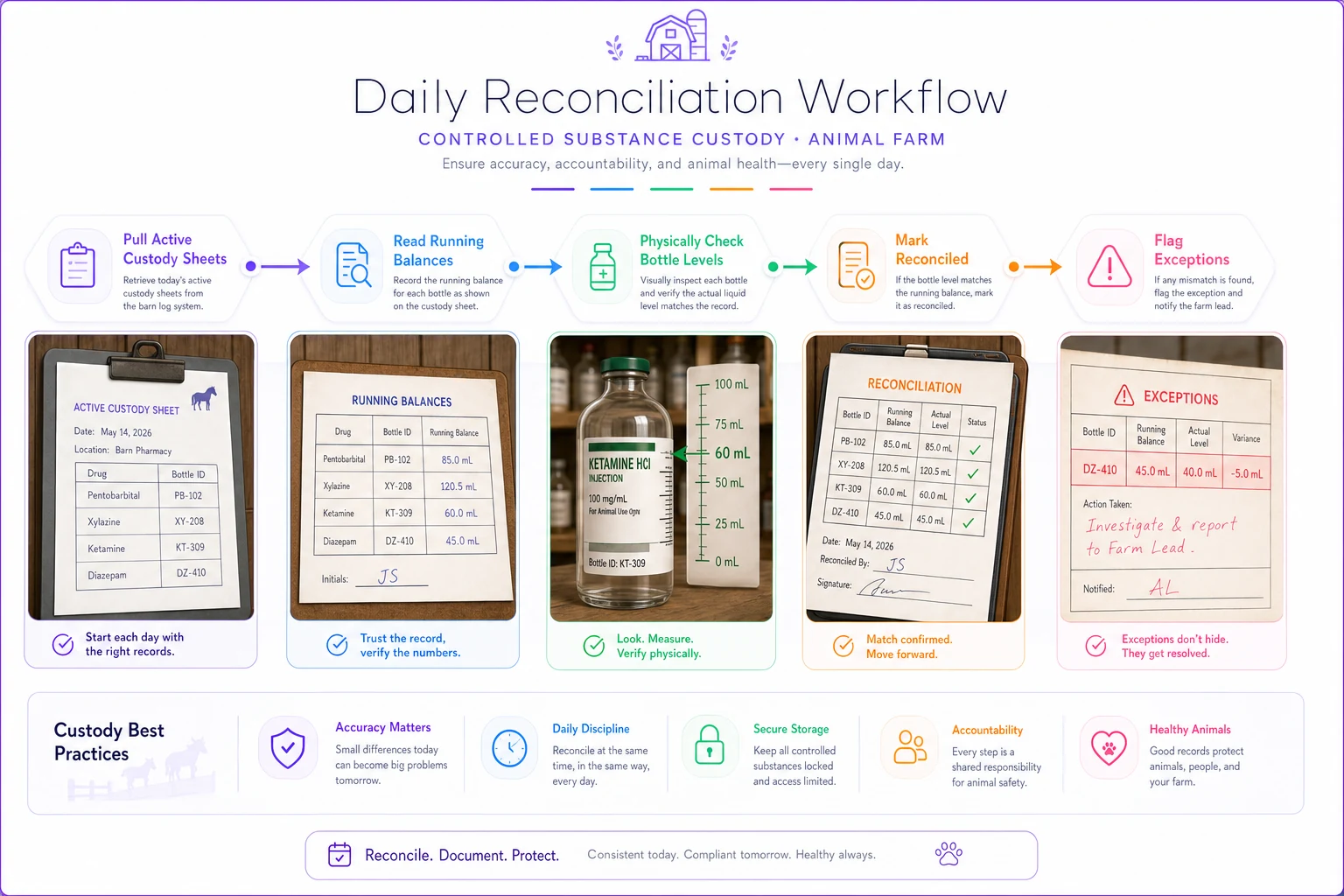
Whoever closes out the day does this as part of locking the cabinet. It works because the discrepancy window is one day. If a count is off, the list of people who had access in the last 24 hours is short, and their memory of that day is still fresh.
A useful habit: reconcile before restocking, never after. If you top up or reorder first, you've erased the evidence of the gap. Count against yesterday's balance while it's still clean.
The exception workflow — what to do when it doesn't match
Most custody systems have no answer for the moment the numbers disagree, which is exactly the moment that matters. A discrepancy with no defined response just becomes a shrug and a corrected number, and a corrected-without-explanation number is worse than no number at all in an audit.
Minor discrepancy (small volume, plausible measurement error). Note it on the sheet, have the person who drew that day's doses confirm their volumes, and record the explanation. A 1–2 cc difference on a viscous drug drawn fast is often real slack, not diversion. Document it either way.
Unexplained discrepancy. The count is off and nobody can account for it. This stops being a paperwork note and becomes an incident: written up, dated, everyone with access during that window listed, and escalated to whoever owns compliance on your operation.
Pattern discrepancy. Small, "explainable" gaps that keep happening on the same shift, same drug, or same person. This is the one that gets missed, because each individual gap looks minor. The pattern is the signal. If the same bottle drifts 2–3 cc low every week under the same person's watch, that's not measurement error.
The whole reason to log reason codes and outcomes on the treatment side is so these patterns are visible — the same discipline that turns treatment data into defensible, audit-ready traceability applies here. A custody gap next to a treatment record with no matching animal is a red flag you want your own system catching before an inspector does.
Storage checks that actually get done
Custody is only as good as the box the drugs sit in. A perfect log on an unlocked cabinet is theater. Build a short storage check into the same daily close:
-
Locked and logged. Cabinet locked, key or code access limited to a named list, and that list reviewed when staff changes.
-
Temperature. For refrigerated products, a daily temp reading — a failed fridge quietly ruining a controlled drug still leaves you accountable for the missing product.
-
Expiration sweep. Weekly scan for expired bottles, pulled and logged for disposal with witness signature. Expired product left in the cabinet is both a compliance issue and a diversion cover story ("oh, that was expired, we tossed it").
-
Separation. Controlled substances physically separated from general medications so custody scope is obvious and counting is fast.
The expiration piece connects back to your one-page sheets: a retired bottle for expiration follows the same close-out and witnessed final count as an empty one. Disposal is a custody event, not a cleanup task.
A realistic scenario
A cow-calf operation running about 400 head had three people with cabinet access and a shared logbook. Their controlled inventory was mostly sedation and euthanasia product. Twice a year they'd count for reorder and find they were "a little short," write it off to spillage, and move on.
When they switched to one sheet per bottle with a daily running-balance reconciliation, the first surprise wasn't theft — it was that roughly a quarter of their entries had volumes recorded from memory and off by 1–3 cc. Once volumes were measured at the time of draw, the daily counts started matching within a small, consistent margin.
The second thing that surfaced: one recurring 4–5 cc weekly gap on a single drug, tied to one shift. Not a dramatic amount — maybe $60–80 worth of product over a couple months — but it was consistent, and under the old system it had been invisible inside the twice-a-year "little short" write-off. The pattern review caught it inside about three weeks. Whether it was sloppy waste handling or something worse, the point is they could finally see it and address it, instead of guessing at reorder time.
Time cost of the new process ran about two to three minutes at day's end. The old logbook, honestly, took nearly as long and told them almost nothing.
When this level of rigor makes sense — and when it's overkill
This makes sense when: you keep controlled substances on-site, more than one person can access them, and you're the one whose name is on the DEA registration or purchasing records. The moment access is shared, per-dose attribution stops being optional.
This is lighter than you need when: your vet administers everything on-farm and you hold no controlled inventory yourself. In that case your record is really the treatment record, and the custody chain is your vet's problem, not yours.
Who should not try to run this on paper alone: operations with multiple sites, rotating seasonal labor, and a lot of open bottles at once. Once the number of active sheets and the number of hands crosses a certain point, manual daily reconciliation across locations gets missed on exactly the busy days when diversion is easiest. That's where an operational platform earns its place — not because software counts the bottles for you, but because it maintains running balances, flags a reconciliation that didn't happen, links each custody entry to the matching treatment and withdrawal record, and surfaces the small recurring gaps a human eye slides past. The value isn't automation for its own sake; it's that the pattern-level discrepancies stop hiding.
The point
A controlled substance custody chain doesn't fail because farmers are careless. It fails because the logging step has more friction than the work step, so records get reconstructed from memory and drift goes unnoticed until it's a gap nobody can explain.
Keep the sheet next to the bottle. Measure the draw instead of estimating it. Carry a running balance. Reconcile every single day against yesterday's number before you restock. Witness the moments most likely to hide a missing dose, and give discrepancies a real place to go instead of a shrug.
Do that consistently, and an inspector's visit becomes a filing exercise instead of a scramble — and the small, quiet losses that never showed up in a twice-a-year count stop happening in the first place.
Ready to optimize your farm management?
Join hundreds of farmers using Barnyly to save time, improve animal health, and increase farm productivity.