

Moving livestock across a state or provincial line looks simple until you actually try to document it. Every jurisdiction wants slightly different paperwork, with slightly different timelines, referencing slightly different animal identifiers. And the moment you're shipping to more than two destinations, the whole thing stops being a checklist and becomes a coordination problem. That's the part most producers underestimate.
The trouble isn't that any single requirement is hard. A Certificate of Veterinary Inspection isn't complicated. A brand inspection isn't complicated. What breaks operations is the overlap — the same shipment might need a CVI valid for 30 days in one state, a permit number requested 48 hours ahead in another, and a specific tag format that a third jurisdiction won't accept unless it was recorded a certain way at the source. You end up managing four or five separate compliance clocks that all start ticking at different moments.
This is a system article, not a tips list. The goal is to show how the moving parts connect — and where they quietly fall apart as your operation scales from occasional sales to regular multi-state movement.
Why compliance breaks down when livestock cross lines
The core issue is that livestock compliance isn't organized around your operation. It's organized around jurisdictions. Each state or region wrote its own rules for its own reasons — disease history, industry politics, whatever — and none of them coordinated with the others. The burden of translation lands entirely on the producer.
In practice, that translation happens inside someone's head. A ranch manager who's shipped to the same three feedlots for a decade just knows that Colorado wants the CVI plus brand inspection, that the Nebraska buyer needs the permit requested a couple days early, and that a particular sale barn won't take animals without a specific tag. That knowledge works fine — until that person is sick, quits, or the operation adds a fourth destination nobody's dealt with before.
Compliance knowledge is almost never written down as a route-to-requirement map. It gets stored as tribal memory and reconstructed under time pressure the morning of a load-out. That's the failure pattern. Not ignorance of the rules — poor organization of the rules relative to the actual movements the business makes.
A typical example: a cow-calf operation selling into three channels — a local auction, a direct feedlot buyer two states over, and an occasional breeding-stock sale that ships further. Three channels, three completely different document sets, three timelines. When volume is low, the owner handles it by memory. When they scale up and a hired hand starts running load-outs, the memory doesn't transfer. Loads get turned back at inspection, or worse, get through with incomplete records that surface during an audit.
The crosswalk: what it actually is
The fix isn't more paperwork. It's a single reference table — a crosswalk — that maps each route (origin → destination) to four things:
Simplify farm operations and enhance animal care.
Barnyly helps you organize, track, and manage every aspect of your farm operations seamlessly.
- Comprehensive livestock tracking
- Automated health alerts
- Feed and resource scheduling
No credit card required
-
The jurisdictions the animals pass through or enter
-
The required documents for that specific route
-
The timelines each document is bound by (lead time to request, validity window, submission deadline)
-
The record fields that must be captured at the source to satisfy those documents
The word "route" matters. Most producers think in destinations, but transit jurisdictions have requirements too. If a load passes through a state that requires in-transit permits or has specific disease-status rules, destination-based thinking misses that entirely.
Here's a simplified version of what the crosswalk looks like once it's built out. Real ones get bigger, but this shows the structure:
| Route | Jurisdictions involved | Required documents | Key timelines | Source record fields needed |
|---|---|---|---|---|
| Ranch → in-state auction | Home state | Brand inspection; owner-shipper statement | Brand insp. day-of | Official ID, brand, headcount |
| Ranch → out-of-state feedlot | Home + destination | CVI; entry permit; brand inspection | Permit request 48h ahead; CVI valid 30 days | Official ID, vaccination dates, vet name, permit # |
| Ranch → breeding sale (multi-state) | Home + transit + destination | CVI; entry permit; disease test results (e.g., trich/BVD); brand inspection | Test results before CVI; permit lead time varies | Official ID, test dates + results, vet, tag format |
| Ranch → export staging facility | Home + federal | CVI; federal export docs; specific test panel | Longest lead time — plan weeks out | Full ID history, test panel, isolation records |
The value here isn't the table itself — it's that the table forces you to work backward from the destination requirement to the record you need to capture before the animal ever moves. That backward mapping is what most operations skip, and it's why documents end up missing at load-out. You can't produce a vaccination-date record on the trailer ramp if nobody logged it three months ago.
The record-field problem is the real bottleneck
Documents like CVIs and permits aren't the hard part — a vet or an office can generate those fairly quickly. The hard part is that those documents depend on data that had to be captured much earlier, in a specific format, and that data usually lives scattered across notebooks, phone photos, and half-remembered treatment dates.
If a breeding sale requires a trich test result referenced by the animal's official ID, and your source records list that animal by a barn name instead of its official tag, you've got a reconciliation problem at the worst possible moment. Multiply that across a load of forty head and you understand why load-outs run late.
The record-field column in the crosswalk is doing quiet, important work: it tells you what to capture at the source so the downstream document is a simple pull instead of a scramble. This is the same discipline behind audit-ready traceability and field-level record templates — the field you forget to record today becomes the compliance gap you can't fill later. Movement compliance is just traceability with a deadline attached.
A useful rule: for every document in your crosswalk, list the exact fields it consumes, then check whether those fields exist in your standing records with matching identifiers. Where they don't match, that's a fix you make now, not on shipping day.
Building the printable compliance calendar
The crosswalk tells you what is required. The calendar tells you when. These have to be separate views of the same data, because the timelines don't line up neatly.
-
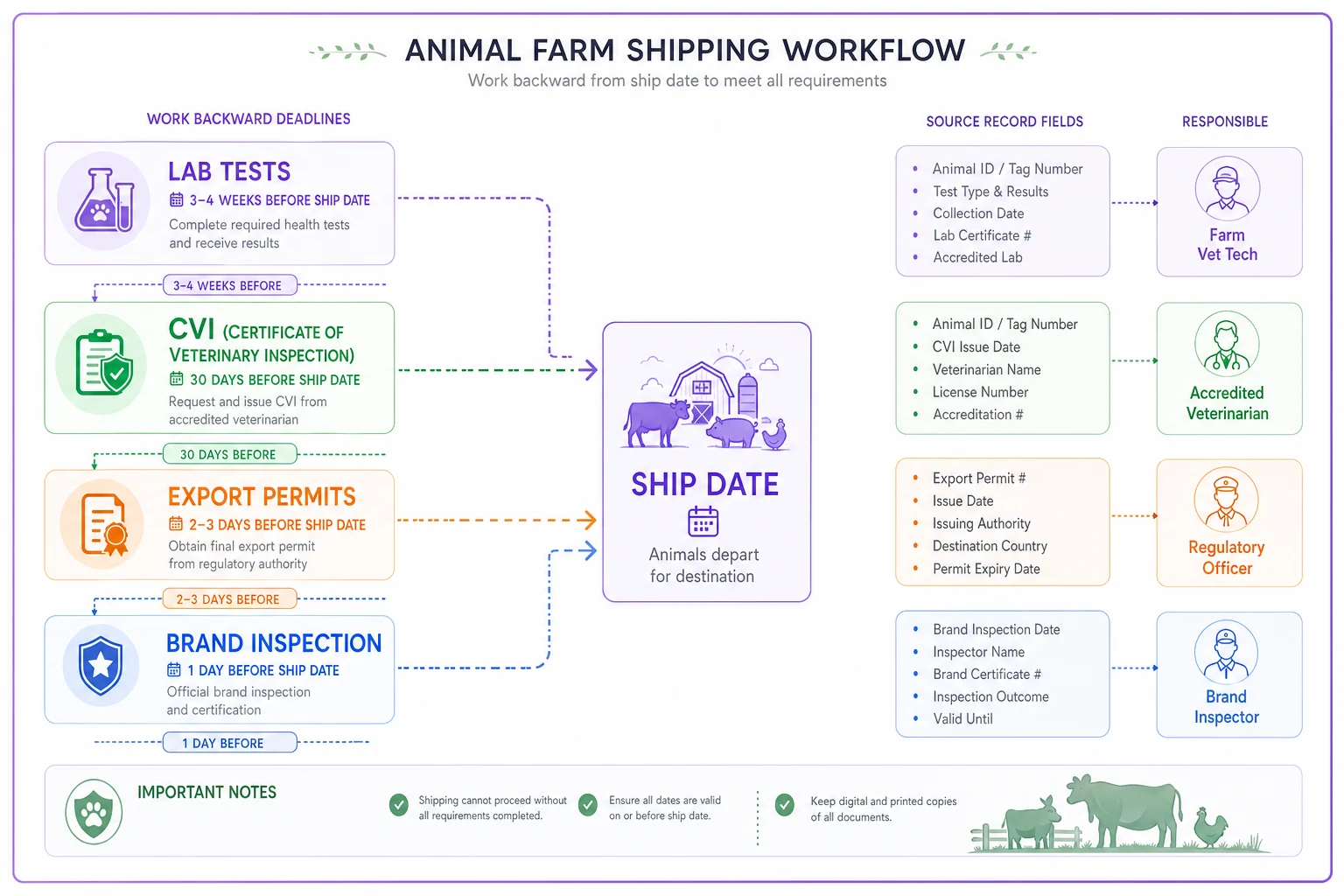
Ship date minus 3–4 weeks anything requiring lab turnaround (disease panels, export testing). These are the deadlines people blow most often because the lead time feels absurdly long relative to how simple the shipment seems.
-
Ship date minus 30 days the CVI validity window opens — schedule the vet visit inside it, not before.
-
Ship date minus 2–3 days entry permit requests for jurisdictions that require advance notice.
-
Ship date minus 1 day brand inspection scheduling, final headcount reconciliation, document assembly.
-
Ship day brand inspection completed, manifest finalized, records verified against the crosswalk one last time.
The printable version matters more than it sounds. A lot of load-outs happen in places with bad cell service, early in the morning, by people who aren't the ones who scheduled the vet. A physical calendar taped inside the office door — or a printed sheet that rides in the truck — closes the gap between the person who knows the requirements and the person actually doing the work.
Tape the printed calendar inside the shipping office or in the truck so the person doing the load-out can follow it without phone access.
A simple process for laying it out
-
List every route the operation actually runs (be honest — include the "occasional" ones).
-
For each route, pull the deadline cascade above and mark the longest lead-time item. That item sets your planning horizon.
-
Work forward from a planned ship date and place each deadline on the calendar.
-
Assign a name to each deadline — not a role, a person. "Someone should handle permits" is how permits get missed.
-
Print it. Post it where load-outs are staged, not just where the office computer sits.
Visualizing the deadline cascade as a simple workflow helps get everyone on the same page.
Keep the printed sheet concise and route-specific so it's actually used on loading days.
Manifest templates producers can use pre-departure
The manifest is where the crosswalk and calendar meet reality. It's the single document that travels with the load and proves, at a glance, that the requirements were satisfied. A good pre-departure manifest isn't just a headcount — it's a verification tool.
-
Shipment header date, origin, destination, transit jurisdictions, driver, plate
-
Document checklist each required doc for that specific route with a checkbox and reference number (CVI #, permit #, brand inspection #)
-
Animal line items official ID, description, and any per-animal requirements (test result reference, vaccination status)
-
Timeline confirmation a small box confirming the permit was requested on time and the CVI is inside its validity window
-
Sign-off the person who verified the load against the crosswalk, and the driver's acknowledgment
Building the checklist from the route's crosswalk row makes gaps visible before the trailer leaves. If the permit-number field is blank, the load doesn't roll. That single rule — no blank required fields, no departure — prevents most of the expensive compliance failures that show up repeatedly across operations.
Keep a separate manifest template per route type. Trying to make one universal template cover an in-state auction run and a multi-state breeding sale produces a form so cluttered that people start skipping fields. Route-specific templates stay short and get filled in correctly.
What breaks at scale
At one or two loads a month to familiar destinations, none of this is strictly necessary. The owner's memory carries it. The system starts earning its keep at exactly the moment the operation crosses a few thresholds:
-
More destinations than one person can hold in their head. Usually somewhere around four or five distinct route types, memory stops being reliable.
-
More than one person running load-outs. The instant compliance knowledge has to transfer between people, undocumented knowledge becomes a liability.
-
Higher-consequence shipments. Breeding stock, export, or high-value loads where a turned-back trailer costs real money and reschedules a chain of downstream events.
The failure at scale isn't dramatic. It's a slow accumulation of near-misses — a permit requested a day late that happened to still get approved, a CVI that expired the day after a shipment squeaked through. Each near-miss reinforces the false belief that the informal system works, right up until one lands during an audit or an actual disease traceback. This ties directly into broader operational risk and continuity planning — compliance knowledge locked in one person's head is a continuity gap the same way a single-point equipment failure is.
A real scenario
A mid-size cow-calf and stocker operation was shipping into four channels: local auction, two out-of-state feedlots, and a growing breeding-stock business selling across three states. The owner handled all compliance personally. When he brought on a second manager to run half the load-outs, things started slipping.
Over roughly six months they had two loads held at inspection for missing permit paperwork, one breeding sale delayed because trich results couldn't be matched to the right animals in time, and a scramble on nearly every multi-state load. Nothing catastrophic — but the delays and rescheduled hauling cost them somewhere in the range of a few thousand dollars across those months, not counting the strain on buyer relationships.
They built a crosswalk covering their four route types, a printed deadline calendar posted in the shipping office, and route-specific manifest templates with the "no blank required fields" rule. The change wasn't magic — it was mostly about making the requirements visible to the second manager instead of trapped in the owner's memory. Over the following season, held loads dropped to zero, and the breeding-sale reconciliation stopped being a fire drill because the required test fields were being captured at working time, months ahead. The owner's summary was blunt: they hadn't learned new rules, they'd just stopped rediscovering the old ones under pressure.
Where software fits — and where it doesn't
You can absolutely run this on paper and a spreadsheet, and plenty of operations should start there. The crosswalk, calendar, and manifest templates are the system; the medium is secondary. Don't buy anything until the paper version is working, because software that automates a broken process just breaks faster.
That said, the point where a workflow platform starts to help is when the record fields, deadlines, and manifests need to stay connected automatically. When your source animal records already carry official IDs, vaccination dates, and test results, an operational platform can pre-populate a route's manifest and flag missing required fields before a load is even scheduled — instead of someone catching it by hand. AI-assisted reminders that count backward from a ship date and surface the longest-lead-time deadline first remove the most common cause of failure: nobody realized the clock started three weeks ago.
The honest boundary is this: software is good at carrying the crosswalk logic and enforcing the deadlines once you've defined them. It's bad at defining them for you. The judgment about which jurisdictions want what, and which routes your operation actually runs, is yours. The value is in never having to hold that judgment in your head again — and in it transferring cleanly to whoever runs the next load-out.
When this is worth building — and when it isn't
Build the full crosswalk-calendar-manifest system when: you run more than a few distinct routes, more than one person handles load-outs, or you ship anything high-consequence like breeding stock or export animals.
Keep it lightweight when: you ship to one or two familiar destinations a handful of times a year. A single printed checklist per destination is probably enough, and a full matrix is over-engineering.
Don't skip it if: you're planning to grow. The worst time to build a compliance system is after a load gets turned back or an audit finds gaps. The whole point of the crosswalk is that it's boring insurance — cheap to build now, expensive to have lacked later.
The pattern underneath all of this is straightforward. Multi-jurisdiction movement fails not because the rules are unknowable, but because operations organize their knowledge around destinations instead of routes, store that knowledge in memory instead of on paper, and capture source records in a format that doesn't match what downstream documents demand. Fix those three things — route-based organization, written crosswalks, and source-matched record fields — and most compliance headaches stop being emergencies and become routine.
Ready to optimize your farm management?
Join hundreds of farmers using Barnyly to save time, improve animal health, and increase farm productivity.