

Most farms don't adopt AI decision tools all at once. It creeps in. First it's a withdrawal calculator that flags when milk is safe to ship. Then a dosing suggestion baked into the health module. Then an alert that says "consider culling ear tag 4471 — low performance, repeat mastitis." And nobody ever sat down and asked the uncomfortable question: how do we know this thing is actually right, and who's on the hook when it isn't?
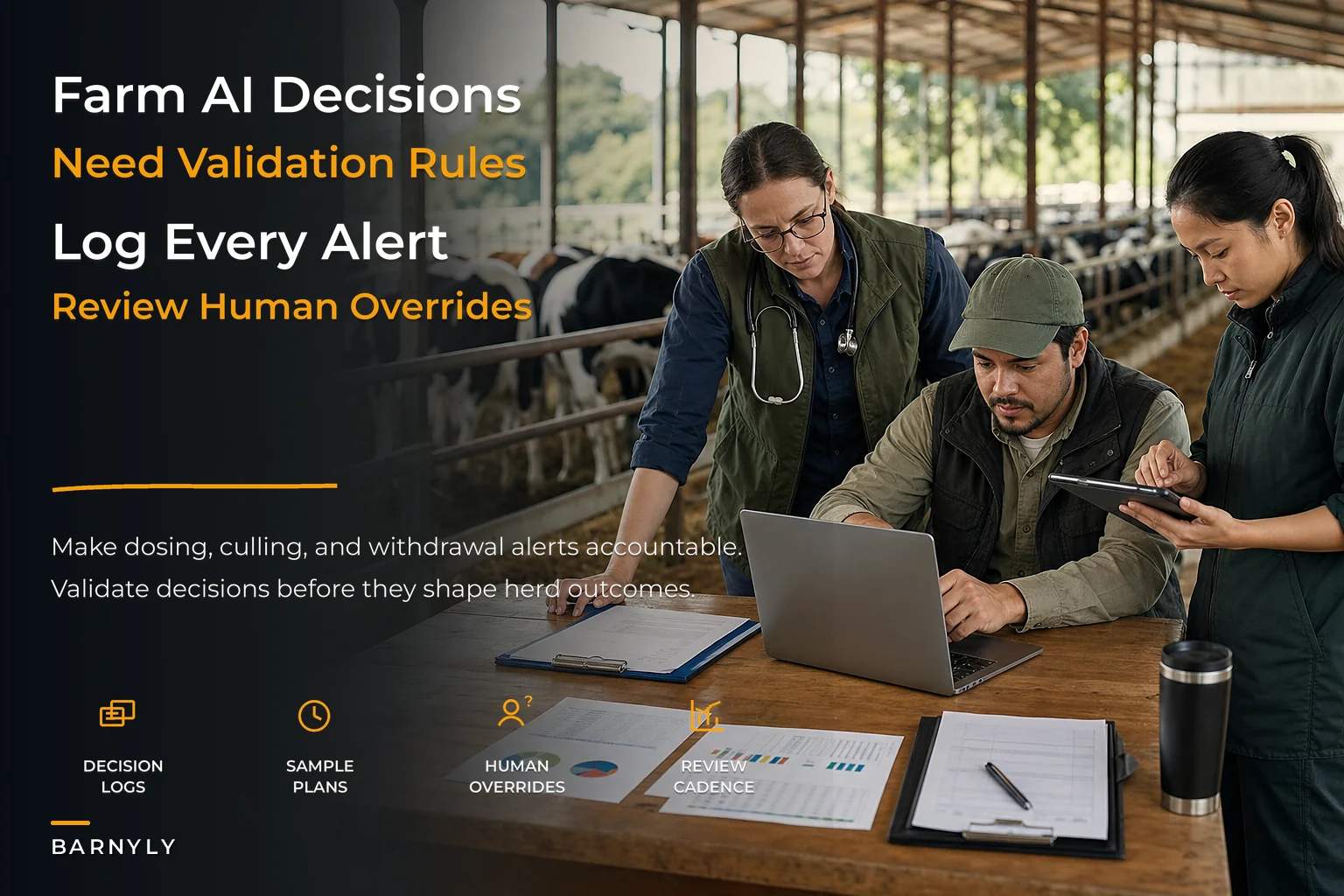
That gap is what validation governance fills. Not the fancy version with a compliance department — the practical version a working ranch can actually run. The whole point of AI validation governance on a farm is boring on purpose: you log what the tool decided, you check a sample of those decisions against reality, you keep a clear rule for when a human overrides the machine, and you review the pattern on a schedule. No PhD required. But skip it, and the failure modes are expensive in ways that don't show up until an inspector, a buyer, or a dead-loss report makes them visible.
The real problem isn't the AI being wrong — it's the farm never finding out
People get this backwards. A tool that's wrong 5% of the time isn't the danger. A tool that's wrong 5% of the time and nobody is sampling for it is the danger. On a farm those two situations look identical for months. The alerts keep firing, staff keep acting on them, and the drift hides inside normal operations.
A typical example: a withdrawal module is set up with the right product database on day one. Eighteen months later a supplier reformulates a dewormer, the label meat-withdrawal changes from 14 to 28 days, and the number in the system never gets updated because nobody owns that field. Every withdrawal calculation since has been quietly wrong. No error message. No red flag. Just a number on a screen that everyone trusts because it was right the last hundred times. The only thing standing between that farm and a residue violation is whether anyone ever checks a sample of decisions against the actual current label.
That's validation. And on most farms it simply doesn't exist as a defined activity. It exists as "Dave noticed something looked off once."
Why this breaks across almost every operation that adopts these tools
The pattern is consistent regardless of species or size. Three things go wrong, and they compound.
Simplify farm operations and enhance animal care.
Barnyly helps you organize, track, and manage every aspect of your farm operations seamlessly.
- Comprehensive livestock tracking
- Automated health alerts
- Feed and resource scheduling
No credit card required
Nobody owns the inputs. AI decision tools are only as good as the reference data behind them — label withdrawals, dose-per-kg rates, breed benchmarks, somatic cell thresholds. These change. Products get reformulated, vets update protocols, your own targets shift as genetics improve. When no single person owns keeping those inputs current, the model's "intelligence" slowly decays into confident wrongness.
Decisions aren't logged in a way you can audit later. A tool suggests a dose, someone accepts it, the animal gets treated. Six weeks later you want to know why that dose was given and whether the tool or the human picked the number. If that's not captured at the moment of decision, you're reconstructing it from memory. This connects directly to having a practical farm data strategy that turns records into predictable KPIs — if the decision itself isn't a record, you can't govern it.
Overrides happen silently. A good stockperson overrides a bad alert constantly — ignores a culling suggestion because they know that cow is three days from calving, bumps a dose because the animal's heavier than the system thinks. That's exactly what should happen. But if overrides aren't logged, you lose the single most valuable signal you have about whether the tool is any good. High override rates on a specific alert type are your early warning. Silent overrides throw that warning in the trash.
What changes as you scale
On a 40-cow operation, one experienced person is effectively the validation layer. They see every alert, they know every animal, and their gut catches most errors. It's fragile but it works.
Push to 400 head, three sites, and seasonal labor, and that invisible safety net disappears. Now the person acting on the dosing alert has never met the animal and has no reason to doubt the number. The alerts that one sharp owner used to filter are now being executed literally. This is the exact moment validation governance stops being optional — and it's also the exact moment farms are least likely to build it, because everyone's drowning in the growth itself.
The four pieces of a governance system that actually runs on a farm
You need four things, and they're all deliberately simple. If any one of them requires a meeting to maintain, it won't survive calving season.
| Component | What it answers | Who owns it | How often |
|---|---|---|---|
| Per-decision log | What did the tool decide, and did a human accept or override it? | Whoever acts on the alert | Every decision |
| Validation sample | Of a random sample, how many AI decisions matched reality? | Herd manager / designated checker | Monthly or by volume |
| Human-override rule | When is a person required to make the call, not the tool? | Owner / vet | Set once, reviewed quarterly |
| Review cadence | What's the pattern over time, and is drift creeping in? | Owner + vet | Quarterly |
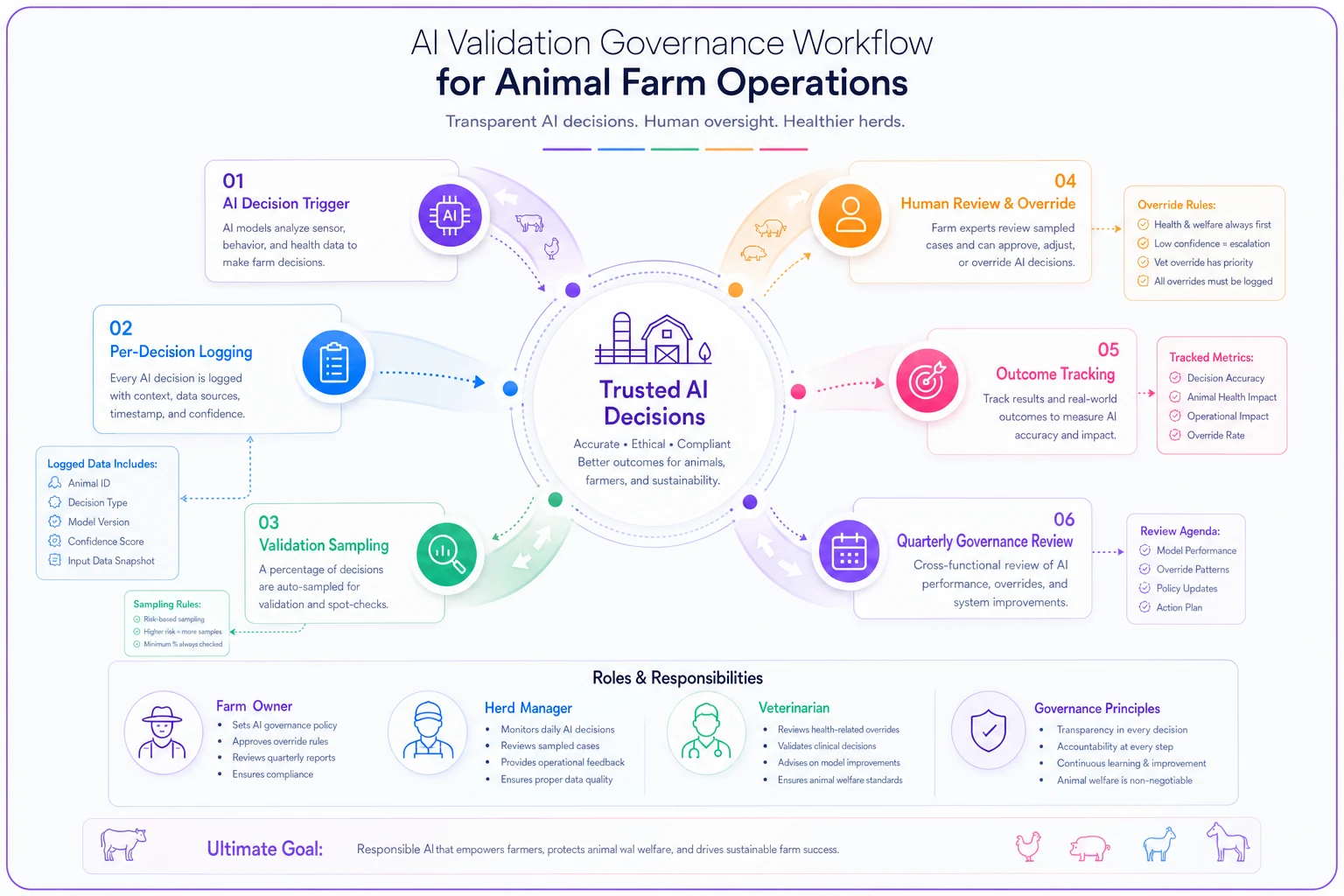
A simple diagram of how the four pieces feed each other.
The magic isn't in any single piece. It's that they feed each other. The decision log is your sample frame. The sample results tell you whether your override rules are set at the right threshold. The review cadence catches the slow drift that a single sample can't. Pull one out and the other three get weaker.
Per-decision logging — keep it to five fields
The instinct is to log everything. Don't. A log with 20 fields gets abandoned by week three. What you actually need to reconstruct and defend a decision later is small:
-
Date / animal ID — when and who
-
Decision type — withdrawal clearance, dose suggestion, cull alert, etc.
-
What the tool recommended — the actual number or flag
-
What happened — accepted as-is, or overridden to [value]
-
Override reason (if any) — one line, free text is fine
Make override reasons mandatory and allow voice-to-text or a two-tap dropdown to keep logging quick.
That last field is the gold. "Overrode cull alert — cow is a confirmed pregnancy, recheck in 60 days" tells you more about tool quality than any dashboard. When you read fifty override reasons in a row, the pattern jumps out: this alert type is firing on animals it shouldn't.
One thing worth flagging from running these systems: make the override reason mandatory but let it be voice-to-text or a two-tap dropdown with a free-text fallback. If logging an override takes longer than the override itself, people will stop overriding and just comply with bad alerts to save time. That's the worst possible outcome.
Validation samples — you don't check everything, you check enough
Full verification is impossible and unnecessary. Sampling is the whole trick. The question is just "is the tool performing the way we think it is," and you can answer that by pulling a handful of decisions and checking them against ground truth.
-
Pick a cadence tied to volume, not the calendar alone. If you process 200 withdrawal clearances a month, sample 15–20. If you only had 12, check all of them. Low volume means full check; high volume means a random pull.
-
Pull the sample randomly, not by exception. The temptation is to only re-check decisions that "felt off." That hides the quiet errors — the ones on decisions everyone trusted. Random is the point.
-
Check against the authoritative source, not the system. For withdrawals, that means the current physical label or the regulatory database — not the number the tool stored. For dosing, the current vet protocol and the animal's actual verified weight.
-
Record match / no-match and the gap size. A withdrawal that was off by a day is a different problem than one off by two weeks. Log the magnitude.
-
Set an action threshold in advance. Decide now what miss rate triggers investigation. Something like: more than one mismatch in a 20-sample pull on withdrawals means freeze and audit the input data.
Real-world scenario. A mixed dairy-and-beef operation running roughly 300 head started monthly sampling of their AI withdrawal clearances — 18 decisions pulled at random, checked against current labels. First month, clean. Second month, two mismatches, both on the same injectable, both because the stored withdrawal was the old formulation. They'd been under-holding by about 10 days on that product for an unknown stretch of time. Cost of the fix: an afternoon updating the product database and re-checking two animals still on-farm. Cost if a buyer's residue test had caught it instead: a rejected load, a flagged supplier record, and a very different conversation with the processor. The sampling didn't prevent the error. It caught the error before anyone outside the farm did. That's the entire job.
Human-override rules — decide the "machine never decides alone" list up front
Some decisions should never be executed on the tool's word alone, no matter how confident the alert looks. Write that list before you're busy, so nobody has to make a judgment call under pressure.
-
Culling alerts always require human confirmation. A cull is irreversible and often wrong for reasons the system can't see — pregnancy, pending sale value, genetic worth, "that's the matriarch and she keeps the herd calm." The tool flags; a person decides.
-
Any dosing that deviates from the standard protocol requires the vet. The tool can suggest within protocol. Outside it, that's a human conversation. This dovetails with telemedicine workflows that link vets to on-farm records — the override and the vet's clinical note should land in the same place, so the "why" lives next to the decision.
-
Withdrawal clearances below a safety margin get a second set of eyes. If a clearance is within a day or two of a shipping deadline, that's exactly when a stale input number does maximum damage. Flag the tight ones for manual confirmation.
-
First time a new animal, new product, or new protocol enters the system, the first few decisions are human-verified. New inputs are where errors enter.
The principle underneath all of these: the tool handles high-volume routine work and the human handles the irreversible and the unusual. Set the boundary once, and it stops being a judgment call every single time.
Review cadence — the quarterly look that catches slow drift
Monthly sampling catches point-in-time errors. It doesn't catch drift — the slow creep where override rates climb a little each month, or one alert type quietly becomes less reliable. That's what the quarterly review is for.
Sit down — owner and vet, an hour, no more — and look at three things:
-
Override rate by decision type over the quarter. Rising overrides on cull alerts means the alert logic is drifting out of step with reality. That's not a human problem; that's a signal to re-tune the threshold or retire the alert.
-
Sample miss rate trend. One bad month is noise. Three months climbing is a trend, and it means an input-ownership problem you haven't found yet.
-
The override-reason text, read in bulk. Patterns live in the reasons. If eight overrides this quarter all say some version of "system weight wrong," your weight-capture process is the real issue, not the dosing tool.
The farms that get long-term value from AI decision tools are the ones that treat the tool as something to be managed, not installed. The quarterly review is where that management actually happens.
When this level of governance makes sense — and when it's overkill
Build the full system when: you've scaled past the point where one person sees every decision, you're running AI-assisted withdrawal or dosing decisions that carry regulatory or food-safety weight, you have seasonal or multi-site labor executing alerts they can't sanity-check from experience, or a buyer or processor audits your records.
Scale it down when: you're a small single-operator farm where you personally see and judge every alert. You still want the per-decision log and the override list — those are cheap insurance — but monthly formal sampling of 20 decisions when you only make 20 decisions is just paperwork. Check them all informally and keep moving.
Who should genuinely not bother with the heavy version: a hobby operation using a tool as a reference suggestion with no regulatory exposure and no staff. The governance overhead would exceed the risk. Keep a log, trust your eyes, done.
The mistake at both ends is the same — matching your governance weight to the tool's sophistication instead of to your exposure. A dumb spreadsheet driving a shipping decision needs more governance than a sophisticated AI that only makes suggestions you double-check anyway.
Where the software layer quietly helps
None of this requires special software to start — a clipboard and a monthly recheck beats nothing by a mile. But the per-decision log is also the thing easiest to let slip when you're busy, and that's where operational platforms with built-in AI automation earn their place: the decision, the recommendation, the accept-or-override, and the reason get captured automatically at the moment the alert is acted on, instead of depending on someone remembering to write it down later. The sample frame builds itself. Override rates roll up without anyone tallying them. The quarterly review becomes reading a report instead of reconstructing a quarter from memory.
That's the honest role of the tooling here — not making decisions more "intelligent," but making the governance around them something a working farm will actually sustain past the first busy season. A validation system you abandon in March isn't a system.
The bottom line
Validation governance for farm AI tools isn't about distrusting the technology. It's about the fact that these tools fail quietly — a stale number, a drifted threshold, a confident alert on an animal the system can't see is pregnant — and quiet failures on a farm turn into residue violations, wrong culls, and under-dosed animals that nobody traces back to the tool. Four simple pieces, owned by real people, running on a schedule, close that gap. Log the decisions. Sample a handful against reality. Keep the irreversible calls human. Look at the pattern every quarter. Do that, and the tools stay an asset instead of slowly becoming a liability you didn't know you were carrying.
Ready to optimize your farm management?
Join hundreds of farmers using Barnyly to save time, improve animal health, and increase farm productivity.