


Most farm software integrations don't fail loudly. They fail quietly. A lab result comes back and never lands in the right animal's record. A vet pushes a treatment note that gets stamped on the wrong pen. A culture result shows up three days late because nobody set a retry rule, and by then you've already made a culling decision based on half the picture.
If you've connected — or tried to connect — a veterinary practice management system or a diagnostic lab portal to your herd records, you already know the hard part isn't the "connection." It's the mapping. Two systems speaking the same protocol but meaning completely different things by the word "ID."
This post is about the unglamorous middle layer: how you map fields between your farm system and outside vet and lab systems, what rules you set for retries and acknowledgments, which provenance fields you must never skip, and how a non-technical ops person can actually watch the whole thing stay healthy. No developer background assumed.
Why vet lab API integration on a farm breaks in ways you don't notice
The frustrating thing about a bad vet lab API integration farm setup is that it usually works in the demo. The vendor sends one test result, it lands in the right place, everybody nods. Then real volume hits and the cracks show.
Here's the pattern. A lab identifies an animal by the accession number on the sample tube. Your farm system identifies that same animal by its management tag. The vet clinic uses a third ID — their own patient number. Nobody mapped those three to each other, so the integration quietly "matches" on whatever field happens to be populated. When it can't match, it either dumps the result into an exceptions bucket nobody checks, or it creates a brand-new animal record that doesn't exist in your real herd.
A few months in, you've got phantom animals, orphaned results, and a growing distrust of your own data. That distrust is the real cost. Once a team stops believing the record, they go back to paper and texts, and you've paid for an integration that made things worse.
This is a close cousin to the problem covered in common integration mistakes where sensor data just sits unused — the data arrives, but the workflow around it was never designed, so it rots.
The minimal mapping spec: what actually has to line up
You don't need a 40-page interface specification. You need a short, exact agreement on a handful of fields. The goal is that every inbound result can be tied to one animal, one sample, and one event — with zero guessing.
Simplify farm operations and enhance animal care.
Barnyly helps you organize, track, and manage every aspect of your farm operations seamlessly.
- Comprehensive livestock tracking
- Automated health alerts
- Feed and resource scheduling
No credit card required
| Field in your farm system | What the vet/lab calls it | Match rule | What breaks if wrong |
|---|---|---|---|
| Animal management tag | Patient ID / Animal ID / Owner ref | Exact match, must be sent on every message | Result lands on wrong or phantom animal |
| Sample / accession number | Accession no. / Lab ref | Unique per sample, never reused | Two results collapse into one |
| Species + sex | Species code | Controlled list (map their codes to yours) | Reference ranges applied wrong |
| Test / panel code | Order code / LOINC-style code | Mapped to your own test catalog | Result shows as "unknown test" |
| Result value + unit | Value + UoM | Unit must travel with value | mg/dL vs mmol/L mix-ups |
| Collection date/time | Collected | Timestamp with timezone | Withdrawal and trend timing wrong |
| Ordering vet | Provider / clinician | Mapped to your vet list | Can't attribute or follow up |
The non-obvious one is unit of measure traveling with the value. A surprising number of integrations pass "14.2" with no unit because "everyone knows it's in the usual range." Then the lab switches analyzers, the unit changes, and your trend charts go sideways with no warning.
The other quiet killer is reusing accession numbers. Some lab portals recycle sample IDs annually. If your match rule treats accession number as globally unique and theirs resets every January, you'll overwrite last year's results. Add the year or a lab prefix into your stored key.
Require the canonical management tag on every inbound message.
A simple rule for your management tag
Pick one canonical animal identifier and make everything else map to it. On most farms that's the management tag, not the official ID or the microchip. Whatever you pick, require that it's sent on every single inbound message. "Optional" ID fields are where integrations go to die — the moment a field is optional, someone's system stops populating it.
Retry and acknowledgment rules a non-technical team can reason about
APIs drop messages. Networks hiccup. A lab portal goes down for maintenance at 2 a.m. The question isn't whether messages get lost — it's whether you find out.
The core concept is the acknowledgment (ack). When your system receives a result, it sends back a signal saying "got it, stored it." When the lab sends a result and gets no ack, it tries again. If you don't define this, you get one of two failure modes: results that silently vanish, or the same result arriving five times and creating duplicates.
Here's a retry and ack ruleset that works for farm operations without needing an engineer babysitting it:
-
Every inbound message gets an ack or a nack. Ack means stored successfully. Nack means received but couldn't be processed — bad animal ID, unknown test code. A nack is not a silent drop. It goes to a visible exceptions list.
-
Retries use backoff, not a flood. If the first delivery fails, retry at 1 min, then 5 min, then 30 min, then hourly for 24 hours. Hammering every 10 seconds overwhelms both sides.
-
Cap retries, then escalate to a human. After 24 hours of failures, stop auto-retrying and fire an alert to the ops inbox. A stuck message should become somebody's task, not an infinite loop.
-
De-duplicate on a stable key. Use accession number + test code + result timestamp as the fingerprint. If that exact combination already exists, don't create a second record — update or ignore.
-
Ack the message, not the batch. If a lab sends 20 results in one batch and 2 fail, ack the 18, nack the 2. All-or-nothing batch handling means one bad record blocks nineteen good ones.
The pattern most small farms miss is #4. Without a de-dup key, a well-meaning retry system becomes a duplicate generator. You end up with the same culture result three times, each slightly timestamped differently, and your treatment history is cluttered with repeats.
Provenance fields: the stuff you'll wish you logged during an audit
Provenance is just the record of where a piece of data came from and what happened to it. On a farm, this matters most when a result feeds a treatment decision, a withdrawal period, or something an inspector later questions.
-
Source system name and version — which lab portal or clinic software sent it
-
Received timestamp — when your system actually got it, separate from collection time
-
Original external IDs — keep the raw accession and patient IDs even after mapping, so you can trace back
-
Mapping version — which version of your field map was in effect when this was processed
-
Processing status — accepted, nacked, manually corrected
-
Who touched it — if a human fixed a mismatch, log who and when
-
Raw payload reference — a stored copy of the original message
That last one is the field people skip and regret. When a result looks wrong, the only way to tell whether the lab sent bad data or your mapping mangled it is to look at exactly what arrived. If you've overwritten the original with your "cleaned" version, you've destroyed your own evidence.
This provenance discipline overlaps heavily with how prescription and clinical data should be tracked in telemedicine workflows that link vets to on-farm records — the same "where did this come from and who can I defend it to" logic applies.
Error-handling patterns that keep bad data out of the herd record
There's a meaningful difference between an integration that stops bad data at the door and one that lets it in and corrects it later. For anything touching animal health, you want the former.
Quarantine, don't guess. When a result can't be confidently matched to an animal, it goes to a quarantine queue — not auto-assigned to the closest match. Auto-matching on "nearest tag number" is how a result for tag 4471 ends up on tag 4417.
Fail visibly, not silently. Every nack and every quarantined record should be countable and reviewable on one screen. If a failure can happen without anyone being able to see it happened, it will pile up.
Validate ranges on arrival. If a result value is wildly outside biological possibility, flag it rather than storing it. It's almost always a unit or decimal-place error upstream.
Make corrections additive. When someone fixes a mismatch, don't erase the wrong version — mark it corrected and keep the history. This protects you if the "fix" turns out to be the actual mistake.
Define ownership of the exceptions queue. This is organizational, not technical, and it's the one that fails most often. An exceptions queue with no named owner is just a slower way to lose data.
An integration-health dashboard template non-technical ops can actually use
You don't need a technical monitoring tool. You need a one-screen view that a herd manager can glance at each morning and know whether yesterday's vet and lab data actually made it in.
| Panel | What it shows | Healthy looks like |
|---|---|---|
| Messages received (24h) | Count by source | Roughly matches expected volume |
| Successfully stored | Count + % of received | 97%+ auto-stored |
| In quarantine | Unmatched results waiting | Low and trending down |
| Nacks / errors | Failed with reason | Near zero, reasons grouped |
| Oldest unresolved exception | Age of the stalest stuck item | Under 24–48 hours |
| Last successful sync per source | Timestamp per lab/clinic | All recent |
The single most useful number on that board is "last successful sync per source." If your main diagnostic lab last synced four days ago and nobody noticed, that's the kind of gap that compounds fast. A silent source is worse than an erroring one, because errors at least announce themselves.
A simple visual of a daily dashboard check workflow:
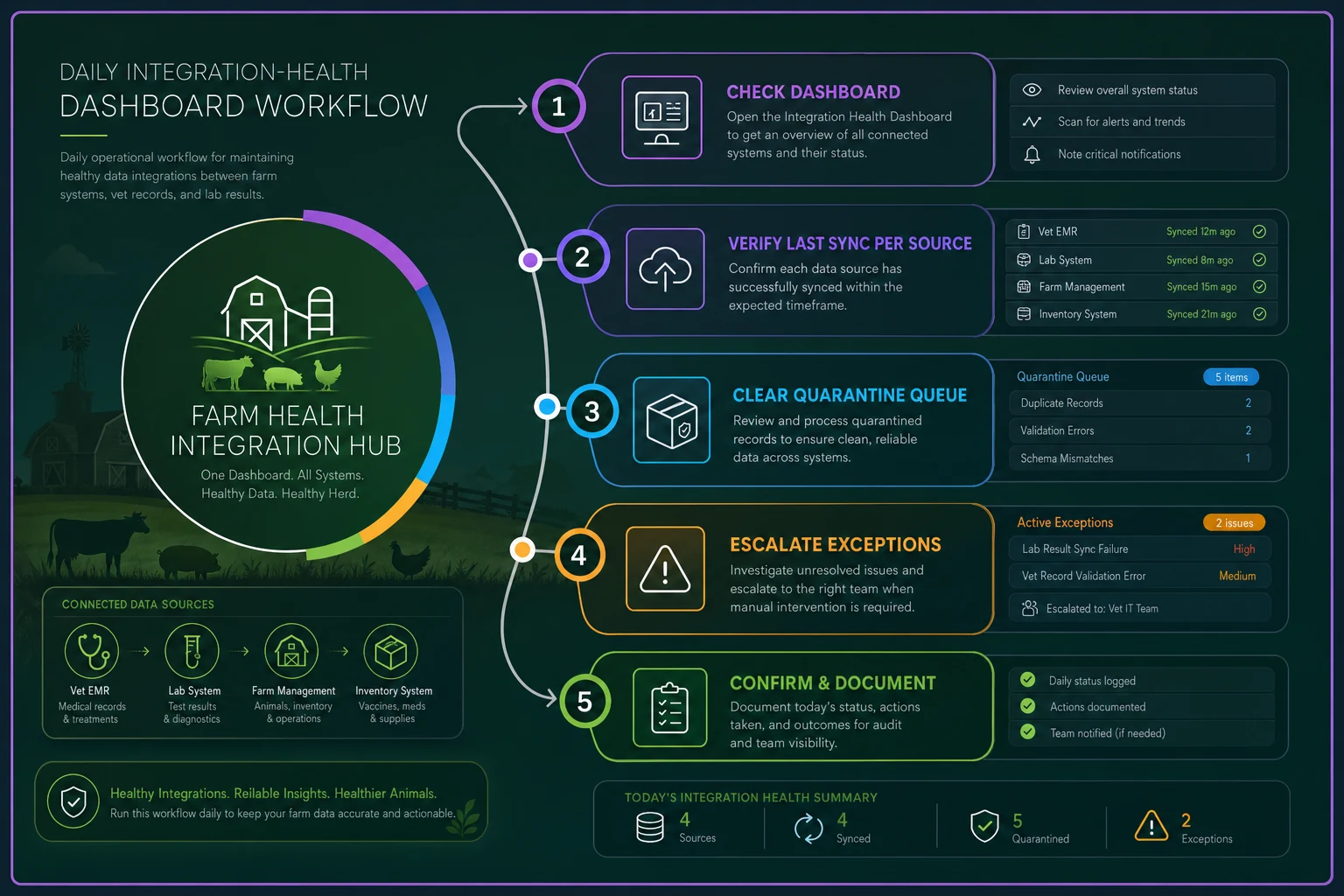
A reasonable ops rhythm: one person checks this board every morning, clears the quarantine queue, and confirms every source synced within the last day. Five minutes. Modern farm management platforms increasingly run this kind of monitoring in the background and only surface an alert when a source goes dark or exceptions start piling up — which is exactly the right use of automation. It watches the boring stuff so a human only gets pulled in when something genuinely needs a decision.
A real scenario: the dairy that trusted its own data again
A roughly 400-head dairy had connected its herd software to two labs and one vet clinic. On paper it was integrated. In practice, about 1 in 8 results was landing in an exceptions bucket that nobody had been assigned to check. Over a few months that bucket held several hundred orphaned results, including mastitis cultures that should have driven treatment choices.
The fix wasn't a new system. It was three things: they pinned down the mapping spec — one canonical tag, units traveling with values, accession numbers prefixed by lab. They added a de-dup key to kill the duplicates that retries had been creating. And they put the morning dashboard check on one named person.
Within about six weeks, the auto-store rate climbed from the low-to-mid 80s up past 97%. The quarantine queue stopped growing and drained down to single digits most days. More importantly, the herd manager stopped double-checking the software against paper, because the number on the screen finally matched reality. That trust was the real return.
When this level of rigor makes sense — and when it's overkill
When it's worth it: You're pulling results from more than one external source, your results feed treatment or withdrawal decisions, or you've already been bitten by a mismatched or missing result. Any farm where a wrong result could cause a residue violation or a bad culling call should treat mapping and provenance as non-negotiable.
When it's probably overkill: A small operation getting a handful of results a month, hand-entered, with a vet you talk to directly. If the volume is low enough that a human reads every result anyway, a heavy integration layer adds complexity you don't need yet.
Who should not rush into this: Anyone who hasn't first settled on a single canonical animal identifier across their whole operation. If your own records can't agree on how to name an animal, no amount of API mapping will save the integration. Fix the internal identity problem first, then connect outward.
The takeaway
A vet and lab integration isn't really a technical project — it's an agreement about meaning. Which field is the real animal ID. What unit a number is in. What happens when a message can't be matched. Who looks at the failures. Get those agreements written down in a short mapping spec, set sane retry and ack rules, keep your provenance, and give a non-technical person one screen to watch it.
Do that and the integration stops being a black box you quietly stopped trusting, and becomes something your decisions can actually lean on.
Ready to optimize your farm management?
Join hundreds of farmers using Barnyly to save time, improve animal health, and increase farm productivity.