

The tractor that dies mid-harvest is never the one you were worried about. It's the old skid steer you use to move round bales, or the generator you assumed would fire up when the ice storm knocked out power. Most breakdowns on a working farm aren't random — they're the predictable result of maintenance schedules built around "when we get to it" instead of "what happens if this fails at the worst possible moment."
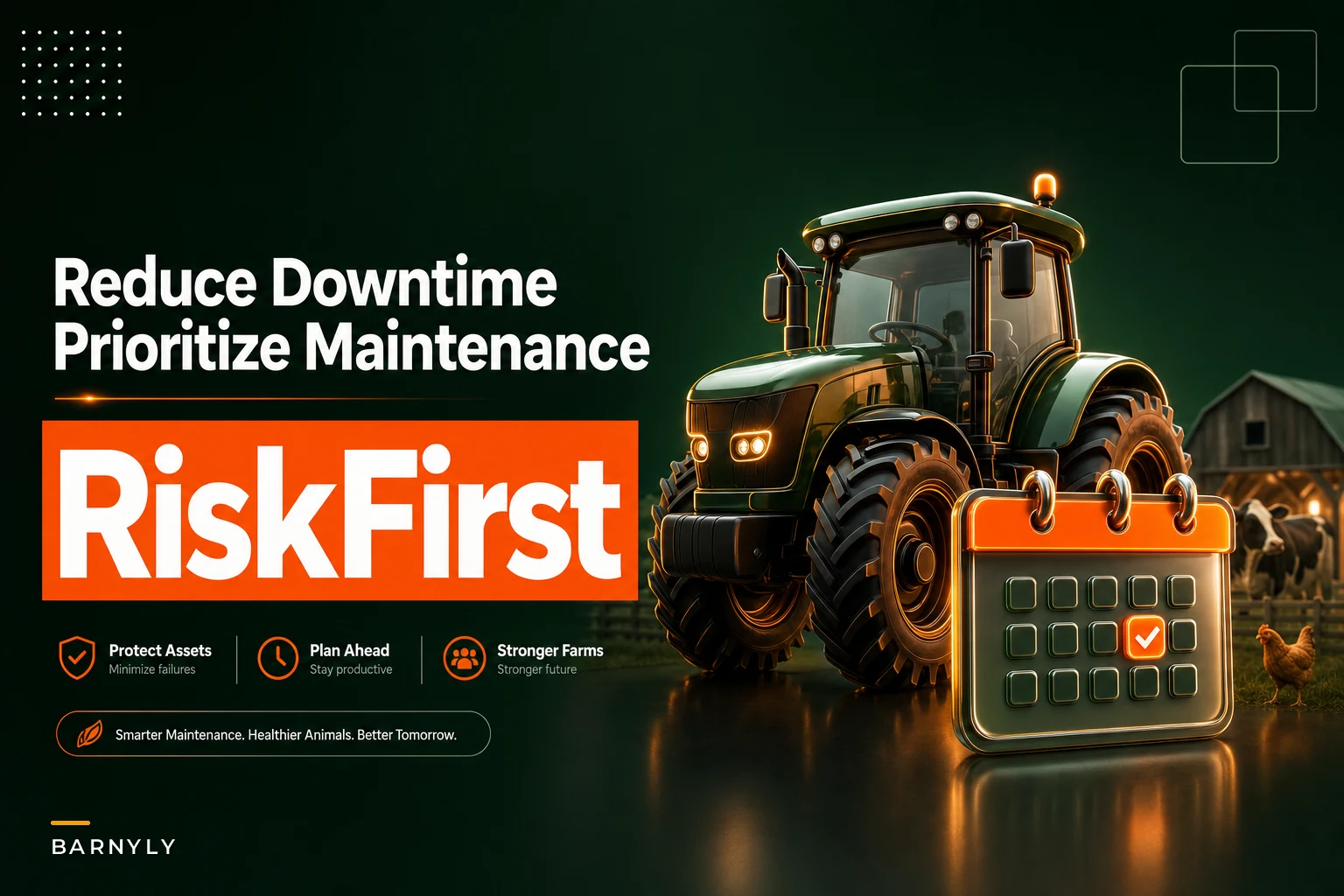
A proper farm equipment maintenance calendar isn't just a service reminder list. It's a way of ranking every piece of gear, machinery, and infrastructure by how badly a failure would hurt your operation on a specific day of the year. A busted post-hole auger in July is an annoyance. A failed stock-tank heater in a January cold snap is a body count.
This post is about building that ranking — and tying it to short inspection checklists, failure logs, and replacement-cost planning so the calendar tells you what to look at, when, and why it matters.
Start with the asset registry, but make it operational
Everyone technically has an asset list somewhere. The problem is it usually lives on a depreciation schedule your accountant built — tells you what something cost and what it's worth on paper, and absolutely nothing about whether it's about to strand you.
-
Asset name and location (which barn, which pasture, which shed)
-
Role in the operation — what breaks downstream if this stops
-
Failure impact window — the times of year a failure hurts most
-
Age and hours/cycles where it applies
-
Replacement cost today (not book value)
-
Lead time to replace or repair — this is the one everyone skips
That last item is the sleeper. A $400 water pump isn't a $400 problem if the replacement is three weeks out and you've got 60 cow-calf pairs depending on that well. The lead time is often the real risk, not the price tag.
Call parts suppliers annually to confirm lead times — it's often the real risk.
One practical note: don't try to register every wrench and hose. Track the assets where a failure changes your day. On a mid-size operation that's usually somewhere between 25 and 60 items — tractors, loaders, the baler, waterers, heaters, fencing chargers, the backup generator, refrigeration for milk or meat, the squeeze chute, irrigation pumps.
Rank by risk, not by the maintenance sticker
The shift that actually reduces downtime: stop scheduling maintenance purely by manufacturer intervals and start scheduling by risk-weighted consequence.
Simplify farm operations and enhance animal care.
Barnyly helps you organize, track, and manage every aspect of your farm operations seamlessly.
- Comprehensive livestock tracking
- Automated health alerts
- Feed and resource scheduling
No credit card required
-
Likelihood of failure in the next season (1–5, based on age, hours, and history)
-
Operational impact if it fails (1–5, how much of your operation stalls)
-
Timing sensitivity (1–5, is failure season concentrated or spread out)
Multiply them and you get a priority number. High-scoring assets get frequent, short inspections and pre-positioned spare parts. Low-scoring ones get checked seasonally and left alone otherwise.
| Asset | Failure likelihood | Operational impact | Timing sensitivity | Priority score | Inspection cadence |
|---|---|---|---|---|---|
| Stock-tank heaters | 3 | 5 | 5 (winter) | 75 | Weekly in cold months |
| Baler | 4 | 5 | 4 (hay season) | 80 | Before + during hay season |
| Backup generator | 2 | 5 | 4 (storm season) | 40 | Monthly test-run |
| Squeeze chute hydraulics | 2 | 4 | 3 (working days) | 24 | Before each working event |
| Post driver | 2 | 2 | 1 | 4 | Annual |
The interesting thing about scoring like this is what floats to the top. Rarely the expensive stuff. It's the cheap, boring items whose failure lands on a bad calendar day — heaters, chargers, water delivery. The unglamorous infrastructure that keeps animals alive and doesn't care what it cost.
Short checklists beat long ones — every time
The number one reason inspection routines fail isn't laziness. It's that the checklist is too long, so nobody actually runs it. A 40-point tractor inspection gets skipped in week two. A 5-point check gets done because it fits between two other chores.
Keep each inspection to what one person can do in a few minutes without tools. For a baler in season, that might be:
-
Belts — cracks, glazing, tension
-
Pickup teeth — bent or missing
-
Chain lube and slack
-
Grease points hit
-
Twine/net feed — free and threaded
That's it. Five things. The goal isn't a full mechanical audit — it's catching the drift before it becomes a mid-field breakdown that costs you a half-day and a windrow full of hay you can't get to before rain.
The short-checklist approach catches roughly the same failures the long one would, because the failures that actually strand you almost always show up in those first few items. The rest of a long list is either stuff that doesn't fail suddenly or doesn't matter much when it does.
The part almost nobody keeps: a failure-mode log
This is where a maintenance calendar goes from a chore list to an actual decision tool. Every time something breaks — or nearly breaks — write down four things:
-
What failed
-
What the early warning sign was (if any)
-
What it cost you (parts + labor + downtime)
-
How long the fix took start to finish
Over a season or two, this log tells you things no manual can. You start seeing that your loader's hydraulic hoses fail every 18–20 months like clockwork, or that the generator only ever refuses to start after sitting unused past 30 days. Those patterns are valuable, because they let you move an item from "reactive" to "scheduled" — replacing the hose on your terms in the shop, not on your knees in the mud during calving.
A real example: a cow-calf operation running about 140 head kept losing waterer float valves in the same two automatic waterers every winter. No log, so each failure felt like bad luck. Once they actually tracked it, the pattern was obvious — those two waterers sat on a north-facing line that froze first. They insulated the line and pre-stocked two float valves. The following winter: zero emergency thaw-outs, and what used to be a panic became a $60 part swap in October.
The failure log is also what makes sensor data useful instead of ornamental. If you're pulling readings off tank levels, engine hours, or temperature probes and it's just piling up somewhere, the log gives it context — you can tie a warning threshold to an actual failure you've already recorded. There's a full breakdown of that gap in why sensor data shouldn't just sit unused, and it pairs directly with what a good failure log gives you.
Tie replacement cost to operational continuity
Most replacement planning happens backward — the thing dies, you scramble, you overpay for whatever's available, and you eat the downtime. Planning forward changes the math entirely.
For each high-priority asset, track:
-
Replacement cost today (call a dealer once a year and update it)
-
Expected remaining life based on your failure log
-
Lead time for a replacement or rebuild
-
Cost of downtime per day if it fails at its worst season
That last number reframes everything. Say your only baler is 12 years old and a failure during hay season costs you roughly $600–$900 a day in lost baling windows and rented equipment, and it takes 4–7 days to source and install a used replacement head. That's a potential $3k–$6k hit sitting inside a machine you keep meaning to deal with. Suddenly pre-buying a rebuild kit in the off-season, or lining up a backup rental relationship before you need it, isn't paranoia — it's cheap insurance.
Worth internalizing: the cost of a failure is almost never the repair. It's the timing. A $200 part that fails during a two-week window when everything is happening at once can cost ten times its price in cascading delays.
Wire the calendar into your event planning
A maintenance calendar that lives in isolation gets ignored. The version that works is layered directly on top of your operational calendar — calving, breeding, hay cuttings, weaning, shipping days, storm season.
Inspections and part-swaps should land just before the events that depend on that equipment, never during them. You service the chute the week before working cattle, not the morning of. You test the generator in early fall, not when the first ice warning hits. You pull the baler through a full inspection before first cutting, then run the short checklist through the season.
This is the same discipline that goes into repeatable operational procedures across the rest of the farm. If you've already built out repeatable SOPs and seasonal rosters, the maintenance calendar slots in as another seasonal layer — one more thing that runs on a schedule instead of on adrenaline.
When this level of tracking makes sense — and when it doesn't
When it's worth it:
-
You run enough equipment that failures are a regular tax on your time
-
You have concentrated seasons where downtime is genuinely expensive
-
You've been surprised by the same kind of failure more than once
-
You're depending on aging equipment you can't easily replace fast
When it's overkill:
-
You've got two pieces of gear and a good relationship with a dealer around the corner
-
Everything you own is under warranty and newish
-
Your operation doesn't have hard timing windows where a failure snowballs
Who should skip the full scoring system: if you're a smaller operation and you already know exactly what's going to break and roughly when, a scoring matrix is just paperwork. Skip straight to the failure log and the pre-season checklists. Those two alone carry most of the value.
A realistic before-and-after
A diversified operation — roughly 90 stockers plus a small hay enterprise — was averaging four or five surprise equipment failures a year that landed at genuinely bad moments. Estimated cost: somewhere in the $8k–$12k range annually once you counted rentals, rush parts, spoiled hay, and lost days.
They didn't buy anything new. They built an asset registry of about 30 items, scored the top dozen by risk, wrote 5-point checklists for the six highest-priority assets, and started a failure log in a cheap notebook that later moved into a shared spreadsheet.
By the end of the second season, surprise failures dropped to one or two. Most of the remaining ones got caught early during a short inspection rather than mid-task. The two big-ticket items got planned rebuilds in the off-season instead of emergency replacements. Rough savings landed somewhere around $5k–$7k a year — not from spending more on maintenance, but from spending it at the right time.
Getting started this week
You don't need software to begin, and you shouldn't wait for a perfect system. A single spreadsheet and a notebook will get you most of the way. Here's the order that works:
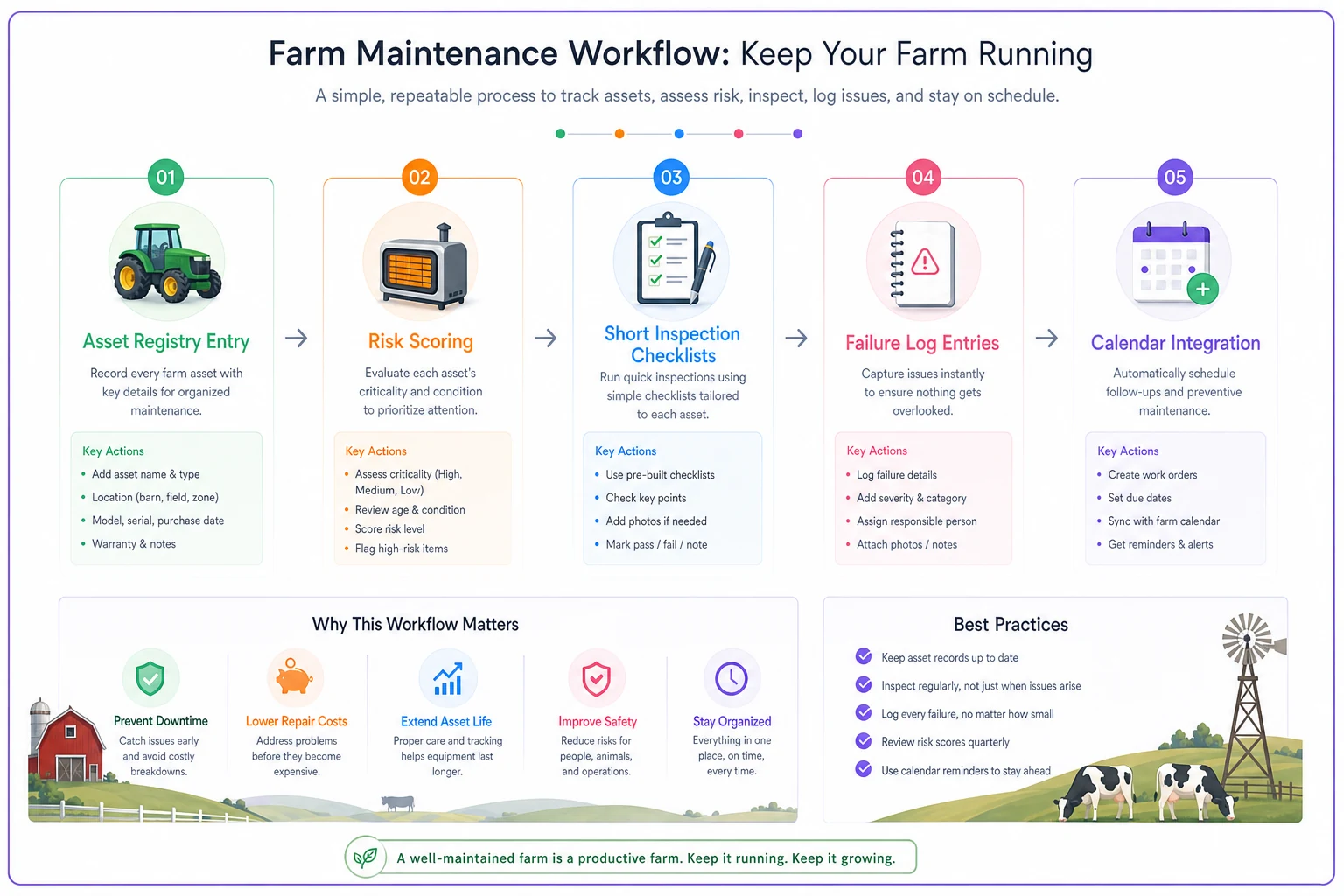
A simple visual of the sequence helps teams follow the steps.
-
List the 25–40 assets whose failure actually changes your day.
-
Add replacement cost and lead time for each — call your dealer for the ones you don't know.
-
Score the top items by likelihood × impact × timing.
-
Write a 5-point checklist for the highest-priority assets only.
-
Lay inspections onto your operational calendar, timed before the events that need each asset.
-
Start the failure log today, even for things that broke last month if you remember them.
Once the volume of assets, checklists, and logs gets big enough that the spreadsheet turns into a mess, that's the natural moment to move into a proper operational platform where inspection reminders, failure history, and replacement timelines live in one place and trigger the right check before the right event. But that's a convenience upgrade, not a prerequisite. The thinking is what reduces the downtime — the tool just keeps it from falling apart as you scale.
The farms that stop getting ambushed by breakdowns aren't the ones with the newest equipment. They're the ones who figured out which failures actually cost them, and moved those failures onto a calendar they control.
Ready to optimize your farm management?
Join hundreds of farmers using Barnyly to save time, improve animal health, and increase farm productivity.