
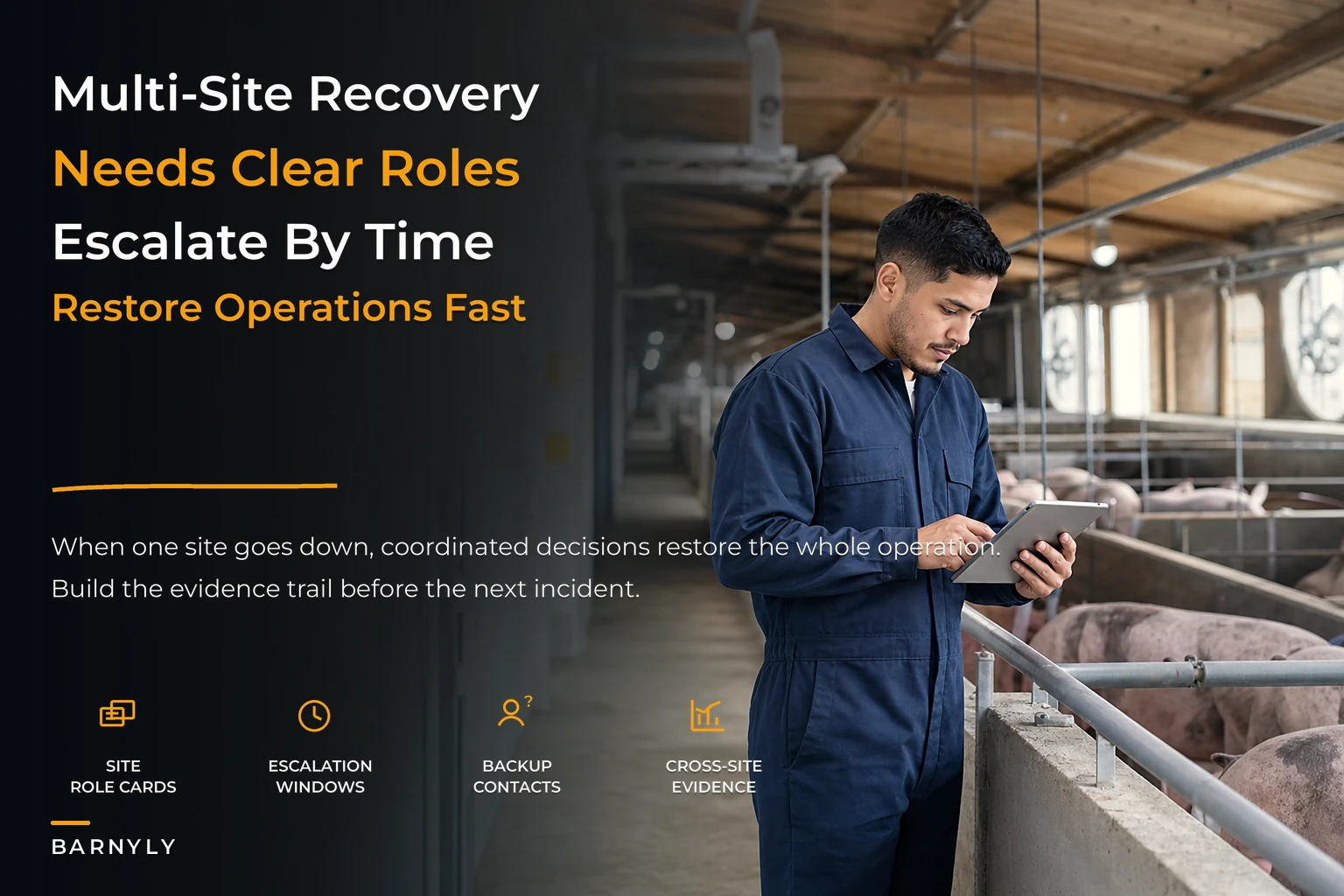

When a single farm hits a disruption — a barn fire, a notifiable disease hold, a flooded access road, a key manager suddenly out for three weeks — most operations can muddle through because everyone on site knows who does what. The problem shows up when you run more than one site. Suddenly the question isn't "can this farm recover?" It's "can all five sites recover in a coordinated way, without stepping on each other, duplicating decisions, or losing the one record an inspector asks for later?"
That's the gap multi-site farm continuity governance is supposed to close. And it's a different beast from single-site contingency planning. A single site needs a plan. A multi-site operation needs governance — a shared set of rules about who decides, who gets told, what evidence travels between sites, and how fast each piece moves. Without that, your sites recover at completely different speeds, your head office gets ten versions of the same situation, and nobody can tell which decisions have actually been made.
This is the layer people skip. They write solid farm-level SOPs and assume coordination will sort itself out. It won't. Coordination is the thing that breaks first.
Why multi-site recovery breaks in ways single-site recovery never does
On one farm, the owner is usually the escalation matrix. Something goes wrong, people walk over and ask. Decisions happen in minutes because everyone's in earshot.
Scale that to four or five sites and the informal system quietly stops working. Here's the pattern that shows up repeatedly when operations grow past a single location:
-
Role ambiguity between sites. Each site has its own stockperson, its own "person who handles the vet," its own informal lead. During a disruption, nobody's sure whether the site manager or head office makes the call on moving animals, pausing deliveries, or authorising emergency spend. So two people make conflicting decisions, or nobody makes one.
-
Escalation that depends on memory. Under pressure, people call whoever they called last time. If that person's unreachable, the chain just stops. There's no agreed second or third contact, so a problem sits for six hours because one phone went to voicemail.
-
Evidence trapped on the wrong site. Site B has a disease outbreak. The movement records showing which animals went from B to C and D last month are sitting in a notebook at Site B — exactly the site that's now locked down. The farms that need those records most can't get them.
None of these are knowledge problems. Every person involved knows their job. They're coordination problems, and coordination is precisely what informal systems can't scale.
A useful way to think about it: single-site recovery is about competence. Multi-site recovery is about governance — agreed roles, agreed triggers, agreed shared records. Competence you already have. Governance is what you have to build on purpose.
The three things that have to be standardised (and nothing more)
Teams over-engineer this. They write a 60-page continuity manual that nobody reads and nobody updates. The manual gathers dust and the operation improvises anyway.
Simplify farm operations and enhance animal care.
Barnyly helps you organize, track, and manage every aspect of your farm operations seamlessly.
- Comprehensive livestock tracking
- Automated health alerts
- Feed and resource scheduling
No credit card required
-
Role cards — who holds which responsibility during a disruption, at each site and at head office.
-
Escalation matrices — what triggers a call upward, who gets called, and the maximum time before it moves to the next level.
-
Cross-site evidence-sharing rules — which records must be reachable from any site, in what format, and who's responsible for keeping them current.
Get these three right and sites can improvise sensibly on the details. Get them wrong and no amount of local competence saves you.
Standardised role cards
A role card is one page. Not a job description — a disruption role. It answers four questions: what you own during an incident, what decisions you can make without asking, what you must escalate, and who covers you if you're unavailable.
The key insight is that role cards should attach to positions, not people. "Site 3 Incident Lead" is a role. On a normal week that might be your experienced stockperson. During lambing when she's flat out, it's whoever's designated as backup. The card doesn't change; the name filling it does. This is the same discipline that makes a succession playbook and handover templates for family-run livestock actually work — the operation keeps running because responsibility lives in the role, not in one irreplaceable head.
A typical role card set across a multi-site operation looks like this:
| Role | Owns during disruption | Can decide alone | Must escalate | Backup |
|---|---|---|---|---|
| Site Incident Lead | On-ground response, animal welfare, local staff | Emergency animal moves within site, spend under set limit | Anything affecting other sites, animal movements off-site, media/regulator contact | Named deputy per site |
| Operations Coordinator (HO) | Cross-site sequencing, resource reallocation | Reallocating feed/labour/equipment between sites | Spend above threshold, legal/regulatory exposure | Second coordinator |
| Compliance Lead | Evidence, regulator contact, movement records | What records to pull and share | Decisions that create legal liability | Owner/director |
| Owner/Director | Final authority, external relationships | Anything | — | Pre-named deputy |
The mistake that quietly kills this: writing cards nobody tests. A role card that's never been used in a drill is a guess. The ones that hold up have been run through at least one tabletop walkthrough where you deliberately make the primary person "unavailable" and see whether the backup actually knows what the card says.
Escalation matrices that move on time, not on memory
An escalation matrix isn't just a phone list. A phone list tells you who to call. A matrix tells you when a situation must move to someone higher, and how long it's allowed to sit before it does.
That time element is the part people leave out, and it's the part that matters most across sites. Without a maximum dwell time, a problem can sit at Site Lead level for a full day while head office assumes it's handled.
A workable escalation flow in plain language: a disruption is detected at a site. The Site Incident Lead assesses it against a short trigger list — does this affect animal welfare beyond routine, does it affect other sites, is a regulator involved, is spend required above the local limit? If none of those apply, it's handled locally and logged. If any of them are true, it moves to the Operations Coordinator within a set window — say, 30 minutes for welfare and cross-site issues, immediately for anything involving a regulator. The Coordinator either resolves it with resources on hand or, if it crosses a spend or liability threshold, escalates to the Owner within a defined window. At every step there's a maximum time; if the named person can't be reached, the chain moves to the backup rather than stalling.
The pattern worth stealing: escalate on triggers and time, never on judgement alone. "Use your judgement about when to call me" always fails under stress, because stressed people under-escalate — they don't want to be the one who overreacted. Hard triggers remove that hesitation.
The flow below visualises how triggers, time windows and backups move an incident up the chain.
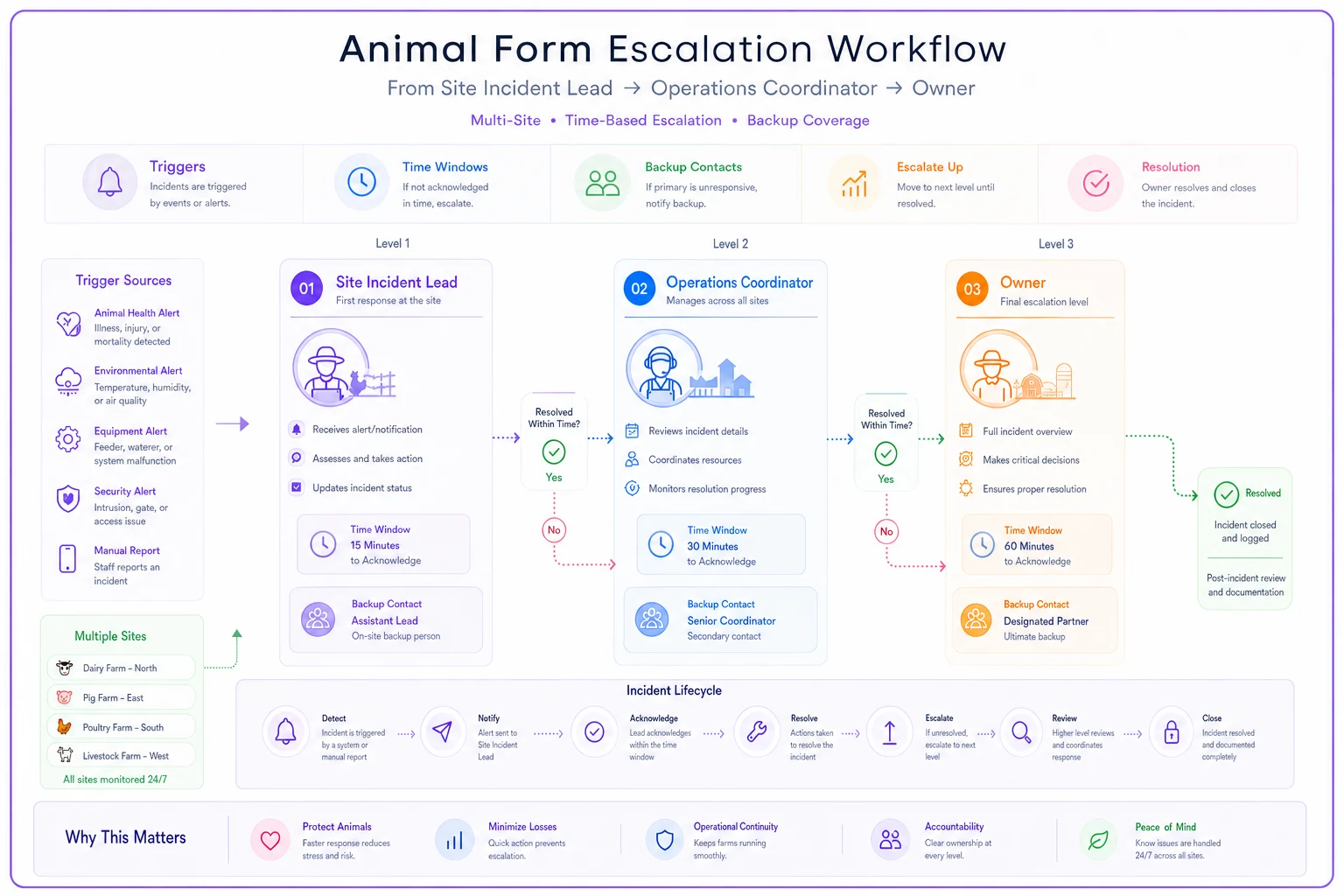
Keep the flow simple so people can follow it under stress.
What breaks as you add sites
The failure points shift depending on how many sites you're running. The thing that saves you at three sites is not the thing that saves you at eight.
At two or three sites: the owner can still hold most of it in their head. The usual break is a single point of failure — everything routes through one person, and when that person is busy managing the crisis, coordination collapses. The fix is simply naming an Operations Coordinator role so cross-site decisions have a home that isn't the firefighter.
At four to six sites: evidence-sharing becomes the bottleneck. Records that lived comfortably on paper or in one person's phone now need to be reachable from anywhere, because the site that needs a record is often not the site that holds it. This is where operations discover their continuity plan was really a single-site plan copied five times, with no shared layer underneath. The broader failure modes here compound fast, which is why it's worth pairing this with a full read on how continuity gaps sink recovery — the record and resource gaps multiply quickly once you're coordinating across locations.
At seven-plus sites: the problem becomes version control and sequencing. Multiple sites hit problems in overlapping windows. You can no longer treat each incident as isolated. Now you're reallocating a finite pool of feed, relief labour, transport and vet availability across competing demands, and the governance question becomes "which site gets the relief crew first, and who decides?" If that answer isn't pre-agreed, every allocation becomes an argument.
The honest takeaway: continuity governance isn't a document you finish. It's a layer you deepen as the operation grows. The role cards you write at three sites need a resource-allocation rule added at seven.
Cross-site evidence-sharing: the rule most operations get wrong
Here's a scenario that plays out more than people admit.
A mixed beef and sheep operation runs four sites across two counties. A notifiable disease suspicion lands at Site 2. The site goes into a standstill — nobody and nothing moves off it. The regulator wants movement records for the last 60 days: which animals came onto Site 2, which left, and where they went. Those records exist. They're in a diary in the Site 2 office and partly in the manager's phone. The manager is now fully occupied managing the standstill and can't stop to compile them. Sites 1, 3 and 4 need to know immediately whether animals they received from Site 2 put them at risk — and they can't see the data either.
Recovery stalled for the better part of two days, not because anyone lacked information, but because the information couldn't travel. It was reachable only from the one place that was now locked down.
The rule that prevents this is simple to state and annoying to implement: any record that affects more than one site must be reachable from every site, independently of the site that created it. Movement logs, shared animal health histories, treatment and withdrawal records for transferred stock, contact details, and the current role cards and escalation matrices — all of it has to live somewhere that a standstill at one location doesn't cut off.
This doesn't mean centralise everything. It means identify the cross-site records specifically and make those reachable. Most of a farm's records are purely local and can stay local. It's the subset that affects other sites that needs the shared rule.
A minimal cross-site evidence checklist:
-
[ ] Animal movement records between sites — updated at the point of movement, not from memory later
-
[ ] Health and treatment histories for any animal transferred between sites
-
[ ] Current withdrawal periods for transferred stock (so a receiving site doesn't sell too early)
-
[ ] Shared supplier, vet and regulator contacts
-
[ ] Live copies of role cards and escalation matrices
-
[ ] A running incident log that each site can read, so nobody acts on stale information
The common failure isn't that farms don't keep these records. It's that they keep them per site, in a form that can't be pulled from anywhere else. That's the quiet flaw that turns a contained incident into a multi-site scramble.
This is also where shared operational software earns its place — not because the technology is the point, but because the "reachable from any site" requirement is genuinely hard to meet on paper across locations. A platform where movement records, treatment histories and the escalation matrix live in one shared place reachable from any site means a standstill at Site 2 doesn't take the records offline with it. The value isn't the software; it's that the evidence keeps travelling when a site goes dark.
Quick-pack templates: what lets sites move in the first hour
The difference between a six-hour delay and a six-day one is usually whatever you can hand someone in the first hour without them having to build it from scratch. That's what a quick-pack is — a small bundle of pre-built templates so each site isn't inventing paperwork mid-crisis.
A practical quick-pack per site contains:
-
The site's role cards — printed and digital, so they work whether or not the power's on.
-
The escalation matrix with current names and backup names filled in.
-
A blank incident log — time, what happened, what was decided, by whom.
-
A movement-record snapshot template — ready to populate the last 60 days fast.
-
A resource-request form — what this site needs from the others (feed, labour, transport) and by when.
-
A one-page regulator-contact script — who calls, what to say, what not to say.
The point of the quick-pack isn't completeness. It's speed under stress. People don't think clearly in the first hour of a crisis; they execute what's in front of them. If what's in front of them is a blank page, you lose the hour. If it's a half-filled template, you keep moving.
Refresh quick-packs quarterly to keep contacts and names current.
One thing worth flagging: quick-packs rot. Names change, sites open and close, contacts move on. A quick-pack that's two years old is worse than useless because people trust it and it's wrong. Whoever owns the Compliance Lead role should own a quarterly refresh — fifteen minutes to confirm names and numbers still match reality.
When this level of governance makes sense — and when it doesn't
When it's worth building: you're running three or more sites, animals or resources move between them, and you'd struggle to name — right now, without checking — who makes the cross-site call during a disruption. If animals transfer between your sites regularly, the evidence-sharing layer alone justifies the effort, because a standstill at one site immediately implicates the others.
When it's overkill: you run a single site, or two sites that operate entirely independently with no shared animals, no shared staff and no shared resources. In that case you need solid single-site contingency plans, not a cross-site governance layer. Building the heavy version here just creates documents nobody uses.
Who should hold off: operations in the middle of rapid change — buying or selling sites, restructuring management — should wait until the structure settles before standardising role cards. Writing cards for a configuration that's about to change wastes the effort. Stabilise first, then standardise.
A real scenario: four sites, one standstill
A family operation running cattle across four sites — roughly 1,100 head total — had good farm-level SOPs and genuinely competent site managers. No shared continuity layer, though. Each site essentially planned for itself.
A suspected disease case triggered a standstill at one site. Because movement records lived locally and no cross-site decision matrix existed, the first response was chaotic: three site managers calling the owner simultaneously, nobody sure whether receiving sites should isolate the animals they'd taken in, and the compliance records for the regulator sitting inaccessible at the locked-down site. Getting coordinated took the best part of two days, and the owner later estimated the delay and duplicated effort cost somewhere in the region of $9k–$12k in wasted relief labour, scrambled transport and avoidable overtime — before counting the stress.
They rebuilt it deliberately over the following off-season. Standardised role cards tied to positions. An escalation matrix with hard time windows and named backups. Cross-site movement and health records moved into one shared place reachable from any site. A quick-pack printed and stored at each location, refreshed quarterly.
The next disruption — a flooded access road cutting one site off for several days — was handled in hours, not days. The Operations Coordinator role reallocated feed and relief labour across the remaining sites against a pre-agreed priority rule. No competing phone calls to the owner. No lost records. The difference wasn't better people. The same people handled both events. The difference was that the second time, the coordination layer already existed.
Multi-site continuity isn't about having a thicker plan than the single-site operation next door. It's about building the thin coordination layer that lets competent sites recover together instead of separately — standardised roles so nobody improvises authority, escalation rules that move on triggers and time instead of memory, and evidence that travels even when one site goes dark.
Most operations already have the hard part: people who know their jobs. What they're missing is the governance that lets those people act in concert when half of them can't reach each other. Build the role cards, the escalation matrix and the cross-site evidence rules once, test them in a low-stakes drill, and keep them current. That's the whole game. The crisis is not the time to discover you never decided who makes the call.
Ready to optimize your farm management?
Join hundreds of farmers using Barnyly to save time, improve animal health, and increase farm productivity.