

Most family farms don't fail during succession because of money or legal paperwork. They fail because the person who "just knew things" walks out the gate one day and takes 30 years of undocumented judgment with them.
Where the cull cows get the best price. Which paddock floods in a wet spring. The vet's cell number. The password to the milk co-op portal. Why the north bore gets shut off in July. None of it is written down, because for decades it never needed to be — it lived in one head.
A farm succession operational playbook exists to close exactly that gap. Not the ownership transfer — lawyers and accountants handle that — but the operational transfer. The knowledge, records, relationships, and daily judgment that actually keep animals alive and cash flowing. This is a systems problem, and it breaks in predictable ways when nobody plans for it.
Below is a 12-month roadmap built around the parts that usually get skipped: an essential record inventory, role cards, credential-transfer templates, and phased valuation checkpoints. The goal isn't a tidy binder. It's continuity that holds up when the successor is running things solo at 5am and something goes wrong.
Why operational succession breaks (even when the legal side is clean)
The legal handover and the operational handover run on completely different timelines, and people mix them up constantly.
Legal succession can close in a quarter. Operational succession — the point where the successor can actually run the whole thing without calling the retiring owner twice a day — takes closer to a full seasonal cycle. The successor needs to live through one calving, one weaning, one breeding decision, one tax year, one drought scare, and one equipment breakdown before the knowledge holder is gone. Compress that timeline and you get someone who's technically the owner but operationally lost.
The second failure point is that knowledge on a family farm is distributed unevenly and nobody maps it. Dad knows the herd genetics and the banking relationship. Mom runs the records, the co-op accounts, and half the government paperwork nobody else has ever touched. The long-time hired hand knows the machinery and the water system better than either of them. When succession planning treats "the owner" as the only knowledge holder, it misses two-thirds of the operation.
Third — and this is the one that quietly sinks operations — records continuity gets treated as an IT task instead of an operational one. Somebody exports a spreadsheet, hands over a laptop, and calls it done. Then breeding season arrives and nobody can find which cows are on their second AI attempt, or what the withdrawal status is on the animals in the sick pen. The data existed. The continuity didn't.
The 12-month handover roadmap
This is phased on purpose. Front-loading everything into month one is how good intentions die. Spread across a year, each phase has a natural checkpoint where you decide whether to keep going, slow down, or fix something before moving on.
Simplify farm operations and enhance animal care.
Barnyly helps you organize, track, and manage every aspect of your farm operations seamlessly.
- Comprehensive livestock tracking
- Automated health alerts
- Feed and resource scheduling
No credit card required
Phase 1 — Months 1–3: Inventory and map
The first quarter is pure discovery. No decisions, no transfers. You're building the map before anyone tries to drive it.
-
Build the essential record inventory (detailed below) — find every record that exists and, more importantly, every record that should exist but only lives in someone's head.
-
Interview each knowledge holder — not just the owner. Write down what only they know.
-
List every external relationship
vet, nutritionist, co-op, banker, buyers, AI tech, equipment dealers, agronomist.
-
List every login, account, and credential the operation depends on.
The uncomfortable output of Phase 1 is usually a long list of things nobody realized were single points of failure. That's the point.
Phase 2 — Months 4–6: Document and shadow
Now the successor starts shadowing during a real operational season. This is where role cards get written — the best time to document a task is while someone's actually doing it, not from memory at the kitchen table afterward.
The retiring owner does the work; the successor does the writing. That flip matters. When the person leaving writes the documentation, they skip the "obvious" steps. When the successor writes it, the gaps show up immediately as questions.
Phase 3 — Months 7–9: Transfer control, keep the safety net
The successor now runs specific areas start-to-finish while the outgoing owner stays reachable but hands-off. Feeding decisions, health calls, purchasing, records — one domain at a time. Credentials get transferred here too, not handed over as a pile of passwords but migrated properly (more on that below).
This is the phase most families rush or skip. A supervised solo run — where the successor makes the call and the mentor is there to catch a real mistake before it costs an animal or a season — is the entire reason you took 12 months instead of one weekend.
Phase 4 — Months 10–12: Solo operation with valuation checkpoints
The successor runs everything. The outgoing owner is available for questions but not making decisions. This final quarter is also when you run the last valuation checkpoint, because now you can value the operation based on how it actually performs under the new operator — not on a nostalgic version of its best years.
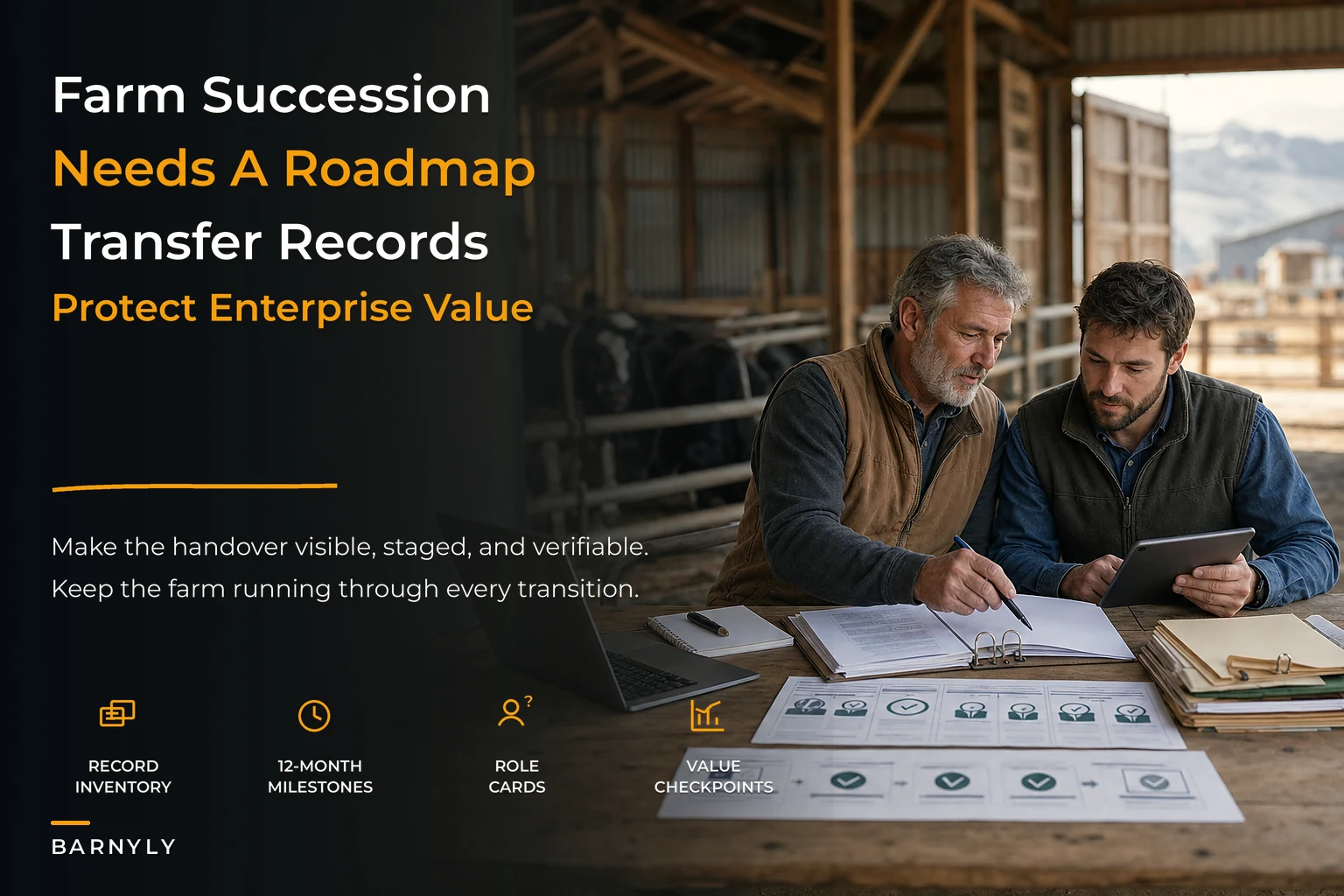
Here's a simple visual of the phased handover workflow.
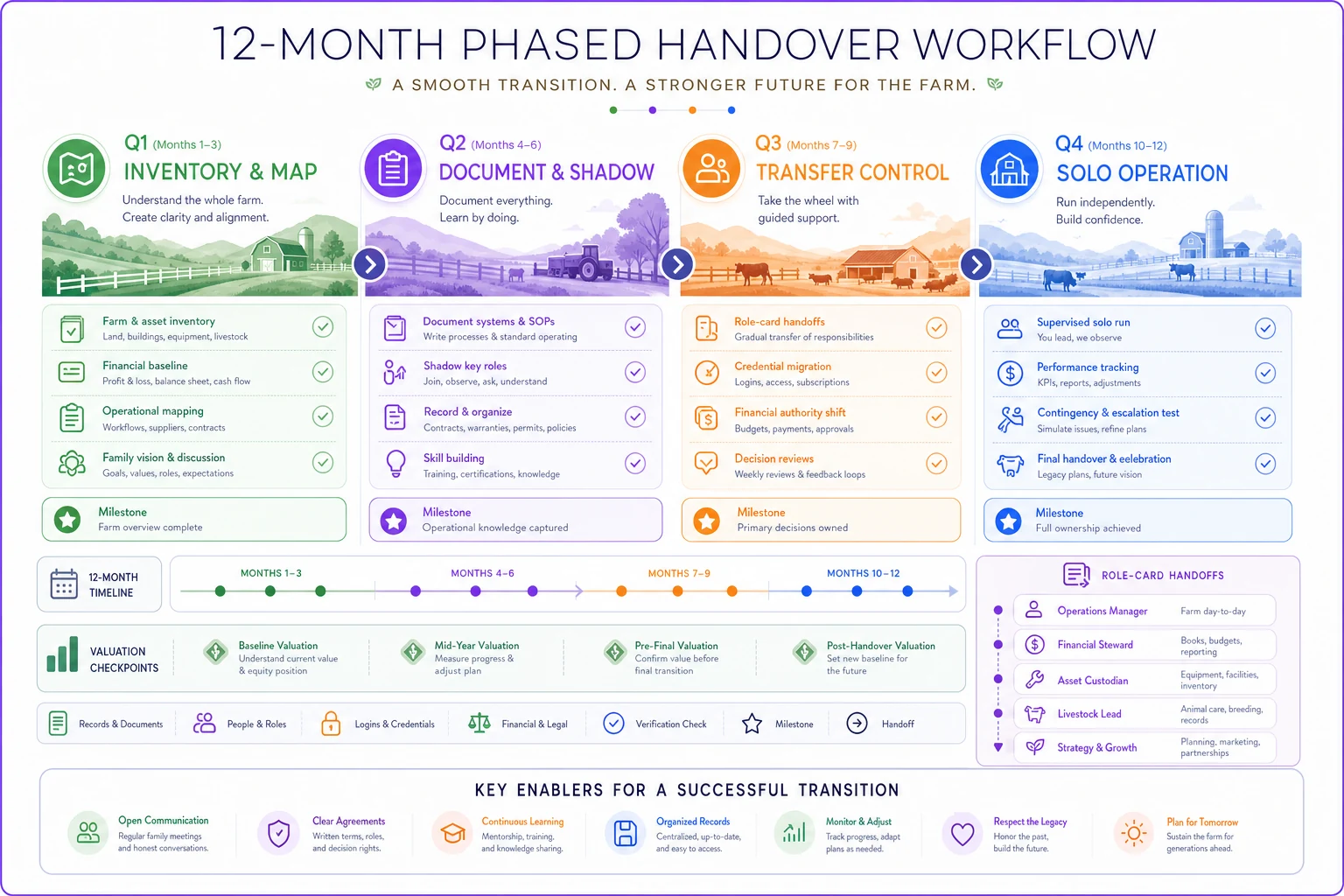
Use the visual to brief family and advisers on the month-by-month milestones and handoff expectations.
The essential record inventory
This is the backbone. If nothing else in this playbook gets done, do this. Farms consistently think their records are in decent shape until someone unfamiliar tries to actually use them under time pressure.
Here's the inventory broken into categories, with a realistic note on where each one usually lives and where it breaks.
| Record category | What it must contain | Where it usually lives | Common continuity gap |
|---|---|---|---|
| Herd/animal records | IDs, genetics, breeding history, health events, treatment/withdrawal status | Software, notebooks, one person's memory | Withdrawal dates and breeding attempts undocumented |
| Financial | Per-head costs, cashflow timing, loan terms, cost basis for tax | Accountant + owner's head | Nobody knows why certain decisions were made |
| Regulatory/compliance | Movement records, medication logs, traceability, welfare records | Mixed paper/digital | Retention timelines and inspector expectations unknown to successor |
| Supplier/buyer relationships | Contacts, pricing history, terms, informal agreements | Owner's phone and memory | Handshake deals with no paper trail |
| Operational SOPs | Feeding, health protocols, seasonal routines, equipment | Rarely written down | The "how we do it here" knowledge |
| Credentials/access | Logins, account numbers, portals, government IDs | Sticky notes, one browser | Successor locked out at the worst moment |
| Physical/asset | Maps, water systems, fencing, machinery history | Owner's head | Where things are and how they fail |
The insight most people miss: the highest-risk records aren't the ones that are missing entirely — those are obvious. The dangerous ones are records that exist but are only interpretable by the person leaving. A spreadsheet full of abbreviations only Dad understands is worse than no spreadsheet, because it creates false confidence.
Role cards: making distributed knowledge transferable
A role card is a one-page document per operational role that answers: what this person does, when they do it, what decisions they own, who they coordinate with, and what breaks if they disappear.
Not a job description. A job description says "manages herd health." A role card says: checks the sick pen every morning before feeding, decides treat-vs-call-vet using these thresholds, records every treatment same-day, escalates to Dr. Reyes at 402-555-xxxx when temp exceeds X or no improvement in 48 hours, coordinates withdrawal timing with the buyer schedule.
A useful role card includes:
-
Daily/weekly/seasonal tasks tied to actual timing, not vague responsibilities
-
Decision authority — what this person can decide alone vs. what needs sign-off
-
Escalation triggers — the specific conditions that mean "call someone"
-
Key relationships — who they coordinate with internally and externally
-
Single points of failure — what genuinely stops if they're unavailable
On most family farms, three or four role cards cover the whole operation. Write them, and you suddenly see the overlap and the gaps — tasks two people assume the other handles, and ones nobody owns until something goes wrong.
This connects directly to building repeatable SOPs, seasonal rosters and handover templates, which turn role cards into something the whole operation runs on rather than a one-time succession artifact.
Credential-transfer templates (do this right or pay for it later)
Credential handover is where otherwise careful successions turn into a genuine mess. Someone retires, three months later the co-op portal needs a password reset, the reset email goes to an inbox nobody monitors, the phone number on file is disconnected, and now the new operator can't submit paperwork before a deadline.
Don't hand over passwords. Migrate ownership. There's a difference.
-
What the account is for and what depends on it (banking, co-op, government portal, herd software, supplier)
-
Current owner of record — the name, email, and phone actually attached to the account
-
New owner of record — updated before handover completes
-
Recovery path — what email and number resets go to, both updated to accounts the successor controls
-
Verification step — successor logs in independently while the outgoing owner is still around to unstick anything
-
Sensitive account flag — banking and government logins get changed, not shared
Always update recovery emails and phone numbers before completing any account transfer.
The template forces the boring but critical work: updating the recovery email and phone on every account so a future password reset actually reaches the right person. Skip that step and you've handed over access that quietly expires the first time an account challenges a login.
Phased valuation and decision checkpoints
Valuation shouldn't be a single number produced at closing. Tie it to the phases, because what the operation is worth changes depending on whether operational value survives the transfer.
Checkpoint 1 (end of Phase 1): Baseline valuation with the operation running as-is. This is the "founder-dependent" value. Be honest — a lot of the value is currently tied to the outgoing owner's undocumented knowledge and relationships. That's a discount, not a bonus.
Checkpoint 2 (end of Phase 2): Re-assess after documentation. If role cards and the record inventory are solid, some of that founder-dependency risk becomes transferable value. An operation is genuinely worth more when its knowledge isn't trapped in one person.
Checkpoint 3 (end of Phase 3): Assess under supervised operation. How does the operation perform with the successor making decisions and the mentor as backup? This is the first real test of whether value survived the transition.
Checkpoint 4 (end of Phase 4): Final valuation under solo operation. This is the number that actually reflects a transferable, going-concern operation — not a snapshot of its best year under the old operator.
Operations that document early often increase in defensible value between checkpoints, because they've converted personal knowledge into operational systems. Operations that skip documentation frequently discover at Checkpoint 3 that performance drops, and the valuation drops with it.
A real scenario
A family cow-calf operation, roughly 180 head, second generation preparing to hand off to a daughter who'd worked the farm part-time for years but had never touched the financial or regulatory side.
The problem surfaced during the record inventory. She knew the animals well. What she had no idea about: the operation depended on a handshake feed arrangement with a neighbor, a co-op account registered under her mother's maiden name, and a state movement-record obligation nobody had ever explained to her. Three single points of failure, all invisible until someone went looking.
They ran the 12-month roadmap. The messy parts weren't the animals — those transferred fine. It was the credential and relationship work: updating recovery emails on close to a dozen accounts, formalizing the feed arrangement into something with actual terms, and writing four role cards that revealed her father had been quietly handling two compliance tasks nobody else knew existed.
By the solo phase, the operation ran without daily calls to Dad. The valuation between the baseline checkpoint and the final one came out noticeably higher — not because the herd changed, but because a buyer or lender could now see a documented, transferable operation instead of one that would collapse the day the founder left.
When this level of planning actually makes sense
A full 12-month phased playbook fits operations where the successor isn't already running things day-to-day, where knowledge is concentrated in one or two people, and where there are real regulatory or financial relationships to transfer. Most family livestock operations fit that description exactly.
When it's overkill: if the successor has already been co-running the operation as a full partner for years and knowledge is genuinely shared, you can compress hard. You still want the record inventory and credential transfer, but the long supervised phases aren't necessary.
Who should not rush this: anyone whose operation has significant undocumented knowledge, informal supplier deals, or compliance obligations the successor has never handled. Rushing doesn't save time — it just moves the failure to the first bad week after the mentor is gone.
Keeping records continuous, not just transferred
The reason to run all of this through a proper records and operations system rather than a pile of spreadsheets is straightforward: succession isn't a one-time event. The record inventory you build, the role cards, the escalation triggers, the withdrawal tracking — all of that has to keep functioning the day after handover and every day after that.
AI-assisted operational platforms help mainly by removing the "trapped in one head" problem. When treatment records, withdrawal dates, breeding attempts, and reorder triggers live in a shared workflow instead of a personal notebook, the successor inherits a system that keeps running, flags what needs attention, and doesn't depend on anyone remembering what the abbreviations mean. That's continuity by design rather than by memory — and it's the same discipline that keeps an operation resilient against any disruption, not just succession. Worth reading alongside a broader operational risk and livestock continuity playbook.
The farms that hand off well aren't the ones with the best animals or the most land. They're the ones where the operation could survive the founder walking out the gate for the last time — because the knowledge, the records, and the relationships were built to outlive any single person running them.
Ready to optimize your farm management?
Join hundreds of farmers using Barnyly to save time, improve animal health, and increase farm productivity.