

Most ranchers find out their claims documentation is thin at the worst possible moment: standing in a muddy pasture next to dead animals, phone in hand, trying to remember whether they took a timestamped photo before the carcass got moved. By then half the evidence is already gone. The weather log that would've proven the storm hit at 2 a.m. is sitting in a text thread. The vet who looked at the sick heifer never wrote anything down because it was "just a quick look." And the adjuster — who's never met you and is paid partly on how well they control payout costs — now gets to interpret all those gaps in your favor of the insurer.
The frustrating part is that livestock insurance claims evidence isn't actually hard to produce. It's just that almost nobody builds the system to capture it before a loss. Claims don't get denied because farmers are dishonest. They get denied, delayed, or quietly reduced because the proof is incomplete, out of order, or impossible to tie to a specific date and animal.
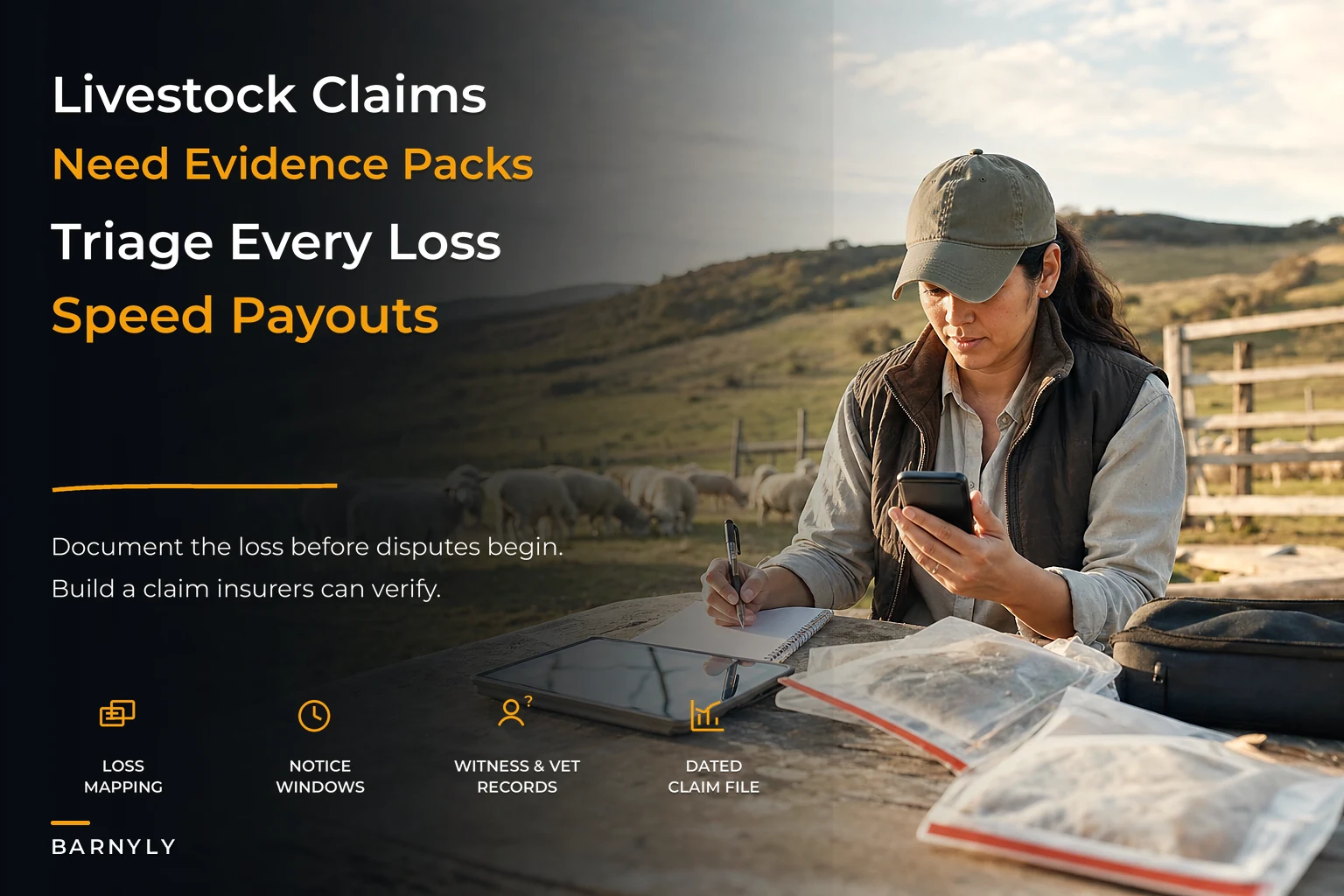
This is about building that system backward — starting from the handful of events that actually trigger claims, working out the minimum evidence each one needs, then putting together checklists and templates that keep your file clean enough that an adjuster has nothing to argue with.
Start from the event, not the paperwork
The mistake most operations make is treating documentation as a general goal — "keep good records" — instead of mapping it to the specific loss events their policy actually covers. Your policy almost certainly doesn't pay out for "a bad year." It pays out for named perils: death from accident, death from specific diseases, weather events, predation, electrocution, transit loss, named disease outbreaks, and so on. Each of those has a different burden of proof.
A photo-heavy file that proves an animal is dead does nothing if the peril was lightning and you have no weather data. A perfect vet report does nothing if the policy required notification within 48 hours and you called on day four.
So the first move is to sit down with your actual policy — not the brochure, the policy — and list every covered event. For each one, write down three things: what triggers the clock (notification deadlines), what the insurer must be convinced of, and what physical evidence disappears fastest. That last column is the one people skip, and it's the one that costs the most.
Here's the kind of mapping that actually holds up when a file gets scrutinized:
| Common claim event | Minimum evidentiary pack | Evidence that disappears fastest | Typical notification window |
|---|---|---|---|
| Accidental death (injury, fall, machinery) | Timestamped photos from multiple angles, vet death certificate or necropsy, animal ID/tag, location record | The scene — once the carcass is moved or scavenged | 24–72 hrs |
| Lightning / storm death | Weather station or NOAA data for your coordinates, photos of carcass pattern (often grouped), location, vet opinion | Weather correlation if you wait days to pull it | 48–72 hrs |
| Disease death (covered diseases) | Clinical history, treatment logs, lab/necropsy results, vet notes, vaccination history | Diagnostic samples if carcass decomposes | 24–48 hrs + lab lead time |
| Predation / attack | Carcass photos showing wound pattern, tracks, wildlife/incident log, sometimes wildlife agency report | Tracks and wound evidence after weather or scavengers | 24–48 hrs |
| Transit / loading death | Transport manifest, driver log, load times, condition-at-loading record, delivery notes | Who saw the animal healthy at loading | 24 hrs |
| Named disease outbreak / depopulation | Official quarantine/order paperwork, herd inventory at time of order, treatment and movement records | Pre-outbreak inventory accuracy | Immediate, follows official notice |
Notice the pattern down the "disappears fastest" column. It's almost always the contextual evidence — weather, scene, who-saw-what-when — not the fact of the loss itself. That's the stuff you can't recreate. It's also what adjusters lean on hardest when they want to question a claim.
Why claims fall apart even when the loss is real
A legitimate loss with a bad file is still a bad claim. In real operations, this usually happens for reasons that have nothing to do with the animal and everything to do with how the information was handled.
Simplify farm operations and enhance animal care.
Barnyly helps you organize, track, and manage every aspect of your farm operations seamlessly.
- Comprehensive livestock tracking
- Automated health alerts
- Feed and resource scheduling
No credit card required
The first is the gap between discovery and documentation. Someone finds a dead animal during morning rounds, deals with the immediate situation, and comes back to "handle the paperwork" that evening or the next day. By then the carcass has been moved, the light is different, and the timestamp on the photo no longer matches a plausible time of death. Adjusters notice timestamp mismatches immediately.
The second is records scattered across five different places. Treatment history in a barn notebook. Vet note on their system. Purchase record in an email thread. Weather confirmation nowhere because nobody pulled it. Even when every piece exists, assembling them into one chronological story takes days, and the story has visible seams where the dates don't quite line up.
The third — and this one quietly kills the most money — is valuation drift. Your policy pays based on an agreed or proven value. If you can't produce the purchase invoice, the weight records, the breeding documentation, or the production history that justifies the animal's worth, the adjuster defaults to a conservative number. On a single high-value bull or a group of registered breeding stock, that gap can be the difference between a fair payout and a fraction of one.
What ties all three together is that they're coordination failures, not honesty failures. The loss was real. The policy covered it. The money still got reduced because the operation couldn't tell a clean, dated, cross-referenced story on demand.
What breaks when you scale
On a small operation, one person usually holds the whole picture in their head. They were there when the animal died, they know the vet, they remember what the weather did. That memory is the documentation system — and it works right up until it doesn't.
The failure shows up in a few predictable ways as operations grow:
-
Multiple people handle the same animal. The person who found the dead cow isn't the person who files the claim, and the context gets lost in the handoff. Nobody wrote down the exact location or whether the fence was down nearby.
-
Multiple sites mean multiple weather realities. A storm that hit the north lease didn't touch the home place. If your weather evidence isn't tied to specific coordinates, you can't prove which animals were exposed to what.
-
Volume turns a 48-hour window into a missed deadline. When you're losing animals across a big herd during a disease event or a severe weather week, that notification deadline gets buried under the operational emergency of actually managing the crisis.
-
Valuation records fall behind. New purchases, weight gains, and breeding changes happen faster than anyone updates the per-animal value documentation. So the insured value on file is stale when you need it.
This is the same underlying weakness that shows up in broader continuity planning. If you've worked through an operational risk and livestock continuity playbook, the insurance layer is really just one more continuity function — the difference between a loss event that drains your cash reserves and one that's reimbursed on a predictable timeline.
The triage-to-claim checklist
The fix isn't "document more." It's having a repeatable response that runs the same way every time a loss is discovered, regardless of who's on shift. Think of it as a triage protocol: the first hour decides the quality of the entire claim.
Run this immediately on discovery of any potential insured loss:
-
Stop and photograph before touching anything. Multiple angles, wide shots showing location and surroundings, close-ups of any wounds or markings, and at least one frame that captures the ear tag or ID. Make sure device timestamps are on.
-
Record exact location. GPS pin, paddock name, nearest landmark. For multi-site operations this is non-negotiable — it anchors weather and scene evidence to a specific place.
-
Capture the scene context. Downed fence, machinery nearby, water source, grouping of multiple animals, tracks, scavenger activity. Note anything that supports or explains the suspected cause.
-
Log the discovery time and who found it. Not the time you wrote it down — the actual discovery time, and the name of the person.
-
Pull the external evidence while it's fresh. If weather is a factor, screenshot or download the NOAA/weather station data for your coordinates today, not next week.
-
Call the vet if the peril requires a clinical opinion or necropsy. Diseases and ambiguous deaths almost always do. Decide fast whether the carcass needs to be preserved for sampling.
-
Check the notification clock and notify the insurer within the window. Even a preliminary notice that says "loss discovered, documentation in progress" protects you against a late-filing denial.
-
Open the claim file and drop everything in, in order. One place, dated, so nothing has to be reconstructed later.
Steps 1 through 5 happen in the first hour — before the scene changes. Everything after that can tolerate some delay. The evidence that disappears fastest gets captured first.
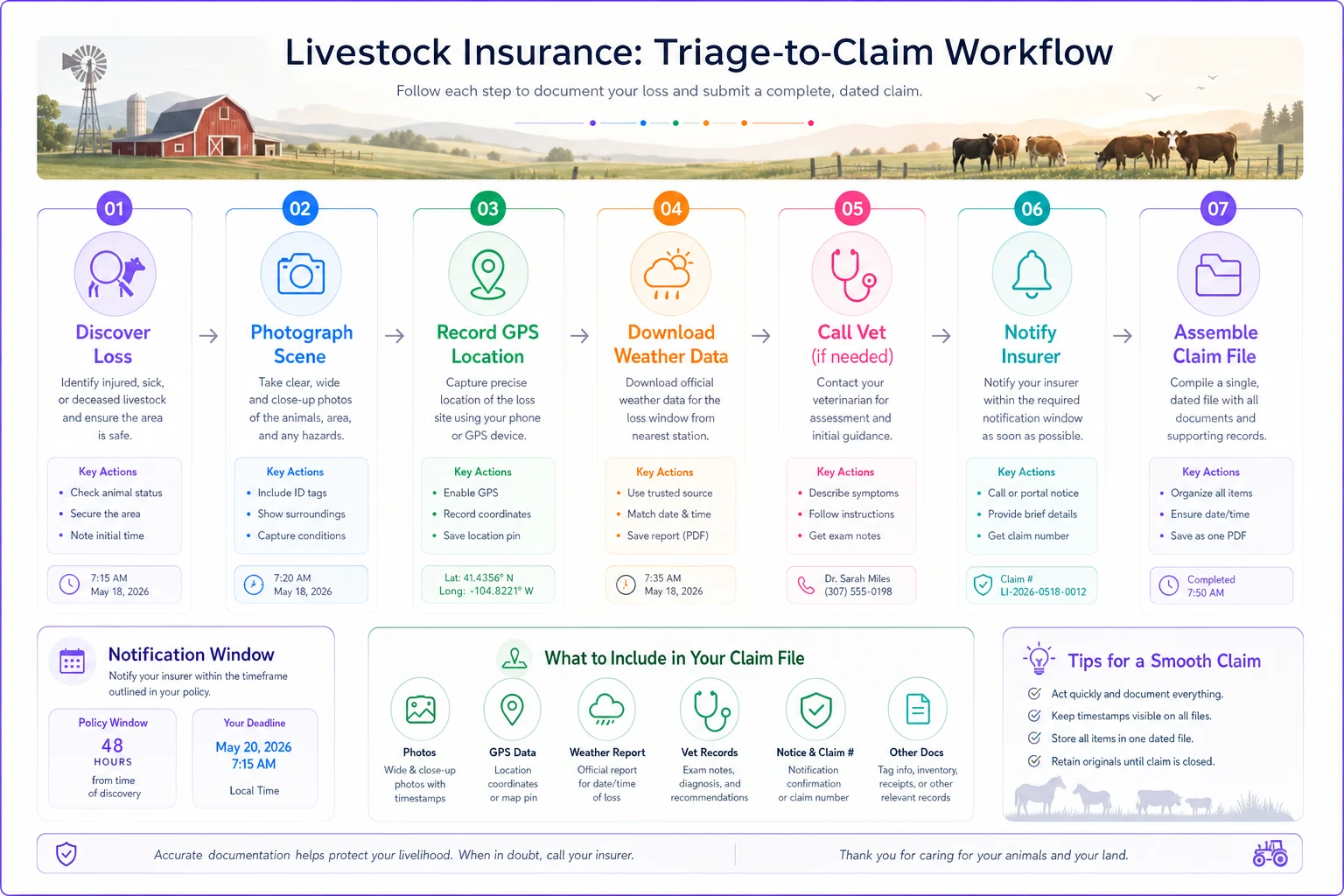
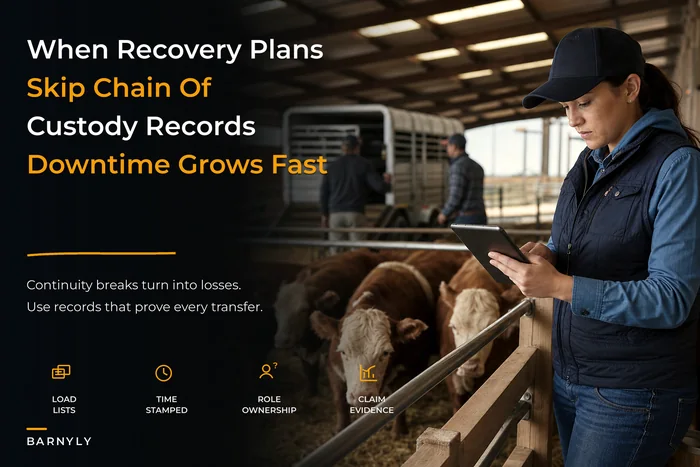
Use this as a quick visual guide to run the triage steps in order.
Keep a prewritten preliminary notice on your phone so you can notify the insurer within the required window without drafting a message under stress.
Everything after the first hour can be slower and more deliberate — pull labs, vet reports, and valuation documents — but the first-hour triage is what preserves the evidence you can't recreate.
Building the chronological log that adjusters can't argue with
A pile of photos and a vet note isn't a claim. A timeline is. The single most persuasive thing you can hand an adjuster is a clean chronological log that reads like a story with no gaps.
A strong log for a disease death doesn't start at death. It starts weeks earlier:
-
Vaccination record showing the animal was properly covered
-
First observation of symptoms, with date and who noticed
-
Treatment given, dosage, by whom, on what date
-
Vet consultation and clinical notes
-
Follow-up treatments and response
-
Death, discovery time, scene documentation
-
Necropsy or lab submission and results
-
Insurer notification and claim filing
Each line is dated, and each connects to a piece of evidence in the file. An adjuster reading that can't find the seam to pry at, because there isn't one. The clinical history proves it wasn't neglect. The treatment log proves you tried. The lab result proves the cause. The timeline proves it all happened in a believable order.
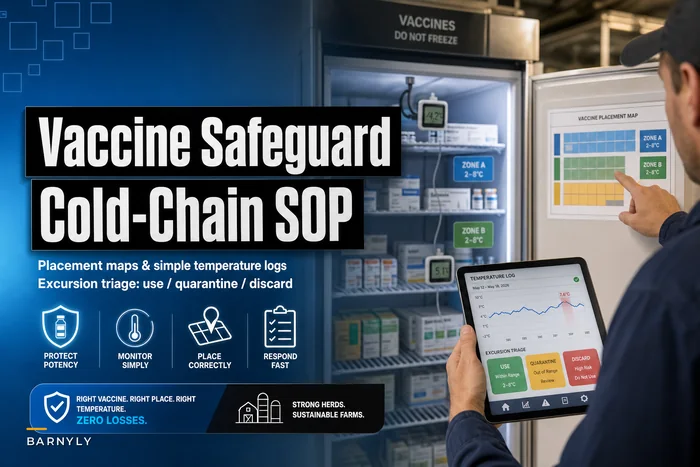
Operations that already run tight health and treatment records have a quiet advantage at claim time — the insurance documentation is mostly a byproduct of records they were keeping anyway. The same discipline that protects you on a farm cold‑chain SOP — timestamped logs, excursion triage, clear chain of responsibility — is the same discipline that produces a defensible claim file. The habits overlap more than most people realize.
Sample correspondence templates that keep you in control
How you communicate with the insurer matters almost as much as what you document. Loose, vague correspondence invites questions. Tight, dated, factual correspondence closes them. Keep a few reusable templates so you're never writing claim communication from scratch during a stressful week.
Initial notification (within the window):
> "Reporting a potential insured loss discovered [date/time] at [location]. Suspected cause: [peril]. [Number] animal(s) affected, ID(s): [tags]. Documentation and vet assessment in progress. Formal claim to follow. Please confirm receipt and advise any immediate requirements."
That one message does three things: it beats the deadline, it establishes the facts you want on record, and it forces the insurer to tell you what they need rather than surprising you later.
Evidence submission cover note:
> "Attached: chronological loss log, [X] timestamped photos, vet death certificate/necropsy, treatment history, vaccination records, weather data for [coordinates/date], and valuation documentation (purchase invoice/weight records). Items listed in index. Please advise if anything further is required within [timeframe]."
Follow-up on delay:
> "Following up on claim [number], submitted [date]. All requested documentation was provided on [date]. Requesting a status update and expected resolution date. Please advise if any item is outstanding."
The follow-up template is the one most people are too polite to send, and it's the one that keeps claims from drifting. A documented, dated request for status is a mild but real form of pressure, and it creates its own paper trail if the claim ever needs escalation.
A real scenario
A cow-calf operation running a few hundred head across three leased parcels lost eleven animals in a single overnight storm — a mix of lightning strike and one group that got pushed into a fence line. Their process at the time was "handle it, file when things calm down." Things didn't calm down for four days.
By the time they pulled together a claim, the carcasses had been dealt with, the photos were inconsistent, nobody had captured the downed fence before it was repaired, and — the expensive part — they couldn't produce weather data tied to the specific lease where most of the losses happened. The adjuster accepted the clear lightning deaths but questioned the fence-line group, and valuation on several animals got knocked down for lack of current records. The payout landed well below what the losses were actually worth, and it took nearly two months to settle.
After rebuilding around an event-triggered checklist, a near-identical situation played out completely differently the following year. A storm hit, animals were lost, but the first-hour protocol ran: scene photos before anything moved, GPS-tagged locations, weather data downloaded that morning for each affected parcel, a preliminary notice to the insurer by midday. The chronological log went to the adjuster inside a week with nothing missing. The claim settled in a few weeks at close to full value, no back-and-forth about the fence-line group because the scene evidence spoke for itself. Same losses, same policy — the only thing that changed was the system capturing the evidence.
When this level of rigor makes sense — and when it's overkill
Building a formal evidence playbook pays off most when your insured value is high, your perils are ambiguous, or your operation is spread across people and sites. Registered breeding stock, high-value bulls, multi-site herds, and operations in storm- or predator-heavy regions all justify the discipline, because the dollar gap between a clean claim and a messy one is large and recurring.
It's less critical if you carry minimal coverage, run a small single-site herd where one person holds the full picture, and rarely file. A lightweight version — a phone folder for timestamped photos and a habit of logging discovery time and location — covers most of the risk without ceremony.
Who should not over-engineer this: anyone who'd spend more time maintaining the system than they'd ever recover in claims. If you've filed one small claim in a decade, you don't need a per-animal valuation register updated weekly. Match the rigor to your actual exposure.
Where software quietly earns its keep
None of this requires special tools — a disciplined operation with a notebook and a phone can file excellent claims. But the coordination problems that break claims at scale are exactly what a good workflow platform handles well in the background.
The real value isn't fancy features. It's that evidence gets captured as a byproduct of normal work. When health events, treatments, vaccinations, locations, and purchase records already live in one connected system, the chronological log for a claim is mostly assembled before you even start.
AI-assisted automation can flag notification deadlines the moment a loss is logged, prompt for the specific evidence a given peril requires, and pull matching weather data for the animal's recorded location — without anyone remembering to do it. That turns the first-hour triage protocol from something you hope people follow into something the system walks them through, which is what actually matters when a loss happens at 5 a.m. and the person on shift has never filed a claim before.
Insurance documentation shouldn't be a separate chore. It should fall out of the records you already keep to run the operation well. Build the operational discipline first, map it to the specific events your policy covers, and the clean claim file becomes almost automatic. The money you recover faster, and the disputes you never have, are the payoff for work you were half-doing anyway.
Ready to optimize your farm management?
Join hundreds of farmers using Barnyly to save time, improve animal health, and increase farm productivity.