

A gate latch fails and two heifers get out onto the county road. Someone jots "cattle out, fixed it" in a notebook, and three months later the exact same latch on the exact same gate fails again. That's almost never bad luck. It's the first incident that never got properly closed out.
Most farm incident records die as a single line in a logbook or a text thread. The animal gets treated, the fence gets patched, everyone moves on. What's missing is the part that actually prevents the repeat: a structured way to capture what happened, score how bad it was, dig into why, assign a fix with a name and date attached, and then — this is the part almost everyone skips — go back weeks later to confirm the fix actually held.
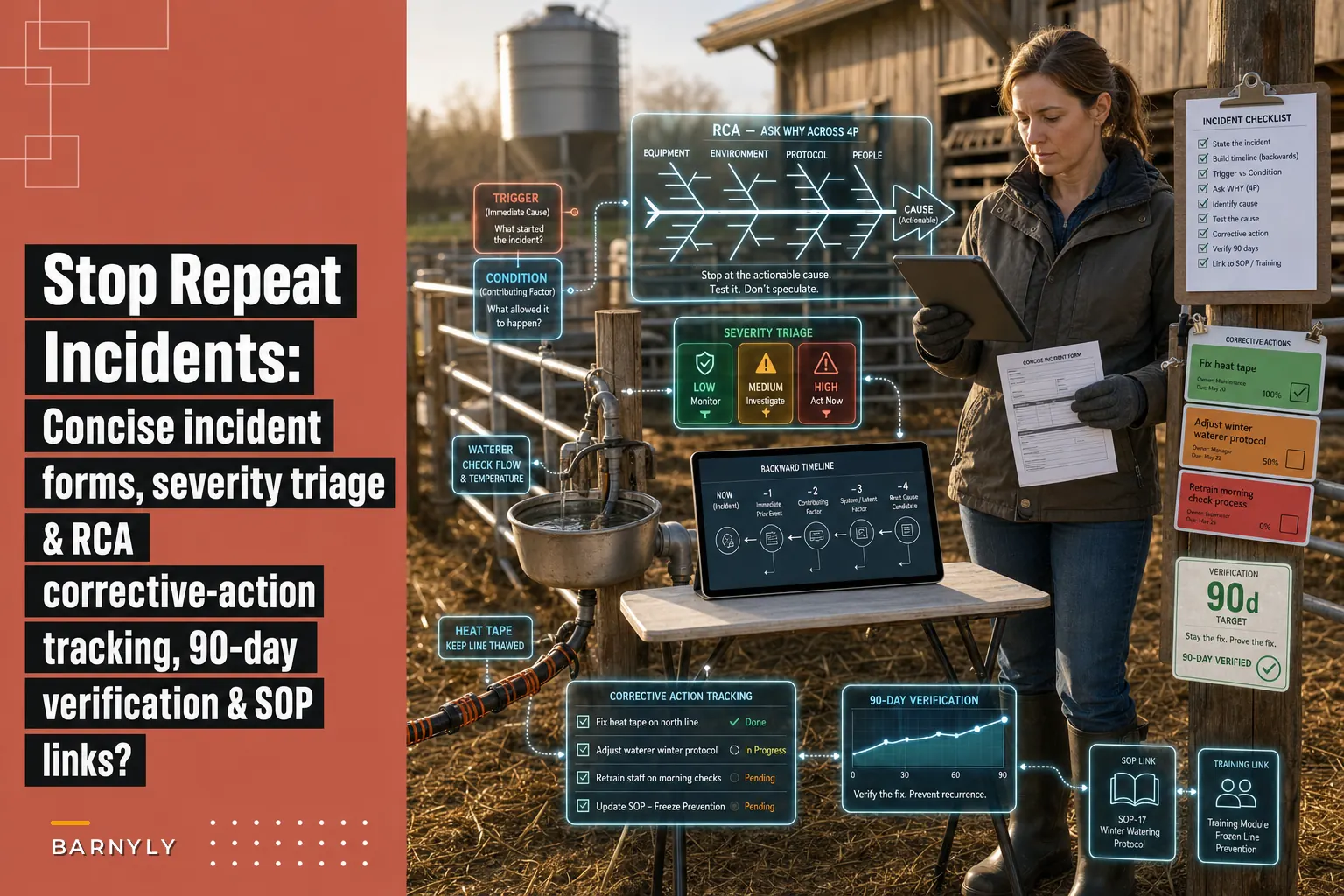
This is about building a farm incident root cause template that's short enough people will actually fill it out, but structured enough it forces the questions that stop repeats.
Why "we fixed it" is the most expensive phrase on the farm
A quick fix treats the symptom and ignores the condition that produced it. A sick calf gets pulled and treated. Done. But nobody asked why that pen had three scours cases in two weeks while the pen next door had none.
In real operations, the breakdown usually looks like this: the person responding to the incident is also the person who's exhausted at 9pm, the animal is stabilized, and writing anything beyond "treated calf 44, scours" feels like paperwork for its own sake. So the record captures the event but none of the context — stocking density that week, who did the last feeding, whether the colostrum protocol got skipped during a staffing gap.
Then the same thing happens again, and because the first record had no depth, there's nothing to compare it to. You can't spot a pattern across three incidents when each one is a four-word note. This same gap shows up constantly in weaker herd-health setups — treatment happens, prevention doesn't, and the operation quietly leaks money. It's worth reading about how these herd-health system mistakes leave prevention and response gaps, because incident logging sits right in the middle of that problem.
The real cost isn't the single incident. It's the repeat. A gate that fails twice, a waterer that freezes every cold snap, a chute injury that happens to a different worker six weeks later — those are the expensive ones, and they're all preventable with a record that goes one layer deeper than "fixed it."
The concise incident form: short enough to actually get filled out
The enemy of incident logging is length. A two-page form at the end of a long day gets abandoned. The whole thing needs to fit on a phone screen or an index card and take under three minutes.
Simplify farm operations and enhance animal care.
Barnyly helps you organize, track, and manage every aspect of your farm operations seamlessly.
- Comprehensive livestock tracking
- Automated health alerts
- Feed and resource scheduling
No credit card required
-
Date, time, and location — specific paddock, pen, or structure, not "the north side"
-
What happened — one or two plain sentences
-
Animals or people involved — tag numbers, worker names
-
Immediate action taken — what you did in the moment to stabilize
-
Conditions at the time — weather, who was on shift, recent changes (new feed batch, new animal group, equipment serviced recently)
-
Severity score — covered in the next section
-
Reported by — so you can follow up with the right person
That "conditions at the time" line does more work than any other field. It's what lets you later see that four separate incidents all happened during the two weeks your most experienced hand was on vacation, or that they all involved the same feed lot number.
One thing worth noting: forms get filled out honestly when they're separated from blame. If the incident form feeds directly into a performance review, people soften what they write. Keep incident records about the event and the system, not the person, and the data stays useful.
Triage severity scoring so the right incidents get real attention
Not every incident deserves a full root cause analysis. A single bird escaping a pen isn't the same as a feed-mixing error that could've hit the whole herd. Without a scoring step, you either over-investigate trivial stuff and burn out, or you under-investigate the serious ones and get blindsided.
A scoring model that actually works on-farm uses two axes: actual or potential harm and likelihood of recurrence. Score each 1–3, multiply, and you get a 1–9 number that tells you how to respond.
| Score | Severity | Response required |
|---|---|---|
| 1–2 | Low | Log it, patch it, no formal RCA |
| 3–4 | Moderate | Log it, quick cause note, flag for pattern-watch |
| 6 | High | Full RCA within 7 days, corrective action assigned |
| 9 | Critical | Immediate RCA, management notified, SOP review triggered |
The key word in that harm axis is potential. A worker who almost got caught in a PTO shaft but walked away fine is a 9, not a 1. The outcome was lucky; the exposure was catastrophic. Farms that only score on actual outcome keep ignoring near-misses until one finally isn't a near-miss anymore. Scoring on potential harm is what lets you act on the warning instead of waiting for the disaster.
One common mistake worth watching for: letting the person closest to the incident score their own severity. People reflexively score down to avoid the paperwork and the attention. Have a second set of eyes confirm anything that scores 6 or above.
Farm-tailored RCA steps that fit livestock reality
Generic root cause frameworks were built for factories and software teams. On a farm, the "five whys" approach still works, but the branches you investigate are different — biology, weather, timing, and human handoffs all interact in ways a manufacturing checklist never accounts for.
-
State the incident factually. No opinions, no blame. "Waterer in Pen 3 froze overnight; 12 head without water for approximately 10 hours."
-
Build the timeline backward. When was it last checked? Last serviced? What changed recently? This often surfaces the cause before you even finish the exercise.
-
Separate the trigger from the condition. The trigger was the cold snap. The condition was that the heat tape had failed three weeks earlier and the repair got deferred. Triggers are often weather or chance; conditions are what you can actually control.
-
Ask "why" across the three usual farm branches equipment/environment, protocol/SOP, and people/handoff. Most real root causes live where two branches meet — a worker didn't check the waterer because the SOP didn't list it because that pen was recently added.
-
Stop at an actionable cause, not a person. "Jake forgot" is not a root cause. "No checklist item exists for newly added pens" is a root cause you can fix permanently.
-
Test the cause with the opposite question "If we fix this, would the incident have been prevented?" If the answer is no, you haven't found the root cause yet.
Here's a practical RCA sequence you can visualize.
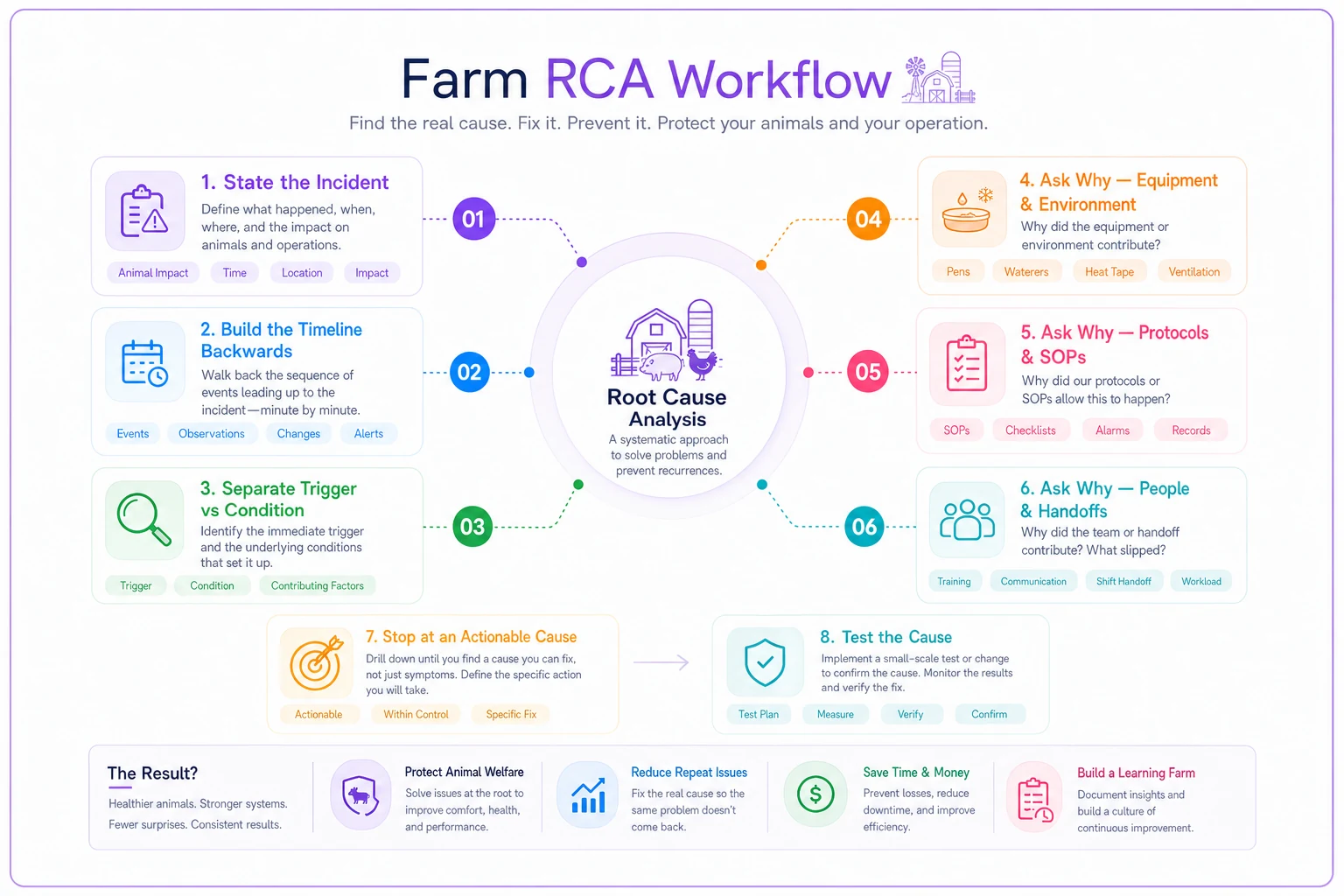
That third step — trigger versus condition — is where most farm RCAs go wrong. You can't stop cold snaps. You absolutely can stop deferring heat-tape repairs. When the RCA output is "it was really cold," you've learned nothing. When it's "our deferred-maintenance list has no hard deadline," you've found something fixable. This connects directly to keeping an asset-risk maintenance calendar with failure logs, because a lot of incident root causes trace straight back to a maintenance item that quietly slipped.
Corrective-action tracking: the part that assigns a name and a date
An RCA that ends with "we should probably check the waterers more often" is a wish, not a corrective action. The handoff from finding the cause to fixing it permanently is where most incident systems fall apart — not because people are lazy, but because the action floats without an owner.
-
A specific action — "Add 'inspect heat tape and waterer function' to the weekly pen checklist"
-
One named owner — not a team, one person
-
A due date — real, on the calendar
-
A verification method — how you'll know it actually happened
After a feed-mixing error dosed a group with the wrong supplement ratio, the corrective action wasn't "be more careful." It was: "Install a second-check sign-off on the feed sheet for any batch with medicated inclusion — owner: feed lead — due: next Monday — verified by: checking the next four feed sheets for the second signature." Specific, owned, dated, verifiable.
Treat open corrective actions like unpaid bills — review the running list weekly so nothing drops off the radar.
Farms that stop repeats treat open corrective actions like unpaid bills. There's a running list, it gets reviewed weekly, and nothing drops off until it's verified complete. A corrective action with no owner and no date has roughly the same effect as not writing anything down at all.
The 90-day verification loop that actually closes the gap
This is the step almost nobody does, and it's probably the most valuable one. You fixed the latch in March. Did it hold through wet April ground when the posts shifted? You added the waterer check to the SOP. Are people actually doing it, or did it quietly fall off after two weeks?
-
Original incident reference and date
-
Root cause identified
-
Corrective action taken and completion date
-
SOP or checklist updated? — link or reference to the exact document and version
-
Who was trained on the change? — names and date
-
90-day check Has the incident recurred? Is the new SOP step being followed? Evidence?
-
Status Verified closed / still monitoring / reopened
The SOP-and-training link matters more than it sounds. A corrective action that changes how things are done but never makes it into the written procedure dies the moment the person who made the fix takes a week off. And a changed SOP that nobody got trained on is just a document nobody follows. The verification loop is what forces those connections to actually exist instead of living in one person's head.
When a 90-day check comes back as "recurred," that's not a failure of the system — that's the system doing exactly its job. It caught a fix that didn't hold before it became a third incident. You reopen it and dig deeper.
A real scenario: the repeat scours problem
A cow-calf operation running around 180 head kept losing calves to scours every spring. Each case got treated individually and logged as a single line. Over two seasons they lost somewhere in the range of 8–11 calves a year to it and had written it off as "that's just spring."
When they started filling out a proper incident form on each case — including the "conditions at the time" line — a pattern surfaced within a few weeks. Nearly every case traced back to one of two calving pens that stayed wetter and got reused faster during the busy stretch. The root cause wasn't the pathogen; it was pen rotation collapsing under calving-season workload.
The corrective action was concrete: a hard rule that no calving pen gets reused without a documented clean-and-rest cycle, added to the calving SOP, with the crew trained before the next season. The 90-day check the following spring confirmed the new rotation was being followed and scours cases dropped to two — both in animals bought in, not born on-site.
Treatment cost per case wasn't the big number. The repeats were. Cutting roughly nine losses a year down to two, on calves worth what they are, paid for the habit of filling out a three-minute form many times over.
When this makes sense — and when it's overkill
The full loop is worth running for anything that scored moderate or above, anything involving animal welfare or human safety, and anything you have even a suspicion might repeat. If you've seen the same type of incident twice, it goes through the full RCA and verification cycle, no debate.
Where it breaks down is trying to run a nine-step RCA on every trivial event. A single escaped chicken you caught in thirty seconds doesn't need a 90-day verification template. Over-processing low-severity stuff is how these systems get abandoned — people decide the whole thing is bureaucratic and stop logging anything, including the serious ones. The severity score exists specifically to protect against that. Low scores get a line and a patch. High scores get the full treatment.
If you're a one-person operation where you are the whole workflow, you still want the incident form and the severity score. Memory is exactly what fails you across a two-year gap between the first and second occurrence. But you can run a lighter corrective-action process since there's no handoff to coordinate.
Keeping the records connected instead of scattered
The practical failure mode here isn't that farmers don't care — it's that the incident lives in a notebook, the SOP lives in a binder, and the training record lives in someone's memory, so the three never connect. The verification loop only works if an incident can point to the SOP version it changed and the training session that followed.
This is where AI-powered operational software built for farm management quietly pays off. When the incident form, corrective action, updated procedure, and training sign-off all live in the same connected platform, the 90-day check takes minutes instead of an afternoon of digging through different records. Good farm management software can link those records automatically and flag open corrective actions before their due dates slip — which removes the main reason these loops fall apart in the first place. The point isn't the software itself; it's that the connection between incident, fix, procedure, and training has to be unbreakable, and connected records are the most straightforward way to make that happen.
The bottom line on repeat incidents
A repeat incident is almost always a first incident that got treated but never closed. The animal got better, the fence got fixed, and the record stopped one question too early.
The fix is a form short enough to actually use, a severity score honest enough to flag near-misses, an RCA that finds controllable conditions instead of blaming weather or bad luck, a corrective action with a name and a date on it, and a 90-day loop that confirms the fix held. Start with the next incident you'd normally log in four words. Give it the full three-minute form instead. Put a reminder 90 days out to check whether it worked. Do that for a season and you'll stop paying for the same problem twice.
A repeat incident is almost always a first incident that got treated but never closed. The animal got better, the fence got fixed, and the record stopped one question too early.
The fix is a form short enough to actually use, a severity score honest enough to flag near-misses, an RCA that finds controllable conditions instead of blaming weather or bad luck, a corrective action with a name and a date on it, and a 90-day loop that confirms the fix held. Start with the next incident you'd normally log in four words. Give it the full three-minute form instead. Put a reminder 90 days out to check whether it worked. Do that for a season and you'll stop paying for the same problem twice.
Ready to optimize your farm management?
Join hundreds of farmers using Barnyly to save time, improve animal health, and increase farm productivity.