


Ask a rancher what a load of manure is worth and you'll usually get a shrug or a rough guess. Ask them how many pounds of nitrogen, phosphorus, and potassium they spread across the north 40 last fall, and the answer gets fuzzy fast. Not because they don't care—because the records live in three separate heads and zero connected systems.
That disconnect is the whole problem. Your animal side knows how many head you're running and roughly what they're eating. Your field side knows what got spread where. But almost nobody has those two halves talking to each other in a way that turns into a fertilizer credit you can actually subtract from your spring input bill.
A working manure nutrient tracking system closes that loop. It takes what you already know about your livestock, estimates the nutrient output by class, logs where those loads actually landed, and then tells you what that means for crop replacement needs and your compliance windows. Done right, it stops you from buying fertilizer you already own and keeps you out of trouble when the inspector shows up.
Where the value actually leaks out
Here's how the money disappears, specifically—because "better records" is a useless goal until you see the actual failure points.
The nutrient estimate never gets made. A 120-head cow-calf operation produces a genuinely large amount of nitrogen and phosphorus over a winter feeding period. But if you never estimate it by class—mature cows versus growing calves versus a handful of bulls—you have no idea what your manure is worth per acre. So you spread it to get rid of it and then buy commercial N in April like the manure never happened.
Loads get spread but not logged by field. The spreader goes out, comes back, goes out again. Nobody writes down that the east paddock got four loads and the hay ground got two. Come planting, you're guessing which fields are already loaded up on phosphorus and which are hungry.
Compliance windows sneak up. Depending on your state and whether you're near a watershed, there are spreading restrictions—frozen ground, saturated soil, setback distances from water. Miss a window and you're not just risking a fine, you're risking runoff that a neighbor or inspector notices.
The pattern that keeps coming up: the animal records and the field records are both fine on their own. They're just never bridged. The nutrient value lives in the gap between them.
What a real nutrient estimate looks like by livestock class
You don't need lab-grade precision to make good decisions. You need consistent, reasonable estimates applied the same way every year. Manure nutrient content varies with diet, bedding, and storage, but book values by animal class get you close enough to plan around.
Simplify farm operations and enhance animal care.
Barnyly helps you organize, track, and manage every aspect of your farm operations seamlessly.
- Comprehensive livestock tracking
- Automated health alerts
- Feed and resource scheduling
No credit card required
| Livestock class | Approx. N (lbs/head/yr) | Approx. P₂O₅ (lbs/head/yr) | Approx. K₂O (lbs/head/yr) |
|---|---|---|---|
| Mature beef cow | 75–95 | 55–65 | 60–80 |
| Growing calf / stocker | 30–45 | 20–30 | 25–35 |
| Bull | 90–110 | 60–75 | 70–90 |
| Dairy cow (lactating) | 130–160 | 45–60 | 110–140 |
| Ewe / doe | 12–18 | 8–12 | 12–18 |
Two things matter more than the exact numbers. First, a lot of nitrogen volatilizes before it ever hits the field—how much depends on storage and how fast you incorporate it. A stockpiled solid pile in an open lot loses more N than a covered pack. Second, phosphorus and potassium are far more stable, which is why P is usually the nutrient that drives your spreading limits, not N.
The practical takeaway: build your estimates off head counts by class, discount nitrogen realistically for your storage method, and treat P as your ceiling. If you're already running clean head counts and class records for other reasons, this is mostly a matter of connecting data you already have—the same principle behind turning livestock records into predictable KPIs instead of letting them sit as isolated notes.
The logging workflow that actually gets used
The fanciest nutrient model in the world is worthless if the guy running the spreader won't log anything. The workflow has to survive contact with a cold morning and a tight window.
Log at the point of loading to avoid reconstructing events from memory later.
Here's a version that holds up:
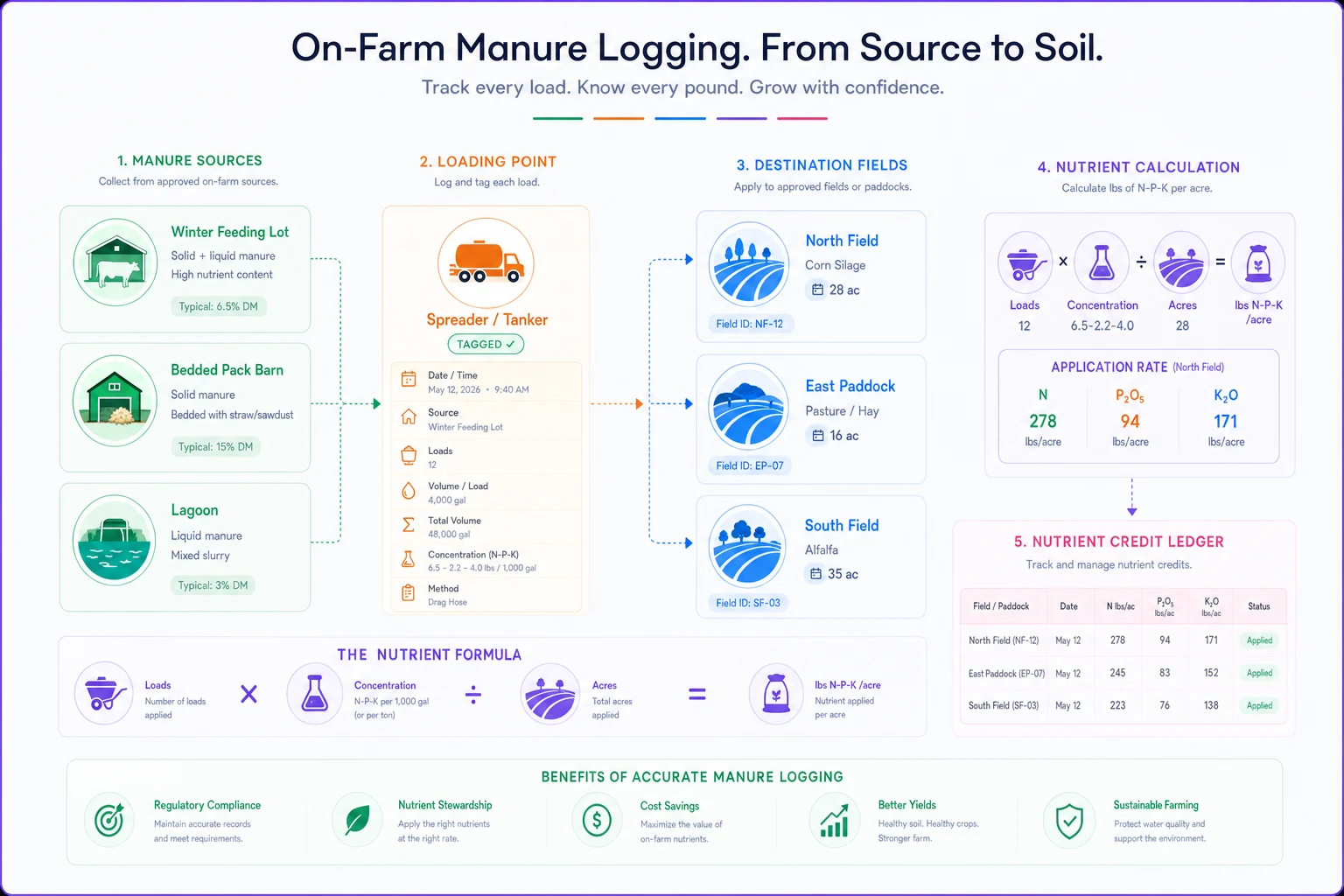
Quick visual of the workflow below.
-
Assign a load "source." Before the season, tag where the manure is coming from—winter feeding lot, bedded pack barn, lagoon. Each source carries an estimated nutrient concentration based on the animal classes that fed there.
-
Log the load at the point of loading, not later. One entry
source, spreader/tanker, and a rough volume or number of loads. Trying to log at the end of the day from memory doesn't work. It just doesn't happen.
-
Assign the destination field or paddock. This is the bridge. A load has no value on your books until it's tied to a specific field.
-
Let the system do the math. Loads × estimated concentration ÷ acres = pounds of N-P-K applied per acre on that field. That's your fertilizer credit.
-
Flag the field against its crop plan. If the field is going into corn next year and just received a heavy P load, the system should show you how much commercial P you can cut.
The whole thing takes maybe 20 seconds per loading event once it's set up. Compare that to reconstructing an entire season of spreading from tire tracks and vague memory in March.
A running field nutrient balance is the payoff
The reason to log loads by field isn't record-keeping for its own sake. It's the running balance.
Every field should carry a simple ledger: nutrients applied (manure plus any commercial) minus nutrients removed (crop uptake at harvest). When a field's phosphorus balance climbs year after year, that's your early warning that you're over-applying—which is both wasted money and a compliance risk in P-sensitive areas. When a field is running a nitrogen deficit, that's where your next loads should go.
A pattern worth catching: farms tend to spread manure on the closest fields because it's convenient, and those fields quietly load up on phosphorus over five or six years while the back fields stay hungry. Nobody decided to do that. It just happened one convenient load at a time. A field-level balance surfaces it before your soil tests do.
Forecasting crop replacement needs
Once you know what each field received and what next year's crop will remove, the fertilizer decision stops being a guess.
A rough example. Say you're planting a 40-acre field to corn expecting around 180 bu/acre. That crop will remove somewhere in the range of 60–70 lbs of P₂O₅ per acre. If your manure records show you applied loads carrying roughly 45 lbs of available P₂O₅ per acre last fall, you know you're most of the way there—and you can size your starter fertilizer to cover the gap instead of blanketing the whole field.
On 40 acres, the difference between "guess high to be safe" and "apply the actual gap" can easily run a few thousand dollars in a single year. Multiply that across every field where manure went and the annual number gets real fast.
The forecasting piece also handles timing. If you know a field is going into a spring crop and your spreading window closes when the ground freezes, the system can flag that you've got a limited number of weeks and X loads still to move. That's exactly the kind of thing that quietly slips until it's too late.
Compliance windows: the part that bites hardest when ignored
Most nutrient-related penalties don't come from bad intentions. They come from spreading in the wrong conditions because nobody was tracking the calendar.
-
Frozen or snow-covered ground — many states restrict or ban application because there's no infiltration and the runoff risk is high.
-
Saturated soil — same problem, different cause.
-
Water setbacks — minimum distances from streams, wells, sinkholes, and drainage.
-
Seasonal application bans — some regions have hard date windows, especially in watersheds under a nutrient management plan.
A system that knows your spreading events by field and date holds you accountable to these instead of relying on someone remembering the rules at 6 a.m. And when an inspector does show up, your load logs tied to fields and dates are exactly the kind of documentation that turns a stressful audit into a five-minute conversation. This ties directly into broader audit-ready traceability with field-level record templates—the same record structure serves both purposes.
A real scenario
A mixed cow-calf and row-crop operation—around 140 head over winter, roughly 600 acres of cropland—had been spreading winter lot manure onto whatever fields were closest and then buying full commercial fertilizer rates every spring like the manure didn't exist.
After one season of logging loads by field and running a simple nutrient balance, two things showed up. First, three fields near the feeding area were sitting on years of excess phosphorus—those got cut off from manure entirely and needed no P purchase. Second, the operation had been badly underestimating the nitrogen and P value going onto the fields that did get manure.
The result wasn't dramatic in a headline way. They trimmed commercial fertilizer spend somewhere in the $8k–$11k range that year, mostly on phosphorus they already had in the ground. And just as important, they finally had defensible records showing they weren't over-applying near the creek. The manure went from "stuff we haul off" to a line item with actual dollar value.
When this makes sense—and when it doesn't
This is worth doing if:
-
You're feeding animals in concentration for any real stretch—winter lots, bedded barns, dairy.
-
You farm ground you can actually apply that manure to.
-
You're in or near a watershed with nutrient rules, or under a certified nutrient management plan.
It's probably overkill if:
-
You've got a handful of animals on pasture year-round and manure never gets collected or hauled—it's distributed by the animals themselves.
-
You have no cropland and give or sell manure off-farm (though even then, basic load logs help the buyer and keep you clean).
Who should not overthink this: a small grazing operation running low stocking density with no confinement period. Your nutrients are already cycling in the paddock. Spend your energy on rotation and rest instead.
Getting started without overcomplicating it
You don't need to model every variable to start capturing value. Begin with:
-
Head counts by class for your confinement or feeding period
-
A single realistic nutrient estimate per manure source
-
A simple load log tied to fields
-
A running per-field balance you actually look at before buying fertilizer
The farms that make this work aren't the ones with the most detailed model. They're the ones who log every load consistently and look at the field balances before writing the spring fertilizer check.
The manure was always worth something. The only question was whether you had the records to prove it and a workflow to act on it before the money walked out the door as fertilizer you didn't need to buy.
Ready to optimize your farm management?
Join hundreds of farmers using Barnyly to save time, improve animal health, and increase farm productivity.