

Most livestock operations track pasture conditions and feed requirements separately. The pasture team monitors grass height, the nutrition side runs feed calculations, someone else orders hay, and accounting tracks costs after the fact. By the time anyone connects those dots, you've either overgrazed paddocks that needed rest or bought expensive feed you didn't actually need.
The disconnect gets painfully obvious during shoulder seasons. A dairy operation near Lancaster ran their standard spring rotation last year, moving cattle through paddocks on a fixed 21-day cycle. Their nutritionist calculated feed needs based on herd size and production targets. Nobody was comparing actual pasture growth rates against feed consumption until a cold snap hit in April. Grass growth stalled, but the rotation kept moving cattle into paddocks with insufficient biomass. By the time they adjusted, they'd burned through hay reserves and were paying premium prices for emergency deliveries.
The real cost wasn't just the $14,000 in unplanned feed purchases. Those overgrazed paddocks took an extra six weeks to recover, which cascaded into the summer grazing plan. They ended up feeding stored forage during peak growing season when pastures should have carried the full load.
Standard measurements create a common language across departments
The fundamental breakdown happens because different parts of the operation use different metrics. Your grazing manager thinks in pasture mass (kg DM/ha), the nutritionist works with megajoules of metabolizable energy, and accounting tracks dollars per ton. These aren't incompatible—they're just not aligned.
Start by establishing baseline measurements everyone uses. Pasture mass becomes your universal currency. Every paddock gets measured the same way: rising plate meter, visual assessment calibrated against actual cuts, or satellite imagery calibrated to local conditions. A beef operation running 180 cows needs roughly 2,800 kg DM/ha before entering a paddock and should exit around 1,500 kg DM/ha. Those numbers aren't arbitrary—they maintain quality regrowth while maximizing utilization.
Calibrate rising plate meter readings against actual cuts each season to keep pasture mass estimates accurate.
Convert everything to these base units. When feed arrives, calculate its dry matter equivalent to pasture mass. A round bale of average hay provides around 250 kg DM. Now you can directly compare the cost of grazing an acre versus feeding a bale. Most operations discover their "cheap" hay isn't cheap at all when compared to well-managed pasture—around $0.02 per kg DM versus $0.08 for purchased feed.
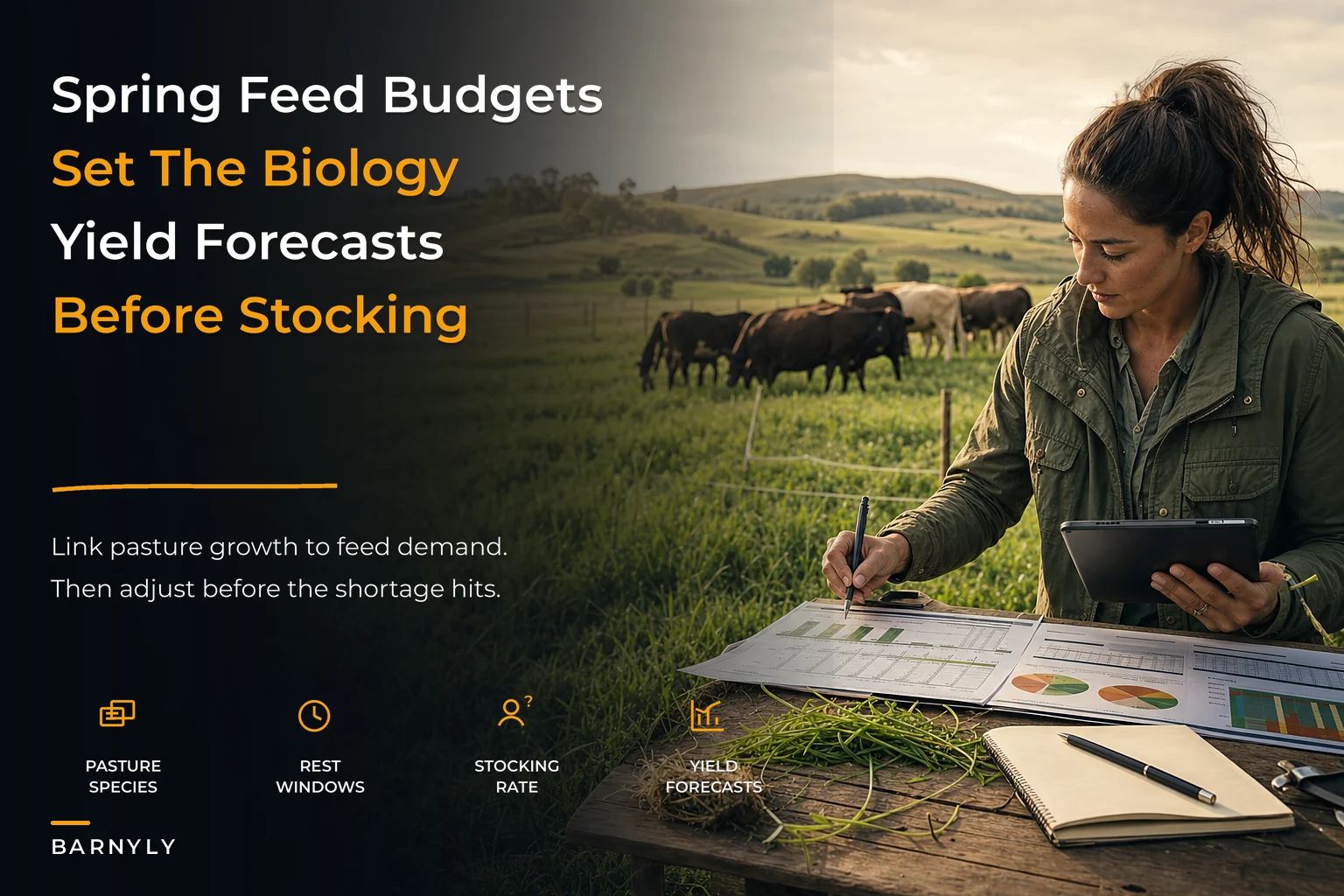
Yield forecasting transforms these measurements from reactive to predictive. Track growth rates weekly during the growing season, biweekly during slow periods. After a few seasons you'll have enough data to predict production within roughly 15% accuracy based on soil moisture, temperature trends, and historical patterns. You don't need years of data to start though—even tracking current-season growth rates helps you see problems developing weeks before they become crises.
Species selection drives the entire system's resilience
The wrong pasture species mix undermines everything else. I worked with a sheep operation that planted perennial ryegrass across all paddocks because it established quickly and looked good in spring. By midsummer, production crashed. They were supplementing with hay while surrounded by dormant pastures, then wondering why their integrated forage planning never balanced.
Simplify farm operations and enhance animal care.
Barnyly helps you organize, track, and manage every aspect of your farm operations seamlessly.
- Comprehensive livestock tracking
- Automated health alerts
- Feed and resource scheduling
No credit card required
Species selection needs to match your operational reality, not what you wish your management intensity was. Three things matter: your actual (not ideal) management intensity, realistic soil conditions, and seasonal feed demand curves. That sheep operation should have included tall fescue for summer persistence, chicory for its parasitic benefits, and reserved ryegrass only for paddocks they could actually irrigate.
Mixed species systems provide biological insurance. A paddock with perennial ryegrass, white clover, tall fescue, and chicory holds production across wider weather extremes than any monoculture. During the 2023 drought, operations with diverse pastures maintained around 60% of normal production while ryegrass monocultures dropped to 30%. The math is simple: maintaining 60% production means buying 40% supplemental feed versus 70%.
Your grazing calendar should reflect species performance curves. Cool-season grasses peak in spring and fall. Warm-season species fill the summer gap. Legumes provide nitrogen and quality when grasses slow down. Plan your rotation so animals hit each paddock when its dominant species is delivering peak nutrition. A paddock that's 30% clover gets grazed when clover hits 15cm—not when the grass looks right.
Rest windows determine next season's carrying capacity
Rest periods aren't just about recovery—they're about competitive advantage.
Every time you graze too soon, desirable species lose root mass while weeds gain ground. The standard 21-30 day recommendation works for intensive operations with irrigation and fertilization. Most farms need 35-45 days in good conditions, up to 60 days during stress periods.
What the textbooks tend to miss: rest requirements change with root reserves. A paddock grazed hard in autumn needs longer spring rest than one spelled through winter. Track this with a simple scoring system. Paddocks exit at score 3 (target residual), 2 (slightly overgrazed), or 1 (hammered). Score 3 paddocks return to rotation after standard rest. Score 2 needs an extra week. Score 1 sits out a full rotation cycle.
The compound effect shows up clearly in year two. A mixed cattle-sheep operation in Virginia implemented scored rest periods in 2022. Paddocks consistently rested properly increased carrying capacity by around 20% the following season. Paddocks pushed too hard showed roughly 15% decline. Proper versus improper rest management created a 35% swing in production from the same land.
Monitor rest effectiveness through regrowth rates. Measure the same paddocks weekly after grazing. Healthy pastures show exponential growth curves—slow initially, rapid through the middle phase, plateauing at ceiling mass. Stressed pastures show linear or declining rates. When multiple paddocks show stress patterns, your rest periods are too short regardless of what the calendar says.
Build feed budgets backward from critical periods
Most operations plan feed budgets forward from current inventory. This guarantees shortage during critical periods. Identify your three highest-risk windows instead and work backward from those.
For spring-calving operations, that's typically late winter (pre-calving nutrition), early summer (peak lactation against potential drought), and autumn (breeding preparation). Calculate maximum possible demand for these periods assuming worst-case pasture production. A 100-cow operation needs roughly 14 tons of dry matter per week during peak lactation. If summer drought historically cuts pasture production by 40%, you need six weeks of backup feed—around 85 tons.
Now integrate this with pasture planning. Some paddocks become sacrifice zones during wet periods to protect others. Some get spelled completely through critical times to ensure quality feed later. High-performing paddocks near handling facilities get maximum protection. Remote or poor-performing paddocks become your buffer zones.
Price triggers turn budgets into action plans. When hay drops below $140/ton, buy for the next critical period. Above $180/ton, reduce stocking rates or adjust weaning times. Between those prices, watch pasture conditions daily. One operation automated these decisions by tracking regional hay prices against inventory levels and generating purchase orders when specific thresholds were hit.
Decision thresholds prevent emotional management
Every grazing decision should have predetermined triggers. Paddock entry: minimum 2,500 kg DM/ha or 15cm average height. Exit: maximum 1,500 kg DM/ha or 7cm. If growth rates drop below 30 kg DM/ha/day for two consecutive weeks, implement drought plan. These aren't suggestions—they're operational rules that execute regardless of how optimistic you feel about coming rain.
Create escalation protocols for when thresholds breach. Level 1 (single paddock below target): skip in rotation, reassess in one week. Level 2 (multiple paddocks below target): reduce stock numbers by 10% through early sales or agistment. Level 3 (system-wide shortage): implement full drought management including confinement feeding and core herd reduction.
The emotional challenge is real. Nobody wants to sell stock when prices are low or feed expensive supplements when pastures look "okay." But "okay" pastures in marginal conditions become poor pastures next season. A 300-head operation that held onto stock too long during 2022's drought spent around $65,000 on emergency feed and took two years to restore pasture condition. Similar operations that destocked early spent roughly $20,000 on planned supplementation and returned to full capacity the following season.
Seasonal workflows connect planning to execution
Spring planning starts eight weeks before expected growth surge. Map every paddock's expected contribution based on species mix, soil moisture, and rest status. Calculate probable yield using conservative growth rates—better to underestimate and have surplus than scramble for feed. Assign paddocks to specific mob rotations with documented triggers for moving to backup plans.
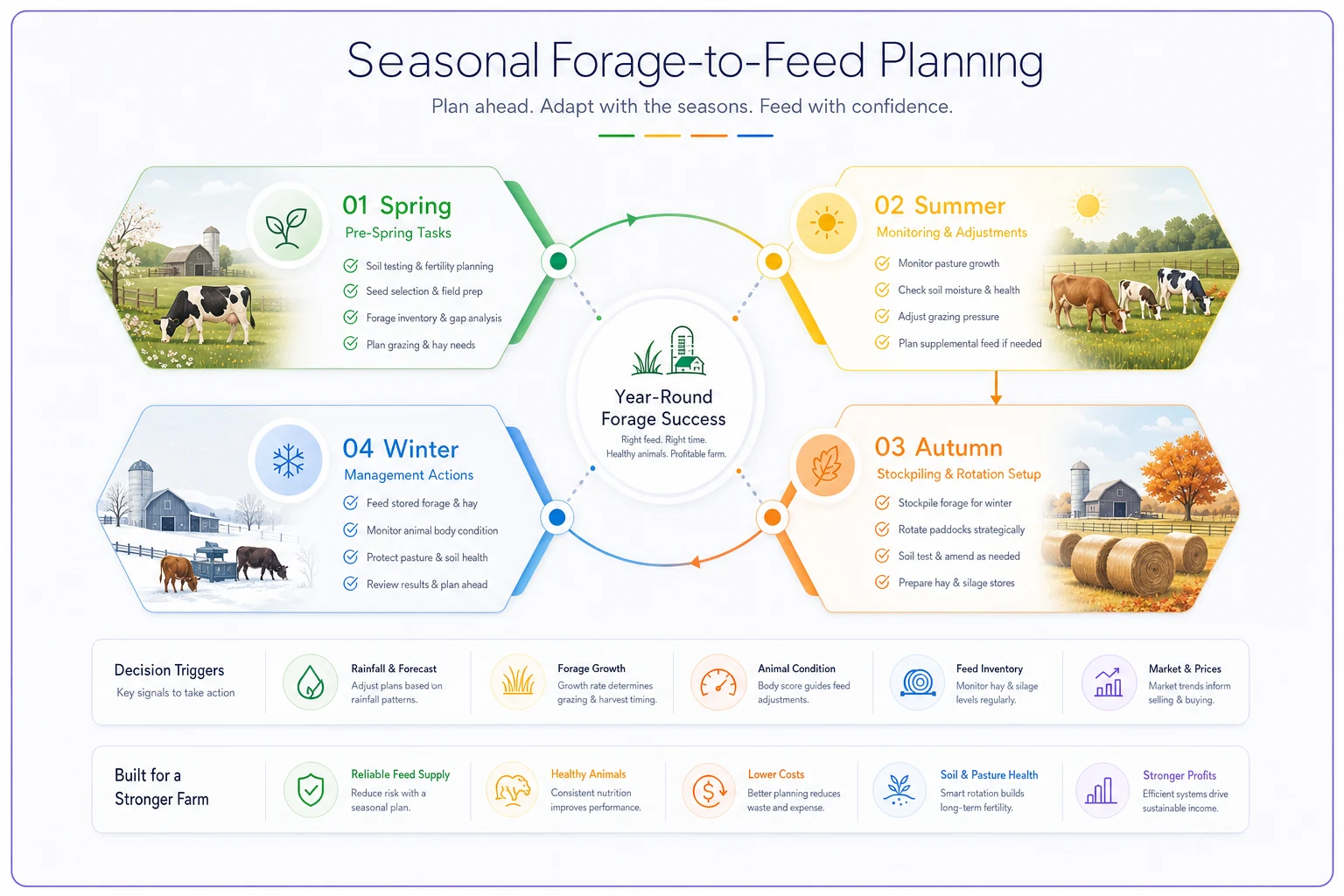
This diagram shows the seasonal planning workflow in one view.
-
Soil test key paddocks (every 3rd year minimum)
-
Score all paddocks for ground cover and species composition
-
Calculate expected dry matter production based on historical rates
-
Map rotation sequences with specific entry/exit targets
-
Order fertilizer based on soil tests and production goals
-
Schedule pasture renovations for poor-performing areas
-
Verify feed inventory covers 130% of the gap between demand and conservative production estimates
Summer requires weekly adjustment as growth rates vary. Track actual versus predicted production. When paddocks consistently exceed targets, you can accelerate rotation or increase stocking density. When they underperform, extend rest periods immediately—don't wait for visible stress. Modern operations increasingly rely on satellite monitoring or automated measurement systems to catch these variations before they become problems.
Autumn sets up the entire next year. This is when you bank feed quality for winter and determine spring pasture conditions. Lock up paddocks for winter stockpile when they hit 2,200 kg DM/ha. Each extra week of growth adds around 300 kg DM/ha but quality declines. The balance point varies by system—dairy operations prioritize quality, beef operations might accept lower quality for higher volume.
Winter management depends entirely on autumn preparation. Operations that stockpiled adequate feed simply rotate through predetermined paddocks. Those that didn't are buying hay at peak prices or managing muddy sacrifice areas that won't recover until late spring. The difference usually traces back to someone overriding the plan in September because pastures "looked good"—so they kept grazing instead of spelling.
Technology integration without the complexity
The volume of calculations and monitoring required for true integrated forage feed planning overwhelms spreadsheet systems. But full farm management software often includes features you'll never use while missing the integration points that actually matter.
Effective operational software for integrated planning needs five core capabilities.
| Capability |
|---|
| First, unified measurement tracking where pasture assessments, feed inventory, and animal numbers exist in the same system. |
| Second, automated calculation of feed budgets based on actual pasture conditions, not theoretical averages. |
| Third, alert systems for when measurements breach thresholds. |
| Fourth, historical tracking to build location-specific growth curves. |
| Fifth, mobile access for entering paddock assessments in the field. |
AI-powered operational platforms help here by pattern matching—identifying when current conditions mirror previous years and suggesting proven responses. Instead of manually comparing weather patterns and growth rates, the system flags when conditions resemble previous drought years and reminds you what worked then. It can calculate optimal rotation speeds based on actual growth rather than calendar dates. Not flashy features, but they eliminate the busywork that makes integrated planning impractical on working farms.
Implementation pathway matters more than features. Start with basic measurement tracking. Add budget calculations once measurement becomes routine. Layer in forecasting after you have a season of baseline data. Most operations try to implement everything at once and abandon the system within a few months. Build the habit before adding complexity.
Common integration failures and their fixes
The first failure point: treating the system as optional during busy periods. Spring work gets overwhelming, nobody enters paddock assessments for three weeks, and suddenly you're making decisions blind exactly when precision matters most. Fix this by scheduling measurements like any other critical task. Tuesday morning means pasture walks, period—not "when things slow down."
Second breakdown: different team members recording different metrics. Your grazing manager estimates pasture height, the owner uses visual scoring, and weekend staff just write "good" or "needs rest." Standardize one method and train everyone identically. Run calibration sessions where everyone assesses the same paddocks and compares results. Acceptable variation is plus or minus 10%. Beyond that, you're not running an integrated system—you're collecting random opinions.
Feed purchasing disconnected from pasture planning creates massive waste. The typical scenario: pasture growth slows, someone panics and orders hay, pastures recover before hay arrives, and now you're storing feed that deteriorates. Establish clear purchasing protocols tied to measurements, not gut feeling. When pasture growth drops below 40 kg DM/ha/day and inventory covers less than 21 days at current consumption, initiate purchase. Otherwise, wait and measure again in a week.
The worst integration failure: having good data but no execution triggers. A sheep operation tracked everything meticulously—weekly pasture measurements, daily growth rates, detailed feed inventories. Beautiful spreadsheets. But they made grazing decisions based on wherever sheep were easiest to move that day. Their data showed clear patterns of overgrazing specific paddocks while others sat idle. Knowing the problem didn't fix it because measurement wasn't connected to mandatory actions.
Before and after: a 400-acre beef operation case study
The operation ran 85 cows on 400 acres of mixed pasture in western Tennessee. Before integration: calendar-based rotation (every paddock got 30 days rest), hay purchased when it "looked necessary," and feed shortages discovered during winter storms when sourcing quality feed affordably was already too late.
Their 2021 numbers were ugly. Feed costs hit $48,000—roughly $565 per cow. Multiple paddocks showed declining productivity from overgrazing during drought. They fed hay for 140 days despite having acres of standing forage. Weaning weights dropped 8% from the previous year.
The transformation started simply. They mapped all paddocks and began weekly measurements using a falling plate meter—about two hours every Tuesday morning. After six weeks, clear patterns emerged. Some paddocks grew 60 kg DM/ha/day while others struggled at 25 kg. They adjusted rotation speeds by paddock performance rather than calendar date.
By year two, they added feed budget calculations comparing pasture availability against consumption requirements. This revealed they were feeding hay unnecessarily during shoulder seasons when a slower rotation would have sufficed. They also identified their consistent feed gap: late July through August when fescue went dormant. Instead of scrambling for expensive summer hay, they planted 40 acres of warm-season annuals specifically for that window.
Year three brought full integration. Paddock measurements fed into automated grazing charts. Feed purchases triggered based on inventory levels and growth projections. They even adjusted cattle sales based on pasture forecasts—selling cull cows earlier when dry conditions were projected rather than feeding them through shortage periods.
The results: feed costs dropped to $31,000 (roughly $365 per cow) despite running the same herd size. Pasture condition scores improved across 80% of paddocks. They fed hay for just 95 days, and that was planned winter feeding, not emergency response. Weaning weights increased 12% from better pasture quality during breeding and lactation.
Who shouldn't attempt full integration
Small hobby farms under 20 acres don't have enough paddocks to justify complex planning. Your energy goes further focusing on soil health and basic rotation. Three or four paddocks, visual assessment, and flexible movement based on growth is enough.
Operations that custom graze with unpredictable numbers need different systems. You can't plan feed budgets when you don't know if you'll have 50 or 200 cattle next month. Focus on maintaining consistent paddock conditions and charging rates that reflect actual carrying capacity rather than trying to maximize utilization.
Extremely extensive operations running under 5 DSE per hectare often lack the infrastructure for intensive monitoring. If checking all paddocks takes two days of driving, weekly measurements aren't realistic. Use strategic monitoring of indicator paddocks and manage zones rather than individual fields.
Making integrated planning sustainable long-term
The system only works if it becomes routine operation, not a special project. Build measurement into your weekly schedule the same way you check water or fences. Use the same day and time—consistency matters more than perfection. Two hours every Tuesday beats six hours "whenever you can."
Train multiple people in assessment techniques. When only one person understands the system, vacations or injuries break the entire process. Document your specific triggers and thresholds—not "move cattle when grass gets short" but "move cattle when average height drops below 8cm or 1,400 kg DM/ha." Clear documentation lets anyone execute the plan.
Accept that integration reveals uncomfortable truths. You might discover your favorite paddock is actually your worst performer. Those bargain hay purchases might cost more than improving pastures. The cattle you're proud of might not justify their feed consumption. The data doesn't care about any of that.
Review and refine annually, not constantly. Collect a full season of data before making major changes. Pasture systems have too much natural variation to judge monthly results. That paddock that looked terrible in June might be your best performer in September. Annual review shows true patterns versus weather noise.
The compound effect of biological and financial planning
Integrated forage feed planning isn't about perfection—it's about connection. When pasture management knows what nutrition needs, when feed purchasing sees what pastures will produce, and when financial planning includes biological reality, the whole operation improves.
The benefits compound. Year one, you reduce panic purchases and emergency feeding. Year two, pasture condition improves from proper rest management. Year three, you're making strategic decisions about stocking rates and enterprise mix based on proven carrying capacity. By year five, you've built enough resilience that droughts become manageable challenges rather than existential threats.
Most operations already collect the necessary information. They measure pastures occasionally, track feed purchases, and monitor animal performance. Integration just connects these isolated data points into operational decisions. Instead of three departments making independent choices that conflict, you have one system where biological reality drives financial outcomes.
The operations that make integrated planning work share a few common traits. They commit to consistent measurement even when it seems unnecessary. They follow predetermined triggers rather than relying on daily judgment calls. They accept that optimization requires occasional discomfort—like selling stock when they'd rather hold, or resting paddocks that look "good enough" to graze.
Your integrated forage feed planning system will be unique to your land, climate, and enterprises. But the principles stay consistent: measure everything in comparable units, rest paddocks based on plant needs rather than calendar convenience, plan feed purchases around critical periods, and execute based on data-driven triggers rather than hope.
The alternative—continuing to manage pastures and feed budgets separately—guarantees you'll keep experiencing the same crises. Drought will always catch you unprepared. Feed costs will spike during shortages you should have seen coming. Pastures will decline gradually until renovation becomes unavoidable. Integration isn't about adding complexity. It's about acknowledging that these systems are already connected and managing them accordingly.
The alternative—continuing to manage pastures and feed budgets separately—guarantees you'll keep experiencing the same crises. Drought will always catch you unprepared. Feed costs will spike during shortages you should have seen coming. Pastures will decline gradually until renovation becomes unavoidable. Integration isn't about adding complexity. It's about acknowledging that these systems are already connected and managing them accordingly.
Ready to optimize your farm management?
Join hundreds of farmers using Barnyly to save time, improve animal health, and increase farm productivity.