

After building operational software for livestock operations across the country, one thing stays consistent: farms with the best conception rates don't just track breeding dates. They treat reproduction as an interconnected system where every decision—from when to pull a bull to which heifers become replacements—triggers specific records that feed the next breeding cycle.
The gap between farms hitting 92% conception rates and those stuck around 65% usually isn't genetics or nutrition. It's whether they've mapped their breeding lifecycle to actual record types that trigger decisions at the right time.
Most farms track breeding in fragments. Heat detection here, pregnancy checks there, calving dates somewhere else. But reproduction is one continuous cycle where today's heifer selection determines next year's calving interval, and this season's sire choice affects replacement rates three years out. When you map this entire cycle to specific records and decision points, breeding stops being reactive.
The breeding lifecycle isn't linear—it's overlapping cycles that need different records
A farm breeding management system that actually works needs to recognize that you're running multiple breeding cycles at the same time. While this year's cows are getting bred, last year's heifers are calving, and next year's replacements are being selected. Each stage needs different record types that connect to create predictable outcomes.
Here's what typically breaks: farms treat breeding records as historical data instead of operational triggers. A breeding date gets logged, then sits there until someone remembers to schedule a pregnancy check. Meanwhile, that same cow might be showing heat again, but without the right record connections, nobody catches it until she's open at preg check 60 days later.
The farms getting this right build their breeding records around decision points, not just events. Every record type connects to a specific action window. A breeding record automatically triggers a 21-day heat watch window. A confirmed pregnancy triggers a dry-off date calculation. An open diagnosis triggers immediate rebreed protocols or cull evaluation.
When you structure breeding data this way, your farm breeding management system becomes less about tracking what happened and more about driving what needs to happen next. The lifecycle stops being an abstract concept and turns into a series of connected workflows that push decisions forward.
Record types that matter: mapping decisions to data points across the breeding cycle
The breeding cycle breaks into five core record categories, each triggering different operational decisions:
Simplify farm operations and enhance animal care.
Barnyly helps you organize, track, and manage every aspect of your farm operations seamlessly.
- Comprehensive livestock tracking
- Automated health alerts
- Feed and resource scheduling
No credit card required
Pre-breeding records (120–60 days before breeding season):
-
Body condition scores
-
Reproductive tract scores for heifers
-
Previous calving dates and intervals
-
Health events that affect breeding
-
Nutritional program adjustments
Active breeding records (breeding season):
-
Heat detection observations
-
Breeding dates and methods (AI vs natural)
-
Sire identification and breeding certificates
-
Technician performance (for AI programs)
-
Rebreed attempts and timing
Pregnancy monitoring records (21–280 days post-breeding):
-
Initial pregnancy checks (30–45 days)
-
Confirmation checks (60–90 days)
-
Fetal sexing results (if done)
-
Pregnancy loss tracking
-
Expected calving dates
Transition records (30 days pre-calving through calving):
-
Dry-off dates and methods
-
Pre-calving vaccinations
-
Calving difficulty scores
-
Calf vigor assessments
-
Postpartum health checks
Replacement decision records (ongoing):
-
Heifer growth benchmarks
-
Dam performance history
-
Sire EPD contributions
-
First-calf heifer rebreed rates
-
Lifetime production projections
Each category needs different sampling frequencies. Pre-breeding might be monthly monitoring, active breeding requires daily observation, pregnancy checks follow set intervals, and replacement decisions accumulate data over years.
The mistake most operations make is treating these as separate systems. Your pre-breeding body condition score should automatically flag cows needing nutritional intervention before breeding. Your calving difficulty score should feed into next year's sire selection. Heifer growth rates should trigger breeding eligibility dates.
Decision triggers: when records should force action, not just documentation
Records without triggers are just expensive filing systems. The operations consistently hitting their breeding targets have specific thresholds that force decisions—not suggestions.
Take body condition scoring. Recording "BCS 4" means nothing unless it triggers action. Farms that maintain high conception rates have clear rules: any cow below BCS 5 sixty days pre-breeding gets moved to a higher nutrition group. No discussion, no "we'll watch her"—the record triggers the move.
| Record Type | Trigger Threshold | Required Action | Timing |
|---|---|---|---|
| Heat observation | No heat by day 45 postpartum | Vet exam + intervention | Within 7 days |
| Breeding attempt | 3rd service | Evaluate for cull vs aggressive protocol | Same week |
| Pregnancy check | Open at 45 days | Immediate rebreed or cull decision | Same day |
| Calving interval | >400 days | Breeding protocol adjustment | Next cycle |
| Heifer weight | <65% mature weight at 14 months | Remove from replacement pool | At weighing |
| Sire conception rate | <60% over 20 breedings | Change sires | Immediately |
The key difference: these aren't guidelines. When a record hits a threshold, the action happens. Operations that leave these decisions to judgment calls see their conception rates drift as different people make different choices.
Some farms try building complex scoring systems with multiple factors. Usually unnecessary. Simple, clear thresholds that everyone understands beat sophisticated models nobody follows. A first-calf heifer that's open after two breeding cycles gets sold—period. A bull with conception rates below 60% gets pulled—no exceptions.
Encode BCS and heat thresholds into your herd management software so actions (nutrition group moves, rebreed scheduling) happen automatically when records are entered.
This might sound rigid, but it's what creates predictable outcomes. When decisions are automatic, your breeding program becomes a system instead of a series of individual calls that may or may not line up with your actual goals.
Sire and dam rules: connecting genetics to replacement economics
Most farms pick sires based on EPDs and hope for the best. But sire selection directly impacts your replacement costs three years from now, and your dam retention rules determine whether you're breeding yourself into a corner or building something sustainable.
Sire selection without replacement economics is just expensive gambling. A bull might have fantastic weaning weight EPDs, but if his daughters don't breed back as first-calf heifers, you've just increased your replacement costs by $400–600 per head in three years.
Terminal sire rules:
-
Use only on cows you won't keep daughters from
-
Bottom 30% of cow herd by production metrics
-
Cows with more than 3 calvings and declining performance
-
Any cow with structural issues you don't want passed on
Maternal sire rules:
-
Proven calving ease for virgin heifers
-
Documented daughter rebreed rates above 85%
-
Milk EPD matched to your forage quality
-
Frame scores appropriate for your environment
Dam retention triggers:
-
First-calf rebreed rate (must hit within 85 days)
-
Calving interval consistency (under 380 days average)
-
Calf performance relative to contemporaries
-
Structural soundness scores at each calving
The math matters more than most operations realize. If your average replacement heifer costs $1,800 to raise to breeding age, and poor sire selection bumps your replacement rate from 15% to 22%, you've added roughly $25,000 in annual costs to a 200-head operation. That's before accounting for the genetic progress you're losing.
Smart farms track these metrics systematically, not just when problems emerge. They know their actual heifer development costs, their true conception rates by sire, and their replacement rates by cow age. That data drives rules, not preferences.
Sampling cadence: the inspection schedule that catches problems before they compound
Breeding problems compound quietly. A missed heat becomes an open cow becomes a late calver becomes a cull candidate. The difference between catching issues early and dealing with a mess later comes down to how often you're actually looking.
Operations that maintain predictable breeding cycles follow rigid inspection schedules:
Daily during breeding season:
-
Heat detection (minimum twice daily, same times)
-
Breeding activity observation
-
Bull soundness visual checks
Weekly during breeding:
-
Body condition score changes
-
Breeding group movements
-
Sire performance quick-check
21-day intervals post-breeding:
-
Return to estrus observation
-
Non-return rate calculations by sire
-
Breeding group performance comparison
45-day pregnancy check:
-
Ultrasound or palpation
-
Immediate rebreed/cull decisions
-
Conception rate by technician/sire
Monthly during gestation:
-
Body condition monitoring
-
Vaccination schedule adherence
-
Nutritional group adjustments
Pre-calving intensification (30 days out):
-
Daily visual checks
-
Twice-daily at 7 days out
-
Every 4–6 hours at first signs
The farms that skip these intervals always pay later. They'll run daily heat detection for two weeks, get busy with hay season, and suddenly realize they've missed three cycles on multiple cows. Now those cows are either open or calving late, pushing the whole calving season longer and making next year's breeding harder to manage.
Building these inspection points into operational schedules—not hoping someone remembers—is what makes the difference. Tuesday mornings are preg-check days. Thursday afternoons are body condition scoring. When it's scheduled, it happens. When it's "whenever we get time," it doesn't.
Integration points: where breeding records connect to health, nutrition, and economics
Breeding doesn't happen in isolation, but most farms manage it that way. Your breeding records need to pull from health events, nutritional programs, and economic data—then push decisions back to those same systems.
A cow with a retained placenta shouldn't just get a health record. That event should automatically flag her breeding schedule for extra monitoring. A group of heifers below target weight shouldn't just get fed more—their breeding eligibility dates should shift accordingly. These connections prevent the gaps that sink reproduction rates.
Health to breeding disconnects:
-
Metritis treatment doesn't trigger an extended voluntary waiting period
-
Lameness events don't flag for breeding soundness exams
-
Vaccine timing conflicts with breeding protocols
-
Disease testing doesn't sync with breeding group movements
Nutrition to breeding gaps:
-
Body condition changes don't trigger ration adjustments
-
Breeding group nutrition doesn't match lactation demands
-
Mineral programs ignore breeding season requirements
-
Feed quality changes don't adjust breeding expectations
Economics blind spots:
-
Replacement costs don't factor into cull decisions
-
Sire costs ignore daughter performance value
-
Extended calving seasons aren't quantified in labor costs
-
Pregnancy loss economic impact stays uncalculated
The fix isn't complicated software—it's building simple connections between systems. When you treat a cow for metritis, her next breeding date pushes back 14 days. When body condition drops below threshold, that cow moves to a higher nutrition group before her next cycle. When conception rates drop below 60%, sire selection changes immediately, not next season.
Some operations try to manage these connections informally or from memory. It doesn't work once you're running more than 50 head. These integration points need to be systematic.
Building your breeding lifecycle map
Mapping your breeding lifecycle to records starts with understanding your actual cycle, not the theoretical one. Most operations think they run a 365-day calving interval, but when you dig into the data, it's closer to 385 days with a 90-day spread. That's your starting reality.
Begin with your current breeding season and work backwards:
-
Define your ideal calving window (example
March 1–April 30)
-
Calculate back to breeding season (May 20–July 20 for 283-day gestation)
-
Set pre-breeding prep window (March 20–May 20 for condition/health)
-
Establish replacement development timeline (Previous March for 14-month breeding age)
-
Build in decision checkpoints (Preg check July 30, Sept 1, Oct 15)
Now assign record types to each phase:
Pre-breeding phase records:
-
Condition scores (monthly starting 60 days out)
-
Reproductive exams (45 days pre-breeding)
-
Vaccination records (30 days pre-breeding)
-
Nutritional adjustments (ongoing)
Breeding phase records:
-
Heat observations (twice daily)
-
Breeding records (at service)
-
Sire usage tracking (daily)
-
Rebreed scheduling (21-day cycles)
Gestation phase records:
-
Pregnancy diagnosis (45, 90, 150 days)
-
Condition monitoring (monthly)
-
Health events (as occurring)
-
Dry-off records (60 days pre-calving)
Analysis phase records:
-
Conception rates by sire
-
Calving intervals by cow age
-
Replacement rates by year
-
Economic performance metrics
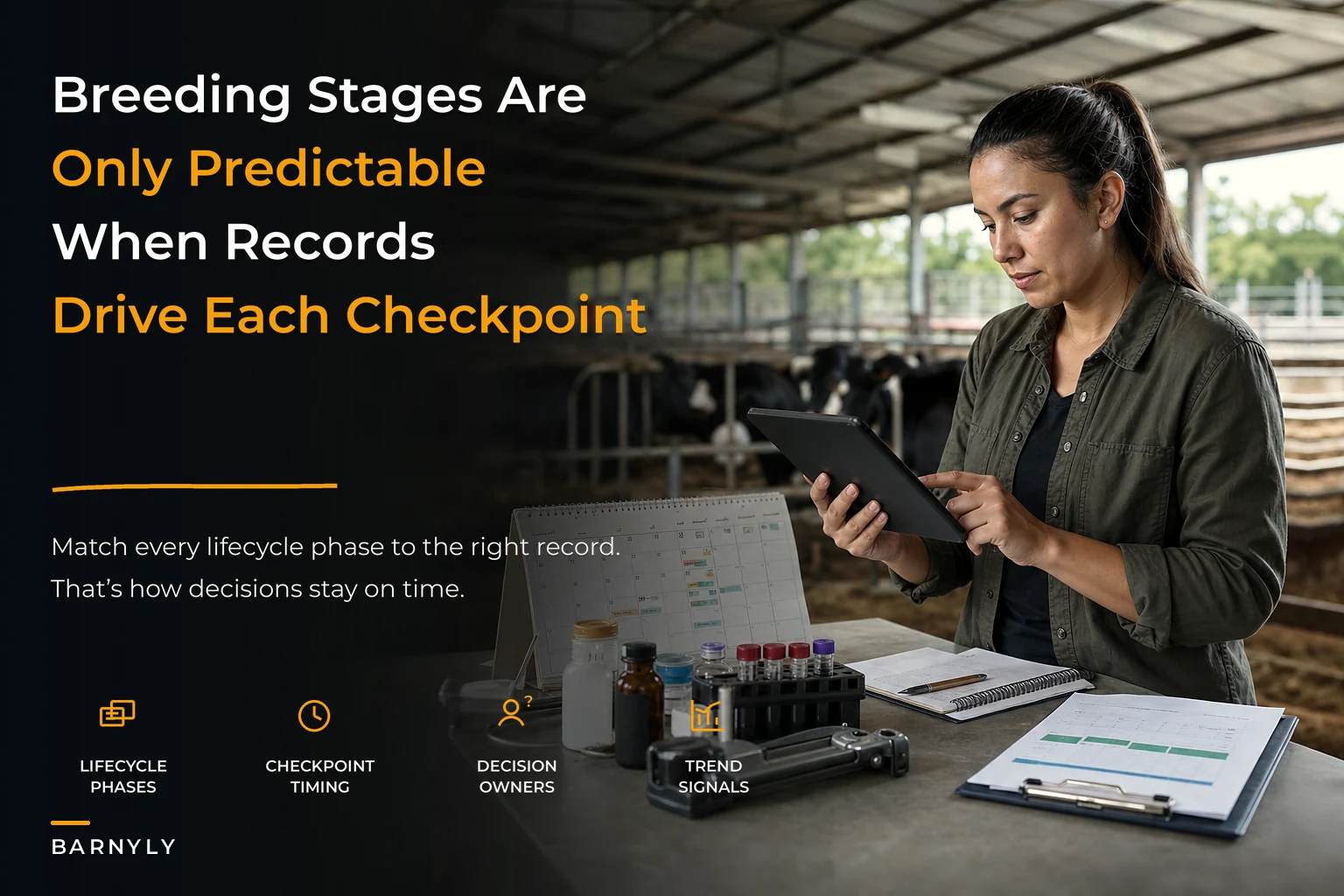
This becomes your operational calendar—not a suggestion guide, but the actual schedule that drives daily work. When someone asks what should be happening with the cow herd this week, the lifecycle map has the answer.
Below is a simple workflow visualization of mapping lifecycle phases to record types.
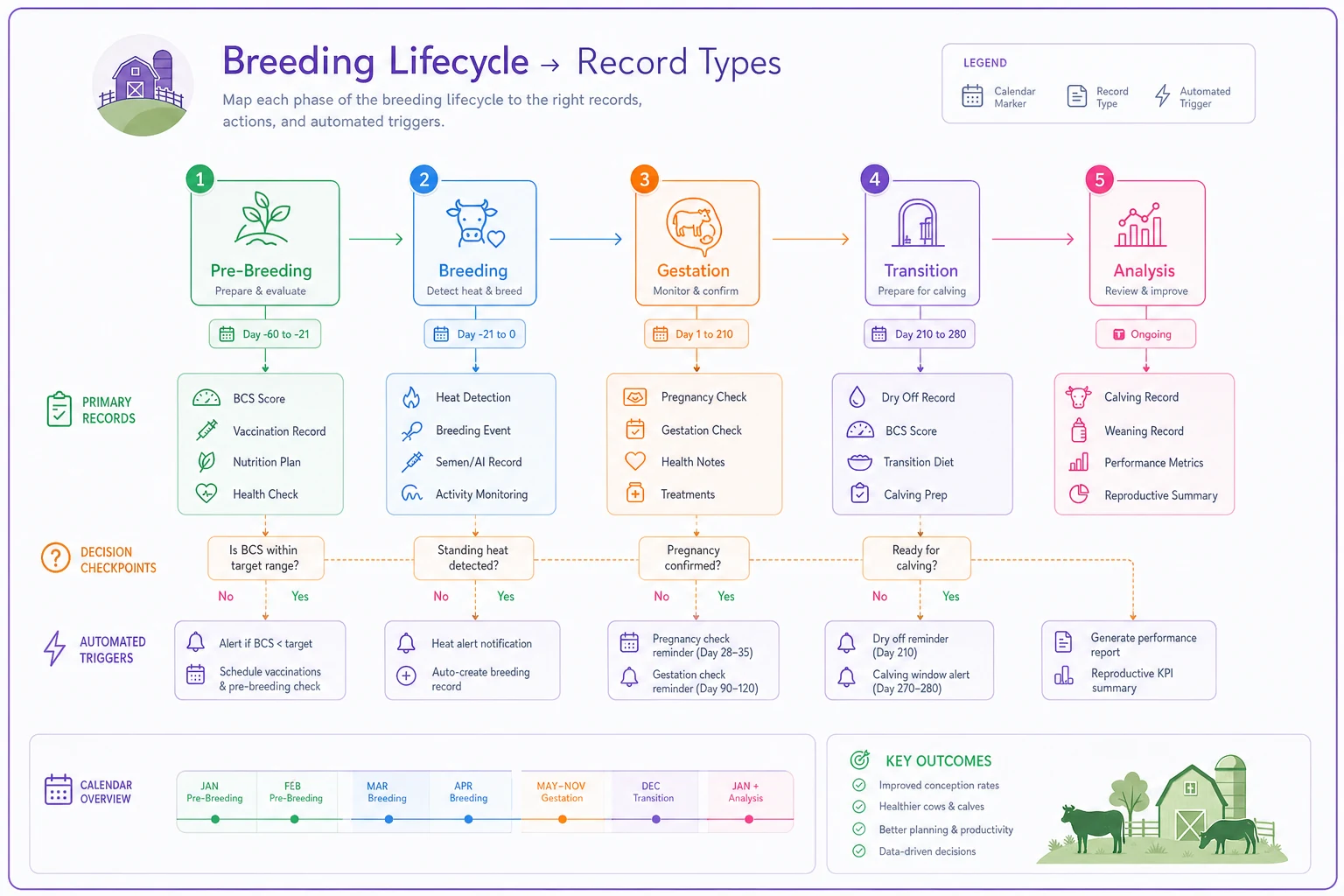
Use this map as your operational calendar—not a suggestion, but the schedule that drives daily work.
From reactive breeding to predictable reproduction cycles
The shift from reactive to predictable breeding isn't about perfect records. It's about records that drive decisions automatically. Operations that make this transition typically see conception rates improve 15–20% in the first year, not from better genetics or nutrition, but from catching problems before they cascade.
A farm breeding management system built on lifecycle mapping means problems surface as data anomalies, not as empty cows at preg check. When a cow doesn't show heat by day 45 postpartum, that's a flag for intervention—not a wait-and-see situation. When conception rates drop for a specific technician, you catch it after 10 breedings, not at the end of the season.
The real value is predictability. When you know 85% of your cows will conceive within two cycles, you can plan next year's feed needs accurately. When replacement rates stay consistent at 15%, you know exactly how many heifers to develop. When calving intervals hold at 375 days, your entire operation—from labor scheduling to marketing—becomes plannable.
This is where AI-powered operational software makes a real difference. Not by making decisions for you, but by connecting all these record types and surfacing the right actions at the right time. The software tracks patterns, calculates intervals, and flags what needs attention today. Instead of managing breeding as dozens of separate tasks, you're running one integrated system where every piece of data feeds the next decision.
Once you map your breeding lifecycle properly, a lot of it runs itself. The records trigger decisions, decisions generate new records, and the cycle continues with less manual oversight. Your team spends less time figuring out what to do next and more time on the work that actually moves conception rates.
For operations looking to scale, this kind of systematic approach becomes the foundation. You can add cows knowing your conception rates will hold. You can plan facility expansions around predictable calving distributions. You can schedule labor around known breeding and calving windows instead of reacting to chaos.
The difference between farms struggling at 65% and those consistently hitting 90% isn't magic—it's methodology. Map your breeding lifecycle to the right records, build in automatic decision triggers, and keep your sampling cadence tight. Do that, and reproduction stops being your biggest variable and starts being your most predictable system.
Ready to optimize your farm management?
Join hundreds of farmers using Barnyly to save time, improve animal health, and increase farm productivity.