

Most livestock operations don't fail an audit because someone did the wrong thing. They fail because nobody can prove the right person was trained to do the right thing at the right time. There's a difference, and it's the one that costs you when an inspector, a processor, or a lawyer starts asking questions.
Here's the pattern that keeps showing up on farms running two, three, or five sites: the head stockperson knows exactly who can pull a calf, who can dose a withdrawal-sensitive antibiotic, and who should never touch the drug fridge unsupervised. But that knowledge lives in one person's head. When that person is on the north block, the crew on the south block is guessing. And when the auditor asks for training records tied to your SOPs, you're printing out a spreadsheet someone last updated 14 months ago.
This article is about building livestock workforce competency tracking as an actual system — one that connects who's trained, what they're allowed to do, how they performed, and the evidence you can hand to an auditor without a two-week scramble. Not a binder. A system.
The gap most operations don't see until it's expensive
The obvious version of a skills gap is dramatic: a new hire administers the wrong dose, an animal is treated inside its withdrawal window, and product gets held or dumped. That happens. But it's rare enough that people chalk it up to bad luck rather than a system failure.
The expensive version is quieter. It's the drip of small competency gaps that never get logged:
-
The relief worker who "sort of" knows the lameness scoring system, so scores drift and your welfare data becomes noise
-
The seasonal crew that was walked through the calving protocol verbally in March and is running on memory by peak season
-
Three people at three sites doing the same task three slightly different ways, so your SOPs technically exist but aren't actually being followed
None of these trigger an incident on any given day. They just slowly erode the reliability of your records. And your records are the thing everything else depends on — your traceability, your treatment justifications, your welfare KPIs. If the person collecting the data wasn't competent to collect it, the data underneath your whole operation is soft.
What makes multi-site operations different isn't that the tasks are harder. It's that the informal knowledge transfer that works fine on a single site — watching, correcting, reminding — stops working the moment your people are spread across locations you can't walk between.
Why this breaks specifically at scale
On a single owner-operated farm, competency tracking is basically invisible because it doesn't need to be a formal system. You know your two employees. You've watched them work for years. You know Dave is meticulous with the drug log and Sam needs reminding. That informal model isn't wrong — it just doesn't transfer.
Simplify farm operations and enhance animal care.
Barnyly helps you organize, track, and manage every aspect of your farm operations seamlessly.
- Comprehensive livestock tracking
- Automated health alerts
- Feed and resource scheduling
No credit card required
The trouble starts at a fairly predictable threshold. In most operations, it's around 8–12 people, or the moment you add a second site. That's when no single person can personally verify everyone's competence anymore. The knowledge that used to live in the manager's head now has to live somewhere the whole organization can see.
Here's what typically breaks, in order:
-
Onboarding becomes inconsistent. Site A trains new hires thoroughly because the manager there cares about it. Site B throws people into the deep end. Same job title, wildly different competence.
-
Refreshers stop happening. Nobody owns them. Everyone assumes annual training is happening somewhere. It isn't.
-
Task permissions blur. People start doing tasks they were never signed off on, simply because they were nearby and it needed doing.
-
Records and reality drift apart. Your SOP binder says one thing. What actually happens in the yard is a folk version passed person to person.
The connection people miss is that competency tracking isn't an HR function bolted onto the side of the farm. It's the layer that makes every other system trustworthy. Your repeatable SOPs and seasonal rosters only produce consistent results if the people executing them are actually verified to do so. An SOP without a competency layer is a wish.
The four pieces that make competency a system, not a filing cabinet
A working system links four things that most farms keep separate: what a role requires, what a person can prove, how they performed, and the evidence trail. Keep them separate and you have paperwork. Connect them and you have something an auditor respects and a manager can actually use.
1. Role cards
A role card is a single-page definition of what a role is allowed and expected to do. Not a job description written for recruitment — an operational one. It answers: what tasks does this role cover, what's the required competency level for each, and what requires supervision.
A typical calving-season role card might look like this:
| Task | Required level | Sign-off needed | Supervision |
|---|---|---|---|
| Routine feeding & water checks | Competent | Yes | None |
| Newborn processing (tag, navel, colostrum) | Competent | Yes | None |
| Assisted calving (basic) | Competent | Yes | On call |
| Assisted calving (complex/malpresentation) | Advanced | Yes | Required until signed |
| Administering antibiotics | Competent + med training | Yes | None |
| Adjusting treatment protocols | Not permitted | — | Vet only |
The point of the card isn't the table itself. It's that it makes "what am I allowed to do" answerable at a glance, at any site, without asking the manager. A relief worker arriving at the south block can be told exactly which tasks they're cleared for.
2. Competency checklists
The role card says what's required. The checklist is how you prove someone actually meets it. The mistake most operations make is treating competency as binary — trained or not trained. Real competence has stages, and your checklist should reflect them.
-
Aware — knows the SOP exists and what it's for
-
Assisted — can perform under direct supervision
-
Competent — performs correctly and unsupervised
-
Can train others — competent plus able to sign off newcomers
Make checklist items strictly observable actions so sign-offs are unambiguous across sites.
That last stage matters more than most people realize. In multi-site operations, you can't scale training if only the owner can validate skills. You need people at each site who are formally cleared to assess others. Without that, competency verification becomes a bottleneck that funnels straight back to you.
Each checklist item should be observable, not theoretical. "Understands biosecurity" is useless. "Correctly follows the footbath and boot-change sequence when moving between the isolation pen and the main herd" is something you can actually watch and sign off on.
3. Training records tied to actual outcomes
This is the piece that turns a competency system from box-ticking into something that genuinely protects you. Training records shouldn't just say "attended calving workshop, March 4." They should link to what happened afterward.
When you tie training records to real outcomes, you can answer questions that actually matter: Did calving assist survival rates improve after the workshop? Did the medication error rate on that site drop after the drug-handling refresher? Did the person who scored the lameness incident have current, verified competency in scoring?
That last question is exactly what connects competency to your herd health system. When a prevention or response gap shows up, it often traces back to a competency gap nobody logged — the right protocol existed, but the person executing it was never verified to run it correctly.
4. Audit evidence that's already assembled
The evidence layer is what most farms build last and regret. If your competency records, training dates, SOP versions, and sign-offs live in four different places, assembling an audit pack becomes a job in itself. Done right, the evidence is a byproduct of the daily system — not a separate scramble before the visit.
This is the same discipline that underpins good record templates and retention timelines — the evidence should exist because the work was recorded properly the first time, not because someone reconstructed it under deadline pressure.
The onboarding-to-progression roadmap
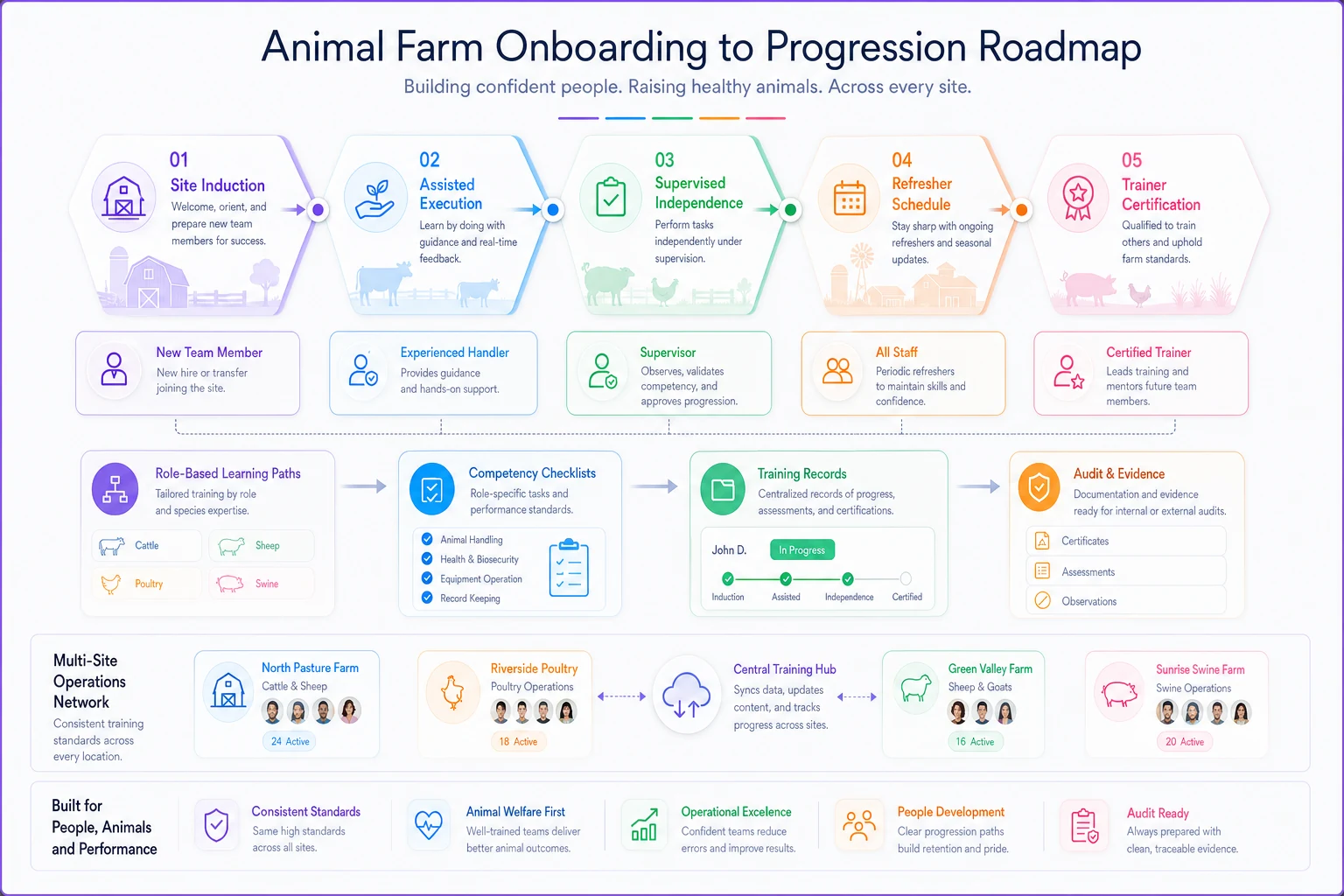
A roadmap defines the path a person takes from day one to fully trusted, and it makes progression a deliberate process instead of "they've been here a while, they're probably fine now."
A workable structure over the first few months looks roughly like this:
-
Days 1–5
Site induction and awareness.
Biosecurity, site layout, emergency procedures, and an overview of which SOPs govern their role. They finish at "Aware" on the core tasks. -
Weeks 1–4
Assisted execution.
Every core task performed under supervision, with the supervisor signing each checklist item as observed. They move to "Assisted." -
Weeks 4–12
Supervised independence.
Working solo on routine tasks, spot-checked on the higher-risk ones. Sign-off to "Competent" happens task by task, not all at once. -
Ongoing
Refresher schedule.
Time-based refreshers for anything with drift risk or regulatory weight — medication handling, welfare scoring, biosecurity. Typically annual, but shorter windows for high-risk tasks. -
Progression
Trainer certification.
For people who'll validate others, an explicit sign-off that they can assess to standard.
This visual shows the onboarding-to-progression steps across multiple sites.
The refresher piece is where most systems quietly rot. People get signed off once and stay "competent" forever on paper, even as protocols change and skills fade. A real schedule flags when a certification is aging out before it lapses — the same logic as tracking a withdrawal period, except what's expiring is a person's clearance to perform a task.
A short real scenario
A cattle and sheep operation running three sites — roughly 4,500 head total, core team of nine plus six seasonal workers at peak — kept failing to trace welfare-scoring inconsistencies. Their lameness data was all over the place. Same animals, scored differently depending on who was on shift, which made their welfare KPIs basically useless for actual decision-making.
The root cause wasn't laziness. Five different people were doing the scoring, and only two had ever been formally trained on the system. The rest picked it up informally and each carried their own drift.
They built role cards defining who was cleared to score, ran everyone through a single calibrated scoring session, and logged each person's competency with a re-check scheduled at six months. Nothing complicated. Within a couple of seasons, scoring variance had tightened noticeably — and when their processor's welfare audit came around, they could show exactly who scored what and that each scorer was verified competent at the time. The audit prep that used to eat a week took an afternoon.
The more interesting outcome wasn't the audit result. Once the scoring was consistent, the welfare data actually became usable for identifying problem paddocks. Fixing the competency gap fixed the data downstream of it.
Where software fits — and where it doesn't
You can run a competency system on paper and spreadsheets. For single-site operations, that's often the right call. The manual version breaks specifically when you can't physically see everyone's records and the tracking becomes a job nobody owns.
That's where an operational platform earns its place — not by doing anything magical, but by keeping the four layers connected and current across sites. Good livestock workforce competency tracking software does a few unglamorous but genuinely useful things:
-
Ties each person's competency status to the actual tasks in your SOPs, so permissions are visible at every site
-
Flags refreshers and expiring certifications before they lapse, instead of relying on someone to remember
-
Links training records to the incidents and outcomes that followed, so you can see whether the training actually moved the needle
-
Assembles audit evidence automatically because the sign-offs, dates, and SOP versions were captured as work happened
AI automation helps mostly in the background here — surfacing which certifications are about to expire, spotting when someone's been performing a task they're not signed off for, flagging a site where onboarding is quietly falling behind the roadmap. It's not replacing your judgment about who's ready. It's making sure the gaps become visible before they become incidents.
When this makes sense — and when it doesn't
Worth building the full system if:
-
You run more than one site, or expect to
-
Your team crosses roughly 10+ people including seasonal
-
You're subject to processor, welfare, or regulatory audits
-
Competency currently lives in one or two people's heads
Probably overkill if:
-
You're a single site with two or three long-tenured people you personally supervise every day
-
Your turnover is near zero and everyone's already cross-trained
Who should not rush this: operations that haven't nailed their underlying SOPs yet. A competency system verifies people against a standard — if the standard is vague or nonexistent, you'll just be formally signing off people on undefined work. Get the SOPs solid first, then build the competency layer on top.
The quiet payoff
The reason competency tracking is worth the setup effort isn't really the audit, even though the audit is what forces most people to finally do it. A visible competency system removes an entire category of uncertainty from running a spread-out operation.
You stop wondering whether the south block is doing calving the same way as the north. You stop discovering after the fact that someone was doing a job they were never cleared for. Skill gaps stop being surprises and start being things you can see coming and close on schedule.
Skills don't disappear all at once. They erode quietly — one un-refreshed certification and one informally-trained hire at a time — until an incident or an audit drags the gap into the light. A competency system is just the discipline of keeping that gap visible while it's still cheap to fix.
Ready to optimize your farm management?
Join hundreds of farmers using Barnyly to save time, improve animal health, and increase farm productivity.